
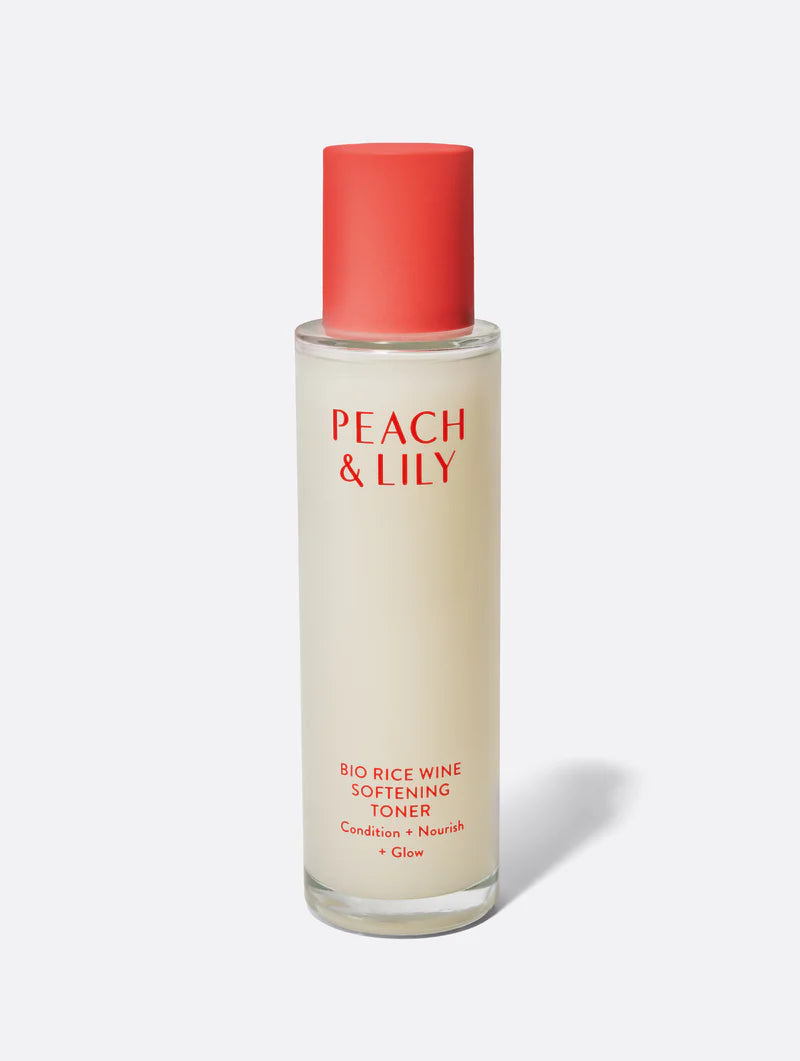

Peach & Lily
Bio Rice Wine Softening Toner

Bio Rice Wine Softening Toner
Peach & Lily
bio-rice-wine-softening-toner
Tone
9784820302117
Morning or Evening?
How often will you use this product?
Notes


Highlights
WHAT IS IT?
Milky toner with Bio Rice™ complex
FEATURES
Deeply nourishes, softens, hydrates, brightens, and supports skin barrier
BEST FOR
combination
CHECKS
Gluten-free
Who Is It For?
All Ages And GendersWhat Does It Help With?
Hydration Brightness Luminosity Skin Barrier SupportBudget
Mid-range ($30-$75)How To Use
Which routine should it be used in?
Instructions:
Key Information


What Peach & Lily Says
Product Description:
Inspired by traditional Korean rice wine, 'makgeolli,' combined with advanced biotechnology, this luxurious milky toner deeply nourishes and softens. Proprietary, nutrient-dense Bio RiceTM with rice wine complex, botanical ferments, and herbal extracts visibly hydrate, brighten, and support the skin barrier.
About the Brand:
Ingredients Overview
Ingredients List
Water,Butylene-Glycol,Rice-Ferment-Filtrate,1-2-Hexanediol,Aspergillus-Rice-Ferment-Extract,Saccharomyces-Rice-Ferment-Filtrate-Extract,Oryza-Sativa-Rice-Bran-Extract,Saccharomyces-Barley-Seed-Ferment-Filtrate,Galactomyces-Ferment-Filtrate,Hydroxyethyl-Urea,Scutellaria-Baicalensis-Root-Extract,Lactobacillus-Ferment-Lysate,Bifida-Ferment-Lysate,Lactobacillus-Soybean-Ferment-Extract,Sphingomonas-Ferment-Extract,Chamaecyparis-Obtusa-Leaf-Extract,Salix-Alba-Bark-Extract,Portulaca-Oleracea-Extract,Origanum-Vulgare-Leaf-Extract,Taraxacum-Officinale-Leaf-Extract,Cinnamomum-Cassia-Bark-Extract,Ethylhexylglycerin,Sodium-Phytate
Key Ingredients
Bio Rice™, rice wine complex, botanical ferments, herbal extracts
Ingredients Details
12 Hexanediol
Common Name(s): 12 hexanediol
DESCRIPTION
What It Does: Delivers targeted skin-conditioning or bioactive benefits through a specific mechanism of action suited to the formulation's intended purpose.
Why It's Used: Specialty actives address specific skin concerns through targeted molecular mechanisms, providing efficacy beyond what base formulation ingredients alone can achieve.
How It Works: The bioactive compound interacts with specific molecular targets in skin cells or the extracellular matrix — enzymes, receptors, structural proteins, or signaling molecules — triggering beneficial biological responses.
Typically Found In: Serums,treatments,moisturizers,specialty products
TECHNICAL DETAILS
Primary Category: Specialty actives
Secondary Functions: Skin-conditioning,anti-aging
Application Areas:

Facial Skincare

Body Care
Hair Care
Beard Care
Color Cosmetics (Makeup)
Dietary/Oral Supplements
Typical Concentration Range: 0.01–5%
SOURCING & ETHICS
Vegan Status: Yes
Halal Status: Yes
Source Notes: Specialty active ingredient; check individual sourcing for vegan status.
SKIN COMPATIBILITY
Irritancy Rating: 1899-12-31 00:00:00 -0800
Sensitivity Concerns: Low sensitization potential at recommended use concentrations.
Safe for Sensitive Skin: Yes
SAFETY & COMPATIBILITY
Safety Profile: Well-characterized cosmetic ingredient with established safety profile. generally non-irritating at typical use concentrations. suitable for leave-on and rinse-off cosmetics.
Works Well With: Niacinamide,hyaluronic acid,vitamin c,peptides
Avoid Combining With: Incompatible with oxidizing agents; check ph stability
SCIENTIFIC NOTE
Specialty actives typically work through enzyme inhibition (e.g., tyrosinase inhibition for brightening, mmp inhibition for anti-aging), receptor activation (e.g., retinoid receptors, ppar-γ for barrier genes), or transcription factor modulation (e.g., nrf2 for antioxidant gene upregulation). structure-activity relationships determine potency and selectivity.
Last Verified: Cosing eu database; pcpc cosmetic ingredient safety reviews; ingredient-specific safety and efficacy literature
Primary Sources: 2025-01-15
Aspergillus/rice Ferment Extract
Common Name(s): Rice ferment extract ferment
DESCRIPTION
What It Does: Delivers postbiotic skin-conditioning metabolites, antioxidant protection, and microbiome-balancing activity through fermentation-derived bioactives.
Why It's Used: Fermentation biotransforms parent substrates into smaller, more bioavailable molecular fractions with enhanced skin activity and postbiotic microbiome benefits.
How It Works: Fermentation-derived metabolites (organic acids, enzymes, peptides, and bioactive polyphenols) interact with skin surface receptors, modulate the microbiome, and penetrate the stratum corneum to condition and protect skin cells.
Typically Found In: Serums,toners,essences,k-beauty formulations,microbiome skincare
TECHNICAL DETAILS
Primary Category: Fermented ingredients
Secondary Functions: Antioxidant,skin-conditioning,brightening
Application Areas:
Facial Skincare
Body Care
Hair Care
Beard Care
Color Cosmetics (Makeup)
Dietary/Oral Supplements
Typical Concentration Range: 0.5–10%
SOURCING & ETHICS
Vegan Status: Yes
Halal Status: Yes
Source Notes: Produced by fermentation process; no animal components unless substrate is animal-derived.
SKIN COMPATIBILITY
Irritancy Rating: 1
Comedogenicity Rating: 0
Sensitivity Concerns: Low sensitization potential at recommended use concentrations.
Safe for Sensitive Skin: Yes
SAFETY & COMPATIBILITY
Safety Profile: Well-characterized cosmetic ingredient with established safety profile. generally non-irritating at typical use concentrations. suitable for leave-on and rinse-off cosmetics.
Works Well With: Niacinamide,hyaluronic acid,ceramides,vitamin c,probiotics
Avoid Combining With: Strong oxidizers; extreme ph
SCIENTIFIC NOTE
Fermentation typically reduces molecular weight of substrate polysaccharides and proteins through enzymatic hydrolysis, increasing skin penetration. postbiotic metabolites (short-chain fatty acids, bacteriocins, organic acids) modulate tlr receptor signaling in keratinocytes, influencing barrier gene expression (filaggrin, loricrin) and immune tone without live microorganism exposure.
Last Verified: Cosing eu database; pcpc cosmetic ingredient safety reviews; postbiotic cosmetic ingredient literature; fermentation biotechnology reviews
Primary Sources: 2025-01-15
Butylene Glycol
Common Name(s): 1,3-butanediol,bg,1,3-butylene glycol
CAS Number: 107-88-0
DESCRIPTION
What It Does: Provides humectant hydration and active ingredient solubilization with excellent skin feel.
Why It's Used: Preferred glycol humectant in premium and k-beauty formulations for superior skin feel vs propylene glycol with equivalent functionality.
How It Works: Two hydroxyl groups at 1,3-positions provide water binding and solvent activity. better tolerated than propylene glycol with minimal sensitization risk. 4-carbon backbone provides slightly greater hydrophobic character enabling dissolution of less polar actives vs pg.
Typically Found In: Toners,essences,serums,k-beauty formulas
TECHNICAL DETAILS
Primary Category: Functional ingredient – glycol humectant
Secondary Functions: Tewl reduction,skin plumping
Application Areas:
Facial Skincare
Body Care
Hair Care
Beard Care
Color Cosmetics (Makeup)
Dietary/Oral Supplements
Typical Concentration Range: 1%–10%
SOURCING & ETHICS
Vegan Status: Yes – synthetic
Halal Status: Yes
Source Notes: Synthetic or naturally derived. excellent aqueous solubility.
SKIN COMPATIBILITY
Irritancy Rating: 1/5 – very low
Comedogenicity Rating: 0/5 – non-comedogenic
Sensitivity Concerns: Non-irritating; suitable for all skin types.
Safe for Sensitive Skin: Yes
SAFETY & COMPATIBILITY
Safety Profile: Excellent safety profile. ewg score: 1.
Works Well With: Ceramides,emollients,occlusives,glycerin,hyaluronic acid
Avoid Combining With: No significant incompatibilities
SCIENTIFIC NOTE
K-beauty's preference for butylene glycol over propylene glycol is driven by two factors: bg's superior skin feel (less tacky than pg's higher viscosity) and its lower sensitization potential (1,3-bg has better spatial distribution of hydroxyl groups that reduces protein interaction vs pg's 1,2-position oh groups).
Last Verified: Cosing database,cir safety assessment
Primary Sources: 2026-03-12
Galactomyces Ferment Filtrate
Common Name(s): Galactomyces ferment filtrate,sake yeast postbiotic,multi-function brightening active
CAS Number: N/a
DESCRIPTION
What It Does: Brightens skin tone by inhibiting melanin transfer from melanocytes to keratinocytes (not tyrosinase inhibition), strengthens the skin barrier by upregulating involucrin and filaggrin expression, minimises pore appearance, and provides antioxidant protection from the ferment's organic acid and flavonoid complex.
Why It's Used: Gff's brightening mechanism differs from all tyrosinase inhibitors — it blocks melanosome transfer rather than melanin synthesis, providing additive brightening when combined with tyrosinase inhibitors and targeting the previously unaddressed transfer step.
How It Works: Gff contains niacinamide (inhibits melanosome par-2 transfer), arbutin-related compounds (tyrosinase inhibition), vitamin b complex, alpha-arbutin, and organic acids. the combined transfer inhibition + tyrosinase inhibition + antioxidant activity explains multi-step brightening. barrier upregulation occurs through fatty acid ceramide precursor provision.
Typically Found In: Brightening,k-beauty,barrier repair
TECHNICAL DETAILS
Primary Category: Active ingredient – skin microbiome support
Secondary Functions: Microbiome balance,prebiotic effect
Application Areas:
Facial Skincare
Body Care
Hair Care
Beard Care
Color Cosmetics (Makeup)
Dietary/Oral Supplements
Typical Concentration Range: 1%–95%
SOURCING & ETHICS
Vegan Status: Yes
Halal Status: Yes
Source Notes: Fermentation-derived or plant-extracted.
SKIN COMPATIBILITY
Irritancy Rating: 1/5 – very low
Comedogenicity Rating: 0/5 – non-comedogenic
Sensitivity Concerns: Non-irritating; beneficial for sensitive skin.
Safe for Sensitive Skin: Yes
SAFETY & COMPATIBILITY
Safety Profile: Excellent safety profile. ewg score: 1.
Works Well With: Ceramides,niacinamide,soothing actives
Avoid Combining With: No significant incompatibilities
SCIENTIFIC NOTE
The legendary sake brewery discovery: morihei uehara observed fermentation workers had unusually smooth, bright skin on their hands despite sun exposure and chemical contact — investigation identified galactomyces as the responsible fermentation organism, leading to the commercial gff cosmetic ingredient.
Last Verified: Cosing database,galactomyces ferment filtrate brightening mechanism review
Primary Sources: 2026-03-12
