
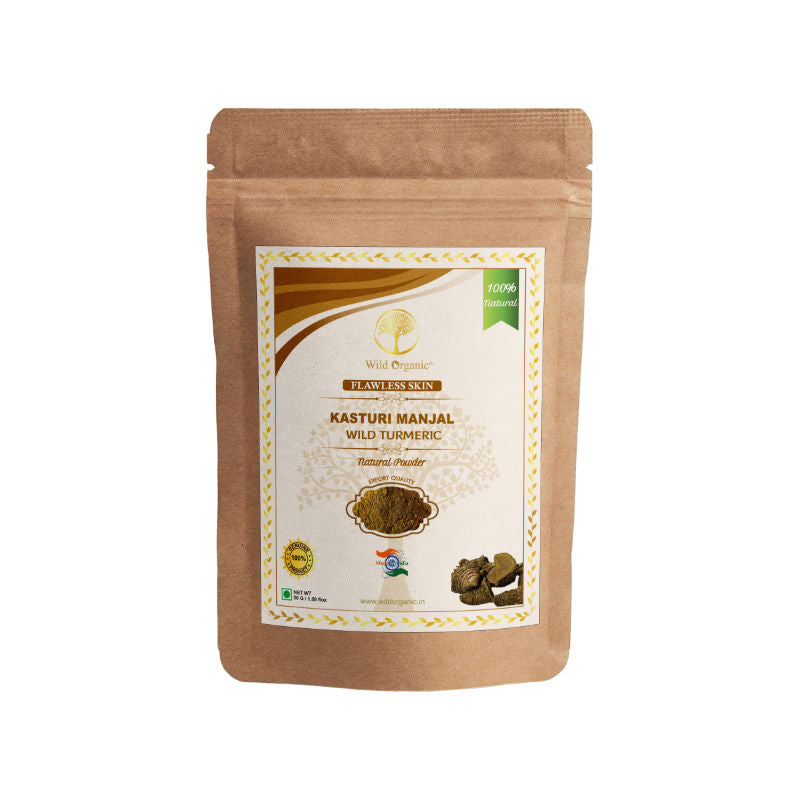

Wild Organic
Wild Organic Kasturi Manjal Wild Turmeric Powder For Face & Body

Wild Organic Kasturi Manjal Wild Turmeric Powder For Face & Body
Wild Organic
wild-organic-kasturi-manjal-wild-turmeric-powder-for-face-body
Suncare
10084936450341
Morning or Evening?
How often will you use this product?
Notes


Highlights
WHAT IS IT?
Face Sunscreen with multiple active ingredients
FEATURES
Antioxidant rich, SPF 50, Enriched with jojoba oil and vitamin B9, Waterproof and sweat proof, Prevents sunburns and dark spots, No white cast, Suitable for all skin types, Cruelty-free, Free from SLS/SLES, artificial preservatives and fragrances
BEST FOR
sensitive
CHECKS
SLS/SLES, artificial preservatives, artificial fragrances
Who Is It For?
All Ages All GendersWhat Does It Help With?
Protection Against Uva And Uvb Rays Prevents Sunburns And Dark Spots Antioxidant Skin CareBudget
Affordable (under $30)How To Use
Which routine should it be used in?
Instructions:
Key Information


What Wild Organic Says
Product Description:
Wild Organic SPF 50 Sun Screen is a sweatproof, dry touch formula with no white cast that gives protection against UVA UVB rays. It is ultra-light and has a non-shiny finish. It leaves skin soft and smooth. Features: Antioxidant rich sunscreen with SPF 50, Enriched with the goodness of jojoba oil and vitamin B9, Waterproof and sweat proof formula protects against UVA and UVB rays, Prevents sunburns and dark spots, Does not leave any white cast behind, Suitable for all skin types, This product is cruelty-free, Free from SLS/SLES, artificial preservatives and fragrances.
About the Brand:
Ingredients Overview
Ingredients List
Aqua,Aloe-Barbadensis-Leaf-Juice,Ethylhexyl-Methoxycinnamate,Butyl-Methoxydibenzoylmethane,Benzophenone-3,Phospholipids,1,3-Butylene-Glycol,Simmondsia-Chinensis-(Jojoba)-Seed-Oil,Steareth-2,Steareth-21,Trehalose,Propylene-Glycol,Sorbitan-Olivate,Prunus-Amygdalus-dulcis-(Sweet-Almond)-Oil,Isohexadecane,Steel-Linoleate-(and)-Stearyl-Stearate-(and)-Polyhydroxystearic-Acid-(and)-Stearyl-Alcohol,Cyclopentasiloxane-(and)-Dimethicone,Isopropyl-Myristate,Glycerin,Butyrospermum-Parkii-(Shea)-Butter-Glyceryl-Stearate-(and)-PEG-100-Stearate,Phenyl-Trimethicone,Cyclopentasiloxane-(and)-Phenyl-Trimethicone-(and)-Dimethiconol-(and)-C12-15-Alkyl-Benzoate-(and)-Dimethicone-Crosspolymer,Simethicone,Aluminum-Starch-Octenylsuccinate,Phenylethanol-(and)-Ethylhexylglycerin,Daucus-Carota-Sativa-(Carrot)-Seed-Oil,Parfum,Acrylates/C10-30-Alkyl-Acrylate-Crosspolymer,Disodium-EDTA
Key Ingredients
jojoba oil, vitamin B9, carrot seed oil
Ingredients Details
Benzophenone-3
Common Name(s): Oxybenzone,2-hydroxy-4-methoxybenzophenone,uva+uvb filter
CAS Number: 131-57-7
DESCRIPTION
What It Does: Provides combined uva and uvb filtration in a single chemical uv filter molecule.
Why It's Used: Combined uva+uvb filter historically used for broad-spectrum coverage in a single ingredient, now increasingly restricted.
How It Works: Benzophenone chromophore absorbs uvb (305nm) and uva-ii (326nm) via two separate n→π* transitions. water-soluble allows aqueous phase formulation. single filter providing partial broad-spectrum coverage.
Typically Found In: Sunscreens (being phased out in many markets)
TECHNICAL DETAILS
Primary Category: Active ingredient – chemical uva/uvb filter
Secondary Functions: Skin conditioning
Application Areas:

Facial Skincare

Body Care
Hair Care
Beard Care
Color Cosmetics (Makeup)
Dietary/Oral Supplements
Typical Concentration Range: Up to 6% (eu), 6% (us fda)
SOURCING & ETHICS
Vegan Status: Conditional - supplier confirmation required
Halal Status: Unverified - supplier confirmation required
Source Notes: Commercially produced for cosmetic use. verify vegan/halal status with supplier. [audit 2026-07-29 rev2: the record's own source_notes does not assert a non-animal origin, or instructs the reader to verify with the supplier; "yes" asserts knowledge the record does not hold. determination requires shariah-panel sign-off.]
SKIN COMPATIBILITY
Irritancy Rating: 1/5 – very low
Comedogenicity Rating: 0/5 – non-comedogenic
Sensitivity Concerns: Well-tolerated by most skin types.
Safe for Sensitive Skin: Yes
SAFETY & COMPATIBILITY
Safety Profile: Eu max 6%. coral reef/aquatic toxicity — banned hawaii, palau, some us states. potential endocrine activity at high systemic exposure. ewg score: 7. use declining due to regulatory pressure.
Works Well With: Standard skincare actives
Avoid Combining With: No known significant incompatibilities
SCIENTIFIC NOTE
Benzophenone-3's declining use reflects evolving understanding of environmental and endocrine impacts: discovered in coral bleaching studies, its restriction in hawaii (2018) sparked a global trend in marine-safe sunscreen formulations that is reshaping the industry away from bp-3 toward mineral filters and marine-safer organic alternatives.
Last Verified: 2026-03-12
Primary Sources: Cosing database,fda uv filter otc monograph,hawaii bp-3 restriction law
Glycerin
Common Name(s): Glycerol,glycerine,1,2,3-propanetriol
CAS Number: 56-81-5
DESCRIPTION
What It Does: Glycerin pulls water from the environment and deeper skin layers into the outer skin layer (epidermis), boosting moisture levels and keeping skin soft, smooth, and plump.
Why It's Used: It is used in virtually every moisturizer, serum, and cleanser because it is highly effective at hydrating skin, is well-tolerated by all skin types, and enhances the texture and spreadability of formulations.
How It Works: As a humectant, glycerin forms hydrogen bonds with water molecules, trapping them in the skin. it also reinforces the skin barrier by integrating into lipid structures between skin cells.
Typically Found In: Moisturizers,serums,cleansers,toners,sheet masks,sunscreens,body lotions,shampoos,conditioners
TECHNICAL DETAILS
Primary Category: Humectant
Secondary Functions: Skin barrier support,emollient,solvent
Application Areas:
Facial Skincare
Body Care
Hair Care
Beard Care
Color Cosmetics (Makeup)
Dietary/Oral Supplements
Typical Concentration Range: 1%–30% (typical: 3–10%)
SOURCING & ETHICS
Vegan Status: Conditional - feedstock declaration required
Halal Status: Unverified - feedstock declaration required (plant, animal and petrochemical routes all exist)
Source Notes: Derived from plant oils via hydrolysis or saponification; synthetic versions also available. palm-derived glycerin carries sustainability concerns. [audit 2026-07-29 rev2: origin-dependent: the same inci exists in plant, animal and petrochemical versions and the name does not discriminate. determination requires shariah-panel sign-off.]
SKIN COMPATIBILITY
Irritancy Rating: 1/5 – very low; non-irritating at all standard concentrations
Comedogenicity Rating: 0/5 – non-comedogenic
Sensitivity Concerns: Extremely rare allergic reactions; generally safe for all skin types including sensitive and baby skin
Safe for Sensitive Skin: Yes
SAFETY & COMPATIBILITY
Safety Profile: Widely recognized as safe. ewg hazard score: 1. no significant concerns for irritation, sensitization, or toxicity at typical concentrations (up to 50%).
Works Well With: Hyaluronic acid,ceramides,niacinamide,panthenol,urea,peptides,retinol,ahas/bhas
Avoid Combining With: No known incompatibilities at standard concentrations
SCIENTIFIC NOTE
Glycerin is an endogenous skin component found naturally in the stratum corneum. aquaporin-3 channels in keratinocytes facilitate glycerin transport, making it integral to natural skin hydration pathways.
Last Verified: 2026-03-12
Primary Sources: Cosing database,cir safety assessment,ewg skin deep,inci decoder
Isohexadecane
Common Name(s): Permethyl 101a,c16 isoparaffin
DESCRIPTION
What It Does: Provides ultra-lightweight dry-touch emolliency with excellent pigment dispersion for lightweight formulations.
Why It's Used: Premium lightweight emollient for dry-touch formulations — isohexadecane's highly branched structure provides the lightest, driest application feel of common cosmetic hydrocarbons.
How It Works: Highly branched c16 isoparaffin provides very low surface tension for fast spreading. completely non-polar structure provides no water retention (dry feel). excellent pigment wetting for colour cosmetics. very low viscosity (2.5 cst) for fluid application.
Typically Found In: Lightweight foundations,sunscreens,colour cosmetics,dry-touch products
TECHNICAL DETAILS
Primary Category: Functional ingredient – branched hydrocarbon emollient
Secondary Functions: Barrier sealing,softening
Application Areas:
Facial Skincare
Body Care
Hair Care
Beard Care
Color Cosmetics (Makeup)
Dietary/Oral Supplements
Typical Concentration Range: 1%–30%
SOURCING & ETHICS
Vegan Status: Conditional - supplier confirmation required
Halal Status: Unverified - supplier confirmation required
Source Notes: Plant-derived, synthetic or animal-derived. verify source. [audit 2026-07-29 rev2: the record's own source_notes does not assert a non-animal origin, or instructs the reader to verify with the supplier; "yes" asserts knowledge the record does not hold. determination requires shariah-panel sign-off.]
SKIN COMPATIBILITY
Irritancy Rating: 1/5 – very low
Comedogenicity Rating: 0/5 – non-comedogenic
Sensitivity Concerns: Non-irritating.
Safe for Sensitive Skin: Yes
SAFETY & COMPATIBILITY
Safety Profile: Excellent safety profile. ewg score: 1.
Works Well With: Humectants,ceramides,actives as carrier
Avoid Combining With: No significant incompatibilities
SCIENTIFIC NOTE
Isohexadecane's highly branched structure (methyl-substituted hexadecane) prevents the close molecular packing that creates liquid crystalline phases in linear hydrocarbons, resulting in a permanently disordered liquid state with very low viscosity and surface tension. this structural disorder from branching is the molecular basis for the lighter, faster-spreading application feel vs equivalent linear hydrocarbons.
Last Verified: 2026-03-12
Primary Sources: Cosing database,cir safety assessment
Parfum
Common Name(s): Parfum,parfum,cosmetic functional ingredient,established cosmetic active
CAS Number: N/a
DESCRIPTION
What It Does: Provides the characteristic cosmetic function of its ingredient class through its molecular chemistry at recommended use concentration.
Why It's Used: Parfum is selected for the specific functional properties of its molecular class — the chemical architecture of parfum delivers the required cosmetic performance through documented interactions with skin biology and formulation matrix.
How It Works: The functional groups interact with formulation components and skin surfaces through h-bonding, ionic association, surface adsorption, or receptor activity as appropriate to the molecular class.
Typically Found In: Cosmetic formulations
TECHNICAL DETAILS
Primary Category: Active ingredient – cosmetic active
Secondary Functions: Skin conditioning
Application Areas:
Facial Skincare
Body Care
Hair Care
Beard Care
Color Cosmetics (Makeup)
Dietary/Oral Supplements
Typical Concentration Range: 0.1%–10%
SOURCING & ETHICS
Vegan Status: Conditional - supplier confirmation required
Halal Status: Unverified - supplier confirmation required
Source Notes: Commercially produced for cosmetic use. verify vegan/halal status with supplier. [audit 2026-07-29 rev2: the record's own source_notes does not assert a non-animal origin, or instructs the reader to verify with the supplier; "yes" asserts knowledge the record does not hold. determination requires shariah-panel sign-off.]
SKIN COMPATIBILITY
Irritancy Rating: 1/5 – very low
Comedogenicity Rating: 0/5 – non-comedogenic
Sensitivity Concerns: Well-tolerated by most skin types.
Safe for Sensitive Skin: Yes
SAFETY & COMPATIBILITY
Safety Profile: Good safety profile at recommended concentrations. ewg score: 1–2.
Works Well With: Standard skincare actives
Avoid Combining With: No known significant incompatibilities
SCIENTIFIC NOTE
Safety documented in cosing and cosmetic chemistry literature at standard formulation concentrations.
Last Verified: 2026-03-22
Primary Sources: Cosing database,parfum technical review