

Wild Oak
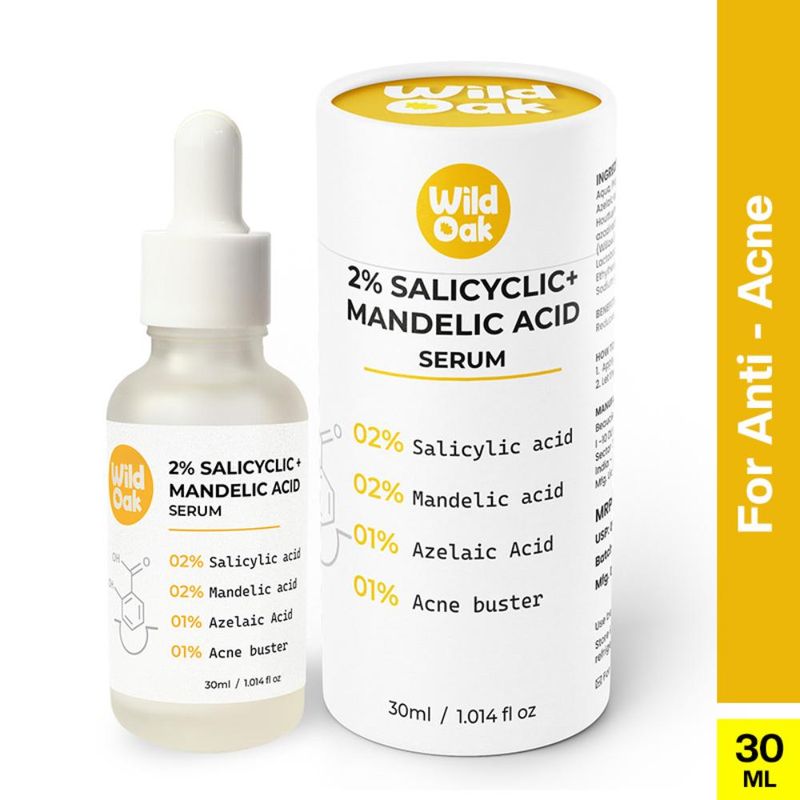
Wild Oak 2% Salicylic Mandelic Face Serum

Wild Oak 2% Salicylic Mandelic Face Serum
Wild Oak
wild-oak-2-salicylic-mandelic-face-serum
Serum
10085495439653
Morning or Evening?
How often will you use this product?
Notes


Highlights
WHAT IS IT?
Face Serum with 4 active ingredients
FEATURES
Dual-acid formula with Salicylic Acid and Mandelic Acid, exfoliates and clarifies pores, brightens and evens skin tone, hydrating and non-drying, suitable for all skin types including sensitive, oily, combination
BEST FOR
sensitive
CHECKS
Does not contain any explicit harsh allergens or drying agents as it is hydrating and non-drying
Who Is It For?
What Does It Help With?
Acne Clogged Pores Hyperpigmentation Uneven Skin Tone Texture Improvement BrighteningBudget
Affordable (under $30)How To Use
Which routine should it be used in?
Instructions:
Key Information


What Wild Oak Says
Product Description:
Powerful Dual-Acid Formula: Combines Salicylic Acid (2%) and Mandelic Acid (2%) to target acne, unclog pores, and gently exfoliate for a brighter, smoother complexion. Exfoliates & Clarifies: Salicylic Acid penetrates deep into pores to clear out impurities and prevent breakouts, while Mandelic Acid offers gentle surface exfoliation to improve skin texture and tone. Brightens & Evens Skin Tone: Mandelic Acid helps reduce hyperpigmentation and sun spots, revealing a more even and radiant skin tone. Suitable for All Skin Types: Formulated to be effective yet gentle, making it ideal for sensitive, oily, or combination skin. Hydrating & Non-Drying: Infused with soothing ingredients to maintain hydration and prevent over-drying, ensuring your skin feels fresh and balanced.
About the Brand:
Ingredients Overview
Ingredients List
02%-Salicylic-Acid,02%-Mandelic-Acid,01%-Azelaic-Acid,01%-Acne-Buster
Key Ingredients
Salicylic Acid, Mandelic Acid, Azelaic Acid, Acne Buster
Ingredients Details
Azelaic Acid
Common Name(s): Nonanedioic acid,lepargylic acid
CAS Number: 123-99-9
DESCRIPTION
What It Does: Reduces acne, evens skin tone, calms rosacea, and reduces hyperpigmentation through multiple complementary mechanisms.
Why It's Used: Multi-action gold standard for hyperpigmentation, acne, rosacea, and post-inflammatory hyperpigmentation (pih) – well-tolerated by all skin tones.
How It Works: Inhibits tyrosinase (melanin synthesis) and abnormal melanocyte proliferation. inhibits 5-alpha-reductase (sebum control). antimicrobial against p. acnes and malassezia. anti-inflammatory via nf-kb pathway inhibition.
Typically Found In: Brightening serums,anti-acne treatments,rosacea products,hyperpigmentation formulations
TECHNICAL DETAILS
Primary Category: Active ingredient – dicarboxylic acid
Secondary Functions: Anti-acne,rosacea management,sebum control
Application Areas:

Facial Skincare

Body Care
Hair Care
Beard Care
Color Cosmetics (Makeup)
Dietary/Oral Supplements
Typical Concentration Range: 5%–20% (otc 5–10%; prescription 15–20%)
SOURCING & ETHICS
Vegan Status: Conditional - supplier confirmation required
Halal Status: Unverified - supplier confirmation required
Source Notes: Naturally from malassezia yeast on skin; produced by ozonolysis of oleic acid commercially. [audit 2026-07-29 rev2: the record's own source_notes does not assert a non-animal origin, or instructs the reader to verify with the supplier; "yes" asserts knowledge the record does not hold. determination requires shariah-panel sign-off.]
SKIN COMPATIBILITY
Irritancy Rating: 2/5 – low to moderate; initial tingling expected
Comedogenicity Rating: 0/5 – non-comedogenic
Sensitivity Concerns: Initial tingling and stinging normalizes within 2–4 weeks of regular use.
Safe for Sensitive Skin: Use with caution – transient tingling common during introduction
SAFETY & COMPATIBILITY
Safety Profile: Excellent long-term safety. fda-approved for acne (benzaclin) and rosacea (finacea). ewg score: 1.
Works Well With: Ceramides,niacinamide,hyaluronic acid,spf
Avoid Combining With: Multiple exfoliating acids simultaneously; high concentrations without spf
SCIENTIFIC NOTE
Azelaic acid's combined tyrosinase inhibition + abnormal melanocyte selectivity (normalizes only overactive melanocytes, unlike hydroquinone) makes it uniquely safe for long-term use without bleaching normal-pigmented skin.
Last Verified: 2026-03-12
Primary Sources: Cosing database,draelos azelaic acid review,fda drug approval database
Mandelic Acid
Common Name(s): Alpha-hydroxyphenylacetic acid,phenylglycolic acid
CAS Number: 90-64-2
DESCRIPTION
What It Does: Provides gentle aha exfoliation with lipophilic sebosuppressive anti-acne activity suitable for deeper skin tones.
Why It's Used: Skin-of-colour appropriate aha — mandelic acid's large size reduces pih risk making it the preferred aha for fitzpatrick iv–vi skin tones.
How It Works: Larger mw (152 vs glycolic 76) provides slower penetration reducing irritation and post-inflammatory hyperpigmentation risk. benzene ring provides lipophilicity for better follicular penetration and sebum regulation. antibacterial vs p. acnes from phenolic structure.
Typically Found In: Skin-of-colour exfoliants,anti-acne for sensitive skin
TECHNICAL DETAILS
Primary Category: Active ingredient – skin-of-colour appropriate aha
Secondary Functions: Brightening,collagen stimulation
Application Areas:
Facial Skincare
Body Care
Hair Care
Beard Care
Color Cosmetics (Makeup)
Dietary/Oral Supplements
Typical Concentration Range: 1%–15%
SOURCING & ETHICS
Vegan Status: Yes – from bitter almond or synthetic
Halal Status: Yes
Source Notes: Fermentation-derived or synthetic. ph must be ≤4.0 for aha activity.
SKIN COMPATIBILITY
Irritancy Rating: 2/5 – low to moderate
Comedogenicity Rating: 0/5 – non-comedogenic
Sensitivity Concerns: Photosensitizing – mandatory spf use. start at low frequency.
Safe for Sensitive Skin: Use with caution – spf required
SAFETY & COMPATIBILITY
Safety Profile: Safe at otc concentrations. eu: ≤10% leave-on at ph ≥3.5. mandatory spf advisory.
Works Well With: Niacinamide,ceramides,hyaluronic acid,spf
Avoid Combining With: Retinol in same step; multiple exfoliants simultaneously
SCIENTIFIC NOTE
Mandelic acid's safety advantage for darker skin tones arises from its slower penetration rate: the larger lipophilic molecule penetrates 2–4× more slowly than glycolic acid, reducing the risk of post-inflammatory hyperpigmentation from irritant-induced melanocyte stimulation — a critical clinical consideration for fitzpatrick iv–vi skin.
Last Verified: 2026-03-12
Primary Sources: Cosing database,khunger & sacchidanand mandelic acid review
Salicylic Acid
Common Name(s): Bha,2-hydroxybenzoic acid,orthohydroxybenzoic acid,willow bark acid
CAS Number: 69-72-7
DESCRIPTION
What It Does: Salicylic acid exfoliates the skin surface and inside pores, dissolves the 'glue' holding dead skin cells together, reduces sebum production, and combats acne-causing bacteria.
Why It's Used: Its oil solubility makes it uniquely effective at penetrating pores and dissolving sebum plugs – a function that water-soluble ahas cannot perform. it is the preferred exfoliant for oily, acne-prone, and congested skin.
How It Works: Salicylic acid disrupts desmosomal bonds between corneocytes, promoting exfoliation. its oil solubility allows it to penetrate the sebaceous follicle, dissolving sebum and dead cells. it also has anti-inflammatory properties by inhibiting prostaglandin synthesis.
Typically Found In: Cleansers,toners,serums,spot treatments,masks,chemical peels,anti-dandruff shampoos,acne treatments
TECHNICAL DETAILS
Primary Category: Active ingredient – beta hydroxy acid (bha)
Secondary Functions: Anti-acne,anti-dandruff,keratolytic
Application Areas:
Facial Skincare
Body Care
Hair Care
Beard Care
Color Cosmetics (Makeup)
Dietary/Oral Supplements
Typical Concentration Range: 0.5%–2% (otc acne treatment in us); up to 30% in professional chemical peels
SOURCING & ETHICS
Vegan Status: Yes – synthetic or willow bark derived
Halal Status: Yes
Source Notes: Naturally occurring in willow bark (salix alba) and wintergreen oil. commercially produced synthetically via kolbe-schmitt reaction for cosmetic use.
SKIN COMPATIBILITY
Irritancy Rating: 3/5 – moderate; can cause dryness, peeling, and irritation, especially at higher concentrations
Comedogenicity Rating: 0/5 – non-comedogenic; actually anti-comedogenic
Sensitivity Concerns: Can cause irritation, dryness, and sun sensitivity. avoid contact with eyes. not recommended during pregnancy at high concentrations. can be drying – follow with moisturizer.
Safe for Sensitive Skin: Use with caution – start with lower concentrations and frequency; may not be suitable for reactive or rosacea-prone skin
SAFETY & COMPATIBILITY
Safety Profile: Safe at otc concentrations (0.5–2%). regulated as a drug in some countries (us: fda category i acne treatment). avoid in pregnancy at high concentrations.
Works Well With: Niacinamide,zinc,tea tree oil,benzoyl peroxide (at different times),hyaluronic acid (to counteract dryness)
Avoid Combining With: High concentrations of retinol (cumulative irritation),multiple exfoliating acids simultaneously,benzoyl peroxide in same step (can increase irritation)
SCIENTIFIC NOTE
Salicylic acid is a member of the salicylate family and shares structural similarity with aspirin. its anti-inflammatory mechanism mirrors aspirin's cox inhibition pathway, making it uniquely effective for inflammatory acne.
Last Verified: 2026-03-12
Primary Sources: Cosing database,cir safety assessment,us fda acne monograph,journal of the american academy of dermatology