
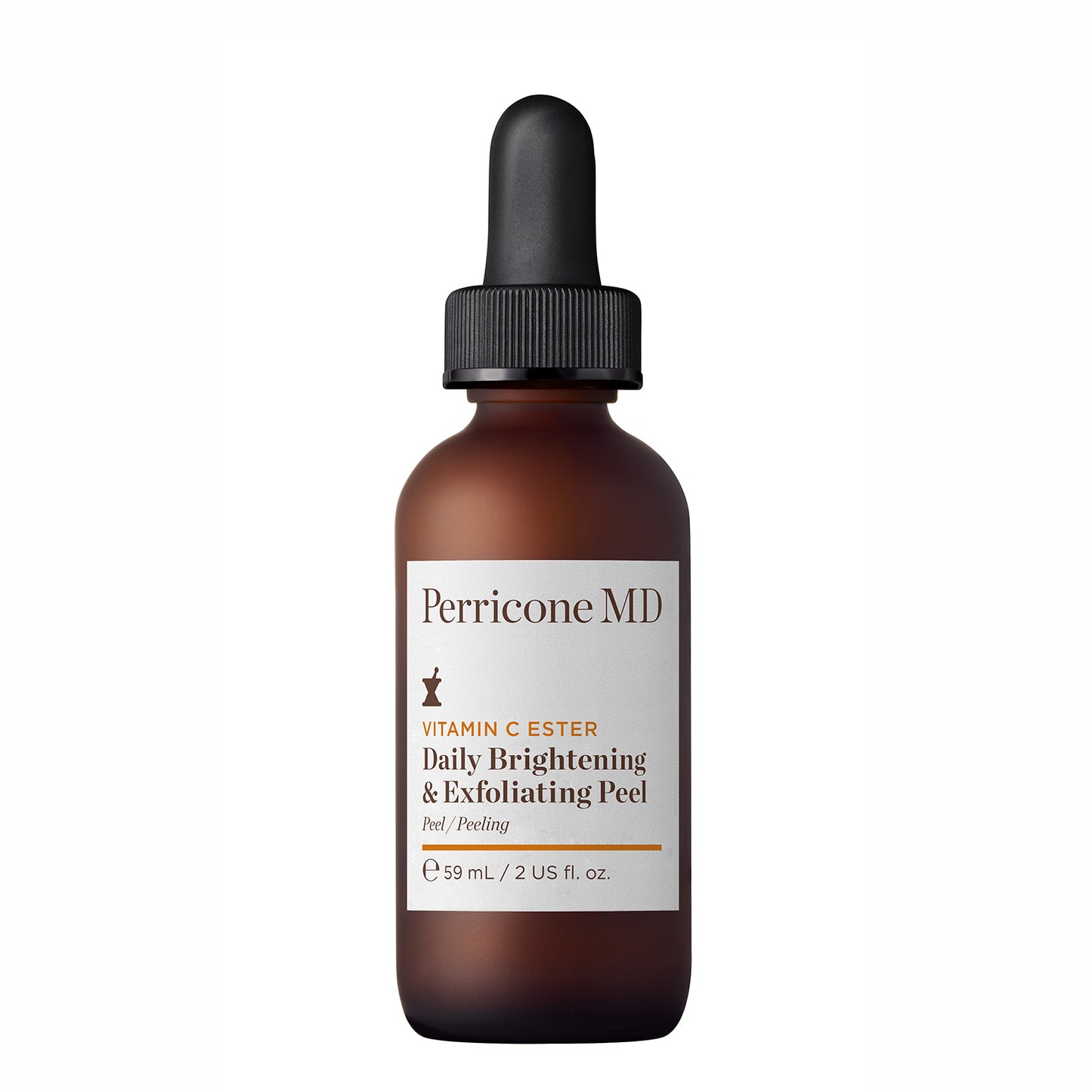

Perricone MD
Vitamin C Ester Daily Brightening & Exfoliating Peel

Vitamin C Ester Daily Brightening & Exfoliating Peel
Perricone MD
vitamin-c-ester-daily-brightening-exfoliating-peel
Exfoliation
9643625578789
Morning or Evening?
How often will you use this product?
Notes


Highlights
WHAT IS IT?
Liquid exfoliating peel with multiple ingredients
FEATURES
No-rinse, resurfacing, brightening, smoothing, fast-absorbing
BEST FOR
Not explicitly mentioned, but suitable for daily use
CHECKS
Not explicitly mentioned
Who Is It For?
Adults (inferred Specific Age Range Not Provided) Both Men And Women (inferred)What Does It Help With?
Eliminates Dead Skin Cells Smooths Uneven Texture Improves Radiance And Glow Reduces Discoloration And Dark SpotsBudget
Mid-rangeHow To Use
Which routine should it be used in?
Instructions:
Key Information

What Perricone MD Says
Product Description:
An advanced, no-rinse resurfacing peel that helps eliminate dead skin cells and smooth uneven texture, while instantly improving skin's radiance and glow. Gentle enough to use daily, this lightweight, fast-absorbing liquid peel helps visibly brighten, tighten and reduce the appearance of discoloration and dark spots over time to promote a visibly healthy, luminous-looking complexion.
About the Brand:
Ingredients Overview
Ingredients List
Water/Aqua/Eau, Propanediol, Glycolic Acid, 3-O-Ethyl Ascorbic Acid, Gluconolactone, PEG-8 Dimethicone, Vaccinium Myrtillus Fruit Extract, PPG-26-Buteth-26, Sodium Hydroxide, PEG-40 Hydrogenated Castor Oil, 1,2-Hexanediol, Saccharum Officinarum (Sugarcane) Extract/Extrait De Canne À Sucre, Ferulic Acid, Citrus Aurantium Dulcis (Orange) Fruit Extract, Citrus Limon (Lemon) Fruit Extract, Sodium Benzoate, Sodium Phytate, Tetrahexyldecyl Ascorbate, Acer Saccharum (Sugar Maple) Extract.
Key Ingredients
Vitamin C Ester, AHA / PHA Super Blend, Ferulic Acid
Ingredients Details
3-o Ethyl Ascorbic Acid
Common Name(s): Ethyl ascorbic acid,3-o-ea,vitamin c ether
DESCRIPTION
What It Does: Provides stable vitamin c activity combining formulation stability with good skin delivery.
Why It's Used: Best balance of stability and bioavailability among vitamin c derivatives — 3-o-ea provides stability superior to ascorbic acid with better bioavailability than large ester forms like ascorbyl tetraisopalmitate.
How It Works: C3 ether position protection prevents oxidation at the most vulnerable c2-c3 enediol. more lipophilic than ascorbic acid for improved skin penetration. ether bond resistant to hydrolysis in formulation but cleaved by skin esterases for active ascorbic acid release in viable epidermis.
Typically Found In: Stable brightening serums,anti-aging vitamin c products
TECHNICAL DETAILS
Primary Category: Active ingredient – ethyl ascorbic acid
Secondary Functions: Tyrosinase inhibitor,collagen cofactor
Application Areas:

Facial Skincare

Body Care
Hair Care
Beard Care
Color Cosmetics (Makeup)
Dietary/Oral Supplements
Typical Concentration Range: 1%–3%
SOURCING & ETHICS
Vegan Status: Yes – synthetic
Halal Status: Yes
Source Notes: Synthetically produced vitamin c derivative.
SKIN COMPATIBILITY
Irritancy Rating: 1/5 – very low
Comedogenicity Rating: 0/5 – non-comedogenic
Sensitivity Concerns: Non-irritating; suitable for all skin types.
Safe for Sensitive Skin: Yes
SAFETY & COMPATIBILITY
Safety Profile: Excellent safety profile. ewg score: 1.
Works Well With: Tocopherol,ferulic acid,niacinamide,spf
Avoid Combining With: No significant incompatibilities
SCIENTIFIC NOTE
3-o-ethyl ascorbic acid's ether bond at c3 provides fundamentally different stability vs ester-bonded vitamin c derivatives (ascorbyl palmitate, ascorbyl tetraisopalmitate). ether bonds are far more resistant to chemical hydrolysis than ester bonds — 3-o-ea is more hydrolysis-stable than c6 ester derivatives while still providing bioactive release via ether cleavage in skin.
Last Verified: 2026-03-12
Primary Sources: Cosing database,cir safety assessment
Gluconolactone
Common Name(s): D-gluconolactone,delta-gluconolactone
CAS Number: 90-80-2
DESCRIPTION
What It Does: Provides the gentlest chemical exfoliation with simultaneous antioxidant, moisture retention, and barrier support.
Why It's Used: Preferred exfoliant for rosacea, eczema, sensitive skin, and post-procedure recovery where standard ahas cause unacceptable irritation.
How It Works: Hydrolyzes slowly on skin surface to gluconic acid providing gentle exfoliation. multiple hydroxyl groups enable water binding (humectant) and metal chelation (antioxidant).
Typically Found In: Sensitive skin exfoliants,rosacea treatments,eczema care,post-procedure recovery
TECHNICAL DETAILS
Primary Category: Active ingredient – polyhydroxy acid (pha)
Secondary Functions: Gentle exfoliation,antioxidant,humectant
Application Areas:
Facial Skincare
Body Care
Hair Care
Beard Care
Color Cosmetics (Makeup)
Dietary/Oral Supplements
Typical Concentration Range: 5%–15%
SOURCING & ETHICS
Vegan Status: Conditional - supplier confirmation required
Halal Status: Unverified - supplier confirmation required
Source Notes: Fermentation-derived from glucose or synthetic. among the safest chemical exfoliants available. [audit 2026-07-29 rev2: status downgraded on audit. determination requires shariah-panel sign-off.]
SKIN COMPATIBILITY
Irritancy Rating: 1/5 – very low
Comedogenicity Rating: 0/5 – non-comedogenic
Sensitivity Concerns: No photosensitization; no stinging; suitable for very sensitive skin.
Safe for Sensitive Skin: Yes – ideal for sensitive, reactive, rosacea, and eczema-prone skin; no photosensitization
SAFETY & COMPATIBILITY
Safety Profile: Exceptional safety profile. no photosensitization. ewg score: 1.
Works Well With: Ceramides,niacinamide,hyaluronic acid,soothing actives
Avoid Combining With: No significant incompatibilities
SCIENTIFIC NOTE
Phas have molecular weights 2–3× larger than ahas, limiting penetration to superficial layers. combined humectant and antioxidant properties make them uniquely well-tolerated while providing meaningful exfoliation.
Last Verified: 2026-03-12
Primary Sources: Cosing database,green & yu (2003) pha review,cir safety assessment
Glycolic Acid
Common Name(s): Hydroxyacetic acid,2-hydroxyacetic acid
CAS Number: 79-14-1
DESCRIPTION
What It Does: Provides maximum aha efficacy from the smallest most penetrating alpha-hydroxy acid.
Why It's Used: The most potent aha — glycolic acid's smallest molecular size provides the deepest penetration and highest efficacy of any alpha-hydroxy acid for exfoliation and anti-aging.
How It Works: Smallest aha (mw 76) provides deepest stratum corneum penetration. disrupts corneodesmosomes reducing cohesion. stimulates fibroblast collagen i and iii synthesis. efficacy is ph-dependent — free acid fraction determines activity.
Typically Found In: Chemical peels,body lotions,anti-aging serums,exfoliating toners
TECHNICAL DETAILS
Primary Category: Active ingredient – primary aha
Secondary Functions: Brightening,collagen stimulation
Application Areas:
Facial Skincare
Body Care
Hair Care
Beard Care
Color Cosmetics (Makeup)
Dietary/Oral Supplements
Typical Concentration Range: 1%–10% cosmetic; higher professional
SOURCING & ETHICS
Vegan Status: Yes – synthetic or fermentation-derived
Halal Status: Yes
Source Notes: Fermentation-derived or synthetic. ph must be ≤4.0 for aha activity.
SKIN COMPATIBILITY
Irritancy Rating: 2/5 – low to moderate
Comedogenicity Rating: 0/5 – non-comedogenic
Sensitivity Concerns: Photosensitizing – mandatory spf use. start at low frequency.
Safe for Sensitive Skin: Use with caution – spf required
SAFETY & COMPATIBILITY
Safety Profile: Eu cosmetics: max 10% leave-on, ph ≥3.5, mandatory sun protection advisory. professional peel concentrations regulated separately.
Works Well With: Niacinamide,ceramides,hyaluronic acid,spf
Avoid Combining With: Retinol in same step; multiple exfoliants simultaneously
SCIENTIFIC NOTE
Glycolic acid's ph-dependent efficacy is critical: at ph 3.0 ~100% is in the free acid (membrane-permeable) form; at ph 3.5 ~70%; at ph 4.0 ~50%. the eu ph ≥3.5 requirement reduces free acid proportion, lowering efficacy but also reducing irritation — why professional peel concentrations at lower ph are far more active than equivalent cosmetic concentrations.
Last Verified: 2026-03-12
Primary Sources: Cosing database,eu aha guidelines,cir safety assessment
Peg-40 Hydrogenated Castor Oil
Common Name(s): Peg-based nonionic emulsifier,ethoxylate surfactant,o/w solubiliser
CAS Number: N/a
DESCRIPTION
What It Does: Stabilises o/w emulsions by reducing interfacial tension, solubilises oils and fragrances in aqueous systems, and wets oil-phase components for improved formulation homogeneity.
Why It's Used: Peg emulsifiers are selected for their precise hlb, broad ph stability (unlike soap emulsifiers that lose function at acidic ph), and compatibility with both anionic and cationic co-ingredients in the formulation system.
How It Works: Peg chain length determines hlb: longer peg = higher hlb = more hydrophilic = better o/w emulsification. at the o/w interface, the peg chain extends into the water phase forming a hydrated steric barrier that prevents droplet coalescence. nonionic character provides ph-independent function across the full cosmetic ph range.
Typically Found In: Emulsions,fragrance solubilisation
TECHNICAL DETAILS
Primary Category: Active ingredient – cosmetic active
Secondary Functions: Skin conditioning
Application Areas:
Facial Skincare
Body Care
Hair Care
Beard Care
Color Cosmetics (Makeup)
Dietary/Oral Supplements
Typical Concentration Range: 1%–10%
SOURCING & ETHICS
Vegan Status: Conditional - supplier confirmation required
Halal Status: Unverified - supplier confirmation required
Source Notes: Commercially produced for cosmetic use. verify vegan/halal status with supplier. [audit 2026-07-29 rev2: the record's own source_notes does not assert a non-animal origin, or instructs the reader to verify with the supplier; "yes" asserts knowledge the record does not hold. determination requires shariah-panel sign-off.]
SKIN COMPATIBILITY
Irritancy Rating: 1/5 – very low
Comedogenicity Rating: 0/5 – non-comedogenic
Sensitivity Concerns: Well-tolerated by most skin types.
Safe for Sensitive Skin: Yes
SAFETY & COMPATIBILITY
Safety Profile: Good safety profile at recommended concentrations. ewg score: 1–2.
Works Well With: Standard skincare actives
Avoid Combining With: No known significant incompatibilities
SCIENTIFIC NOTE
Mixed peg emulsifier systems (e.g., peg-100 stearate + glyceryl stearate) form more cohesive interfacial films than single emulsifiers — the geometric complementarity of the co-emulsifier pair providing better mechanical emulsion stability than either component alone.
Last Verified: 2026-03-12
Primary Sources: Cosing database,peg-40 hydrogenated castor oil peg emulsifier review