

Perricone MD
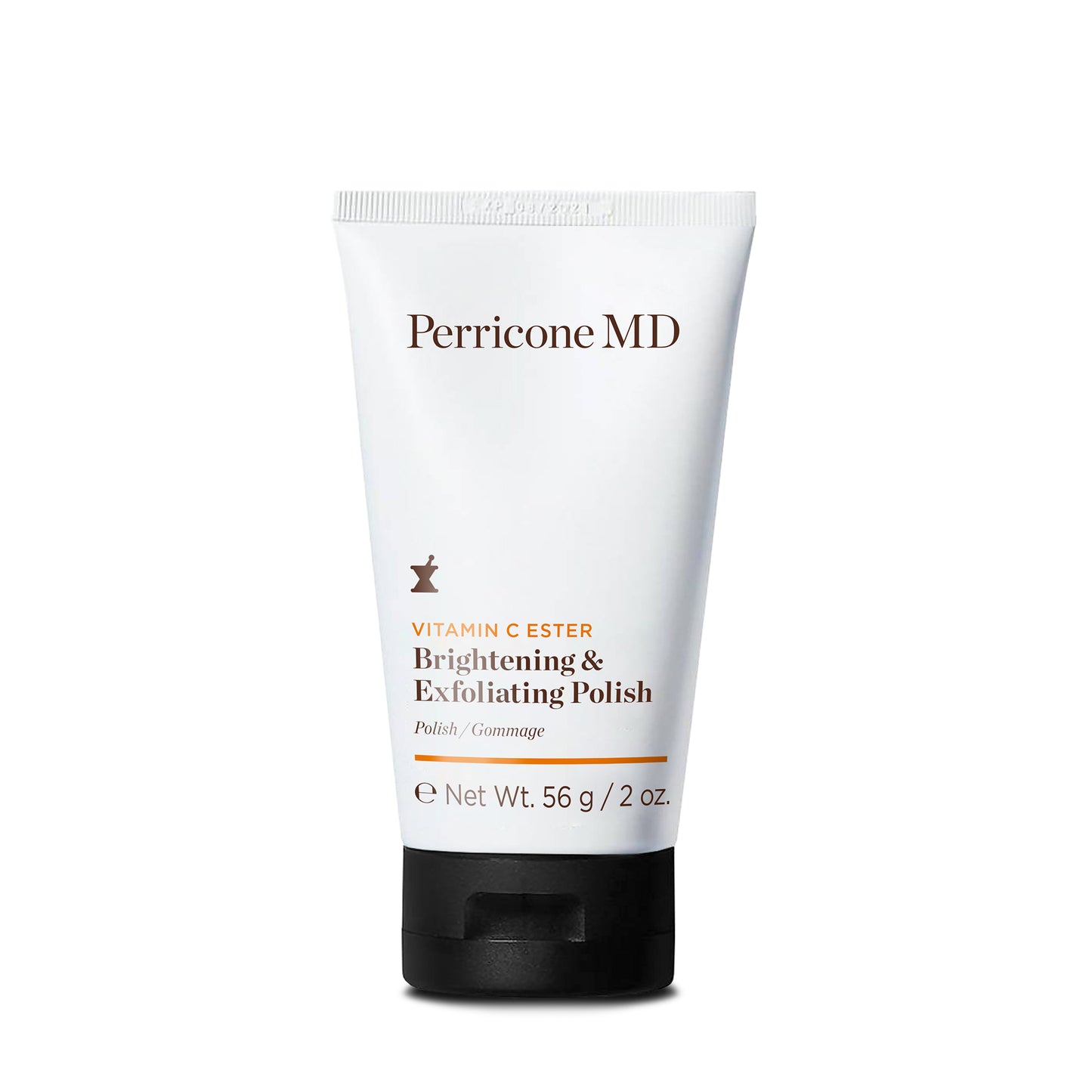
Vitamin C Ester Brightening & Exfoliating Polish

Vitamin C Ester Brightening & Exfoliating Polish
Perricone MD
vitamin-c-ester-brightening-exfoliating-polish
Exfoliation
9643617812773
Morning or Evening?
How often will you use this product?
Notes


Highlights
WHAT IS IT?
Exfoliating polish
FEATURES
Exfoliating treatment with ultra-fine, granular silica to eliminate dead skin cells, unclog pores of debris, excess oil and impurity build-up without micro-tears or scratching, minimize the look of dullness, dark spots and uneven tone
BEST FOR
All skin types
CHECKS
Does not contain micro-tears or scratching particles
Who Is It For?
Adults (18+) Both Men And WomenWhat Does It Help With?
Dullness Uneven Texture Discoloration Uneven Tone Loss Of Radiance Clogged Pores Impurities And Build-upBudget
PremiumHow To Use
Which routine should it be used in?
Instructions:
Key Information

What Perricone MD Says
Product Description:
An intensive weekly exfoliating treatment with ultra-fine, granular silica to instantly eliminate dead skin cells and unclog pores of debris, excess oil and impurity build-up without micro-tears or scratching. Antioxidant-rich papaya and mango fruit extracts deliver gentle, effective exfoliation to minimize the look of dullness, dark spots and uneven tone over time. Leaves skin looking smoother and more refined with less imperfections.
About the Brand:
Ingredients Overview
Ingredients List
Propanediol, Glycerin, Glyceryl Stearate SE, 3-O-Ethyl Ascorbic Acid, Hydrated Silica, Oleth-20, Water/Aqua/Eau, Ascorbyl Palmitate, Silica Cetyl Silylate, Phenoxyethanol, Caprylyl Glycol, Carica Papaya (Papaya) Fruit Extract, Ferulic Acid, Mangifera Indica (Mango) Fruit Extract, Tetrahexyldecyl Ascorbate, Tocopheryl Acetate, Fragrance (Parfum), Leuconostoc/Radish Root Ferment Lysate Filtrate, Haematococcus Pluvialis Extract, Tocopherol, Limonene, Linalool
Key Ingredients
Vitamin C Ester, Ferulic Acid, Enzymatic Fruit Complex (papaya and mango extracts)
Ingredients Details
3-o Ethyl Ascorbic Acid
Common Name(s): Ethyl ascorbic acid,3-o-ea,vitamin c ether
DESCRIPTION
What It Does: Provides stable vitamin c activity combining formulation stability with good skin delivery.
Why It's Used: Best balance of stability and bioavailability among vitamin c derivatives — 3-o-ea provides stability superior to ascorbic acid with better bioavailability than large ester forms like ascorbyl tetraisopalmitate.
How It Works: C3 ether position protection prevents oxidation at the most vulnerable c2-c3 enediol. more lipophilic than ascorbic acid for improved skin penetration. ether bond resistant to hydrolysis in formulation but cleaved by skin esterases for active ascorbic acid release in viable epidermis.
Typically Found In: Stable brightening serums,anti-aging vitamin c products
TECHNICAL DETAILS
Primary Category: Active ingredient – ethyl ascorbic acid
Secondary Functions: Tyrosinase inhibitor,collagen cofactor
Application Areas:

Facial Skincare

Body Care
Hair Care
Beard Care
Color Cosmetics (Makeup)
Dietary/Oral Supplements
Typical Concentration Range: 1%–3%
SOURCING & ETHICS
Vegan Status: Yes – synthetic
Halal Status: Yes
Source Notes: Synthetically produced vitamin c derivative.
SKIN COMPATIBILITY
Irritancy Rating: 1/5 – very low
Comedogenicity Rating: 0/5 – non-comedogenic
Sensitivity Concerns: Non-irritating; suitable for all skin types.
Safe for Sensitive Skin: Yes
SAFETY & COMPATIBILITY
Safety Profile: Excellent safety profile. ewg score: 1.
Works Well With: Tocopherol,ferulic acid,niacinamide,spf
Avoid Combining With: No significant incompatibilities
SCIENTIFIC NOTE
3-o-ethyl ascorbic acid's ether bond at c3 provides fundamentally different stability vs ester-bonded vitamin c derivatives (ascorbyl palmitate, ascorbyl tetraisopalmitate). ether bonds are far more resistant to chemical hydrolysis than ester bonds — 3-o-ea is more hydrolysis-stable than c6 ester derivatives while still providing bioactive release via ether cleavage in skin.
Last Verified: Cosing database,cir safety assessment
Primary Sources: 2026-03-12
Ascorbyl Palmitate
Common Name(s): L-ascorbyl-6-palmitate,vitamin c palmitate,fat-soluble vitamin c
CAS Number: 137-66-6
DESCRIPTION
What It Does: Provides lipid-soluble antioxidant protection in skin and oil-based formulations.
Why It's Used: Oil-based formulations as fat-soluble vitamin c active and formulation antioxidant preservative (e304).
How It Works: Skin esterases cleave the bond releasing ascorbic acid and palmitic acid. lipophilic form may integrate into cell membranes for lipid-phase antioxidant protection.
Typically Found In: Oil serums,emulsions,sunscreens,anti-aging creams
TECHNICAL DETAILS
Primary Category: Active ingredient – vitamin c derivative
Secondary Functions: Lipid-soluble antioxidant,formulation preservative
Application Areas:
Facial Skincare
Body Care
Hair Care
Beard Care
Color Cosmetics (Makeup)
Dietary/Oral Supplements
Typical Concentration Range: 0.1%–1%
SOURCING & ETHICS
Vegan Status: Yes – synthetic
Halal Status: Yes
Source Notes: Esterification of ascorbic acid with palmitic acid. gras food additive (e304).
SKIN COMPATIBILITY
Irritancy Rating: 1/5 – very low
Comedogenicity Rating: 1/5 – very low; palmitic acid minor concern
Sensitivity Concerns: Non-irritating; suitable for all skin types.
Safe for Sensitive Skin: Yes
SAFETY & COMPATIBILITY
Safety Profile: Excellent safety profile. ewg score: 1.
Works Well With: Tocopherol,ferulic acid,niacinamide,spf
Avoid Combining With: No significant incompatibilities
SCIENTIFIC NOTE
Debate exists about efficiency of ester hydrolysis in intact skin and prooxidant potential of uv degradation products. formulating with the antioxidant triad (c+e+ferulic) mitigates this concern.
Last Verified: Cosing database,cir safety assessment,ewg skin deep
Primary Sources: 2026-03-12
Glycerin
Common Name(s): Glycerol,glycerine,1,2,3-propanetriol
CAS Number: 56-81-5
DESCRIPTION
What It Does: Glycerin pulls water from the environment and deeper skin layers into the outer skin layer (epidermis), boosting moisture levels and keeping skin soft, smooth, and plump.
Why It's Used: It is used in virtually every moisturizer, serum, and cleanser because it is highly effective at hydrating skin, is well-tolerated by all skin types, and enhances the texture and spreadability of formulations.
How It Works: As a humectant, glycerin forms hydrogen bonds with water molecules, trapping them in the skin. it also reinforces the skin barrier by integrating into lipid structures between skin cells.
Typically Found In: Moisturizers,serums,cleansers,toners,sheet masks,sunscreens,body lotions,shampoos,conditioners
TECHNICAL DETAILS
Primary Category: Humectant
Secondary Functions: Skin barrier support,emollient,solvent
Application Areas:
Facial Skincare
Body Care
Hair Care
Beard Care
Color Cosmetics (Makeup)
Dietary/Oral Supplements
Typical Concentration Range: 1%–30% (typical: 3–10%)
SOURCING & ETHICS
Vegan Status: Yes – plant-derived (coconut, soy, palm) or synthetic
Halal Status: Yes – when plant-derived or synthetic; verify source with supplier
Source Notes: Derived from plant oils via hydrolysis or saponification; synthetic versions also available. palm-derived glycerin carries sustainability concerns.
SKIN COMPATIBILITY
Irritancy Rating: 1/5 – very low; non-irritating at all standard concentrations
Comedogenicity Rating: 0/5 – non-comedogenic
Sensitivity Concerns: Extremely rare allergic reactions; generally safe for all skin types including sensitive and baby skin
Safe for Sensitive Skin: Yes
SAFETY & COMPATIBILITY
Safety Profile: Widely recognized as safe. ewg hazard score: 1. no significant concerns for irritation, sensitization, or toxicity at typical concentrations (up to 50%).
Works Well With: Hyaluronic acid,ceramides,niacinamide,panthenol,urea,peptides,retinol,ahas/bhas
Avoid Combining With: No known incompatibilities at standard concentrations
SCIENTIFIC NOTE
Glycerin is an endogenous skin component found naturally in the stratum corneum. aquaporin-3 channels in keratinocytes facilitate glycerin transport, making it integral to natural skin hydration pathways.
Last Verified: Cosing database,cir safety assessment,ewg skin deep,inci decoder
Primary Sources: 2026-03-12
Glyceryl Stearate Se
Common Name(s): Glyceryl monostearate se,self-emulsifying glyceryl stearate
DESCRIPTION
What It Does: Provides self-emulsifying o/w emulsification with less co-emulsifier requirement.
Why It's Used: Simplified emulsification for formulations where self-emulsification reduces complexity vs standard gms requiring hlb-matched co-emulsifier blends.
How It Works: Small amount of embedded sodium/potassium stearate soap provides in-situ hlb modification enabling self-emulsification without requiring precisely hlb-matched co-emulsifier. forms stable o/w emulsions with water alone under high-shear mixing.
Typically Found In: Simple cream formulations,single-emulsifier systems
TECHNICAL DETAILS
Primary Category: Functional ingredient – self-emulsifying monoglyceride
Secondary Functions: Barrier sealing,softening
Application Areas:
Facial Skincare
Body Care
Hair Care
Beard Care
Color Cosmetics (Makeup)
Dietary/Oral Supplements
Typical Concentration Range: 1%–10%
SOURCING & ETHICS
Vegan Status: Yes – from vegetable glycerol and stearic acid
Halal Status: Yes
Source Notes: Plant-derived, synthetic or animal-derived. verify source.
SKIN COMPATIBILITY
Irritancy Rating: 1/5 – very low
Comedogenicity Rating: 1/5 – low; formulation-dependent
Sensitivity Concerns: Non-irritating.
Safe for Sensitive Skin: Yes
SAFETY & COMPATIBILITY
Safety Profile: Excellent safety profile. ewg score: 1.
Works Well With: Humectants,ceramides,actives as carrier
Avoid Combining With: No significant incompatibilities
SCIENTIFIC NOTE
Glyceryl stearate se's built-in self-emulsification arises from the small percentage (~2-5%) of potassium stearate soap co-crystallized with the monoglyceride. this soap provides the high-hlb co-emulsifier 'partner' needed for stable o/w emulsification without requiring the formulator to select and add a separate high-hlb emulsifier – an elegant simplification of classic emulsifier hlb matching theory.
Last Verified: Cosing database,cir safety assessment
Primary Sources: 2026-03-12
