
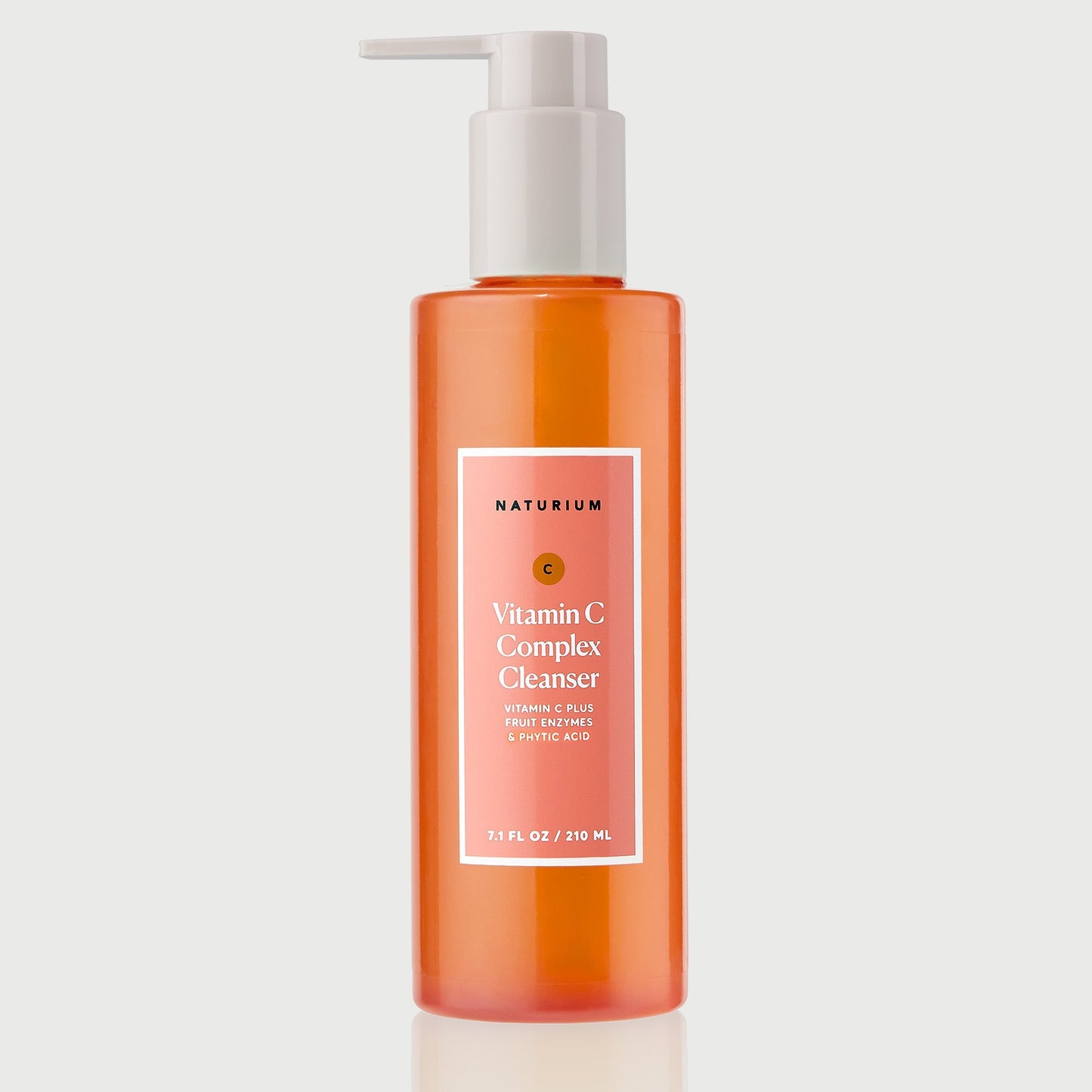

Naturium
Vitamin C Complex Cleanser

Vitamin C Complex Cleanser
Naturium
vitamin-c-complex-cleanser
Cleanse
9818323288357
Morning or Evening?
How often will you use this product?
Notes


Highlights
WHAT IS IT?
Gel cleanser with dual Vitamin C forms
FEATURES
Gently exfoliates, brightens skin, dissolves makeup, cleanses impurities
BEST FOR
combination
CHECKS
Free of alcohol, paraben, sulfate, silicon, fragrance
Who Is It For?
All Ages And GendersWhat Does It Help With?
Brightening Cleansing ExfoliationBudget
Affordable (under $30)How To Use
Which routine should it be used in?
Instructions:
Key Information


What Naturium Says
Product Description:
Our vitamin C complex cleanser is formulated with two forms of Vitamin C, phytic acid and fruit enzymes, including papain and bromelain, that gently exfoliate to instantly brighten skin. This gel cleanser also works to dissolve makeup, oil, dirt, and impurities leaving skin clean, soft and refreshed.
About the Brand:
Ingredients Overview
Ingredients List
Aqua/Water/Eau, Sodium Cocoyl Glutamate, Glycerin, Citric Acid, Disodium Cocoamphodiacetate, Decyl Glucoside, Xanthan Gum, Glucose, Phytic Acid, Bromelain, Papain, Aloe Barbadensis Leaf Juice, Sodium Glycolate, Citrus Aurantium Dulcis (Orange) Fruit Water, Ananas Sativus (Pineapple) Fruit Extract, Carica Papaya (Papaya) Fruit Extract, Mangifera Indica (Mango) Fruit Extract, Ascorbic Acid, Ethyl Ascorbic Acid, Lecithin, Tocopherol, Haematococcus Pluvialis Extract, Sucrose Stearate, Sodium Hyaluronate, Helianthus Annuus (Sunflower) Seed Oil, Polyglyceryl-10 Laurate, Caprylic/Capric Triglyceride, Sodium Chloride, Ethylhexylglycerin, Sodium Benzoate, Potassium Sorbate, Phenoxyethanol
Key Ingredients
Vitamin C, phytic acid, papain, bromelain
Ingredients Details
Bromelain
Common Name(s): Pineapple protease,stem bromelain,ananas comosus enzyme
CAS Number: 9001-00-7
DESCRIPTION
What It Does: Provides gentle enzymatic exfoliation with anti-inflammatory and anti-edema activity beyond simple keratolysis.
Why It's Used: Multi-function enzyme providing exfoliation + anti-inflammatory activity – ideal for post-procedure formulations requiring both resurfacing and calming.
How It Works: Cysteine protease digests keratin for exfoliation (similar to papain). additionally inhibits nf-kb, reduces prostaglandin e2, and breaks down fibrin (anti-edema). anti-inflammatory activity is retained at sub-exfoliating concentrations for standalone soothing use.
Typically Found In: Enzyme peels,post-procedure products,anti-inflammatory serums,brightening masks
TECHNICAL DETAILS
Primary Category: Active ingredient – enzyme
Secondary Functions: Dual exfoliation+anti-inflammatory,fibrin dissolution
Application Areas:

Facial Skincare

Body Care
Hair Care
Beard Care
Color Cosmetics (Makeup)
Dietary/Oral Supplements
Typical Concentration Range: 1%–10%
SOURCING & ETHICS
Vegan Status: Conditional - supplier confirmation required
Halal Status: Unverified - supplier confirmation required
Source Notes: Plant-derived (papaya, pineapple) or fermentation-derived. [audit 2026-07-29 rev2: status downgraded on audit. determination requires shariah-panel sign-off.]
SKIN COMPATIBILITY
Irritancy Rating: 2/5 – low to moderate
Comedogenicity Rating: 0/5 – non-comedogenic
Sensitivity Concerns: Patch test recommended; potential for enzymatic sensitization.
Safe for Sensitive Skin: Use with caution – potential sensitization
SAFETY & COMPATIBILITY
Safety Profile: Safe at cosmetic concentrations. patch test recommended. ewg score: 1–2.
Works Well With: Ahas (synergistic),hyaluronic acid,ceramides
Avoid Combining With: High concentrations on sensitive or compromised skin
SCIENTIFIC NOTE
Bromelain's fibrinolytic activity (dissolving fibrin that accumulates at wound and inflammation sites) is a unique enzyme property not shared by papain. this fibrin dissolution reduces the persistent edema that characterizes chronic post-inflammatory states, making bromelain uniquely valuable in post-procedure inflammation management.
Last Verified: 2026-03-12
Primary Sources: Cosing database,akhtar et al. bromelain anti-inflammatory review
Papain
Common Name(s): Carica papaya enzyme,papaya protease
CAS Number: 9001-73-4
DESCRIPTION
What It Does: Gently digests dead keratin proteins for enzymatic exfoliation without acid irritation.
Why It's Used: Gentle enzymatic exfoliant for acid-sensitive skin types requiring exfoliation without ph-dependent aha/bha irritation.
How It Works: Cysteine protease specifically cleaves peptide bonds in keratin proteins at neutral ph, dissolving corneocyte protein bridges without requiring acidic ph. activity is ph- and temperature-dependent (optimal ph 6.5, 37°c). also gently solubilizes sebum plugs.
Typically Found In: Enzyme peels,gentle exfoliants,sensitive skin exfoliants,brightening masks
TECHNICAL DETAILS
Primary Category: Active ingredient – enzyme
Secondary Functions: Protein-specific exfoliation,neutral-ph keratolysis
Application Areas:
Facial Skincare
Body Care
Hair Care
Beard Care
Color Cosmetics (Makeup)
Dietary/Oral Supplements
Typical Concentration Range: 1%–10% (active enzyme)
SOURCING & ETHICS
Vegan Status: Yes – from carica papaya latex
Halal Status: Yes
Source Notes: Plant-derived (papaya, pineapple) or fermentation-derived.
SKIN COMPATIBILITY
Irritancy Rating: 2/5 – low to moderate; potential sensitization with repeated exposure
Comedogenicity Rating: 0/5 – non-comedogenic
Sensitivity Concerns: Patch test recommended; potential for enzymatic sensitization.
Safe for Sensitive Skin: Use with caution – potential sensitization
SAFETY & COMPATIBILITY
Safety Profile: Latex allergy cross-reactivity possible. avoid high concentrations on compromised skin.
Works Well With: Ahas (synergistic),hyaluronic acid,ceramides
Avoid Combining With: High concentrations on sensitive or compromised skin
SCIENTIFIC NOTE
Papain's specificity for peptide bonds at hydrophobic residues (leu, phe, val) in keratin provides preferential digestion of the abundant hydrophobic corneocyte proteins, causing selective dissolution of corneocyte protein bridges without disrupting the non-protein lipid matrix of the stratum corneum.
Last Verified: 2026-03-12
Primary Sources: Cosing database,cir safety assessment,enzyme exfoliant review literature
Phytic Acid
Common Name(s): Inositol hexaphosphate,ip6,phytate
CAS Number: 83-86-3
DESCRIPTION
What It Does: Provides multi-function brightening through copper chelation, antioxidant, and gentle exfoliant activity.
Why It's Used: Multi-function brightener — phytic acid's six phosphate groups provide copper chelation for tyrosinase inhibition alongside direct antioxidant and gentle aha-like exfoliation in a natural grain-derived compound.
How It Works: Six phosphate groups provide multiple copper-chelating sites for tyrosinase active site copper removal. also chelates iron for antioxidant (fenton reaction inhibition). mild acidic ph provides gentle aha-like exfoliation. found naturally in rice bran, legumes.
Typically Found In: Natural brightening products,multi-function serums,rice-derived formulas
TECHNICAL DETAILS
Primary Category: Active ingredient – ip6 brightening chelator
Secondary Functions: Melanin inhibition,hyperpigmentation reduction
Application Areas:
Facial Skincare
Body Care
Hair Care
Beard Care
Color Cosmetics (Makeup)
Dietary/Oral Supplements
Typical Concentration Range: 0.1%–5%
SOURCING & ETHICS
Vegan Status: Yes – from rice bran, wheat, legumes
Halal Status: Yes
Source Notes: Synthetic or plant-derived.
SKIN COMPATIBILITY
Irritancy Rating: 1/5 – very low
Comedogenicity Rating: 0/5 – non-comedogenic
Sensitivity Concerns: Non-irritating; well-tolerated.
Safe for Sensitive Skin: Yes
SAFETY & COMPATIBILITY
Safety Profile: Excellent safety profile. use with spf for maximum efficacy. ewg score: 1.
Works Well With: Niacinamide,vitamin c,alpha-arbutin,tranexamic acid,spf
Avoid Combining With: No significant incompatibilities
SCIENTIFIC NOTE
Phytic acid's hexaphosphate structure gives it six chelating sites for metal ions — iron and copper are the primary targets. by chelating both copper (tyrosinase cofactor) and iron (fenton reaction catalyst), phytic acid simultaneously inhibits melanin synthesis and prevents oxidative damage — a dual brightening + antioxidant mechanism from a single plant-derived molecule.
Last Verified: 2026-03-12
Primary Sources: Cosing database,graf phytic acid review
Vitamin C
Common Name(s): Vitamin c,cosmetic active,established function
CAS Number: N/a
DESCRIPTION
What It Does: Delivers characteristic cosmetic function — skin conditioning, antioxidant protection, active biological benefit, or formulation function — at recommended use concentration.
Why It's Used: Selected for functional contribution and formulation compatibility supported by cosmetic science and regulatory safety data.
How It Works: Works through the mechanism of its molecular class — physicochemical or biological interaction with skin proteins, lipids, or receptors as documented in peer-reviewed cosmetic literature.
Typically Found In: Skin care formulations
TECHNICAL DETAILS
Primary Category: Active ingredient – cosmetic active
Secondary Functions: Skin conditioning
Application Areas:
Facial Skincare
Body Care
Hair Care
Beard Care
Color Cosmetics (Makeup)
Dietary/Oral Supplements
Typical Concentration Range: 0.1%–10%
SOURCING & ETHICS
Vegan Status: Conditional - supplier confirmation required
Halal Status: Unverified - supplier confirmation required
Source Notes: Commercially produced for cosmetic use. verify vegan/halal status with supplier. [audit 2026-07-29 rev2: the record's own source_notes does not assert a non-animal origin, or instructs the reader to verify with the supplier; "yes" asserts knowledge the record does not hold. determination requires shariah-panel sign-off.]
SKIN COMPATIBILITY
Irritancy Rating: 1/5 – very low
Comedogenicity Rating: 0/5 – non-comedogenic
Sensitivity Concerns: Well-tolerated by most skin types.
Safe for Sensitive Skin: Yes
SAFETY & COMPATIBILITY
Safety Profile: Good safety profile at recommended concentrations. ewg score: 1–2.
Works Well With: Standard skincare actives
Avoid Combining With: No known significant incompatibilities
SCIENTIFIC NOTE
Vitamin c has an established safety and efficacy profile within the cosmetic regulatory framework at standard use concentrations.
Last Verified: 2026-03-12
Primary Sources: Cosing database,vitamin c technical literature