
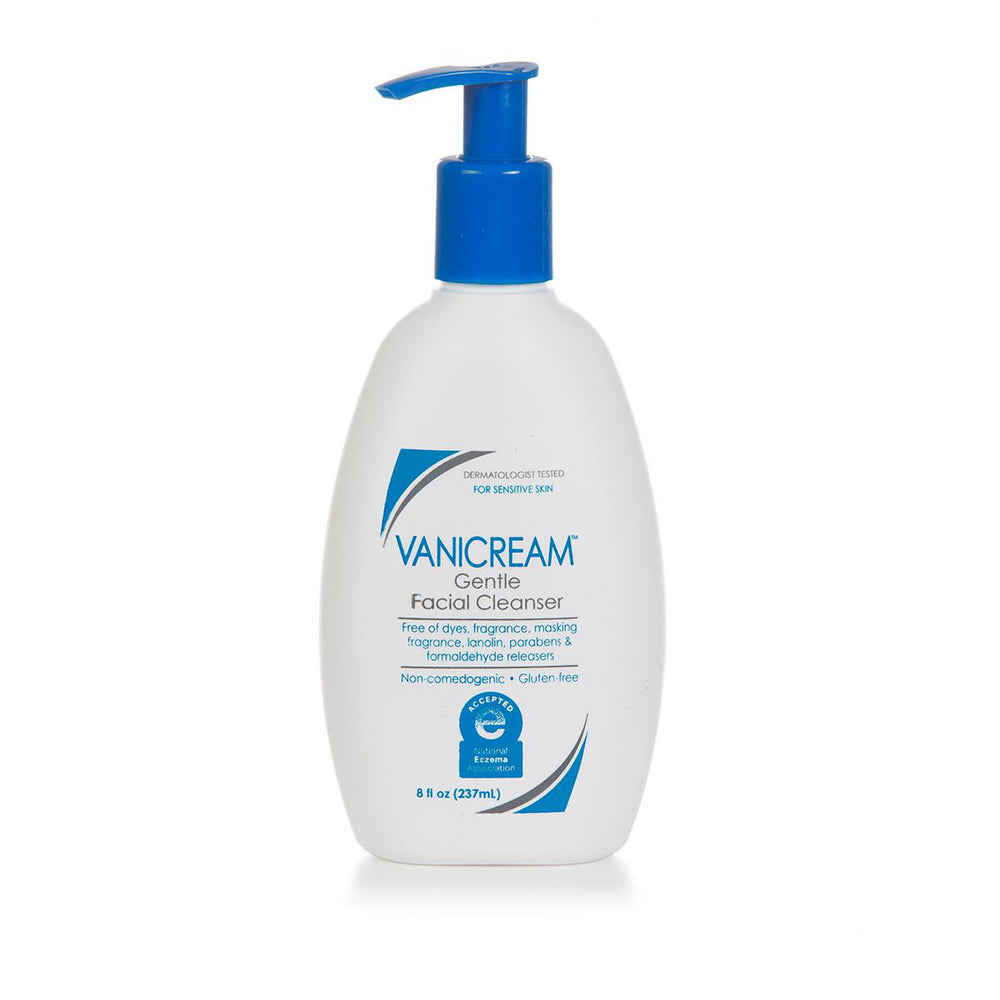

Vanicream
Vanicream Gentle Facial Cleanser

Vanicream Gentle Facial Cleanser
Vanicream
vanicream-gentle-facial-cleanser
Cleanse
9818305069349
Morning or Evening?
How often will you use this product?
Notes


Highlights
WHAT IS IT?
Gentle facial cleanser with 12 ingredients
FEATURES
Soap-free, pH balanced, non-comedogenic, no harsh cleansing agents, no botanical extracts, no essential oils
BEST FOR
sensitive
CHECKS
Free of sulfates, dyes, fragrance, masking fragrance, lanolin, parabens, formaldehyde releasers
Who Is It For?
All Ages With Sensitive SkinWhat Does It Help With?
Removes Makeup And Excess Oils Without Drying Skin Helps Maintain Clean And Soft SkinBudget
Affordable (under $30)How To Use
Which routine should it be used in?
Instructions:
Key Information


What Vanicream Says
Product Description:
A soap-free formula that is gentle to even the most delicate and sensitive skin. Our mildest cleanser specifically formulated for daily facial use. Helps remove makeup and excess skin oils without drying your skin. Leaves skin feeling clean and soft. Ideal for dry skin.
About the Brand:
Ingredients Overview
Ingredients List
water, glycerin, coco-glucoside, sodium-cocoyl-glycinate, acrylates-copolymer, caprylyl-glycol, mica, sodium-chloride, 1-2-hexanediol, titanium-dioxide, sodium-hydroxide, disodium-EDTA
Key Ingredients
glycerin, coco-glucoside, sodium-cocoyl-glycinate
Ingredients Details
1-2-hexanediol
Common Name(s): 1-2-hexanediol,cosmetic active,functional ingredient
CAS Number: N/a
DESCRIPTION
What It Does: Delivers characteristic cosmetic function at recommended use concentration.
Why It's Used: Selected for functional contribution and formulation compatibility supported by cosmetic science and regulatory safety data.
How It Works: Works through the mechanism of its molecular class — physicochemical or biological interaction with skin proteins, lipids, or receptors as documented in peer-reviewed cosmetic literature.
Typically Found In: Skin care formulations
TECHNICAL DETAILS
Primary Category: Active ingredient – cosmetic active
Secondary Functions: Skin conditioning
Application Areas:

Facial Skincare

Body Care
Hair Care
Beard Care
Color Cosmetics (Makeup)
Dietary/Oral Supplements
Typical Concentration Range: 0.1%–10%
SOURCING & ETHICS
Vegan Status: Conditional
Halal Status: Yes
Source Notes: Commercially produced for cosmetic use. verify vegan/halal status with supplier.
SKIN COMPATIBILITY
Irritancy Rating: 1/5 – very low
Comedogenicity Rating: 0/5 – non-comedogenic
Sensitivity Concerns: Well-tolerated by most skin types.
Safe for Sensitive Skin: Yes
SAFETY & COMPATIBILITY
Safety Profile: Good safety profile at recommended concentrations. ewg score: 1–2.
Works Well With: Standard skincare actives
Avoid Combining With: No known significant incompatibilities
SCIENTIFIC NOTE
1-2-hexanediol has an established safety and efficacy profile within the cosmetic regulatory framework at standard use concentrations.
Last Verified: Cosing database,1-2-hexanediol technical literature
Primary Sources: 2026-03-12
Acrylates Copolymer
Common Name(s): Acrylic copolymer,carbopol ez,flexible film former
CAS Number: 25133-97-5
DESCRIPTION
What It Does: Provides versatile acrylic film formation and thickening across broad ph range.
Why It's Used: Versatile workhorse polymer for film formation and thickening across diverse cosmetic product types from acidic aha serums to alkaline cleansers.
How It Works: Copolymer of acrylic acid and methacrylic acid esters. thickens via polymer chain entanglement and electrostatic repulsion. film formation from chain entanglement on water evaporation. broad ph stability from balanced acid/neutral monomer composition.
Typically Found In: Serums,lotions,sunscreens — versatile across formulation types
TECHNICAL DETAILS
Primary Category: Functional ingredient – acrylic film former
Secondary Functions: Skin conditioning
Application Areas:
Facial Skincare
Body Care
Hair Care
Beard Care
Color Cosmetics (Makeup)
Dietary/Oral Supplements
Typical Concentration Range: 0.1%–3%
SOURCING & ETHICS
Vegan Status: Yes – synthetic
Halal Status: Yes
Source Notes: Commercially produced for cosmetic use. verify vegan/halal status with supplier.
SKIN COMPATIBILITY
Irritancy Rating: 1/5 – very low
Comedogenicity Rating: 0/5 – non-comedogenic
Sensitivity Concerns: Well-tolerated by most skin types.
Safe for Sensitive Skin: Yes
SAFETY & COMPATIBILITY
Safety Profile: Good safety profile at recommended concentrations. ewg score: 1–2.
Works Well With: Standard skincare actives
Avoid Combining With: No known significant incompatibilities
SCIENTIFIC NOTE
Acrylates copolymers' broad ph thickening stability (vs carbomer's ph-sensitive thickening, requiring neutralisation for viscosity) enables thickening of acidic aha serums (ph 3-4) without neutralisation — maintaining the low ph required for aha efficacy while providing viscosity control. this acid-stable thickening is impossible with conventional carbomers.
Last Verified: Cosing database,cir safety assessment
Primary Sources: 2026-03-12
Caprylyl Glycol
Common Name(s): 1,2-octanediol,octanediol,sensiva sc 50
CAS Number: 1117-86-8
DESCRIPTION
What It Does: Provides the most potent antimicrobial diol activity alongside skin feel enhancement.
Why It's Used: Premium antimicrobial diol — caprylyl glycol's c8 chain provides the strongest membrane-disrupting antimicrobial activity of common diol preservative boosters with unique skin-feel enhancement.
How It Works: C8 1,2-diol: c8 chain length provides strongest bacterial and fungal membrane disruption of common diols. emollient skin feel improvement from c8 chain length interaction with skin surface. active at lower concentrations than shorter-chain diols. synergistic with ethylhexylglycerin.
Typically Found In: Natural preservation systems,skin feel enhancement
TECHNICAL DETAILS
Primary Category: Functional ingredient – antimicrobial humectant
Secondary Functions: Skin conditioning
Application Areas:
Facial Skincare
Body Care
Hair Care
Beard Care
Color Cosmetics (Makeup)
Dietary/Oral Supplements
Typical Concentration Range: 0.1%–1%
SOURCING & ETHICS
Vegan Status: Yes – synthetic
Halal Status: Yes
Source Notes: Commercially produced for cosmetic use. verify vegan/halal status with supplier.
SKIN COMPATIBILITY
Irritancy Rating: 1/5 – very low
Comedogenicity Rating: 0/5 – non-comedogenic
Sensitivity Concerns: Well-tolerated by most skin types.
Safe for Sensitive Skin: Yes
SAFETY & COMPATIBILITY
Safety Profile: Good safety profile at recommended concentrations. ewg score: 1–2.
Works Well With: Standard skincare actives
Avoid Combining With: No known significant incompatibilities
SCIENTIFIC NOTE
Caprylyl glycol's antimicrobial potency follows the chain-length dependent membrane activity of fatty acids: c8 is the optimal chain length for membrane disruption (same as caprylic acid's antimicrobial optimum), providing maximum membrane integration without the skin sensitisation associated with longer chain lengths. this chain-length pharmacophore relationship is why c8 > c6 > c5 in diol antimicrobial potency despite identical head group chemistry.
Last Verified: Cosing database,schülke sensiva sc 50 technical data,cir safety assessment
Primary Sources: 2026-03-12
Coco-glucoside
Common Name(s): Coconut glucoside,apg c8-c16
CAS Number: 68515-73-1
DESCRIPTION
What It Does: Provides gentle, natural-origin cleansing with good foam from mixed coconut chain alkyl glucosides.
Why It's Used: Widely used natural surfactant for green beauty formulations requiring good foam performance with natural-origin and mild credentials.
How It Works: Mixed c8-c16 fatty alcohol chain lengths from coconut provide broader foam stability than single-chain glucosides. non-ionic glucoside headgroup provides mildness. better detergency and rinsing than individual chain-length apgs due to mixed chain distribution.
Typically Found In: Natural shampoos,body washes,facial cleansers
TECHNICAL DETAILS
Primary Category: Functional ingredient – coconut alkyl glucoside
Secondary Functions: Skin conditioning
Application Areas:
Facial Skincare
Body Care
Hair Care
Beard Care
Color Cosmetics (Makeup)
Dietary/Oral Supplements
Typical Concentration Range: 2%–20%
SOURCING & ETHICS
Vegan Status: Yes – from coconut fatty alcohols and glucose
Halal Status: Yes
Source Notes: Commercially produced for cosmetic use. verify vegan/halal status with supplier.
SKIN COMPATIBILITY
Irritancy Rating: 1/5 – very low
Comedogenicity Rating: 0/5 – non-comedogenic
Sensitivity Concerns: Well-tolerated by most skin types.
Safe for Sensitive Skin: Yes
SAFETY & COMPATIBILITY
Safety Profile: Good safety profile at recommended concentrations. ewg score: 1–2.
Works Well With: Standard skincare actives
Avoid Combining With: No known significant incompatibilities
SCIENTIFIC NOTE
Coco-glucoside's natural chain length distribution (c8-c16) provides synergistic surfactant effects where different chain lengths optimize different properties: shorter chains provide initial foam burst, longer chains provide foam stability and soil removal, creating better overall performance than any single chain length alone.
Last Verified: Cosing database,cir safety assessment
Primary Sources: 2026-03-12
