

Uriage
Uriage Face Cleanser Make-Up Remover Ultra-Soft Airy Foam Rinse-Off Cleanser Dermatologically Tested

Uriage Face Cleanser Make-Up Remover Ultra-Soft Airy Foam Rinse-Off Cleanser Dermatologically Tested
Uriage
uriage-face-cleanser-make-up-remover-ultra-soft-airy-foam-rinse-off-cleanser-dermatologically-tested
Cleanse
10085024432421
Morning or Evening?
How often will you use this product?
Notes


Highlights
WHAT IS IT?
Face cleanser and make-up remover foam, 13 ingredients
FEATURES
Removes makeup, cleanses and purifies skin, moisturizes and soothes skin, contains Uriage Thermal Water and organic Edelweiss extract, 98% natural origin ingredients, biodegradable formula, eco-friendly packaging
BEST FOR
sensitive
CHECKS
No parabens, no silicones, no sulfates mentioned
Who Is It For?
Age 18-69 All GendersWhat Does It Help With?
Makeup Removal Cleansing Impurities Moisturizing Soothing Purifying SkinBudget
Mid-range ($30-$75)How To Use
Which routine should it be used in?
Instructions:
Key Information


What Uriage Says
Product Description:
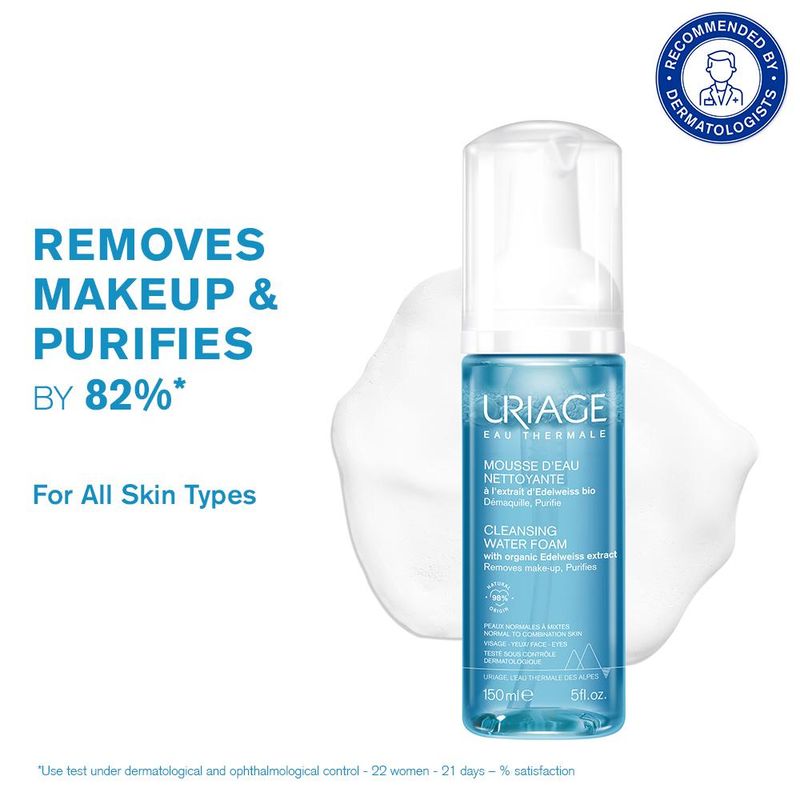
Uriage Cleansing Water Foam has an airy and creamy texture that gently cleanses and removes makeup from the face and eyes. The skin is clear, soft, and smooth, and the complexion is more radiant. This product is ideal for perfecting make-up removal or double cleansing. The formula of this make-up remover foam contains 98% ingredients of natural origin and is biodegradable. Features include removal of makeup, cleansing and purifying with an ultra-gentle cleansing base, moisturizing and soothing enriched with Uriage Thermal Water and organic Edelweiss extract, providing a fresh feeling while soothing and moisturizing skin. Eco-friendly commitment with 98% ingredients of natural origin, 100% natural complex sourced in the Alps, biodegradable formula, use without cotton pads, and a new bottle made from 25% recycled and 100% recyclable plastic. Results show 82% satisfaction in makeup removal, 95% satisfaction in skin purification, and 91% satisfaction in smooth, soft skin. Tested on 22 women aged 18 to 69 with sensitive skin and makeup users. It has a fruity, floral fragrance with tangy notes, creamy and airy foam, perfect for double cleansing, and is tested under dermatological and ophthalmological control.
About the Brand:
Ingredients Overview
Ingredients List
aqua-water-eau,decyl-glucoside,butylene-glycol,sodium-cocoyl-glutamate,glycerin,sodium-methyl-cocoyl-taurate,parfum-fragrance,peg-40-hydrogenated-castor-oil,phenoxyethanol,coco-glucoside,glyceryl-oleate,benzoic-acid,citric-acid,polyquaternium-10,sodium-acetate,sodium-chloride,punica-granatum-fruit-extract
Key Ingredients
Uriage Thermal Water, organic Edelweiss extract
Ingredients Details
Coco-glucoside
Common Name(s): Coconut glucoside,apg c8-c16
CAS Number: 68515-73-1
DESCRIPTION
What It Does: Provides gentle, natural-origin cleansing with good foam from mixed coconut chain alkyl glucosides.
Why It's Used: Widely used natural surfactant for green beauty formulations requiring good foam performance with natural-origin and mild credentials.
How It Works: Mixed c8-c16 fatty alcohol chain lengths from coconut provide broader foam stability than single-chain glucosides. non-ionic glucoside headgroup provides mildness. better detergency and rinsing than individual chain-length apgs due to mixed chain distribution.
Typically Found In: Natural shampoos,body washes,facial cleansers
TECHNICAL DETAILS
Primary Category: Functional ingredient – coconut alkyl glucoside
Secondary Functions: Skin conditioning
Application Areas:

Facial Skincare
Body Care
Hair Care

Beard Care
Color Cosmetics (Makeup)
Dietary/Oral Supplements
Typical Concentration Range: 2%–20%
SOURCING & ETHICS
Vegan Status: Conditional - supplier confirmation required
Halal Status: Unverified - supplier confirmation required
Source Notes: Commercially produced for cosmetic use. verify vegan/halal status with supplier. [audit 2026-07-29 rev2: the record's own source_notes does not assert a non-animal origin, or instructs the reader to verify with the supplier; "yes" asserts knowledge the record does not hold. determination requires shariah-panel sign-off.]
SKIN COMPATIBILITY
Irritancy Rating: 1/5 – very low
Comedogenicity Rating: 0/5 – non-comedogenic
Sensitivity Concerns: Well-tolerated by most skin types.
Safe for Sensitive Skin: Yes
SAFETY & COMPATIBILITY
Safety Profile: Good safety profile at recommended concentrations. ewg score: 1–2.
Works Well With: Standard skincare actives
Avoid Combining With: No known significant incompatibilities
SCIENTIFIC NOTE
Coco-glucoside's natural chain length distribution (c8-c16) provides synergistic surfactant effects where different chain lengths optimize different properties: shorter chains provide initial foam burst, longer chains provide foam stability and soil removal, creating better overall performance than any single chain length alone.
Last Verified: 2026-03-12
Primary Sources: Cosing database,cir safety assessment
Glycerin
Common Name(s): Glycerol,glycerine,1,2,3-propanetriol
CAS Number: 56-81-5
DESCRIPTION
What It Does: Glycerin pulls water from the environment and deeper skin layers into the outer skin layer (epidermis), boosting moisture levels and keeping skin soft, smooth, and plump.
Why It's Used: It is used in virtually every moisturizer, serum, and cleanser because it is highly effective at hydrating skin, is well-tolerated by all skin types, and enhances the texture and spreadability of formulations.
How It Works: As a humectant, glycerin forms hydrogen bonds with water molecules, trapping them in the skin. it also reinforces the skin barrier by integrating into lipid structures between skin cells.
Typically Found In: Moisturizers,serums,cleansers,toners,sheet masks,sunscreens,body lotions,shampoos,conditioners
TECHNICAL DETAILS
Primary Category: Humectant
Secondary Functions: Skin barrier support,emollient,solvent
Application Areas:
Facial Skincare
Body Care
Hair Care
Beard Care
Color Cosmetics (Makeup)
Dietary/Oral Supplements
Typical Concentration Range: 1%–30% (typical: 3–10%)
SOURCING & ETHICS
Vegan Status: Conditional - feedstock declaration required
Halal Status: Unverified - feedstock declaration required (plant, animal and petrochemical routes all exist)
Source Notes: Derived from plant oils via hydrolysis or saponification; synthetic versions also available. palm-derived glycerin carries sustainability concerns. [audit 2026-07-29 rev2: origin-dependent: the same inci exists in plant, animal and petrochemical versions and the name does not discriminate. determination requires shariah-panel sign-off.]
SKIN COMPATIBILITY
Irritancy Rating: 1/5 – very low; non-irritating at all standard concentrations
Comedogenicity Rating: 0/5 – non-comedogenic
Sensitivity Concerns: Extremely rare allergic reactions; generally safe for all skin types including sensitive and baby skin
Safe for Sensitive Skin: Yes
SAFETY & COMPATIBILITY
Safety Profile: Widely recognized as safe. ewg hazard score: 1. no significant concerns for irritation, sensitization, or toxicity at typical concentrations (up to 50%).
Works Well With: Hyaluronic acid,ceramides,niacinamide,panthenol,urea,peptides,retinol,ahas/bhas
Avoid Combining With: No known incompatibilities at standard concentrations
SCIENTIFIC NOTE
Glycerin is an endogenous skin component found naturally in the stratum corneum. aquaporin-3 channels in keratinocytes facilitate glycerin transport, making it integral to natural skin hydration pathways.
Last Verified: 2026-03-12
Primary Sources: Cosing database,cir safety assessment,ewg skin deep,inci decoder
Phenoxyethanol
Common Name(s): 2-phenoxyethanol,rose ether,ethylene glycol monophenyl ether
CAS Number: 122-99-6
DESCRIPTION
What It Does: Prevents microbial contamination and spoilage in cosmetic formulations.
Why It's Used: The benchmark cosmetic preservative – eu-permitted up to 1%, effective against virtually all cosmetically relevant microorganisms, and excellent tolerability.
How It Works: Phenol ring provides broad antimicrobial activity via disruption of bacterial and fungal cell membranes and inhibition of enzymatic activity. effective against gram-positive and gram-negative bacteria, yeasts (candida), and molds (aspergillus). activity ph range: 3-9.
Typically Found In: All cosmetic formulations as primary preservative
TECHNICAL DETAILS
Primary Category: Functional ingredient – broad-spectrum preservative
Secondary Functions: Skin conditioning
Application Areas:
Facial Skincare
Body Care
Hair Care
Beard Care
Color Cosmetics (Makeup)
Dietary/Oral Supplements
Typical Concentration Range: 0.1%–1% (eu max 1%)
SOURCING & ETHICS
Vegan Status: Conditional - supplier confirmation required
Halal Status: Unverified - supplier confirmation required
Source Notes: Commercially produced for cosmetic use. verify vegan/halal status with supplier. [audit 2026-07-29 rev2: the record's own source_notes does not assert a non-animal origin, or instructs the reader to verify with the supplier; "yes" asserts knowledge the record does not hold. determination requires shariah-panel sign-off.]
SKIN COMPATIBILITY
Irritancy Rating: 1/5 – very low
Comedogenicity Rating: 0/5 – non-comedogenic
Sensitivity Concerns: Well-tolerated by most skin types.
Safe for Sensitive Skin: Yes
SAFETY & COMPATIBILITY
Safety Profile: Eu cosmetics regulation max 1%. sccs assessed as safe at ≤1%. avoid use around eyes in baby products per some country regulations. ewg score: 4.
Works Well With: Standard skincare actives
Avoid Combining With: No known significant incompatibilities
SCIENTIFIC NOTE
Phenoxyethanol's widespread adoption as the primary cosmetic preservative followed the phaseout of parabens from many formulations in the 2000s-2010s. despite having a comparable or better safety profile to parabens, it is often cited in 'free-from' formulations – a consumer perception issue rather than a scientific safety concern.
Last Verified:
Polyquaternium-10
Common Name(s): Pq-10,hydroxyethylcellulose ethyl trimethylammonium chloride,jr-400
CAS Number: 54351-50-7
DESCRIPTION
What It Does: Provides film-forming conditioning and detangling with heat protection in a polymer that adsorbs substantively to hair.
Why It's Used: The most widely used cationic polymer conditioner – provides excellent conditioning and detangling while adsorbing strongly to damaged hair areas that need conditioning most.
How It Works: Cationic quaternary ammonium groups along the polymer backbone adsorb to anionic sites on hair keratin. higher charge density on damaged hair (more negative sites) leads to preferential adsorption where conditioning is needed. polymer film formation provides heat protection and volume.
Typically Found In: Shampoos,2-in-1 products,conditioners,styling products
TECHNICAL DETAILS
Primary Category: Functional ingredient – cationic polymer conditioner
Secondary Functions: Skin conditioning
Application Areas:
Facial Skincare
Body Care
Hair Care
Beard Care
Color Cosmetics (Makeup)
Dietary/Oral Supplements
Typical Concentration Range: 0.1%–2%
SOURCING & ETHICS
Vegan Status: Conditional - supplier confirmation required
Halal Status: Unverified - supplier confirmation required
Source Notes: Commercially produced for cosmetic use. verify vegan/halal status with supplier. [audit 2026-07-29 rev2: the record's own source_notes does not assert a non-animal origin, or instructs the reader to verify with the supplier; "yes" asserts knowledge the record does not hold. determination requires shariah-panel sign-off.]
SKIN COMPATIBILITY
Irritancy Rating: 1/5 – very low
Comedogenicity Rating: 0/5 – non-comedogenic
Sensitivity Concerns: Well-tolerated by most skin types.
Safe for Sensitive Skin: Yes
SAFETY & COMPATIBILITY
Safety Profile: Good safety profile at recommended concentrations. ewg score: 1–2.
Works Well With: Standard skincare actives
Avoid Combining With: No known significant incompatibilities
SCIENTIFIC NOTE
Polyquaternium-10's 'self-targeting' to damaged hair sites is a unique smart conditioning mechanism. as hair damage increases negative charge density by exposing keratin's aspartate and glutamate carboxylate groups, pq-10's cationic polymer backbone adsorbs preferentially to these high-charge damage sites – automatically delivering more conditioning where the hair needs it most.
Last Verified: 2026-03-12
Primary Sources: Cosing database,robbins hair science,cir safety assessment