
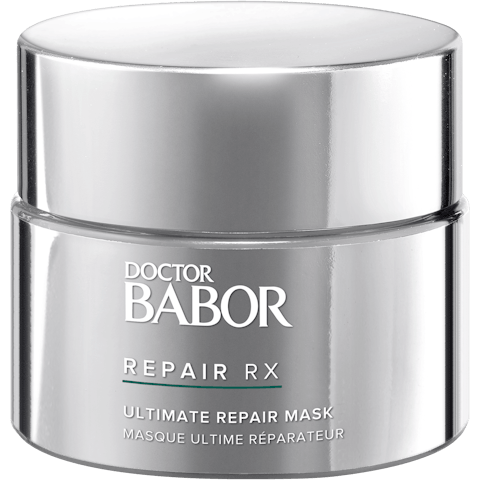

BABOR
Ultimate Repair Mask

Ultimate Repair Mask
BABOR
ultimate-repair-mask
Face Mask
9580165464357
Morning or Evening?
How often will you use this product?
Notes


Highlights
WHAT IS IT?
A face mask with a cream texture containing various ingredients to support skin rejuvenation.
FEATURES
Rich, intensively rejuvenating cream mask to support skin regeneration.
BEST FOR
All Skin Types
CHECKS
Paraben Free, Silicone Free, Sulfate Free
Who Is It For?
Above 18 Not Specified For Women Or Men.What Does It Help With?
Supports Skin's Natural Rejuvenation Process For A More Even Rejuvenated Complexion.Budget
PremiumHow To Use
Which routine should it be used in?
Instructions:
Key Information


What BABOR Says
Product Description:
A rich cream mask to intensively support skin rejuvenation.
About the Brand:
Ingredients Overview
Ingredients List
AQUA, COCOGLYCERIDES, ALCOHOL DENAT., CERA ALBA, CETEARYL ALCOHOL, GLYCERIN, BUTYROSPERMUM PARKII BUTTER, DECYL OLEATE, GLYCINE SOJA OIL, HYDROGENATED VEGETABLE GLYCERIDES, OLEA EUROPAEA FRUIT OIL, POTASSIUM CETYL PHOSPHATE, SORBITOL, DIMETHICONE, PANTHENOL, PHENOXYETHANOL, HYDROGENATED PALM GLYCERIDES, SODIUM ACRYLATE/SODIUM ACRYLOYLDIMETHYL TAURATE COPOLYMER, ROYAL JELLY, POLYISOBUTENE, XANTHAN GUM, ALLANTOIN, ALOE BARBADENSIS LEAF JUICE, URTICA DIOICA EXTRACT, SCROPHULARIA NODOSA EXTRACT, RUMEX ACETOSA LEAF EXTRACT, ROSMARINUS OFFICINALIS LEAF EXTRACT, PANAX GINSENG ROOT EXTRACT, NASTURTIUM OFFICINALE EXTRACT, FUMARIA OFFICINALIS EXTRACT, FUCUS VESICULOSUS EXTRACT, POTASSIUM SORBATE, ETHYLHEXYLGLYCERIN, DISODIUM EDTA, CITRIC ACID, CAPRYLYL/CAPRYL GLUCOSIDE, HELIANTHUS ANNUUS SEED OIL, TOCOPHEROL, PARFUM, PANTOLACTONE, LINALOOL, SODIUM BENZOATE
Key Ingredients
COCOGLYCERIDES, BUTYROSPERMUM PARKII BUTTER, GLYCINE SOJA OIL, OLEA EUROPAEA FRUIT OIL, PANTHENOL, ROYAL JELLY, ALLANTOIN, ALOE BARBADENSIS LEAF JUICE, URTICA DIOICA EXTRACT, ROSMARINUS OFFICINALIS LEAF EXTRACT, PANAX GINSENG ROOT EXTRACT
Ingredients Details
Alcohol Denat.
Common Name(s): Alcohol denat.,denatured ethanol,solvent antimicrobial astringent
CAS Number: N/a
DESCRIPTION
What It Does: Alcohol denat. dissolves oil-soluble and water-soluble cosmetic actives, provides rapid antimicrobial activity at concentrations above 60–70% by denaturing microbial proteins, delivers a refreshing cooling sensation through evaporative cooling on skin, and temporarily enhances the penetration of topical actives by transiently disrupting the stratum corneum lipid bilayer organisation.
Why It's Used: Formulators choose alcohol denat. for its irreplaceable combination of solvent power, antimicrobial activity, and penetration-enhancing properties. no other cosmetic solvent simultaneously provides the cooling sensory experience of alcohol (from evaporative cooling at the skin surface), the immediate antimicrobial activity required for sanitisers (from protein denaturation above 60%), and the transient sc lipid disruption that improves active ingredient delivery (essential in actives-rich toners and essences). for denatured alcohol specifically, denaturing agents (typically 5% isopropanol or bitrex) prevent consumption without affecting cosmetic function.
How It Works: Alcohol denat. works through multiple mechanisms depending on concentration: (1) solvent action — alcohol's hydroxyl group provides hydrogen bonding with water while the short alkyl chain provides interaction with organic solutes, enabling dissolution of both hydrophilic and moderately lipophilic cosmetic actives in a single solvent; (2) antimicrobial — above 60% concentration, ethanol denatures microbial proteins by disrupting non-covalent bonds maintaining protein secondary and tertiary structure — the alcohol molecules intercalate between protein chains, disrupting the hydrophobic interactions and hydrogen bonds that maintain enzyme active site geometry. this non-specific protein denaturation is immediately bactericidal and virucidal with no resistance mechanism possible; (3) sc penetration enhancement — at lower concentrations (5–30%), ethanol transiently fluidises the sc lipid bilayer by intercalating between the ordered lipid lamellae, disrupting the crystal packing and increasing lipid bilayer fluidity. this transient fluidisation increases the diffusion coefficient of co-applied actives through the sc for up to 30 minutes post-application; (4) astringency — alcohol's protein precipitating action at the skin surface contracts superficial proteins, temporarily tightening pores and reducing oiliness.
Typically Found In: Toners,hand sanitisers,actives serums
TECHNICAL DETAILS
Primary Category: Active ingredient – cosmetic active
Secondary Functions: Skin conditioning
Application Areas:

Facial Skincare

Body Care
Hair Care
Beard Care
Color Cosmetics (Makeup)
Dietary/Oral Supplements
Typical Concentration Range: 5%–95%
SOURCING & ETHICS
Vegan Status: Yes
Halal Status: Yes
Source Notes: Commercially produced for cosmetic use. verify vegan/halal status with supplier.
SKIN COMPATIBILITY
Irritancy Rating: 1/5 – very low
Comedogenicity Rating: 0/5 – non-comedogenic
Sensitivity Concerns: Well-tolerated by most skin types.
Safe for Sensitive Skin: Yes
SAFETY & COMPATIBILITY
Safety Profile: Good safety profile at recommended concentrations. ewg score: 1–2.
Works Well With: Standard skincare actives
Avoid Combining With: No known significant incompatibilities
SCIENTIFIC NOTE
Ethanol concentration-dependent antimicrobial efficacy: below 40% — minimal bactericidal effect (insufficient protein denaturation); 40–60% — bacteriostatic, not bactericidal; 60–70% — peak bactericidal efficacy against both enveloped and non-enveloped viruses and vegetative bacteria (optimal water content maintains protein hydration required for denaturation to proceed); 80–90% — remains effective but slightly reduced from decreased water activity; 95–100% — reduced efficacy (insufficient water for protein denaturation). the 70% 'sweet spot' for sanitisers reflects this concentration-efficacy peak, not a formulation convenience.
Last Verified: Cosing database,alcohol denat. ethanol solvent antimicrobial review
Primary Sources: 2026-03-12
Butyrospermum Parkii Butter
Common Name(s): Butyrospermum parkii butter,botanical carrier oil,emollient fatty acid delivery
CAS Number: N/a
DESCRIPTION
What It Does: Softens and conditions skin by integrating into sc lipid bilayers, delivers essential fatty acids (oleic, linoleic, linolenic) for barrier lipid synthesis, and provides rich, non-stripping moisturisation.
Why It's Used: Natural carrier oils provide the closest compositional match to endogenous sc lipids, delivering emolliency through genuine barrier integration rather than simple surface occlusion.
How It Works: Fatty acid triglycerides partition into sc lipid bilayers — oleic acid (c18:1) provides fluid, emollient integration; linoleic acid (c18:2) acts as essential ceramide precursor; saturated fatty acids provide more occlusive barrier reinforcement.
Typically Found In: Moisturisers,facial oils,natural skin care
TECHNICAL DETAILS
Primary Category: Functional ingredient – emollient
Secondary Functions: Barrier sealing,softening
Application Areas:
Facial Skincare
Body Care
Hair Care
Beard Care
Color Cosmetics (Makeup)
Dietary/Oral Supplements
Typical Concentration Range: 1%–100%
SOURCING & ETHICS
Vegan Status: Conditional
Halal Status: Yes
Source Notes: Plant-derived, synthetic or animal-derived. verify source.
SKIN COMPATIBILITY
Irritancy Rating: 1/5 – very low
Comedogenicity Rating: 1/5 – low; formulation-dependent
Sensitivity Concerns: Non-irritating.
Safe for Sensitive Skin: Yes
SAFETY & COMPATIBILITY
Safety Profile: Excellent safety profile. ewg score: 1.
Works Well With: Humectants,ceramides,actives as carrier
Avoid Combining With: No significant incompatibilities
SCIENTIFIC NOTE
Essential fatty acids — linoleic (c18:2, n-6) and α-linolenic (c18:3, n-3) acids — cannot be synthesised by the body; topical delivery through carrier oils provides direct substrate for ceramide and eicosanoid biosynthesis in the epidermis.
Last Verified: Cosing database,butyrospermum parkii butter carrier oil botanical review
Primary Sources: 2026-03-12
Cera Alba
Common Name(s): Cera alba,beeswax,structuring wax occlusive emollient
CAS Number: N/a
DESCRIPTION
What It Does: Structures lip balms and anhydrous formulations through the wax crystal network, provides occlusive barrier protection reducing tewl, and conditions skin with the emollient fatty acids and esters in the wax composition.
Why It's Used: Beeswax as a traditional wax has both structure and emollient function from its complex wax ester (c32-c36) composition.
How It Works: Beeswax forms a crystalline wax network above its melting point (beeswax ~62°c; carnauba ~83°c; candelilla ~68°c). on cooling, wax crystals nucleate and grow forming a three-dimensional network that immobilises liquid oils — providing semi-solid stick structure. wax melting point determines temperature stability range for product use conditions.
Typically Found In: Lip care,anhydrous balms,emulsions
TECHNICAL DETAILS
Primary Category: Functional ingredient – emollient
Secondary Functions: Barrier sealing,softening
Application Areas:
Facial Skincare
Body Care
Hair Care
Beard Care
Color Cosmetics (Makeup)
Dietary/Oral Supplements
Typical Concentration Range: 1%–30%
SOURCING & ETHICS
Vegan Status: Conditional
Halal Status: Conditional
Source Notes: Plant-derived, synthetic or animal-derived. verify source.
SKIN COMPATIBILITY
Irritancy Rating: 1/5 – very low
Comedogenicity Rating: 1/5 – low; formulation-dependent
Sensitivity Concerns: Non-irritating.
Safe for Sensitive Skin: Yes
SAFETY & COMPATIBILITY
Safety Profile: Excellent safety profile. ewg score: 1.
Works Well With: Humectants,ceramides,actives as carrier
Avoid Combining With: No significant incompatibilities
SCIENTIFIC NOTE
Carnauba (highest melting wax at ~83°c) provides the hardest, most heat-stable wax structure; beeswax (~62°c) provides more pliable, skin-compatible structure; candelilla (~68°c) provides the vegan beeswax alternative used in certified natural and vegan formulations.
Last Verified: Cosing database,natural wax structuring emollient review
Primary Sources: 2026-03-12
Cetearyl Alcohol
Common Name(s): Cetostearyl alcohol,c16-18 fatty alcohol
CAS Number: 8005-44-5
DESCRIPTION
What It Does: Provides fatty alcohol emulsification and thickening for stable, well-textured emulsions.
Why It's Used: The most widely used fatty alcohol in cosmetics – provides emulsification, thickening, and emolliency simultaneously from a single ingredient with excellent safety profile.
How It Works: Forms bilayer lamellar structures in water with emulsifiers creating a viscous structured network that thickens and stabilizes emulsions. fatty alcohol emolliency provides direct skin conditioning. bilayer formation reduces inter-droplet coalescence in emulsions.
Typically Found In: Creams,lotions,conditioners – virtually all emulsion products
TECHNICAL DETAILS
Primary Category: Functional ingredient – fatty alcohol emulsifier/thickener
Secondary Functions: Barrier sealing,softening
Application Areas:
Facial Skincare
Body Care
Hair Care
Beard Care
Color Cosmetics (Makeup)
Dietary/Oral Supplements
Typical Concentration Range: 1%–25%
SOURCING & ETHICS
Vegan Status: Yes – from vegetable or coconut/palm fatty acids
Halal Status: Yes
Source Notes: Plant-derived, synthetic or animal-derived. verify source.
SKIN COMPATIBILITY
Irritancy Rating: 1/5 – very low
Comedogenicity Rating: 1/5 – low; formulation-dependent
Sensitivity Concerns: Non-irritating.
Safe for Sensitive Skin: Yes
SAFETY & COMPATIBILITY
Safety Profile: Excellent safety profile. ewg score: 1.
Works Well With: Humectants,ceramides,actives as carrier
Avoid Combining With: No significant incompatibilities
SCIENTIFIC NOTE
Cetearyl alcohol's ability to form lamellar liquid crystal structures ('krafft phases') with water and co-emulsifiers provides not only emulsion stability but also enhanced skin penetration via the lamellar skin barrier pathway. these crystalline structures can act as a reservoir for active ingredients, slowly releasing them as the lamellar structure melts on skin contact.
Last Verified: Cosing database,cir safety assessment
Primary Sources: 2026-03-12
