

Shiseido
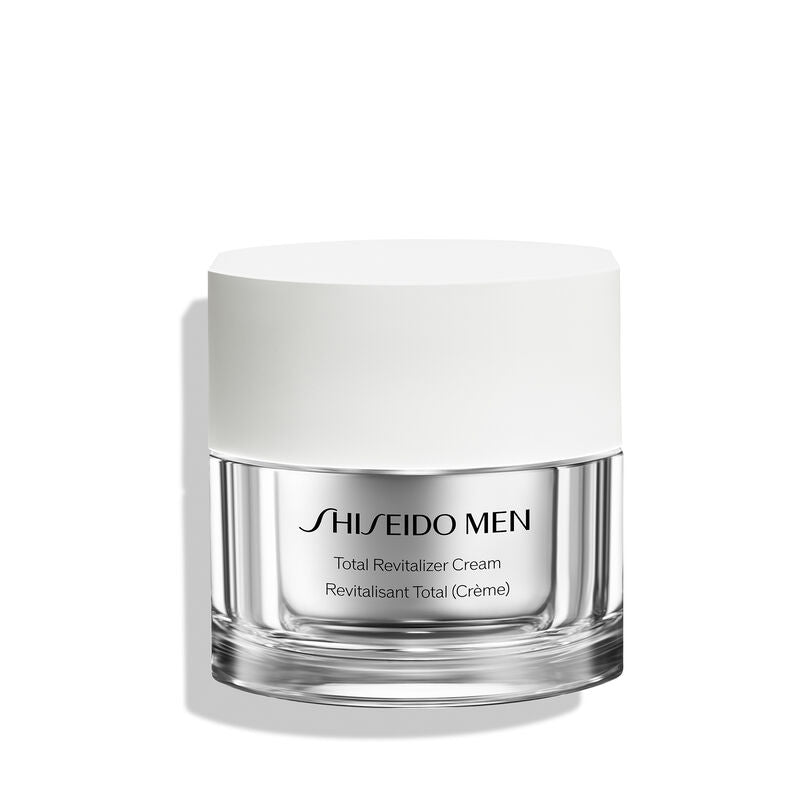
Total Revitalizer Cream

Total Revitalizer Cream
Shiseido
total-revitalizer-cream
Moisturize
9605084479781
Morning or Evening?
How often will you use this product?
Notes


Highlights
WHAT IS IT?
Anti-aging moisturizer
FEATURES
A high-performance anti-aging cream with Rice Bran Technology that helps improve wrinkles, sagging, dullness & loss of firmness. It intensively hydrates for 48 hours & visibly improves roughness in four weeks.
BEST FOR
Normal to dry skin types
CHECKS
Parabens-free, sulfates-free
Who Is It For?
Men Age Not Specified (likely Adult Men)What Does It Help With?
Wrinkles Sagging Dullness Roughness Loss Of FirmnessBudget
PremiumHow To Use
Which routine should it be used in?
Instructions:
Key Information


What Shiseido Says
Product Description:
A high performance anti-aging cream formulated with Rice Bran Technology that helps improve five skin aging concerns for men including wrinkles, sagging, dullness, roughness and loss of firmness.
About the Brand:
Ingredients Overview
Ingredients List
Water(Aqua/Eau), Dimethicone, Glycerin, Alcohol Denat, Dipropylene Glycol, Ammonium Acryloyldimethyltaurate/VP Copolymer, Erythritol, PEG/PPG-14/7 Dimethyl Ether, Phenoxyethanol, Cetyl Ethylhexanoate, Tocopheryl Acetate, Acrylamide/Sodium Acryloyldimethyltaurate Copolymer, Methyl Methacrylate Crosspolymer, Isohexadecane, Polysorbate 60, PEG-20 Glyceryl Isostearate, Aminopropyl Dimethicone, Butylene Glycol, Fragrance (Parfum), Polysorbate 80, Sodium Citrate, Acrylates/C10-30 Alkyl Acrylate Crosspolymer, Dipotassium Glycyrrhizate, Polyquaternium-51, Sorbitan Oleate, Potassium Hydroxide, Silica, Citric Acid, Sodium Metabisulfite, Sodium Metaphosphate, Linalool, Benzyl Benzoate, Limonene, Butylphenyl Methylpropional, Sanguisorba Officinalis Root Extract, Rubus Suavissimus (Raspberry) Leaf Extract, Iron Oxides (Ci 77492), Sodium Carboxymethyl Beta-Glucan, Hydrolyzed Conchiolin Protein
Key Ingredients
Tocopheryl Acetate, Glycerin, Dipotassium Glycyrrhizate
Ingredients Details
Tocopheryl Acetate
Common Name(s): Vitamin e acetate,alpha-tocopherol acetate,dl-alpha-tocopheryl acetate
CAS Number: 7695-91-2
DESCRIPTION
What It Does: Provides stable vitamin e delivery with antioxidant activity after esterase hydrolysis in skin.
Why It's Used: The formulation-stable vitamin e — tocopheryl acetate's ester protection prevents oxidative degradation during shelf life while releasing active tocopherol in skin for equivalent biological activity.
How It Works: Acetate ester blocks the phenolic oh group responsible for oxidation and radical scavenging. skin esterases cleave acetate bond releasing free tocopherol. released tocopherol provides lipid peroxyl radical scavenging in cell membranes. also provides direct emollient and skin conditioning.
Typically Found In: Moisturisers,sunscreens,anti-aging products — extremely widespread
TECHNICAL DETAILS
Primary Category: Active ingredient – stable vitamin e ester
Secondary Functions: Free radical scavenging,anti-aging
Application Areas:

Facial Skincare
Body Care

Hair Care
Beard Care
Color Cosmetics (Makeup)
Dietary/Oral Supplements
Typical Concentration Range: 0.1%–5%
SOURCING & ETHICS
Vegan Status: Conditional – natural from vegetable oils (soy, sunflower); synthetic dl-form
Halal Status: Unverified - supplier confirmation required
Source Notes: Plant-derived extract or synthetic. [audit 2026-07-29 rev2: status downgraded on audit. determination requires shariah-panel sign-off.]
SKIN COMPATIBILITY
Irritancy Rating: 1/5 – very low
Comedogenicity Rating: 0/5 – non-comedogenic
Sensitivity Concerns: Non-irritating; well-tolerated.
Safe for Sensitive Skin: Yes
SAFETY & COMPATIBILITY
Safety Profile: The d-alpha-tocopheryl acetate (natural isomer) is biologically superior to dl-alpha-tocopheryl acetate (racemic synthetic) for skin antioxidant activity. ingredient label d- vs dl- prefix identifies natural vs synthetic origin.
Works Well With: Vitamin c,vitamin e,ferulic acid,spf,other antioxidants
Avoid Combining With: No significant incompatibilities
SCIENTIFIC NOTE
Tocopheryl acetate's conversion to active tocopherol in skin is quantitatively efficient: skin esterase activity is sufficient to cleave 60-80% of applied tocopheryl acetate within 24 hours of application. however, the conversion rate varies with skin condition (eczematous or barrier-compromised skin has reduced esterase activity), meaning tocopheryl acetate efficacy may be reduced precisely in the skin conditions that most need antioxidant support.
Last Verified:
Water(aqua/eau)
Common Name(s): Water(aqua/eau) extract
DESCRIPTION
What It Does: Provides antioxidant protection, soothing anti-inflammatory effects, and skin-conditioning benefits through plant-derived polyphenols and phytochemicals.
Why It's Used: Plant extracts concentrate bioactive phytochemicals evolved for environmental protection — uv, microbial, and oxidative stressors — that translate to skin benefits.
How It Works: Polyphenols (flavonoids, phenolic acids) inhibit nf-κb-mediated inflammatory signaling, scavenge reactive oxygen species through electron donation, and chelate pro-oxidant metal ions to reduce oxidative skin damage.
Typically Found In: Serums,toners,moisturizers,masks,essences
TECHNICAL DETAILS
Primary Category: Botanical extracts
Secondary Functions: Antioxidant,anti-inflammatory
Application Areas:
Facial Skincare
Body Care
Hair Care
Beard Care
Color Cosmetics (Makeup)
Dietary/Oral Supplements
Typical Concentration Range: 0.1–10%
SOURCING & ETHICS
Vegan Status: Yes
Halal Status: Yes
Source Notes: Plant-derived extract; no animal components.
SKIN COMPATIBILITY
Irritancy Rating: 1899-12-31 00:00:00 -0800
Sensitivity Concerns: Low sensitization potential at recommended use concentrations.
Safe for Sensitive Skin: Yes
SAFETY & COMPATIBILITY
Safety Profile: Well-characterized cosmetic ingredient with established safety profile. generally non-irritating at typical use concentrations. suitable for leave-on and rinse-off cosmetics.
Works Well With: Niacinamide,hyaluronic acid,vitamin c,ceramides
Avoid Combining With: Strong oxidizing agents
SCIENTIFIC NOTE
Plant secondary metabolites (flavonoids, terpenes, phenolic acids) are biosynthesized as defense compounds against uv, herbivores, and pathogens. their anti-inflammatory activity typically derives from competitive inhibition of cox-2 and 5-lox enzymes (ic50 1–50 µm), while antioxidant activity involves single electron transfer (set) and hydrogen atom transfer (hat) mechanisms with structure-dependent rate constants.
Last Verified: 2025-01-15
Primary Sources: Cosing eu database; pcpc cosmetic ingredient safety reviews; phytochemical and ethnobotanical literature