
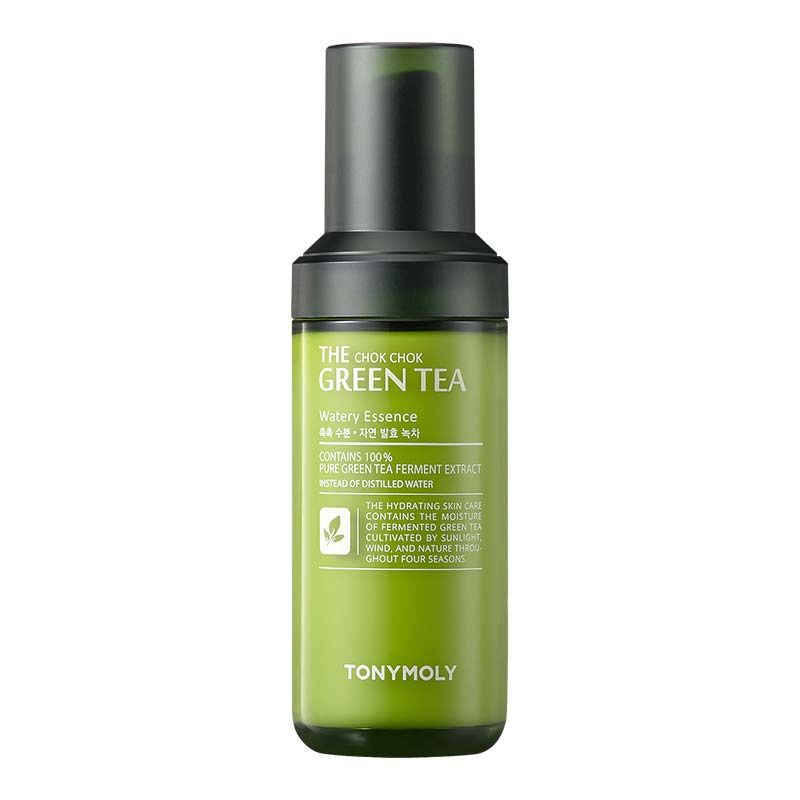

TONYMOLY
TONYMOLY The Chok Chok Green Tea Watery Essence

TONYMOLY The Chok Chok Green Tea Watery Essence
TONYMOLY
tonymoly-the-chok-chok-green-tea-watery-essence
Serum
10084754456869
Morning or Evening?
How often will you use this product?
Notes


Highlights
WHAT IS IT?
Essence with over 80% fermented green tea extract
FEATURES
Contains Pure Fermented Green Tea Extract with high antioxidant and moisturizing benefits, Lemon Seed Oil with antibacterial and antifungal properties, Rosewood Oil for soothing and revitalizing, absorbs quickly, lightweight texture
BEST FOR
sensitive
CHECKS
Alcohol-free, Paraben-Free
Who Is It For?
All Genders No Specific Age Range MentionedWhat Does It Help With?
Hydration Soothing Antioxidant Benefits BrighteningBudget
Mid-range ($30-$75)How To Use
Which routine should it be used in?
Instructions:
Key Information


What TONYMOLY Says
Product Description:
Tony Moly The Chok Chok Green Tea Watery Essence contains the moisture of fermented green tea cultivated by sunlight, wind and nature throughout the four seasons. The highly concentrated moisture essence in formulated with over 80% Green Tea extract and helps quench skins thirst as it delivers moisture deep into the skin. Tony Moly Chok Chok collection features a special fermented Korean green tea called 'ChungTaeJeon' with over a thousand years of history. 'ChungTaeJeon', the world's first naturally fermented green tea, is fermented through sunlight for over 365 days and provides gentle yet intense moisture and hydration that lasts.
About the Brand:
Ingredients Overview
Ingredients List
Camellia-Sinensis-Leaf-Extract,Cyclomethicone,Methylpropanediol,PPG-14-Butyl-Ether,Alcohol,Hydrogenated-Ethylhexyl-Oliviate,Polyglyceryl-3-Methylglucose-Distearate,3-O-Ethyl-Ascorbic-Acid,Citrus-Limon-(Lemon)-Seed-Oil,Aniba-Rosaeodora-(Rosewood)-Wood-Oil,Dimethicone/Vinyl-Dimethicone-Crosspolymer,Hydroxyethyl-Acrylate/Sodium-Acryloyldimethyl-Taurate-Copolymer,Ammonium-Acryloyldimethyltaurate/VP-Copolymer,Acrylates/C10-30-Alkyl-Acrylate-Crosspolymer,Hydrogenated-Olive-Oil-Unsaponifiables,1,2-Hexanediol,Tromethamine,Disodium-EDTA
Key Ingredients
Pure Fermented Green Tea Extract,Lemon Seed Oil,Rosewood Oil
Ingredients Details
1-2-hexanediol
Common Name(s): 1-2-hexanediol,cosmetic active,functional ingredient
CAS Number: N/a
DESCRIPTION
What It Does: Delivers characteristic cosmetic function at recommended use concentration.
Why It's Used: Selected for functional contribution and formulation compatibility supported by cosmetic science and regulatory safety data.
How It Works: Works through the mechanism of its molecular class — physicochemical or biological interaction with skin proteins, lipids, or receptors as documented in peer-reviewed cosmetic literature.
Typically Found In: Skin care formulations
TECHNICAL DETAILS
Primary Category: Active ingredient – cosmetic active
Secondary Functions: Skin conditioning
Application Areas:

Facial Skincare

Body Care
Hair Care
Beard Care
Color Cosmetics (Makeup)
Dietary/Oral Supplements
Typical Concentration Range: 0.1%–10%
SOURCING & ETHICS
Vegan Status: Conditional - supplier confirmation required
Halal Status: Unverified - supplier confirmation required
Source Notes: Commercially produced for cosmetic use. verify vegan/halal status with supplier. [audit 2026-07-29 rev2: the record's own source_notes does not assert a non-animal origin, or instructs the reader to verify with the supplier; "yes" asserts knowledge the record does not hold. determination requires shariah-panel sign-off.]
SKIN COMPATIBILITY
Irritancy Rating: 1/5 – very low
Comedogenicity Rating: 0/5 – non-comedogenic
Sensitivity Concerns: Well-tolerated by most skin types.
Safe for Sensitive Skin: Yes
SAFETY & COMPATIBILITY
Safety Profile: Good safety profile at recommended concentrations. ewg score: 1–2.
Works Well With: Standard skincare actives
Avoid Combining With: No known significant incompatibilities
SCIENTIFIC NOTE
1-2-hexanediol has an established safety and efficacy profile within the cosmetic regulatory framework at standard use concentrations.
Last Verified: 2026-03-12
Primary Sources: Cosing database,1-2-hexanediol technical literature
Alcohol
Common Name(s): Alcohol,cosmetic active,functional ingredient
CAS Number: N/a
DESCRIPTION
What It Does: Delivers characteristic cosmetic function at recommended use concentration.
Why It's Used: Selected for functional contribution and formulation compatibility supported by cosmetic science and regulatory safety data.
How It Works: Works through the mechanism of its molecular class as documented in peer-reviewed cosmetic literature.
Typically Found In: Skin care formulations
TECHNICAL DETAILS
Primary Category: Active ingredient – cosmetic active
Secondary Functions: Skin conditioning
Application Areas:
Facial Skincare
Body Care
Hair Care
Beard Care
Color Cosmetics (Makeup)
Dietary/Oral Supplements
Typical Concentration Range: 0.1%–10%
SOURCING & ETHICS
Vegan Status: Yes - standard ethanol routes are non-animal; confirm denaturant origin
Halal Status: Conditional - ethanol production route and residual concentration; jurisdiction-dependent, refer to certifier stance
Source Notes: Commercially produced for cosmetic use. verify vegan/halal status with supplier. [audit 2026-07-29 rev2: ethanol pathway; determination depends on route, on whether the plant also produces beverage alcohol, and on residual concentration. determination requires shariah-panel sign-off.]
SKIN COMPATIBILITY
Irritancy Rating: 1/5 – very low
Comedogenicity Rating: 0/5 – non-comedogenic
Sensitivity Concerns: Well-tolerated by most skin types.
Safe for Sensitive Skin: Yes
SAFETY & COMPATIBILITY
Safety Profile: Good safety profile at recommended concentrations. ewg score: 1–2.
Works Well With: Standard skincare actives
Avoid Combining With: No known significant incompatibilities
SCIENTIFIC NOTE
Alcohol has an established safety profile within the cosmetic regulatory framework at standard use concentrations.
Last Verified: 2026-03-12
Primary Sources: Cosing database,alcohol technical literature
Cyclomethicone
Common Name(s): Cyclomethicone,cyclic volatile silicone,dry-touch carrier solvent
CAS Number: N/a
DESCRIPTION
What It Does: Provides a dry, weightless application vehicle that evaporates cleanly leaving actives and non-volatile silicones deposited on skin — eliminating the residual heaviness of conventional liquid carrier solvents.
Why It's Used: Cyclosiloxanes are the unique volatile silicone solvents that dissolve non-volatile silicones (dimethicone, cyclomethicone), organic uv filters, and lipophilic actives, providing the sensory-superior dry-touch application experience in premium formulations.
How It Works: Cyclosiloxane vapour pressure (d5 cyclopentasiloxane ~0.3 mmhg at 25°c) provides clean evaporation at body temperature. the cyclic ring structure provides lower boiling point than equivalent linear dimethicone, enabling faster evaporation while the ring conformation maintains the silicone's low surface energy for smooth application.
Typically Found In: Primers,antiperspirants,sunscreens
TECHNICAL DETAILS
Primary Category: Functional ingredient – emollient
Secondary Functions: Barrier sealing,softening
Application Areas:
Facial Skincare
Body Care
Hair Care
Beard Care
Color Cosmetics (Makeup)
Dietary/Oral Supplements
Typical Concentration Range: 1%–50%
SOURCING & ETHICS
Vegan Status: Conditional - supplier confirmation required
Halal Status: Unverified - supplier confirmation required
Source Notes: Plant-derived, synthetic or animal-derived. verify source. [audit 2026-07-29 rev2: the record's own source_notes does not assert a non-animal origin, or instructs the reader to verify with the supplier; "yes" asserts knowledge the record does not hold. determination requires shariah-panel sign-off.]
SKIN COMPATIBILITY
Irritancy Rating: 1/5 – very low
Comedogenicity Rating: 1/5 – low; formulation-dependent
Sensitivity Concerns: Non-irritating.
Safe for Sensitive Skin: Yes
SAFETY & COMPATIBILITY
Safety Profile: Excellent safety profile. ewg score: 1.
Works Well With: Humectants,ceramides,actives as carrier
Avoid Combining With: No significant incompatibilities
SCIENTIFIC NOTE
Cyclopentasiloxane (d5) and cyclohexasiloxane (d6) are under eu regulatory review for potential environmental persistence (pbt assessment) — formulators should monitor eu regulation 2018/35 implementation for restrictions in wash-off products.
Last Verified: 2026-03-12
Primary Sources: Cosing database,eu cyclosiloxane regulatory review
Methylpropanediol
Common Name(s): 1,3-butylene glycol alternative,2-methyl-1,3-propanediol,proline-2-propanediol
CAS Number: 2163-42-0
DESCRIPTION
What It Does: Provides humectant and solvent functionality with improved skin feel vs butylene glycol.
Why It's Used: Premium humectant solvent with superior skin feel to conventional diols for elegant premium formulation textures.
How It Works: Branched c4 structure provides good humectant activity. branching reduces viscosity and stickiness vs linear propylene glycol. excellent solvent for challenging actives. antimicrobial boosting from diol structure.
Typically Found In: Premium serums,active delivery systems
TECHNICAL DETAILS
Primary Category: Functional ingredient – humectant
Secondary Functions: Tewl reduction,skin plumping
Application Areas:
Facial Skincare
Body Care
Hair Care
Beard Care
Color Cosmetics (Makeup)
Dietary/Oral Supplements
Typical Concentration Range: 1%–10%
SOURCING & ETHICS
Vegan Status: Yes – synthetic
Halal Status: Yes
Source Notes: Synthetic or naturally derived. excellent aqueous solubility.
SKIN COMPATIBILITY
Irritancy Rating: 1/5 – very low
Comedogenicity Rating: 0/5 – non-comedogenic
Sensitivity Concerns: Non-irritating; suitable for all skin types.
Safe for Sensitive Skin: Yes
SAFETY & COMPATIBILITY
Safety Profile: Excellent safety profile. ewg score: 1.
Works Well With: Ceramides,emollients,occlusives,glycerin,hyaluronic acid
Avoid Combining With: No significant incompatibilities
SCIENTIFIC NOTE
Methylpropanediol's methyl branch provides a 25% reduction in dynamic viscosity vs linear butylene glycol at equivalent concentration — a physically measurable skin feel improvement from the branching's reduction of intermolecular attractive forces. this viscosity reduction translates directly to the 'less sticky, lighter' skin feel that premium formulations require.
Last Verified: 2026-03-12
Primary Sources: Cosing database,cir safety assessment