
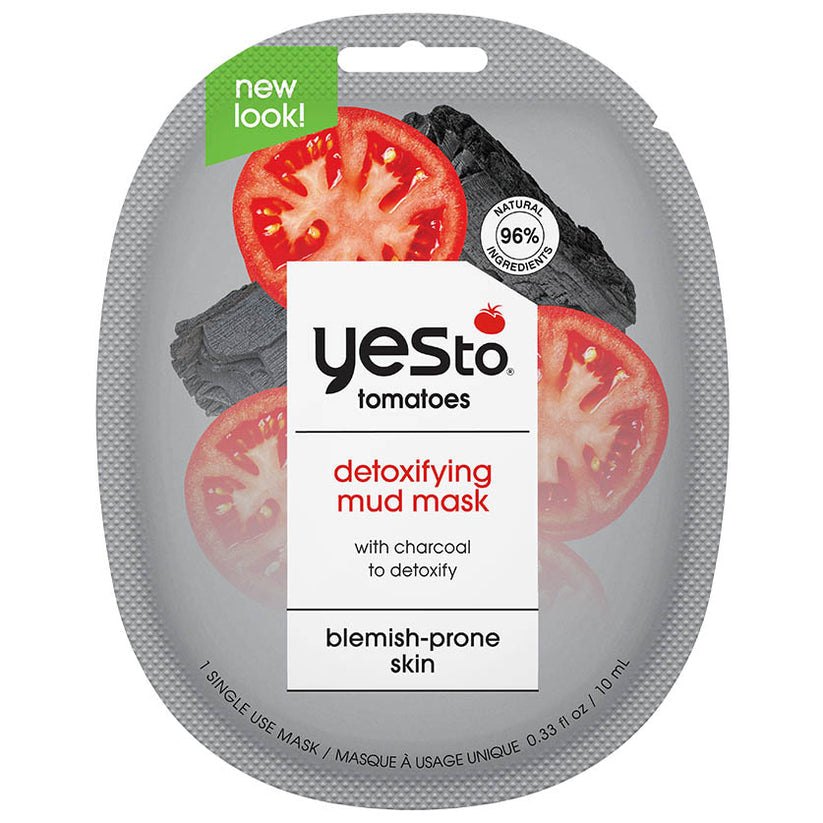

Yes To
tomatoes detoxifying mud mask with charcoal to detoxify blemish_x0096_prone skin single use

tomatoes detoxifying mud mask with charcoal to detoxify blemish_x0096_prone skin single use
Yes To
tomatoes-detoxifying-mud-mask-with-charcoal-to-detoxify-blemish-prone-skin-single-use
Face Mask
9706836492581
Morning or Evening?
How often will you use this product?
Notes


Highlights
WHAT IS IT?
Face mask with multiple ingredients
FEATURES
Detoxifying, Acne-fighting, Conditioning
BEST FOR
Blemish-prone skin
CHECKS
Free of parabens, silicones, phthalates
Who Is It For?
Adults (recommended For Adult Use Only)What Does It Help With?
Acne Breakouts ImpuritiesBudget
AffordableHow To Use
Which routine should it be used in?
Instructions:
Key Information


What Yes To Says
Product Description:
This rich and creamy mud mask draws out impurities and helps prevent new acne from forming, leaving you with a healthier-looking complexion in just 10 minutes. Formulated with Charcoal and a medicated dose of 1% Salicylic Acid, this mask detoxifies and treats breakouts. Conditions your skin with a botanical blend of Tomato, Aloe, Watermelon, Pumpkin and Chamomile Extracts. Apply once or twice weekly for optimal benefits.
About the Brand:
Ingredients Overview
Ingredients List
Water, Propanediol, Bentonite, Kaolin, Glycerin, Magnesium Aluminum Silicate, Galactoarabinan, Aloe Barbadensis (Aloe) Leaf Juice, Charcoal Powder, Allantoin, Citrullus Lanatus (Watermelon) Fruit Extract, Lens Esculenta (Lentil) Seed Extract, Solanum Lycopersicum (Tomato) Fruit/Leaf/Stem Extract, Gingkobiloba Leaf Extract, Cucurbita Pepo (Pumpkin), Chamomilla Recutita (Matricaria) Flower Extract, Aspalathus Linearis Extract, Xanthan Gum, Iron Oxide (Ci 77499), Alcohol, Sodium Hydroxide, Phenoxyethanol, Fragrance.
Key Ingredients
Salicylic Acid, Charcoal, Tomato Extract, Aloe, Watermelon Extract, Pumpkin Extract, Chamomile Extract
Ingredients Details
Allantoin
Common Name(s): 5-ureidohydantoin,glyoxyldiureide,aluminum dihydroxy allantoinate
CAS Number: 97-59-6
DESCRIPTION
What It Does: Soothes irritation, accelerates wound healing, promotes skin cell renewal, and provides mild keratolytic exfoliation.
Why It's Used: Gold standard multi-function soothing active – one of the most widely used cosmetic ingredients across all product types for its exceptional tolerability and clinically proven multi-action skin conditioning.
How It Works: Promotes keratinocyte proliferation and fibroblast migration for wound healing. mild keratolytic activity by disrupting corneocyte binding. anti-irritant via direct protein binding and anti-inflammatory cytokine reduction. humectant activity via hydroxyl groups.
Typically Found In: Post-procedure products,sensitive skin formulas,wound care,anti-acne treatments,baby products
TECHNICAL DETAILS
Primary Category: Active ingredient – soothing / anti-inflammatory
Secondary Functions: Wound healing,keratolytic,anti-irritant
Application Areas:

Facial Skincare
Body Care

Hair Care
Beard Care
Color Cosmetics (Makeup)
Dietary/Oral Supplements
Typical Concentration Range: 0.1%–2%
SOURCING & ETHICS
Vegan Status: Conditional - feedstock declaration required
Halal Status: Unverified - feedstock declaration required (plant, animal and petrochemical routes all exist)
Source Notes: Plant-derived extract or synthetic. [audit 2026-07-29 rev2: origin-dependent: the same inci exists in plant, animal and petrochemical versions and the name does not discriminate. determination requires shariah-panel sign-off.]
SKIN COMPATIBILITY
Irritancy Rating: 1/5 – very low
Comedogenicity Rating: 0/5 – non-comedogenic
Sensitivity Concerns: Exceptionally well-tolerated; suitable for all skin types including baby and compromised skin.
Safe for Sensitive Skin: Yes – particularly recommended for sensitive skin
SAFETY & COMPATIBILITY
Safety Profile: Excellent safety profile. ewg score: 1.
Works Well With: Ceramides,panthenol,allantoin,hyaluronic acid,centella asiatica
Avoid Combining With: No significant incompatibilities
SCIENTIFIC NOTE
Allantoin's keratinocyte proliferation stimulation occurs via receptor-mediated signaling (possibly machr activation) rather than non-specific irritation-driven proliferation, making it a true wound-healing stimulant rather than a pro-inflammatory proliferative signal.
Last Verified: 2026-03-12
Primary Sources: Cosing database,cir safety assessment,araújo et al. allantoin review
Aloe Barbadensis Aloe Leaf Juice
Common Name(s): Aloe barbadensis aloe leaf juice extract
DESCRIPTION
What It Does: Provides antioxidant protection, soothing anti-inflammatory effects, and skin-conditioning benefits through plant-derived polyphenols and phytochemicals.
Why It's Used: Plant extracts concentrate bioactive phytochemicals evolved for environmental protection — uv, microbial, and oxidative stressors — that translate to skin benefits.
How It Works: Polyphenols (flavonoids, phenolic acids) inhibit nf-κb-mediated inflammatory signaling, scavenge reactive oxygen species through electron donation, and chelate pro-oxidant metal ions to reduce oxidative skin damage.
Typically Found In: Serums,toners,moisturizers,masks,essences
TECHNICAL DETAILS
Primary Category: Botanical extracts
Secondary Functions: Antioxidant,anti-inflammatory
Application Areas:
Facial Skincare
Body Care
Hair Care
Beard Care
Color Cosmetics (Makeup)
Dietary/Oral Supplements
Typical Concentration Range: 0.1–10%
SOURCING & ETHICS
Vegan Status: Yes
Halal Status: Yes
Source Notes: Plant-derived extract; no animal components.
SKIN COMPATIBILITY
Irritancy Rating: 1899-12-31 00:00:00 -0800
Sensitivity Concerns: Low sensitization potential at recommended use concentrations.
Safe for Sensitive Skin: Yes
SAFETY & COMPATIBILITY
Safety Profile: Well-characterized cosmetic ingredient with established safety profile. generally non-irritating at typical use concentrations. suitable for leave-on and rinse-off cosmetics.
Works Well With: Niacinamide,hyaluronic acid,vitamin c,ceramides
Avoid Combining With: Strong oxidizing agents
SCIENTIFIC NOTE
Plant secondary metabolites (flavonoids, terpenes, phenolic acids) are biosynthesized as defense compounds against uv, herbivores, and pathogens. their anti-inflammatory activity typically derives from competitive inhibition of cox-2 and 5-lox enzymes (ic50 1–50 µm), while antioxidant activity involves single electron transfer (set) and hydrogen atom transfer (hat) mechanisms with structure-dependent rate constants.
Last Verified: 2025-01-15
Primary Sources: Cosing eu database; pcpc cosmetic ingredient safety reviews; phytochemical and ethnobotanical literature
Bentonite
Common Name(s): Montmorillonite,volcanic ash clay,swelling clay
CAS Number: 1302-78-9
DESCRIPTION
What It Does: Provides thixotropic clay gellation and deep oil absorption from swelling smectite clay.
Why It's Used: Strongest adsorbing clay for deep cleansing masks – bentonite's high cation exchange capacity and swelling capacity provide the deepest oil and toxin adsorption of common cosmetic clays.
How It Works: Montmorillonite 2:1 layered silicate swells up to 15× in water via interlayer water absorption. very high cation exchange capacity (cec: 80-150 meq/100g) provides exceptional adsorption of cations, oils, and toxins. thixotropic gel provides 'mask that hardens' sensory experience.
Typically Found In: Clay masks,deep cleansing products,detoxifying formulas
TECHNICAL DETAILS
Primary Category: Functional ingredient – swelling clay mineral
Secondary Functions: Skin conditioning
Application Areas:
Facial Skincare
Body Care
Hair Care
Beard Care
Color Cosmetics (Makeup)
Dietary/Oral Supplements
Typical Concentration Range: 1%–25%
SOURCING & ETHICS
Vegan Status: Conditional - supplier confirmation required
Halal Status: Unverified - supplier confirmation required
Source Notes: Commercially produced for cosmetic use. verify vegan/halal status with supplier. [audit 2026-07-29 rev2: the record's own source_notes does not assert a non-animal origin, or instructs the reader to verify with the supplier; "yes" asserts knowledge the record does not hold. determination requires shariah-panel sign-off.]
SKIN COMPATIBILITY
Irritancy Rating: 1/5 – very low
Comedogenicity Rating: 0/5 – non-comedogenic
Sensitivity Concerns: Well-tolerated by most skin types.
Safe for Sensitive Skin: Yes
SAFETY & COMPATIBILITY
Safety Profile: Good safety profile at recommended concentrations. ewg score: 1–2.
Works Well With: Standard skincare actives
Avoid Combining With: No known significant incompatibilities
SCIENTIFIC NOTE
Bentonite's extraordinary swelling (up to 15× dry volume) arises from its 2:1 layer structure: sodium bentonite's inter-layer sodium cations attract very thick water shells, forcing the silicate layers apart by electrostatic repulsion. calcium bentonite swells only 2-3× by comparison, explaining why sodium-exchanged bentonite is the industrial standard for swelling applications.
Last Verified: 2026-03-12
Primary Sources: Cosing database,cir safety assessment
Charcoal Powder
Common Name(s): Activated charcoal/fuller's earth,pore cleansing adsorbent,detoxifying clay
CAS Number: N/a
DESCRIPTION
What It Does: Physically adsorbs excess sebum, environmental pollution particulates, and skin surface impurities into the porous structure, purifies pores during mask application, and provides the 'detox' pore-drawing action validated by the visible sebum and debris transfer to the mask on removal.
Why It's Used: Provides genuine documented high-capacity physical adsorption — not a marketing claim but a measurable adsorbent capacity. activated charcoal's ~2000 m²/g surface area adsorbs sebum lipids and particulate pollutants through van der waals forces at concentrations no clay or silica alternative can match.
How It Works: Activated charcoal's turbostratic graphite structure (disordered graphene layers) provides pore sizes of 0.5–50 nm covering micro, meso, and macro pore ranges. sebum lipids adsorb into mesopores (2–50 nm) via van der waals forces; pollutant pahs adsorb via π-π stacking with graphene rings; the high-capacity adsorption drives equilibrium-driven partitioning from pore to charcoal surface.
Typically Found In: Charcoal masks,pore purifying,detox
TECHNICAL DETAILS
Primary Category: Active ingredient – mineral / metal active
Secondary Functions: Antimicrobial,sebum regulation,antioxidant enzyme cofactor
Application Areas:
Facial Skincare
Body Care
Hair Care
Beard Care
Color Cosmetics (Makeup)
Dietary/Oral Supplements
Typical Concentration Range: 5%–30%
SOURCING & ETHICS
Vegan Status: Yes
Halal Status: Yes
Source Notes: Mineral/inorganic compound. cosmetic or pharmaceutical grade.
SKIN COMPATIBILITY
Irritancy Rating: 1/5 – very low
Comedogenicity Rating: 0/5 – non-comedogenic
Sensitivity Concerns: Non-irritating at recommended concentrations.
Safe for Sensitive Skin: Yes at recommended concentrations
SAFETY & COMPATIBILITY
Safety Profile: Excellent safety profile at cosmetic concentrations. ewg score: 1–2.
Works Well With: Niacinamide,salicylic acid,other actives
Avoid Combining With: No significant incompatibilities at standard concentrations
SCIENTIFIC NOTE
Activated charcoal's adsorption capacity (1–3 g sebum/g charcoal) significantly exceeds kaolin clay (~0.5 g/g) and bentonite (~0.8 g/g) — the higher porosity-to-mass ratio from carbonisation providing the most efficient sebum adsorption per gram of any cosmetic adsorbent.
Last Verified: 2026-03-12
Primary Sources: Cosing database,activated charcoal pore adsorption capacity review