

BABOR
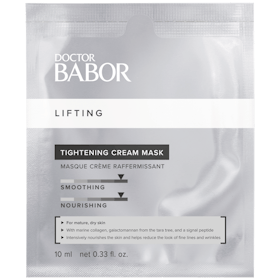
Tightening Cream Mask

Tightening Cream Mask
BABOR
tightening-cream-mask
Face Mask
9605071995173
Morning or Evening?
How often will you use this product?
Notes


Highlights
WHAT IS IT?
A tightening cream mask with multiple ingredients
FEATURES
Anti-aging treatment for firmer looking skin
BEST FOR
Mature skin, Dry skin
CHECKS
Free of synthetic dyes, Mineral oil free, Paraben-free, PEG-free, Silicone-free, Sulfate-free, Free of synthetic polymers
Who Is It For?
Not Specified Likely Adults (18+) Of Any GenderWhat Does It Help With?
Anti-aging Lifting & FirmingBudget
AffordableHow To Use
Which routine should it be used in?
Instructions:
Key Information

What BABOR Says
Product Description:
The TIGHTENING CREAM MASK provides demanding, mature, and dry skin with high-performance LIFTING active ingredients and visibly reduces fine lines and wrinkles. For instantly smoother and intensively nourished skin.
About the Brand:
Ingredients Overview
Ingredients List
AQUA, OLEA EUROPAEA FRUIT OIL, PRUNUS AMYGDALUS DULCIS OIL, GLYCERIN, CICHORIUM INTYBUS ROOT OLIGOSACCHARIDES, BUTYROSPERMUM PARKII BUTTER, CETYL ALCOHOL, CETEARYL OLIVATE, OLEYL ALCOHOL, SORBITAN OLIVATE, MICROCRYSTALLINE CELLULOSE, PHENOXYETHANOL, ZANTHOXYLUM BUNGEANUM FRUIT EXTRACT, XANTHAN GUM, CELLULOSE GUM, CAFFEINE, SOLUBLE COLLAGEN, TOCOPHEROL, HELIANTHUS ANNUUS SEED OIL, ETHYLHEXYLGLYCERIN, MAGNESIUM ASPARTATE, ZINC GLUCONATE, GLUCONOLACTONE, CAESALPINIA SPINOSA GUM, SODIUM BENZOATE, SODIUM HYDROXIDE, COPPER GLUCONATE, DIPEPTIDE DIAMINOBUTYROYL BENZYLAMIDE DIACETATE, CALCIUM GLUCONATE, HYDROGENATED PALM GLYCERIDES CITRATE
Key Ingredients
Galactomannan, Marine collagen, Signal peptide, Zanthoxylum fruit extract
Ingredients Details
Butyrospermum Parkii Butter
Common Name(s): Butyrospermum parkii butter,botanical carrier oil,emollient fatty acid delivery
CAS Number: N/a
DESCRIPTION
What It Does: Softens and conditions skin by integrating into sc lipid bilayers, delivers essential fatty acids (oleic, linoleic, linolenic) for barrier lipid synthesis, and provides rich, non-stripping moisturisation.
Why It's Used: Natural carrier oils provide the closest compositional match to endogenous sc lipids, delivering emolliency through genuine barrier integration rather than simple surface occlusion.
How It Works: Fatty acid triglycerides partition into sc lipid bilayers — oleic acid (c18:1) provides fluid, emollient integration; linoleic acid (c18:2) acts as essential ceramide precursor; saturated fatty acids provide more occlusive barrier reinforcement.
Typically Found In: Moisturisers,facial oils,natural skin care
TECHNICAL DETAILS
Primary Category: Functional ingredient – emollient
Secondary Functions: Barrier sealing,softening
Application Areas:

Facial Skincare
Body Care
Hair Care

Beard Care
Color Cosmetics (Makeup)
Dietary/Oral Supplements
Typical Concentration Range: 1%–100%
SOURCING & ETHICS
Vegan Status: Conditional - supplier confirmation required
Halal Status: Unverified - supplier confirmation required
Source Notes: Plant-derived, synthetic or animal-derived. verify source. [audit 2026-07-29 rev2: the record's own source_notes does not assert a non-animal origin, or instructs the reader to verify with the supplier; "yes" asserts knowledge the record does not hold. determination requires shariah-panel sign-off.]
SKIN COMPATIBILITY
Irritancy Rating: 1/5 – very low
Comedogenicity Rating: 1/5 – low; formulation-dependent
Sensitivity Concerns: Non-irritating.
Safe for Sensitive Skin: Yes
SAFETY & COMPATIBILITY
Safety Profile: Excellent safety profile. ewg score: 1.
Works Well With: Humectants,ceramides,actives as carrier
Avoid Combining With: No significant incompatibilities
SCIENTIFIC NOTE
Essential fatty acids — linoleic (c18:2, n-6) and α-linolenic (c18:3, n-3) acids — cannot be synthesised by the body; topical delivery through carrier oils provides direct substrate for ceramide and eicosanoid biosynthesis in the epidermis.
Last Verified: 2026-03-12
Primary Sources: Cosing database,butyrospermum parkii butter carrier oil botanical review
Cetearyl Olivate
Common Name(s): Nonionic emulsifier,o/w surfactant,emulsion stabiliser
CAS Number: N/a
DESCRIPTION
What It Does: Stabilises o/w emulsions by forming a molecular monolayer at the oil-water interface, provides co-emulsification synergy with other emulsifiers, and contributes to emulsion texture through interfacial film properties.
Why It's Used: Nonionic emulsifiers are preferred for sensitive skin and ph-extreme formulations — no ionic charge means no electrostatic interaction with skin proteins, no ph-dependent function loss, and compatibility with both anionic and cationic co-ingredients.
How It Works: Hlb determines emulsion type: hlb 8–12 for o/w emulsification; hlb 3–6 for w/o. the peg or glycoside head group provides hydrophilicity while the c16–c18 fatty chain provides lipophilicity. at the o/w interface, nonionic emulsifiers form a mixed monolayer reducing interfacial tension from ~35 mn/m (clean oil-water) to 5–10 mn/m, providing thermodynamic stabilisation.
Typically Found In: Creams,lotions,o/w emulsions
TECHNICAL DETAILS
Primary Category: Active ingredient – cosmetic active
Secondary Functions: Skin conditioning
Application Areas:
Facial Skincare
Body Care
Hair Care
Beard Care
Color Cosmetics (Makeup)
Dietary/Oral Supplements
Typical Concentration Range: 1%–10%
SOURCING & ETHICS
Vegan Status: Conditional - supplier confirmation required
Halal Status: Unverified - supplier confirmation required
Source Notes: Commercially produced for cosmetic use. verify vegan/halal status with supplier. [audit 2026-07-29 rev2: the record's own source_notes does not assert a non-animal origin, or instructs the reader to verify with the supplier; "yes" asserts knowledge the record does not hold. determination requires shariah-panel sign-off.]
SKIN COMPATIBILITY
Irritancy Rating: 1/5 – very low
Comedogenicity Rating: 0/5 – non-comedogenic
Sensitivity Concerns: Well-tolerated by most skin types.
Safe for Sensitive Skin: Yes
SAFETY & COMPATIBILITY
Safety Profile: Good safety profile at recommended concentrations. ewg score: 1–2.
Works Well With: Standard skincare actives
Avoid Combining With: No known significant incompatibilities
SCIENTIFIC NOTE
Mixed emulsifier systems (e.g., glyceryl stearate + peg-100 stearate, or cetearyl glucoside + cetearyl alcohol) provide better emulsion stability than single emulsifiers — synergistic packing of different molecular geometries creates a more cohesive, mechanically robust interfacial film.
Last Verified: 2026-03-12
Primary Sources: Cosing database,nonionic emulsifier hlb system review
Cetyl Alcohol
Common Name(s): 1-hexadecanol,palmityl alcohol,n-cetyl alcohol
CAS Number: 36653-82-4
DESCRIPTION
What It Does: Provides c16 fatty alcohol emolliency and thickening for well-textured cosmetic emulsions.
Why It's Used: Lighter-textured fatty alcohol alternative to stearyl alcohol for creams and conditioners requiring less heavy emolliency.
How It Works: C16 chain length provides slightly lower melting point (49°c) than stearyl (60°c) giving softer, lighter emulsion texture. forms lamellar networks for thickening and stability. direct skin and hair conditioning via fatty alcohol film.
Typically Found In: Creams,hair conditioners,lotions
TECHNICAL DETAILS
Primary Category: Functional ingredient – fatty alcohol
Secondary Functions: Barrier sealing,softening
Application Areas:
Facial Skincare
Body Care
Hair Care
Beard Care
Color Cosmetics (Makeup)
Dietary/Oral Supplements
Typical Concentration Range: 1%–15%
SOURCING & ETHICS
Vegan Status: Yes - standard ethanol routes are non-animal; confirm denaturant origin
Halal Status: Conditional - ethanol production route and residual concentration; jurisdiction-dependent, refer to certifier stance
Source Notes: Plant-derived, synthetic or animal-derived. verify source. [audit 2026-07-29 rev2: ethanol pathway; determination depends on route, on whether the plant also produces beverage alcohol, and on residual concentration. determination requires shariah-panel sign-off.]
SKIN COMPATIBILITY
Irritancy Rating: 1/5 – very low
Comedogenicity Rating: 1/5 – low; formulation-dependent
Sensitivity Concerns: Non-irritating.
Safe for Sensitive Skin: Yes
SAFETY & COMPATIBILITY
Safety Profile: Excellent safety profile. ewg score: 1.
Works Well With: Humectants,ceramides,actives as carrier
Avoid Combining With: No significant incompatibilities
SCIENTIFIC NOTE
Cetyl alcohol's c16 chain length is at the approximate thermal transition point for fatty alcohol lamellar crystallization at skin temperature (33°c). this transition (from ordered crystalline to disordered liquid phase near skin temperature) provides the characteristic 'melts on application' sensory profile that makes cetyl alcohol-containing products feel cooling and light on initial application.
Last Verified: 2026-03-12
Primary Sources: Cosing database,cir safety assessment
Cichorium Intybus Root Oligosaccharides
Common Name(s): Cichorium intybus root oligosaccharides,cichorium intybus root oligosaccharides,chicory inulin prebiotic,bifidogenic fructan humectant
CAS Number: N/a
DESCRIPTION
What It Does: Selectively nourishes bifidobacterium and lactobacillus skin commensals as the most clinically documented prebiotic substrate while providing hygroscopic moisture retention from the fructooligosaccharide's multiple oh groups.
Why It's Used: Chicory inulin is the gold standard prebiotic substrate — decades of gut microbiome clinical studies demonstrating bifidobacterium selectivity directly applicable to the skin microbiome with the same bifidogenic fermentation mechanism.
How It Works: Beta-fructosidic linkages in inulin are cleaved specifically by bifidobacterium (beta-fructosidase, ec 3.2.1.26) and lactobacillus species — the beta-2,1 linkage geometry is not recognised by most pathogenic organisms providing selective bifidogenic fermentation. scfa products reinforce skin acid mantle.
Typically Found In: Microbiome skin care,prebiotic hydration
TECHNICAL DETAILS
Primary Category: Active ingredient – humectant
Secondary Functions: Moisture retention,hydration
Application Areas:
Facial Skincare
Body Care
Hair Care
Beard Care
Color Cosmetics (Makeup)
Dietary/Oral Supplements
Typical Concentration Range: 0.5%–5%
SOURCING & ETHICS
Vegan Status: Yes
Halal Status: Yes
Source Notes: Plant-derived or fermentation-produced.
SKIN COMPATIBILITY
Irritancy Rating: 1/5 – very low
Comedogenicity Rating: 0/5 – non-comedogenic
Sensitivity Concerns: Non-irritating; suitable for sensitive skin.
Safe for Sensitive Skin: Yes
SAFETY & COMPATIBILITY
Safety Profile: Excellent safety profile. ewg score: 1.
Works Well With: Ceramides,emollients,occlusives,barrier actives
Avoid Combining With: No significant incompatibilities
SCIENTIFIC NOTE
Chicory inulin degree of polymerisation (dp) determines specificity: short chain fos (dp 2-8) provides highest bifidogenic activity; long chain inulin (dp >23) provides better humectant film formation — dp selection depends on target functional priority.
Last Verified: 2026-03-22
Primary Sources: Cosing database,cichorium intybus inulin fos prebiotic bifidogenic review