

ThriveCo
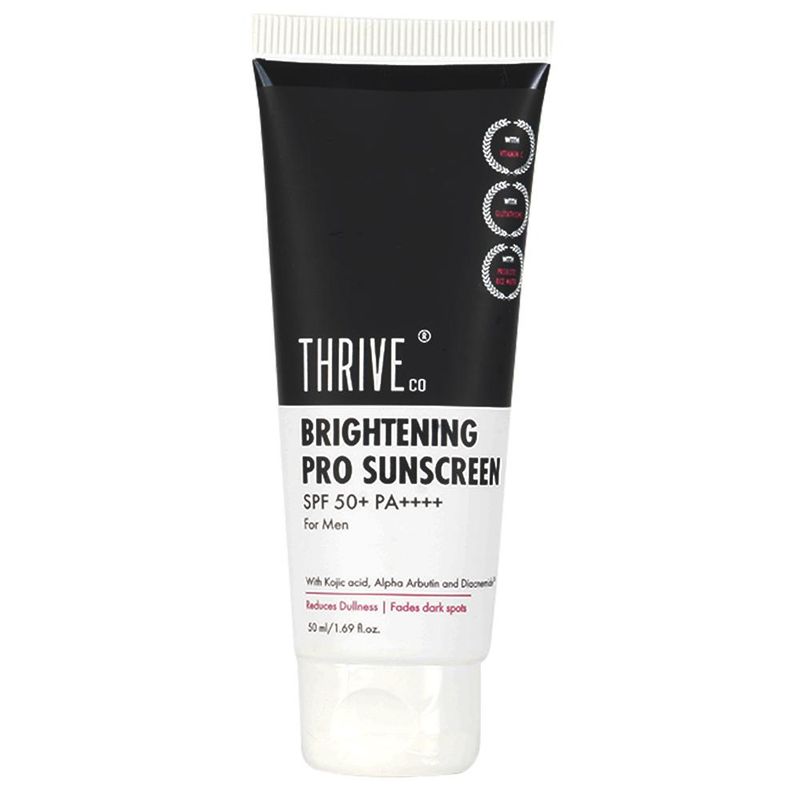
ThriveCo Brightening Pro Sunscreen For Men

ThriveCo Brightening Pro Sunscreen For Men
ThriveCo
thriveco-brightening-pro-sunscreen-for-men
Suncare
10084837622053
Morning or Evening?
How often will you use this product?
Notes


Highlights
WHAT IS IT?
Sunscreen with multiple active ingredients (more than 10 ingredients)
FEATURES
Brightening UV defense with PA 50++++, blocks 90% UVB rays, reduces acne and dark spots, fades discoloration and evens skin tone, improves skin texture, hydrates and strengthens skin, non-sticky and sweat-resistant, lightweight watery texture, no white cast
BEST FOR
oily
CHECKS
Free from parabens, harmful silicones, cyclopentasiloxane, sulfates, mineral oils, SLS, petroleum
Who Is It For?
Men No Specified Age Range MentionedWhat Does It Help With?
Sunburn Prevention Hyperpigmentation Acne Reduction Dark Spot Control Skin Brightening Hydration Skin Texture ImprovementBudget
Affordable (under $30)How To Use
Which routine should it be used in?
Instructions:
Key Information


What ThriveCo Says
Product Description:
Protect and brighten your skin with ThriveCo Brightening Sunscreen, designed specifically for men. Offering powerful broad-spectrum defense with a PA rating of 50++++, it shields your skin from UVA and UVB rays, preventing sunburn, hyperpigmentation, and long-term skin damage. Lightweight and non-sticky, it blends effortlessly for a clear, natural finish without the white cast. Key features include brightening UV defense, powerful ingredients like Diacnemide, Kojic acid, alpha-arbutin, probiotic rice water, Mahua oil, and hyaluronic acid. This sunscreen is ideal for oily skin, sweat-resistant, non-sticky, and cruelty-free. Free from parabens, harmful silicones, cyclopentasiloxane, sulfates, mineral oils, SLS, and petroleum.
About the Brand:
Ingredients Overview
Ingredients List
Aqua,Octyl-Methoxycinnamate,Avobenzone,Bis-Ethylhexyloxyphenol-Methoxyphenyl-Triazine,1,3-Butylene-Glycol,Diethylhexyl-Butamido-Triazone,Ethyl-Olivate,Coco-Fatty-Methyl-Ester,Propanediol,Triethanolamine,Azelaic-Acid,Hamamelis-Virginiana-Leaf-Extract,Hyaluronic-Acid,Isododecane,Cyclopentasiloxane,Cetearyl-Olivate,Sorbitan-Olivate,Oryza-Sativa-(Rice)-Extract,Cetearyl-Alcohol,PEG-100-Stearate,Glyceryl-Stearate,3-O-Ethyl-Ascorbic-Acid,Hydrolyzed-Hyaluronic-Acid,Kojic-Acid,Alpha-Arbutin,Glutathione,Madhuca-Indica-Oil,Allantoin,Acrylates/C10-30-Alkyl-Acrylate-Crosspolymer,Ethylhexylglycerin,Phenoxyethanol,Lactic-Acid,Tetrasodium-EDTA,CI-60730,Perfume
Key Ingredients
Diacnemide,Kojic acid,Alpha arbutin,Probiotic rice water,Mahua oil,Hyaluronic acid
Ingredients Details
Allantoin
Common Name(s): 5-ureidohydantoin,glyoxyldiureide,aluminum dihydroxy allantoinate
CAS Number: 97-59-6
DESCRIPTION
What It Does: Soothes irritation, accelerates wound healing, promotes skin cell renewal, and provides mild keratolytic exfoliation.
Why It's Used: Gold standard multi-function soothing active – one of the most widely used cosmetic ingredients across all product types for its exceptional tolerability and clinically proven multi-action skin conditioning.
How It Works: Promotes keratinocyte proliferation and fibroblast migration for wound healing. mild keratolytic activity by disrupting corneocyte binding. anti-irritant via direct protein binding and anti-inflammatory cytokine reduction. humectant activity via hydroxyl groups.
Typically Found In: Post-procedure products,sensitive skin formulas,wound care,anti-acne treatments,baby products
TECHNICAL DETAILS
Primary Category: Active ingredient – soothing / anti-inflammatory
Secondary Functions: Wound healing,keratolytic,anti-irritant
Application Areas:

Facial Skincare
Body Care

Hair Care
Beard Care
Color Cosmetics (Makeup)
Dietary/Oral Supplements
Typical Concentration Range: 0.1%–2%
SOURCING & ETHICS
Vegan Status: Conditional - feedstock declaration required
Halal Status: Unverified - feedstock declaration required (plant, animal and petrochemical routes all exist)
Source Notes: Plant-derived extract or synthetic. [audit 2026-07-29 rev2: origin-dependent: the same inci exists in plant, animal and petrochemical versions and the name does not discriminate. determination requires shariah-panel sign-off.]
SKIN COMPATIBILITY
Irritancy Rating: 1/5 – very low
Comedogenicity Rating: 0/5 – non-comedogenic
Sensitivity Concerns: Exceptionally well-tolerated; suitable for all skin types including baby and compromised skin.
Safe for Sensitive Skin: Yes – particularly recommended for sensitive skin
SAFETY & COMPATIBILITY
Safety Profile: Excellent safety profile. ewg score: 1.
Works Well With: Ceramides,panthenol,allantoin,hyaluronic acid,centella asiatica
Avoid Combining With: No significant incompatibilities
SCIENTIFIC NOTE
Allantoin's keratinocyte proliferation stimulation occurs via receptor-mediated signaling (possibly machr activation) rather than non-specific irritation-driven proliferation, making it a true wound-healing stimulant rather than a pro-inflammatory proliferative signal.
Last Verified: 2026-03-12
Primary Sources: Cosing database,cir safety assessment,araújo et al. allantoin review
Alpha-arbutin
Common Name(s): 4-hydroxyphenyl-alpha-d-glucopyranoside
DESCRIPTION
What It Does: Provides potent tyrosinase inhibition with improved stability and tolerability over other arbutin forms.
Why It's Used: Premium arbutin — alpha configuration provides 10× greater tyrosinase inhibition than beta-arbutin at equivalent concentration, making alpha-arbutin the most effective arbutin form.
How It Works: Alpha-glucoside linkage provides enhanced metabolic stability vs beta-arbutin (less enzymatic hydrolysis to free hydroquinone in skin). inhibits tyrosinase via competitive substrate inhibition (ic50 ~24μg/ml vs beta-arbutin ~525μg/ml — 20× more potent). inhibits dopa oxidase step in melanogenesis.
Typically Found In: Brightening serums,anti-spot products,premium lightening
TECHNICAL DETAILS
Primary Category: Active ingredient – arbutin brightening agent
Secondary Functions: Melanin inhibition,hyperpigmentation reduction
Application Areas:
Facial Skincare
Body Care
Hair Care
Beard Care
Color Cosmetics (Makeup)
Dietary/Oral Supplements
Typical Concentration Range: 0.5%–2%
SOURCING & ETHICS
Vegan Status: Yes – synthetic enzymatic synthesis
Halal Status: Yes
Source Notes: Synthetic or plant-derived.
SKIN COMPATIBILITY
Irritancy Rating: 1/5 – very low
Comedogenicity Rating: 0/5 – non-comedogenic
Sensitivity Concerns: Non-irritating; well-tolerated.
Safe for Sensitive Skin: Yes
SAFETY & COMPATIBILITY
Safety Profile: Excellent safety profile. use with spf for maximum efficacy. ewg score: 1.
Works Well With: Niacinamide,vitamin c,alpha-arbutin,tranexamic acid,spf
Avoid Combining With: No significant incompatibilities
SCIENTIFIC NOTE
Alpha-arbutin's 10–20× greater potency vs beta-arbutin at equivalent concentration arises from the alpha-glycosidic bond geometry — the alpha configuration positions the hydroquinone aglycone at a specific orientation relative to the glucose that fits the tyrosinase active site copper more precisely than the beta isomer's different spatial arrangement.
Last Verified: ##########
Primary Sources: Cosing database,sugimoto et al. arbutin tyrosinase study
Avobenzone
Common Name(s): Parsol 1789,avobenzone
DESCRIPTION
What It Does: Provides uva-i protection (340-400nm) critical for photoaging prevention — the only widely available chemical uva-i filter.
Why It's Used: The essential uva-i filter — avobenzone is the only commonly approved chemical filter providing protection in the photoaging-critical 340-400nm range essential for broad-spectrum sunscreen claims.
How It Works: Dibenzoylmethane chromophore absorbs uva-i (λmax 357nm, εmax ~36,000). photodegrades via photoisomerisation requiring photostabilisation (octocrylene, bemotrizinol) for durability.
Typically Found In: Broad-spectrum sunscreens,anti-aging spf products
TECHNICAL DETAILS
Primary Category: Active ingredient – chemical uva-i filter
Secondary Functions: Skin conditioning
Application Areas:
Facial Skincare
Body Care
Hair Care
Beard Care
Color Cosmetics (Makeup)
Dietary/Oral Supplements
Typical Concentration Range: Up to 5% (eu), 3% (us fda)
SOURCING & ETHICS
Vegan Status: Conditional - supplier confirmation required
Halal Status: Unverified - supplier confirmation required
Source Notes: Commercially produced for cosmetic use. verify vegan/halal status with supplier. [audit 2026-07-29 rev2: the record's own source_notes does not assert a non-animal origin, or instructs the reader to verify with the supplier; "yes" asserts knowledge the record does not hold. determination requires shariah-panel sign-off.]
SKIN COMPATIBILITY
Irritancy Rating: 1/5 – very low
Comedogenicity Rating: 0/5 – non-comedogenic
Sensitivity Concerns: Well-tolerated by most skin types.
Safe for Sensitive Skin: Yes
SAFETY & COMPATIBILITY
Safety Profile: Eu max 5%. fda: 3%. ewg score: 2. requires photostabilisation. photoallergy risk in some individuals.
Works Well With: Standard skincare actives
Avoid Combining With: No known significant incompatibilities
SCIENTIFIC NOTE
Avobenzone's photodegradation discovery drove development of photostabilisation technology — the period from avobenzone's 1978 introduction to development of effective photostabilisers in the 1990s was marked by sunscreens with inadequate uva durability. bemotrizinol (tinosorb s) development provided the most elegant solution by providing a photostable molecule with equivalent uva coverage.
Last Verified: 2026-03-12
Primary Sources: Cosing database,fda uv filter otc monograph,shaath sunscreen photostabilisation review
Cyclopentasiloxane
Common Name(s): Cyclopentasiloxane,cyclic volatile silicone,dry-touch carrier solvent
CAS Number: N/a
DESCRIPTION
What It Does: Provides a dry, weightless application vehicle that evaporates cleanly leaving actives and non-volatile silicones deposited on skin — eliminating the residual heaviness of conventional liquid carrier solvents.
Why It's Used: Cyclosiloxanes are the unique volatile silicone solvents that dissolve non-volatile silicones (dimethicone, cyclomethicone), organic uv filters, and lipophilic actives, providing the sensory-superior dry-touch application experience in premium formulations.
How It Works: Cyclosiloxane vapour pressure (d5 cyclopentasiloxane ~0.3 mmhg at 25°c) provides clean evaporation at body temperature. the cyclic ring structure provides lower boiling point than equivalent linear dimethicone, enabling faster evaporation while the ring conformation maintains the silicone's low surface energy for smooth application.
Typically Found In: Primers,antiperspirants,sunscreens
TECHNICAL DETAILS
Primary Category: Functional ingredient – emollient
Secondary Functions: Barrier sealing,softening
Application Areas:
Facial Skincare
Body Care
Hair Care
Beard Care
Color Cosmetics (Makeup)
Dietary/Oral Supplements
Typical Concentration Range: 1%–50%
SOURCING & ETHICS
Vegan Status: Conditional - supplier confirmation required
Halal Status: Unverified - supplier confirmation required
Source Notes: Plant-derived, synthetic or animal-derived. verify source. [audit 2026-07-29 rev2: the record's own source_notes does not assert a non-animal origin, or instructs the reader to verify with the supplier; "yes" asserts knowledge the record does not hold. determination requires shariah-panel sign-off.]
SKIN COMPATIBILITY
Irritancy Rating: 1/5 – very low
Comedogenicity Rating: 1/5 – low; formulation-dependent
Sensitivity Concerns: Non-irritating.
Safe for Sensitive Skin: Yes
SAFETY & COMPATIBILITY
Safety Profile: Excellent safety profile. ewg score: 1.
Works Well With: Humectants,ceramides,actives as carrier
Avoid Combining With: No significant incompatibilities
SCIENTIFIC NOTE
Cyclopentasiloxane (d5) and cyclohexasiloxane (d6) are under eu regulatory review for potential environmental persistence (pbt assessment) — formulators should monitor eu regulation 2018/35 implementation for restrictions in wash-off products.
Last Verified: 2026-03-12
Primary Sources: Cosing database,eu cyclosiloxane regulatory review