

THE RAW
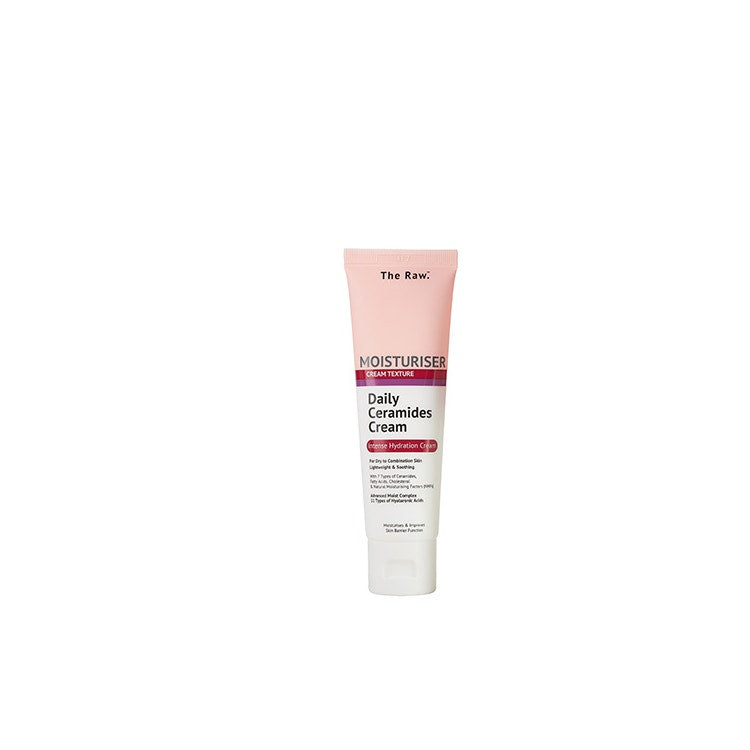
The Raw Daily Ceramides Cream Moisturiser 50Ml

The Raw Daily Ceramides Cream Moisturiser 50Ml
THE RAW
the-raw-daily-ceramides-cream-moisturiser-50ml
Moisturize
10085006541093
Morning or Evening?
How often will you use this product?
Notes


Highlights
WHAT IS IT?
Ceramide enriched daily cream with natural moisturizing factors and humectants
FEATURES
Unique blend of NMFs, Hyaluronic Acids, squalane and jojoba oil; Triple Action System with humectants, emollients and occlusives; enriched with 7 types of ceramides, essential fatty acids, and cholesterol; lightweight non-greasy texture; improves and fortifies skin barrier
BEST FOR
sensitive
CHECKS
Does not contain information on parabens, sulfates, alcohol explicitly; fragrance is present
Who Is It For?
What Does It Help With?
Intense Hydration Moisture Retention Improving And Fortifying Skin Barrier Soft And Smooth SkinBudget
Mid-range ($30-$75)How To Use
Which routine should it be used in?
Instructions:
Key Information


What THE RAW Says
Product Description:
The Raw. Daily Ceramides Cream Moisturiser is a unique blend of Natural Moisturising factors (NMFs), Hyaluronic Acids (HAs), squalane and jojoba oil. This product innovatively activates a Triple Action System, giving you the goodness of humectants, emollients and occlusives in rich formula in one single tube. This advanced formula is enriched with 7 types of ceramides, essential fatty acids, and cholesterol which not only provides intense hydration and moisture, but also improves and fortifies the skin barrier. Perfect for daily use, the lightweight texture glides flawlessly onto your skin, resulting in a non-greasy, long-lasting hydration experience for soft and smooth skin.
About the Brand:
Ingredients Overview
Ingredients List
ETHANOL,WATER,FRAGRANCE,PEG-40,HYDROGENATED-CASTOR-OIL,PROPYLENE,GLYCOL,CEDARWOOD-OIL,CEDRENOL,LEMON-OIL,PATCHOULI-OIL,BLACKPEPPER-OIL,GERANIUM-OIL,PINK-PEPPERCORN-EXTRACT
Key Ingredients
Ceramides,Hyaluronic Acid,Squalane,Jojoba Oil,Essential Fatty Acids,Cholesterol
Ingredients Details
Cedrenol
Common Name(s): Cedrenol
DESCRIPTION
What It Does: Delivers targeted skin-conditioning or bioactive benefits through a specific mechanism of action suited to the formulation's intended purpose.
Why It's Used: Specialty actives address specific skin concerns through targeted molecular mechanisms, providing efficacy beyond what base formulation ingredients alone can achieve.
How It Works: The bioactive compound interacts with specific molecular targets in skin cells or the extracellular matrix — enzymes, receptors, structural proteins, or signaling molecules — triggering beneficial biological responses.
Typically Found In: Serums,treatments,moisturizers,specialty products
TECHNICAL DETAILS
Primary Category: Specialty actives
Secondary Functions: Skin-conditioning,anti-aging
Application Areas:

Facial Skincare

Body Care
Hair Care
Beard Care
Color Cosmetics (Makeup)
Dietary/Oral Supplements
Typical Concentration Range: 0.01–5%
SOURCING & ETHICS
Vegan Status: Yes
Halal Status: Yes
Source Notes: Specialty active ingredient; check individual sourcing for vegan status.
SKIN COMPATIBILITY
Irritancy Rating: 1899-12-31 00:00:00 -0800
Sensitivity Concerns: Low sensitization potential at recommended use concentrations.
Safe for Sensitive Skin: Yes
SAFETY & COMPATIBILITY
Safety Profile: Well-characterized cosmetic ingredient with established safety profile. generally non-irritating at typical use concentrations. suitable for leave-on and rinse-off cosmetics.
Works Well With: Niacinamide,hyaluronic acid,vitamin c,peptides
Avoid Combining With: Incompatible with oxidizing agents; check ph stability
SCIENTIFIC NOTE
Specialty actives typically work through enzyme inhibition (e.g., tyrosinase inhibition for brightening, mmp inhibition for anti-aging), receptor activation (e.g., retinoid receptors, ppar-γ for barrier genes), or transcription factor modulation (e.g., nrf2 for antioxidant gene upregulation). structure-activity relationships determine potency and selectivity.
Last Verified: Cosing eu database; pcpc cosmetic ingredient safety reviews; ingredient-specific safety and efficacy literature
Primary Sources: 2025-01-15
Ethanol
Common Name(s): Ethanol,cosmetic active,functional ingredient
CAS Number: N/a
DESCRIPTION
What It Does: Delivers characteristic cosmetic function at recommended use concentration.
Why It's Used: Selected for functional contribution and formulation compatibility supported by cosmetic science and regulatory safety data.
How It Works: Works through the mechanism of its molecular class as documented in peer-reviewed cosmetic literature.
Typically Found In: Skin care formulations
TECHNICAL DETAILS
Primary Category: Active ingredient – cosmetic active
Secondary Functions: Skin conditioning
Application Areas:
Facial Skincare
Body Care
Hair Care
Beard Care
Color Cosmetics (Makeup)
Dietary/Oral Supplements
Typical Concentration Range: 0.1%–10%
SOURCING & ETHICS
Vegan Status: Conditional
Halal Status: Yes
Source Notes: Commercially produced for cosmetic use. verify vegan/halal status with supplier.
SKIN COMPATIBILITY
Irritancy Rating: 1/5 – very low
Comedogenicity Rating: 0/5 – non-comedogenic
Sensitivity Concerns: Well-tolerated by most skin types.
Safe for Sensitive Skin: Yes
SAFETY & COMPATIBILITY
Safety Profile: Good safety profile at recommended concentrations. ewg score: 1–2.
Works Well With: Standard skincare actives
Avoid Combining With: No known significant incompatibilities
SCIENTIFIC NOTE
Ethanol has an established safety profile within the cosmetic regulatory framework at standard use concentrations.
Last Verified: Cosing database,ethanol technical literature
Primary Sources: 2026-03-12
Fragrance
Common Name(s): Fragrance ingredient,eu allergen or aromatic component,olfactory/flavour
CAS Number: N/a
DESCRIPTION
What It Does: Provides the complete fragrance profile contributing to product sensory experience and consumer appeal.
Why It's Used: Fragrance is a major consumer purchase driver — up to 70% of consumers make purchasing decisions partially based on product scent.
How It Works: Fragrance blends interact with olfactory receptors providing the sensory profile — complex mixtures activate multiple receptor types for rich, multidimensional scent experiences.
Typically Found In: All fragrance products
TECHNICAL DETAILS
Primary Category: Active ingredient – cosmetic active
Secondary Functions: Skin conditioning
Application Areas:
Facial Skincare
Body Care
Hair Care
Beard Care
Color Cosmetics (Makeup)
Dietary/Oral Supplements
Typical Concentration Range: Standard use levels
SOURCING & ETHICS
Vegan Status: Conditional
Halal Status: Yes
Source Notes: Commercially produced for cosmetic use. verify vegan/halal status with supplier.
SKIN COMPATIBILITY
Irritancy Rating: 1/5 – very low
Comedogenicity Rating: 0/5 – non-comedogenic
Sensitivity Concerns: Well-tolerated by most skin types.
Safe for Sensitive Skin: Yes
SAFETY & COMPATIBILITY
Safety Profile: Good safety profile at recommended concentrations. ewg score: 1–2.
Works Well With: Standard skincare actives
Avoid Combining With: No known significant incompatibilities
SCIENTIFIC NOTE
Ifra guidelines set usage limits for fragrance ingredients based on skin sensitisation and phototoxicity assessment for each application category.
Last Verified: Eu regulation 1223/2009 annex iii,ifra standards,fragrance allergen declaration requirements
Primary Sources: 2026-03-12
Glycol
Common Name(s): Glycol,glycol,polyethylene glycol medium mw,humectant co-solvent emulsifier
CAS Number: N/a
DESCRIPTION
What It Does: Provides hygroscopic moisture retention and co-solvent activity for active ingredient dissolution from the polyether backbone's multiple ether oxygen water-binding groups.
Why It's Used: Peg molecular weight determines primary function: low mw (co-solvent/humectant), medium mw (emulsifier/solubiliser), high mw (film-former/thickener) — enabling the same chemical class to address multiple formulation needs across the mw range.
How It Works: Peg ether oxygens (1 per ch₂ch₂o repeat unit) provide 2-3 h-bond acceptors per unit — the chain of ether oxygens binding water molecules creating the hygroscopic character. at low mw (liquid state), provides co-solvent dissolution; at high mw (waxy solid), provides film-forming character through chain entanglement.
Typically Found In: Versatile formulations
TECHNICAL DETAILS
Primary Category: Active ingredient – cosmetic active
Secondary Functions: Skin conditioning
Application Areas:
Facial Skincare
Body Care
Hair Care
Beard Care
Color Cosmetics (Makeup)
Dietary/Oral Supplements
Typical Concentration Range: 0.5%–20%
SOURCING & ETHICS
Vegan Status: Yes
Halal Status: Yes
Source Notes: Commercially produced for cosmetic use. verify vegan/halal status with supplier.
SKIN COMPATIBILITY
Irritancy Rating: 1/5 – very low
Comedogenicity Rating: 0/5 – non-comedogenic
Sensitivity Concerns: Well-tolerated by most skin types.
Safe for Sensitive Skin: Yes
SAFETY & COMPATIBILITY
Safety Profile: Good safety profile at recommended concentrations. ewg score: 1–2.
Works Well With: Standard skincare actives
Avoid Combining With: No known significant incompatibilities
SCIENTIFIC NOTE
1,4-dioxane contamination monitoring: ethylene oxide polymerisation generates trace 1,4-dioxane — eu and us regulations require <10 ppm in finished products. supplier coa confirming dioxane level is required for regulatory compliance.
Last Verified: Cosing database,glycol peg polyethylene glycol review
Primary Sources: 2026-03-22
