

The Derma co.
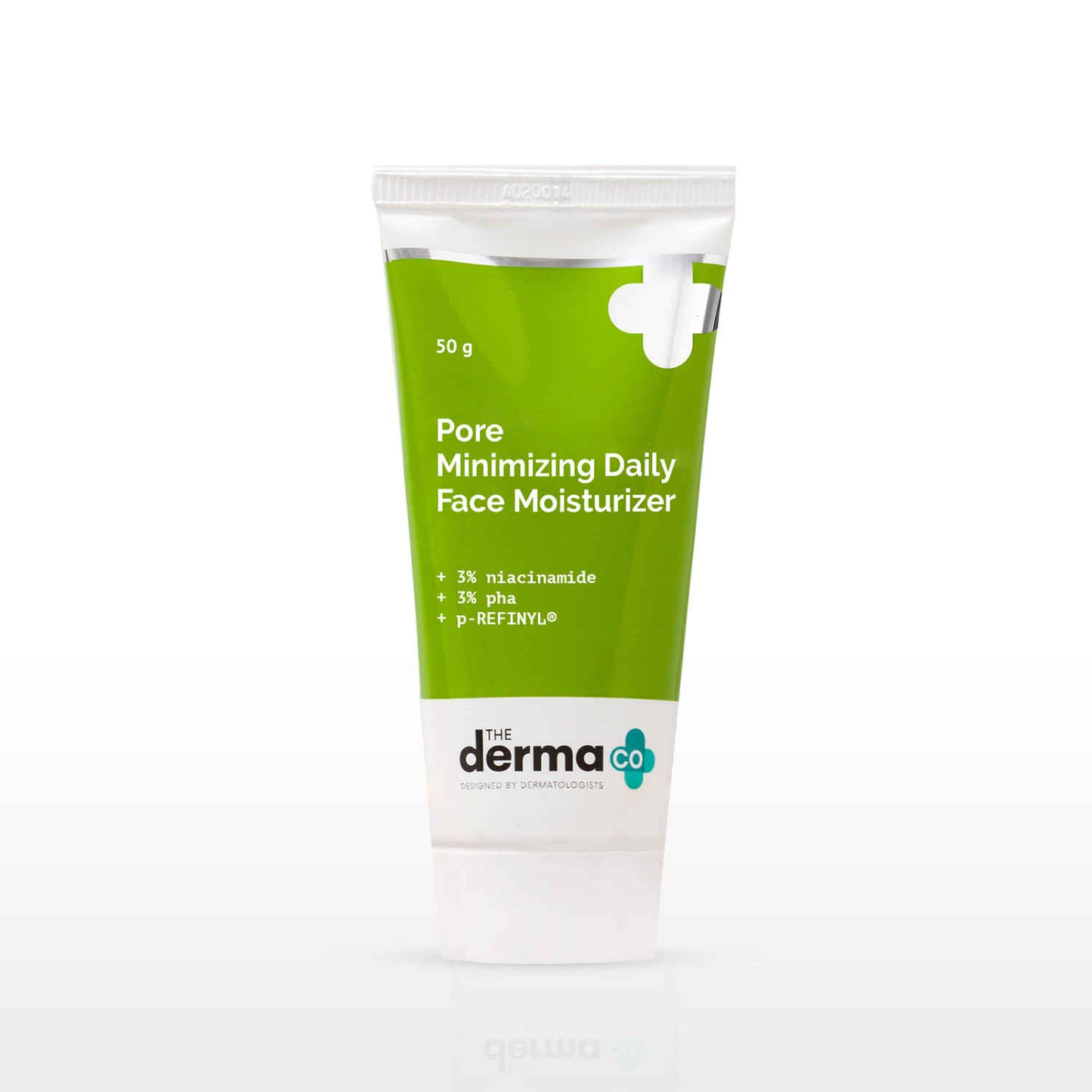
The Derma Co. Pore Minimizing Daily Face Moisturizer with 3% Niacinamide 3% PHA and p-REFINYLA® for Open Pores - 50 gm

The Derma Co. Pore Minimizing Daily Face Moisturizer with 3% Niacinamide 3% PHA and p-REFINYLA® for Open Pores - 50 gm
The Derma co.
the-derma-co-pore-minimizing-daily-face-moisturizer-with-3-niacinamide-3-pha-and-p-refinyla-r-for-open-pores-50-gm
Moisturize
10084865704229
Morning or Evening?
How often will you use this product?
Notes


Highlights
WHAT IS IT?
Face moisturizer with 4 main active ingredients
FEATURES
Minimizes enlarged pores, nourishes skin, activates anti-dehydration shield, fragrance-free, boosts collagen synthesis, minimizes sebum production, unclogs pores, dermatologically tested, safe for sensitive skin
BEST FOR
sensitive
CHECKS
No fragrance
Who Is It For?
What Does It Help With?
Dehydration Enlarged Pores Sebum Control Skin Nourishment Pore UncloggingBudget
Affordable (under $30)How To Use
Which routine should it be used in?
Instructions:
Key Information


What The Derma co. Says
Product Description:
Dehydrated skin with open & clogged pores? Meet Pore Minimizing Daily Face Moisturizer, your pore-fect partner for smooth & healthy skin! Powered with 3% Niacinamide, 3% PHA and p-REFINYL®, this skin-replenishing formula minimizes enlarged pores and nourishes skin while activating the anti-dehydration shield with the help of AQUAXYL™. This breakthrough ingredient reinforces the synthesis of essential lipids and proteins involved in the formation of your skin's outer layer. This moisturizer has a fragrance-free formulation and its regular usage boosts collagen synthesis, minimizes sebum production, and unclogs pores. Dermatologically tested and safe for all skin types including sensitive skin.
About the Brand:
Ingredients Overview
Ingredients List
Aqua, Coco-Caprylate/Caprate, Neopentyl Glycol Diheptanoate, Gluconolactone, Niacinamide, Diethylhexyl Carbonate¸, Propanediol, Cetyl Alcohol, Pentaerythrityl Distearate, Lens Esculenta Fruit Extract, Alpha-Glucan Oligosaccharide, Xylitylglucoside, Anhydroxylitol, Xylitol (Aquaxyl), Methyl Glucose Sesquistearate, Trilaurin, Salicylic Acid (<2%(W/W)), Glycolic Acid, Ethylhexylglycerin, Phenoxyethanol, Disodium EDTA, Xanthan Gum, Carbomer, Sodium Hydroxide
Key Ingredients
Niacinamide, Salicylic Acid, Cica-Glow, Vitamin E
Ingredients Details
Alpha-glucan Oligosaccharide
Common Name(s): Cosmetic ingredient,functional cosmetic active,skin care
CAS Number: N/a
DESCRIPTION
What It Does: Provides documented functional activity from alpha-glucan oligosaccharide.
Why It's Used: Alpha-glucan oligosaccharide contributes established cosmetic function from its characteristic chemical structure and physicochemical properties.
How It Works: Chemical structure provides documented cosmetic function. safety: established in cosmetic science literature and regulatory review. use: standard cosmetic concentrations.
Typically Found In: Skin care formulations
TECHNICAL DETAILS
Primary Category: Active ingredient – cosmetic active
Secondary Functions: Skin conditioning
Application Areas:

Facial Skincare

Body Care
Hair Care
Beard Care
Color Cosmetics (Makeup)
Dietary/Oral Supplements
Typical Concentration Range: 0.1%–10%
SOURCING & ETHICS
Vegan Status: Conditional
Halal Status: Yes
Source Notes: Commercially produced for cosmetic use. verify vegan/halal status with supplier.
SKIN COMPATIBILITY
Irritancy Rating: 1/5 – very low
Comedogenicity Rating: 0/5 – non-comedogenic
Sensitivity Concerns: Well-tolerated by most skin types.
Safe for Sensitive Skin: Yes
SAFETY & COMPATIBILITY
Safety Profile: Good safety profile at recommended concentrations. ewg score: 1–2.
Works Well With: Standard skincare actives
Avoid Combining With: No known significant incompatibilities
SCIENTIFIC NOTE
Alpha-glucan oligosaccharide provides documented cosmetic activity through its characteristic mechanism. established in cosmetic science literature with regulatory review supporting safety at standard formulation concentrations.
Last Verified: Cosing database,alpha-glucan oligosaccharide technical literature
Primary Sources: 2026-03-12
Anhydroxylitol
Common Name(s): Anhydroxylitol,cosmetic active,functional ingredient
CAS Number: N/a
DESCRIPTION
What It Does: Delivers characteristic cosmetic function at recommended use concentration.
Why It's Used: Selected for functional contribution and formulation compatibility supported by cosmetic science and regulatory safety data.
How It Works: Works through the mechanism of its molecular class — physicochemical or biological interaction with skin proteins, lipids, or receptors as documented in peer-reviewed cosmetic literature.
Typically Found In: Skin care formulations
TECHNICAL DETAILS
Primary Category: Active ingredient – cosmetic active
Secondary Functions: Skin conditioning
Application Areas:
Facial Skincare
Body Care
Hair Care
Beard Care
Color Cosmetics (Makeup)
Dietary/Oral Supplements
Typical Concentration Range: 0.1%–10%
SOURCING & ETHICS
Vegan Status: Conditional
Halal Status: Yes
Source Notes: Commercially produced for cosmetic use. verify vegan/halal status with supplier.
SKIN COMPATIBILITY
Irritancy Rating: 1/5 – very low
Comedogenicity Rating: 0/5 – non-comedogenic
Sensitivity Concerns: Well-tolerated by most skin types.
Safe for Sensitive Skin: Yes
SAFETY & COMPATIBILITY
Safety Profile: Good safety profile at recommended concentrations. ewg score: 1–2.
Works Well With: Standard skincare actives
Avoid Combining With: No known significant incompatibilities
SCIENTIFIC NOTE
Anhydroxylitol has an established safety and efficacy profile within the cosmetic regulatory framework at standard use concentrations.
Last Verified: Cosing database,anhydroxylitol technical literature
Primary Sources: 2026-03-12
Carbomer
Common Name(s): Carbopol,polyacrylic acid,carboxyvinyl polymer
DESCRIPTION
What It Does: Provides transparent gel textures and thickening at very low concentrations via ph-responsive swelling.
Why It's Used: The most widely used gel thickener – provides crystal-clear, stable gels at concentrations as low as 0.1-0.5% with ph-controlled viscosity.
How It Works: Highly crosslinked polyacrylic acid remains tightly coiled at acidic ph. neutralization with naoh or triethanolamine ionizes carboxylic groups causing electrostatic repulsion that unfolds and swells the polymer coils, dramatically increasing viscosity. concentration-dependent thickening.
Typically Found In: Gels,serums,emulsions,sunscreens
TECHNICAL DETAILS
Primary Category: Functional ingredient – polyacrylic acid thickener
Secondary Functions: Skin conditioning
Application Areas:
Facial Skincare
Body Care
Hair Care
Beard Care
Color Cosmetics (Makeup)
Dietary/Oral Supplements
Typical Concentration Range: 0.1%–2%
SOURCING & ETHICS
Vegan Status: Yes – synthetic
Halal Status: Yes
Source Notes: Commercially produced for cosmetic use. verify vegan/halal status with supplier.
SKIN COMPATIBILITY
Irritancy Rating: 1/5 – very low
Comedogenicity Rating: 0/5 – non-comedogenic
Sensitivity Concerns: Well-tolerated by most skin types.
Safe for Sensitive Skin: Yes
SAFETY & COMPATIBILITY
Safety Profile: Good safety profile at recommended concentrations. ewg score: 1–2.
Works Well With: Standard skincare actives
Avoid Combining With: No known significant incompatibilities
SCIENTIFIC NOTE
Carbomer's ph-responsive swelling mechanism provides an elegant formulation control tool: a neutralized gel can be liquefied by ph reduction (adding acid) and re-thickened by reneutralization. this reversible rheology control allows two-phase products that mix on application without the need for mechanical emulsification.
Last Verified: Cosing database,cir safety assessment
Primary Sources: 2026-03-12
Cetyl Alcohol
Common Name(s): 1-hexadecanol,palmityl alcohol,n-cetyl alcohol
CAS Number: 36653-82-4
DESCRIPTION
What It Does: Provides c16 fatty alcohol emolliency and thickening for well-textured cosmetic emulsions.
Why It's Used: Lighter-textured fatty alcohol alternative to stearyl alcohol for creams and conditioners requiring less heavy emolliency.
How It Works: C16 chain length provides slightly lower melting point (49°c) than stearyl (60°c) giving softer, lighter emulsion texture. forms lamellar networks for thickening and stability. direct skin and hair conditioning via fatty alcohol film.
Typically Found In: Creams,hair conditioners,lotions
TECHNICAL DETAILS
Primary Category: Functional ingredient – fatty alcohol
Secondary Functions: Barrier sealing,softening
Application Areas:
Facial Skincare
Body Care
Hair Care
Beard Care
Color Cosmetics (Makeup)
Dietary/Oral Supplements
Typical Concentration Range: 1%–15%
SOURCING & ETHICS
Vegan Status: Yes – from vegetable or coconut/palm fatty acids
Halal Status: Yes
Source Notes: Plant-derived, synthetic or animal-derived. verify source.
SKIN COMPATIBILITY
Irritancy Rating: 1/5 – very low
Comedogenicity Rating: 1/5 – low; formulation-dependent
Sensitivity Concerns: Non-irritating.
Safe for Sensitive Skin: Yes
SAFETY & COMPATIBILITY
Safety Profile: Excellent safety profile. ewg score: 1.
Works Well With: Humectants,ceramides,actives as carrier
Avoid Combining With: No significant incompatibilities
SCIENTIFIC NOTE
Cetyl alcohol's c16 chain length is at the approximate thermal transition point for fatty alcohol lamellar crystallization at skin temperature (33°c). this transition (from ordered crystalline to disordered liquid phase near skin temperature) provides the characteristic 'melts on application' sensory profile that makes cetyl alcohol-containing products feel cooling and light on initial application.
Last Verified: Cosing database,cir safety assessment
Primary Sources: 2026-03-12
