

The Derma co.
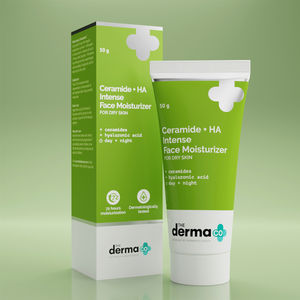
The Derma Co. Ceramide + HA Intense Daily Face Moisturizer with Ceramides & Hyaluronic Acid For Dry Skin - 50 gm

The Derma Co. Ceramide + HA Intense Daily Face Moisturizer with Ceramides & Hyaluronic Acid For Dry Skin - 50 gm
The Derma co.
the-derma-co-ceramide-ha-intense-daily-face-moisturizer-with-ceramides-hyaluronic-acid-for-dry-skin-50-gm
Moisturize
10084963254565
Morning or Evening?
How often will you use this product?
Notes


Highlights
WHAT IS IT?
Daily Face Moisturizer with Ceramides & Hyaluronic Acid; 2 key ingredients
FEATURES
Calms irritated skin; Slows skin aging; Hydrates for 72 hours; Locks in and replenishes moisture; Repairs skin damage; Dermatologically tested
BEST FOR
dry
CHECKS
No information on exclusions
Who Is It For?
No Specific Age Or Gender MentionedWhat Does It Help With?
Itchy Dry Skin Skin Aging Hydration Healing Dry Damaged Or Compromised SkinBudget
Affordable (under $30)How To Use
Which routine should it be used in?
Instructions:
Key Information

What The Derma co. Says
Product Description:
Itchy dry skin spoiling your day? Dermatologist-designed Ceramide + HA Intense Moisturizer calms irritated skin, slows skin aging, and hydrates for 72 hours. The Ceramide + HA Intense Moisturizer locks in and replenishes moisture levels to heal severely dry, damaged, or compromised skin. It offers 72 hours of moisturization. Ceramide & Hyaluronic Acid repairs skin damage and retains moisture while speeding up the healing process. Dermatologically tested, Ceramide + HA Intense Moisturizer is safe, potent, and highly efficacious.
About the Brand:
Ingredients Overview
Ingredients List
Purified Water, Glycerin, Sodium Storage: Acrylate/Sodium Acryloyldimethyl Taurate Copolymer (and) Hydrogenated Polydecene (and) Trideceth-6 (and) Sorbitan Laurate, Cetearyl Alcohol, Caprylic/Capric Triglyceride, Saccharide Isomerate (and) Aqua (and) Citric Acid (and) Sodium Citrate, Behenyl Alcohol, Sorbitan Stearate (and) Sorbityl Laurate, Cetearyl Alcohol (and) Dicetyl Phosphate (and) Ceteth-10 Phospahte, Cyclopentasiloxane (and) Phenyl Trimethicone (and) Dimethiconol (and) C12-15 Alkyl Benzoate (and) Dimethicone Crosspolymer, Phenoxyethanol (and) Ethylhexylglycerin, Xylitylglucoside (and) Anhydroxylitol (and) Xylitol, Avena sativa (Oat) kernel flour, Sodium Hyaluronate (and) Aqua (and) Phenoxyethanol, Panthenol, Ceramide 3; Ceramide 6 II; Ceramide 1; Phytosphingosine; Cholesterol; Sodium Lauroyl Lactylate; Carbomer; Xanthan Gum, Cholesterol, Disodium EDTA, Pentaerythrityl Tetra-di-t-butyl Hydroxyhydrocinnamate, Fragrance
Key Ingredients
Ceramide, Hyaluronic Acid
Ingredients Details
Behenyl Alcohol
Common Name(s): Behenyl alcohol,inci ingredient,cosmetic active
CAS Number: N/a
DESCRIPTION
What It Does: Provides documented cosmetic activity from behenyl alcohol.
Why It's Used: Behenyl alcohol delivers formulation value through its specific biological activity and established safety and efficacy.
How It Works: Source: behenyl alcohol. mechanism: documented in cosmetic literature. safety: cosing-reviewed. standard cosmetic use concentrations.
Typically Found In: Skin care formulations,active products
TECHNICAL DETAILS
Primary Category: Active ingredient – antioxidant
Secondary Functions: Free radical scavenging,anti-aging
Application Areas:

Facial Skincare
Body Care

Hair Care
Beard Care
Color Cosmetics (Makeup)
Dietary/Oral Supplements
Typical Concentration Range: 0.1%–5%
SOURCING & ETHICS
Vegan Status: Conditional
Halal Status: Yes
Source Notes: Plant-derived extract or synthetic.
SKIN COMPATIBILITY
Irritancy Rating: 1/5 – very low
Comedogenicity Rating: 0/5 – non-comedogenic
Sensitivity Concerns: Non-irritating; well-tolerated.
Safe for Sensitive Skin: Yes
SAFETY & COMPATIBILITY
Safety Profile: Excellent safety profile. ewg score: 1.
Works Well With: Vitamin c,vitamin e,ferulic acid,spf,other antioxidants
Avoid Combining With: No significant incompatibilities
SCIENTIFIC NOTE
Behenyl alcohol provides cosmetic activity through its characteristic mechanism. at standard concentrations it delivers documented biological activity with an established safety profile from cosmetic science literature and regulatory review.
Last Verified: Cosing database,behenyl alcohol technical literature
Primary Sources: 2026-03-12
Caprylic/capric Triglyceride
Common Name(s): Mct oil,fractionated coconut oil,c8/c10 triglyceride
CAS Number: 73398-61-5
DESCRIPTION
What It Does: Lightweight, stable emollient that solubilizes oil-soluble actives for excellent delivery without greasy feel.
Why It's Used: Universal lightweight emollient base and solubilizer for oil-soluble actives in serums and low-viscosity formulations where mineral oil or petrolatum would be too heavy.
How It Works: Medium-chain length provides ideal balance of spreading coefficient, penetration rate, and barrier-sealing properties. excellent solubilizer for vitamin e, retinoids, and other lipophilic actives.
Typically Found In: Serums,facial oils,sunscreens,anti-aging products,hair products
TECHNICAL DETAILS
Primary Category: Active ingredient – medium-chain triglyceride emollient
Secondary Functions: Active solubilizer,spreading agent
Application Areas:
Facial Skincare
Body Care
Hair Care
Beard Care
Color Cosmetics (Makeup)
Dietary/Oral Supplements
Typical Concentration Range: 1%–50%
SOURCING & ETHICS
Vegan Status: Yes – from coconut/palm kernel oil
Halal Status: Yes
Source Notes: Fractionated by hydrolysis and re-esterification of coconut oil. only c8 and c10 fatty acids retained.
SKIN COMPATIBILITY
Irritancy Rating: 1/5 – very low
Comedogenicity Rating: 1/5 – very low; medium-chain length generally non-comedogenic
Sensitivity Concerns: Non-irritating.
Safe for Sensitive Skin: Yes
SAFETY & COMPATIBILITY
Safety Profile: Excellent safety profile. ewg score: 1.
Works Well With: Humectants,ceramides,actives as carrier
Avoid Combining With: No significant incompatibilities
SCIENTIFIC NOTE
Mct oil's medium-chain length (c8/c10) provides superior oxidative stability vs longer polyunsaturated chains and better skin aesthetics (lighter, less greasy) vs longer chain emollients (c16/c18). excellent solubilizer for retinoic acid, tocopheryl esters, and other lipophilic actives.
Last Verified: Cosing database,cir safety assessment,ewg skin deep
Primary Sources: 2026-03-12
Cetearyl Alcohol
Common Name(s): Cetostearyl alcohol,c16-18 fatty alcohol
CAS Number: 8005-44-5
DESCRIPTION
What It Does: Provides fatty alcohol emulsification and thickening for stable, well-textured emulsions.
Why It's Used: The most widely used fatty alcohol in cosmetics – provides emulsification, thickening, and emolliency simultaneously from a single ingredient with excellent safety profile.
How It Works: Forms bilayer lamellar structures in water with emulsifiers creating a viscous structured network that thickens and stabilizes emulsions. fatty alcohol emolliency provides direct skin conditioning. bilayer formation reduces inter-droplet coalescence in emulsions.
Typically Found In: Creams,lotions,conditioners – virtually all emulsion products
TECHNICAL DETAILS
Primary Category: Functional ingredient – fatty alcohol emulsifier/thickener
Secondary Functions: Barrier sealing,softening
Application Areas:
Facial Skincare
Body Care
Hair Care
Beard Care
Color Cosmetics (Makeup)
Dietary/Oral Supplements
Typical Concentration Range: 1%–25%
SOURCING & ETHICS
Vegan Status: Yes – from vegetable or coconut/palm fatty acids
Halal Status: Yes
Source Notes: Plant-derived, synthetic or animal-derived. verify source.
SKIN COMPATIBILITY
Irritancy Rating: 1/5 – very low
Comedogenicity Rating: 1/5 – low; formulation-dependent
Sensitivity Concerns: Non-irritating.
Safe for Sensitive Skin: Yes
SAFETY & COMPATIBILITY
Safety Profile: Excellent safety profile. ewg score: 1.
Works Well With: Humectants,ceramides,actives as carrier
Avoid Combining With: No significant incompatibilities
SCIENTIFIC NOTE
Cetearyl alcohol's ability to form lamellar liquid crystal structures ('krafft phases') with water and co-emulsifiers provides not only emulsion stability but also enhanced skin penetration via the lamellar skin barrier pathway. these crystalline structures can act as a reservoir for active ingredients, slowly releasing them as the lamellar structure melts on skin contact.
Last Verified: Cosing database,cir safety assessment
Primary Sources: 2026-03-12
Cholesterol
Common Name(s): 5-cholesten-3-ol,cholesterin
CAS Number: 57-88-5
DESCRIPTION
What It Does: Provides essential barrier sterol function as one of three critical stratum corneum lipid components.
Why It's Used: Essential component of complete barrier repair formulations – the stratum corneum barrier requires ceramides:cholesterol:fatty acids in approximately 1:1:1 molar ratio for complete barrier restoration.
How It Works: Integrates between ceramide headgroups in lamellar body structures, providing fluidity and flexibility to the otherwise rigid ceramide-dominated lipid matrix. controls lamellar body phase behavior for functional barrier.
Typically Found In: Barrier repair moisturizers,eczema treatments,dry skin formulations
TECHNICAL DETAILS
Primary Category: Active ingredient – barrier sterol
Secondary Functions: Lamellar body structure,barrier sterol
Application Areas:
Facial Skincare
Body Care
Hair Care
Beard Care
Color Cosmetics (Makeup)
Dietary/Oral Supplements
Typical Concentration Range: 0.01%–1%
SOURCING & ETHICS
Vegan Status: Conditional – animal-derived (lanolin) or plant-derived phytosterol analogs; verify
Halal Status: Conditional – verify source
Source Notes: Traditionally from lanolin (wool grease). plant-derived cholesterol alternatives include phytosterols, though these show slightly different barrier integration. verify for vegan/halal.
SKIN COMPATIBILITY
Irritancy Rating: 1/5 – very low
Comedogenicity Rating: 0/5 – non-comedogenic
Sensitivity Concerns: Endogenous molecule; excellent tolerability.
Safe for Sensitive Skin: Yes
SAFETY & COMPATIBILITY
Safety Profile: Exceptional safety profile. natural skin component. ewg score: 1.
Works Well With: Other ceramides,cholesterol,free fatty acids,hyaluronic acid,niacinamide
Avoid Combining With: No significant incompatibilities
SCIENTIFIC NOTE
Elias demonstrated that barrier repair requires all three lipid classes (ceramides, cholesterol, fatty acids) in approximately equimolar ratios. formulations providing only ceramides without cholesterol and fatty acids show significantly inferior barrier restoration vs complete triple-lipid combinations.
Last Verified: Cosing database,elias et al. barrier lipid ratio study,loden barrier repair review
Primary Sources: 2026-03-12
