

The Derma co.
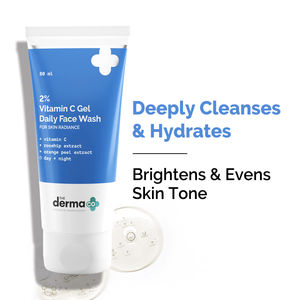
The Derma Co. 2% Vitamin C Gel Daily Face Wash with Vitamin C, Rosehip & Orange Peel Extract for Glowing Skin - 80 ml

The Derma Co. 2% Vitamin C Gel Daily Face Wash with Vitamin C, Rosehip & Orange Peel Extract for Glowing Skin - 80 ml
The Derma co.
the-derma-co-2-vitamin-c-gel-daily-face-wash-with-vitamin-c-rosehip-orange-peel-extract-for-glowing-skin-80-ml
Cleanse
10084779786533
Morning or Evening?
How often will you use this product?
Notes


Highlights
WHAT IS IT?
2% Vitamin C Gel Face Wash; 3 key ingredients (Vitamin C, Rosehip Extract, Orange Peel Extract)
FEATURES
Blend of Vitamin C, Rosehip Extract and Orange Peel Extract; Makes skin glow; Fades discolorations; Protects against pigmentation; Hydrates dry, itchy skin; Antibacterial and anti-inflammatory effects
BEST FOR
sensitive
CHECKS
Does not contain harmful chemicals (implied), hydration and soothing properties
Who Is It For?
All Genders; No Specific Age MentionedWhat Does It Help With?
Glowing Skin Hyperpigmentation Dry And Itchy Skin Pigmentation Protection Soothing InflammationBudget
Affordable (under $30)How To Use
Which routine should it be used in?
Instructions:
Key Information


What The Derma co. Says
Product Description:
Out with the old in with the NEW Glow all the way with The Derma Co 2 Vitamin C Gel Face Wash with a powerful blend of Vitamin C Rosehip Extract and Orange Peel Extract. Vitamin C works its magic to make your skin glow and banishes those pesky discolorations. Bid farewell to hyperpigmentation as this superhero ingredient shields your skin from future pigmentation battles. But wait there's more Enter Rosehip Extract which quenches dry and itchy skin revealing a captivating glow. It's like a refreshing sip of hydration for your skin making dryness and discomfort a thing of the past. And let's not forget Orange Peel Extract which with its antibacterial and antiinflammatory powers keeps your skin calm and soothed. Embrace this extraordinary fusion and unlock the door to the glowing healthy skin you've always dreamed of.
About the Brand:
Ingredients Overview
Ingredients List
Purified Water, Cocamidopropyl Betaine, Sodium Laureth-5 Carboxylate, Decyl Glucoside, Acrylates Copolymer, Coco Glucoside, Cocamide Monoethanolamine, Glycerin, Propanediol, Sodium Ascorbyl Phosphate, Polysorbate 20, Rosehip Extract, Orange Peel Extract, Citric Acid, Sodium Hydroxide, Methylchloroisothiazolinone & Methylisothiazolinone and Ethylenediaminetetraacetic acid
Key Ingredients
Vitamin C,Rosehip Extract,Orange Peel Extract
Ingredients Details
Acrylates Copolymer
Common Name(s): Acrylic copolymer,carbopol ez,flexible film former
CAS Number: 25133-97-5
DESCRIPTION
What It Does: Provides versatile acrylic film formation and thickening across broad ph range.
Why It's Used: Versatile workhorse polymer for film formation and thickening across diverse cosmetic product types from acidic aha serums to alkaline cleansers.
How It Works: Copolymer of acrylic acid and methacrylic acid esters. thickens via polymer chain entanglement and electrostatic repulsion. film formation from chain entanglement on water evaporation. broad ph stability from balanced acid/neutral monomer composition.
Typically Found In: Serums,lotions,sunscreens — versatile across formulation types
TECHNICAL DETAILS
Primary Category: Functional ingredient – acrylic film former
Secondary Functions: Skin conditioning
Application Areas:

Facial Skincare

Body Care
Hair Care
Beard Care
Color Cosmetics (Makeup)
Dietary/Oral Supplements
Typical Concentration Range: 0.1%–3%
SOURCING & ETHICS
Vegan Status: Yes – synthetic
Halal Status: Yes
Source Notes: Commercially produced for cosmetic use. verify vegan/halal status with supplier.
SKIN COMPATIBILITY
Irritancy Rating: 1/5 – very low
Comedogenicity Rating: 0/5 – non-comedogenic
Sensitivity Concerns: Well-tolerated by most skin types.
Safe for Sensitive Skin: Yes
SAFETY & COMPATIBILITY
Safety Profile: Good safety profile at recommended concentrations. ewg score: 1–2.
Works Well With: Standard skincare actives
Avoid Combining With: No known significant incompatibilities
SCIENTIFIC NOTE
Acrylates copolymers' broad ph thickening stability (vs carbomer's ph-sensitive thickening, requiring neutralisation for viscosity) enables thickening of acidic aha serums (ph 3-4) without neutralisation — maintaining the low ph required for aha efficacy while providing viscosity control. this acid-stable thickening is impossible with conventional carbomers.
Last Verified: Cosing database,cir safety assessment
Primary Sources: 2026-03-12
Citric Acid
Common Name(s): Lemon acid,2-hydroxypropane-1,2,3-tricarboxylic acid
CAS Number: 77-92-9
DESCRIPTION
What It Does: Adjusts ph to optimal ranges, chelates destabilizing metal ions, provides mild exfoliation at higher concentrations.
Why It's Used: Universal cosmetic ph adjuster and chelating agent. aha exfoliant activity is secondary.
How It Works: As ph adjuster, donates protons. as chelating agent, three carboxylic groups bind divalent metals (ca²⁺, mg²⁺, fe²⁺) preventing oxidative degradation.
Typically Found In: Nearly all cosmetic formulations,brightening products,exfoliants
TECHNICAL DETAILS
Primary Category: Active ingredient – alpha hydroxy acid (aha)
Secondary Functions: Chelating agent,ph adjustment,preservation enhancement
Application Areas:
Facial Skincare
Body Care
Hair Care
Beard Care
Color Cosmetics (Makeup)
Dietary/Oral Supplements
Typical Concentration Range: 0.1%–10%
SOURCING & ETHICS
Vegan Status: Yes – synthetic or fermentation-derived
Halal Status: Yes
Source Notes: Produced by fermentation of sugars by aspergillus niger. gras (e330). most abundant organic acid in citrus.
SKIN COMPATIBILITY
Irritancy Rating: 1/5 – very low at low concentrations; 2/5 at exfoliant concentrations
Comedogenicity Rating: 0/5 – non-comedogenic
Sensitivity Concerns: Photosensitizing – mandatory spf use. start at low frequency.
Safe for Sensitive Skin: Use with caution – spf required
SAFETY & COMPATIBILITY
Safety Profile: Safe at otc concentrations. eu: ≤10% leave-on at ph ≥3.5. mandatory spf advisory.
Works Well With: Niacinamide,ceramides,hyaluronic acid,spf
Avoid Combining With: Retinol in same step; multiple exfoliants simultaneously
SCIENTIFIC NOTE
Three carboxylic acid groups provide multiple proton donation sites and stronger chelation than monocarboxylic ahas. this makes citric acid the preferred cosmetic chelating agent alongside edta.
Last Verified: Cosing database,cir safety assessment,ewg skin deep
Primary Sources: 2026-03-12
Cocamidopropyl Betaine
Common Name(s): Capb,cocoamidopropyl betaine,coconut betaine
CAS Number: 61789-40-0
DESCRIPTION
What It Does: Boosts foam, enhances mildness, and conditions skin and hair when combined with primary surfactants.
Why It's Used: The standard foam booster and mildness enhancer in virtually all shampoos, body washes, and facial cleansers – provides synergistic mildness improvement with anionic surfactants.
How It Works: Amphoteric (zwitterionic) character provides positive charge interaction with hair keratin for antistatic conditioning. reduces irritation of co-formulated anionic surfactants via ionic complex formation. foam stabilization via bilayer reinforcement in foam lamellae.
Typically Found In: Shampoos,body washes,facial cleansers,baby products
TECHNICAL DETAILS
Primary Category: Functional ingredient – amphoteric surfactant
Secondary Functions: Skin conditioning
Application Areas:
Facial Skincare
Body Care
Hair Care
Beard Care
Color Cosmetics (Makeup)
Dietary/Oral Supplements
Typical Concentration Range: 2%–15%
SOURCING & ETHICS
Vegan Status: Yes – from coconut fatty acids and dimethylaminopropylamine
Halal Status: Yes
Source Notes: Commercially produced for cosmetic use. verify vegan/halal status with supplier.
SKIN COMPATIBILITY
Irritancy Rating: 1/5 – very low
Comedogenicity Rating: 0/5 – non-comedogenic
Sensitivity Concerns: Well-tolerated by most skin types.
Safe for Sensitive Skin: Yes
SAFETY & COMPATIBILITY
Safety Profile: Good safety profile at recommended concentrations. ewg score: 1–2.
Works Well With: Standard skincare actives
Avoid Combining With: No known significant incompatibilities
SCIENTIFIC NOTE
Capb's mildness-enhancing synergy with sls has a molecular mechanism: capb's positive imidazoline head group forms an ion pair complex with sls's anionic sulfate group, reducing sls's free monomer concentration (the irritation-causing species) without significantly reducing micelle-forming capacity (the cleansing species).
Last Verified: Cosing database,ananthapadmanabhan surfactant review,cir safety assessment
Primary Sources: 2026-03-12
Decyl Glucoside
Common Name(s): Capryl glucoside,apg surfactant,alkyl polyglucoside
CAS Number: 68515-73-1
DESCRIPTION
What It Does: Provides gentle non-ionic cleansing from natural glucose-derived surfactant chemistry.
Why It's Used: Leading natural-origin surfactant for green/natural formulations requiring gentle, non-ionic cleansing with excellent biodegradability credentials.
How It Works: Non-ionic surfactant with glucoside headgroup and decyl (c10) chain provides mild cleansing via micelle formation. non-ionic character provides lower irritation potential than anionic surfactants. fully biodegradable and from renewable sources.
Typically Found In: Natural cleansers,baby products,green beauty formulas,scalp cleansers
TECHNICAL DETAILS
Primary Category: Functional ingredient – alkyl glucoside surfactant
Secondary Functions: Skin conditioning
Application Areas:
Facial Skincare
Body Care
Hair Care
Beard Care
Color Cosmetics (Makeup)
Dietary/Oral Supplements
Typical Concentration Range: 2%–20%
SOURCING & ETHICS
Vegan Status: Yes – from glucose (plant) and fatty alcohols
Halal Status: Yes
Source Notes: Commercially produced for cosmetic use. verify vegan/halal status with supplier.
SKIN COMPATIBILITY
Irritancy Rating: 1/5 – very low
Comedogenicity Rating: 0/5 – non-comedogenic
Sensitivity Concerns: Well-tolerated by most skin types.
Safe for Sensitive Skin: Yes
SAFETY & COMPATIBILITY
Safety Profile: Good safety profile at recommended concentrations. ewg score: 1–2.
Works Well With: Standard skincare actives
Avoid Combining With: No known significant incompatibilities
SCIENTIFIC NOTE
Alkyl glucosides' (apgs) non-ionic character means they have no electrical charge that could interact with skin surface proteins and phospholipids – a key reason for their exceptional mildness. ionic surfactants (sulfates, carboxylates) bind to positively charged protein lysine/arginine residues causing denaturation; apgs have no such binding affinity.
Last Verified: Cosing database,cir safety assessment
Primary Sources: 2026-03-12
