

The Derma co.
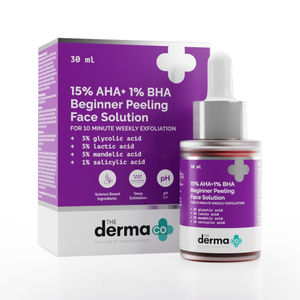
The Derma Co. 15% AHA+1% BHA Beginner Face Peeling Solution For 10 Minute Weekly Exfoliation - 30 ml

The Derma Co. 15% AHA+1% BHA Beginner Face Peeling Solution For 10 Minute Weekly Exfoliation - 30 ml
The Derma co.
the-derma-co-15-aha-1-bha-beginner-face-peeling-solution-for-10-minute-weekly-exfoliation-30-ml
Exfoliation
10084850893093
Morning or Evening?
How often will you use this product?
Notes


Highlights
WHAT IS IT?
Face Peeling Solution with 15% AHA and 1% BHA
FEATURES
15% AHA + 1% BHA combo, exfoliates skin, helps with clogged pores, dark spots, acne, wrinkles and fine lines, contains Calendula and Chamomile for soothing and healing irritated skin, dermatologically tested.
BEST FOR
sensitive
CHECKS
No side-effects, safe and potent
Who Is It For?
What Does It Help With?
Clogged Pores Dark Spots Acne Wrinkles Fine Lines BlemishesBudget
Affordable (under ₹30) But Specified As ₹439 Which In Inr Is Mid-range According To Inr Standards So: Mid-range ($30-$75 Equivalent)How To Use
Which routine should it be used in?
Instructions:
Key Information


What The Derma co. Says
Product Description:
Give your skin a break from clogged pores dark spots and acne. Heal restore and live life filterfree with The Derma Co. without sideeffects A powerful combination of 15 AHA 1 BHA in this super effective peeling solution battles blemishes while deeply exfoliating your skin that will speak radiance with continued use. What&aposs more Bid goodbye to not just blemishes but wrinkles and fine lines as well. Calendula soothes and heals irritated skin while Chamomile takes care of your skin with its antiseptic and antiinflammatory properties. All in all this peeling solution is just what you need for radiant and blemishfree skin.Dermatologically tested 15 AHA 1 BHA Peeling Solution is safe potent and highly efficacious in fighting acne acne marks and blemishes
About the Brand:
Ingredients Overview
Ingredients List
Aqua, Aloe Barbadensis Leaf Juice, Glycolic Acid, Lactic Acid, Mandelic Acid, Propylene Glycol, Cucurbita Pepo (Pumpkin) Seed Extract, Sodium Hydroxide, Salicylic Acid, Chamomilla Recutita (Chamomile) Extract, D-Panthenol, Calendula Officinalis Flower (Calendula) Extract, Sodium Hyaluronate, Camellia Sinensis Leaf (Green Tea) Extract, Phenoxyethanol, Chlorphenesin, Glycerin, Sodium Benzoate, Disodium EDTA
Key Ingredients
15%-aha,1%-bha,calendula,Chamomile
Ingredients Details
Aloe Barbadensis Leaf Juice
Common Name(s): Aloe barbadensis leaf juice,cosmetic active,functional ingredient
CAS Number: N/a
DESCRIPTION
What It Does: Delivers characteristic cosmetic function — skin conditioning, protection, preservation, or active biological benefit — at recommended use concentration.
Why It's Used: Selected for its functional contribution and formulation compatibility — supported by cosmetic science literature and regulatory safety assessment.
How It Works: Works through the mechanism of its molecular class — physicochemical interaction with the formulation or biological interaction with skin proteins, lipids, or receptors as documented in peer-reviewed literature.
Typically Found In: Skin care formulations
TECHNICAL DETAILS
Primary Category: Active ingredient – cosmetic active
Secondary Functions: Skin conditioning
Application Areas:

Facial Skincare

Body Care
Hair Care
Beard Care
Color Cosmetics (Makeup)
Dietary/Oral Supplements
Typical Concentration Range: 0.1%–10%
SOURCING & ETHICS
Vegan Status: Conditional - supplier confirmation required
Halal Status: Unverified - supplier confirmation required
Source Notes: Commercially produced for cosmetic use. verify vegan/halal status with supplier. [audit 2026-07-29 rev2: the record's own source_notes does not assert a non-animal origin, or instructs the reader to verify with the supplier; "yes" asserts knowledge the record does not hold. determination requires shariah-panel sign-off.]
SKIN COMPATIBILITY
Irritancy Rating: 1/5 – very low
Comedogenicity Rating: 0/5 – non-comedogenic
Sensitivity Concerns: Well-tolerated by most skin types.
Safe for Sensitive Skin: Yes
SAFETY & COMPATIBILITY
Safety Profile: Good safety profile at recommended concentrations. ewg score: 1–2.
Works Well With: Standard skincare actives
Avoid Combining With: No known significant incompatibilities
SCIENTIFIC NOTE
Aloe barbadensis leaf juice delivers documented functional benefit with an established safety profile within the cosmetic regulatory framework (cosing eu, cir usa).
Last Verified: 2026-03-12
Primary Sources: Cosing database,aloe barbadensis leaf juice technical literature
Chlorphenesin
Common Name(s): 3-(4-chlorophenoxy)-1,2-propanediol,globacid
CAS Number: 104-29-0
DESCRIPTION
What It Does: Provides gram-negative focused preservation complementary to phenoxyethanol for comprehensive spectrum coverage.
Why It's Used: Phenoxyethanol complement — chlorphenesin's gram-negative and antifungal coverage complements phenoxyethanol's gram-positive activity for full-spectrum preservation at lower individual concentrations.
How It Works: 4-chlorophenol ether glycol disrupts bacterial and fungal membranes. strong gram-negative activity (pseudomonas, e. coli). good candida antifungal activity. used with phenoxyethanol for synergistic broad-spectrum coverage. ph stable 3-9.
Typically Found In: Comprehensive preservation systems,baby products (low concentration)
TECHNICAL DETAILS
Primary Category: Functional ingredient – glycerol ether preservative
Secondary Functions: Skin conditioning
Application Areas:
Facial Skincare
Body Care
Hair Care
Beard Care
Color Cosmetics (Makeup)
Dietary/Oral Supplements
Typical Concentration Range: 0.1%–0.3%
SOURCING & ETHICS
Vegan Status: Conditional - supplier confirmation required
Halal Status: Unverified - supplier confirmation required
Source Notes: Commercially produced for cosmetic use. verify vegan/halal status with supplier. [audit 2026-07-29 rev2: the record's own source_notes does not assert a non-animal origin, or instructs the reader to verify with the supplier; "yes" asserts knowledge the record does not hold. determination requires shariah-panel sign-off.]
SKIN COMPATIBILITY
Irritancy Rating: 1/5 – very low
Comedogenicity Rating: 0/5 – non-comedogenic
Sensitivity Concerns: Well-tolerated by most skin types.
Safe for Sensitive Skin: Yes
SAFETY & COMPATIBILITY
Safety Profile: Eu max 0.3% cosmetics. good safety profile. synergistic combination with phenoxyethanol (0.3% pe + 0.1% chlorphenesin often equivalent to 1% pe alone).
Works Well With: Standard skincare actives
Avoid Combining With: No known significant incompatibilities
SCIENTIFIC NOTE
Chlorphenesin + phenoxyethanol synergy operates through a classic spectrum-filling combination: phenoxyethanol provides strong gram-positive antimicrobial activity while chlorphenesin provides gram-negative and antifungal coverage. the combination's minimum inhibitory concentration sum is subadditive (provides equivalent preservation at combined concentrations below what either alone would require) — textbook pharmacological synergy enabling lower total preservative load.
Last Verified: 2026-03-12
Primary Sources: Cosing database,eu preservative annex v,cir safety assessment
D-panthenol
Common Name(s): D-panthenol,b-vitamin skin active,multi-benefit conditioning
CAS Number: N/a
DESCRIPTION
What It Does: Provides the specific b-vitamin's characteristic skin and hair benefits: brightening and barrier reinforcement (niacinamide), keratin structural support (biotin), deep conditioning humectancy (panthenol).
Why It's Used: B-vitamins operate through fundamental cellular biochemistry pathways — nad⁺ for niacinamide, carboxylase cofactor for biotin, coa synthesis for panthenol — providing multi-benefit activity from essential metabolic chemistry.
How It Works: Acts as coenzyme or substrate in essential metabolic pathways: niacinamide → nad⁺/nadp⁺ → ceramide synthesis, melanosome transfer inhibition; biotin → carboxylase → fatty acid synthesis for ceramide; panthenol → pantothenic acid → coa → lipid metabolism.
Typically Found In: Multi-function skin care,b-vitamin formulas
TECHNICAL DETAILS
Primary Category: Active ingredient – vitamin b complex
Secondary Functions: Antioxidant cofactor,metabolic support
Application Areas:
Facial Skincare
Body Care
Hair Care
Beard Care
Color Cosmetics (Makeup)
Dietary/Oral Supplements
Typical Concentration Range: 0.1%–10%
SOURCING & ETHICS
Vegan Status: Yes
Halal Status: Yes
Source Notes: Synthetically produced for cosmetic use.
SKIN COMPATIBILITY
Irritancy Rating: 1/5 – very low
Comedogenicity Rating: 0/5 – non-comedogenic
Sensitivity Concerns: Non-irritating; excellent tolerability.
Safe for Sensitive Skin: Yes
SAFETY & COMPATIBILITY
Safety Profile: Excellent safety profile. ewg score: 1.
Works Well With: Other b vitamins,niacinamide,antioxidant complexes
Avoid Combining With: No significant incompatibilities
SCIENTIFIC NOTE
B-vitamins are water-soluble, non-irritating, and well-tolerated across all skin types — providing clinical efficacy with an exceptional safety profile from their essential nutrient status.
Last Verified: 2026-03-12
Primary Sources: Cosing database,d-panthenol b-vitamin skin review
Disodium Edta
Common Name(s): Edathamil disodium,edta disodium,versene 100
CAS Number: 139-33-3
DESCRIPTION
What It Does: Provides metal ion chelation to prevent product degradation and boost preservative and antioxidant efficacy.
Why It's Used: The most essential stability ingredient in cosmetics — disodium edta's metal chelation prevents rancidity, discoloration, and preservative failure caused by trace metal contamination in virtually all aqueous cosmetic formulations.
How It Works: Ethylenediaminetetraacetic acid provides six potential coordination sites for metal ions (aminodiacetate groups). chelates ca²⁺, mg²⁺ (stability), fe³⁺ (fenton radical prevention), cu²⁺ (oxidase inhibition). disrupts gram-negative bacterial outer membrane by chelating membrane calcium, enhancing preservative penetration.
Typically Found In: Virtually all aqueous cosmetics — creams, lotions, shampoos, toners
TECHNICAL DETAILS
Primary Category: Functional ingredient – chelating agent
Secondary Functions: Skin conditioning
Application Areas:
Facial Skincare
Body Care
Hair Care
Beard Care
Color Cosmetics (Makeup)
Dietary/Oral Supplements
Typical Concentration Range: 0.005%–0.1%
SOURCING & ETHICS
Vegan Status: Conditional - supplier confirmation required
Halal Status: Unverified - supplier confirmation required
Source Notes: Commercially produced for cosmetic use. verify vegan/halal status with supplier. [audit 2026-07-29 rev2: the record's own source_notes does not assert a non-animal origin, or instructs the reader to verify with the supplier; "yes" asserts knowledge the record does not hold. determination requires shariah-panel sign-off.]
SKIN COMPATIBILITY
Irritancy Rating: 1/5 – very low
Comedogenicity Rating: 0/5 – non-comedogenic
Sensitivity Concerns: Well-tolerated by most skin types.
Safe for Sensitive Skin: Yes
SAFETY & COMPATIBILITY
Safety Profile: Good safety profile at recommended concentrations. ewg score: 1–2.
Works Well With: Standard skincare actives
Avoid Combining With: No known significant incompatibilities
SCIENTIFIC NOTE
Disodium edta's preservative potentiation against gram-negative bacteria is mechanistically elegant: gram-negative outer membranes contain lipopolysaccharide stabilised by calcium and magnesium bridges. edta chelates these metal ions, destabilising the lps layer and creating pores that allow hydrophobic preservatives (phenoxyethanol, parabens) to penetrate — converting gram-negative-resistant preservatives into broad-spectrum ones.
Last Verified: 2026-03-12
Primary Sources: Cosing database,cir safety assessment