

The Derma co.
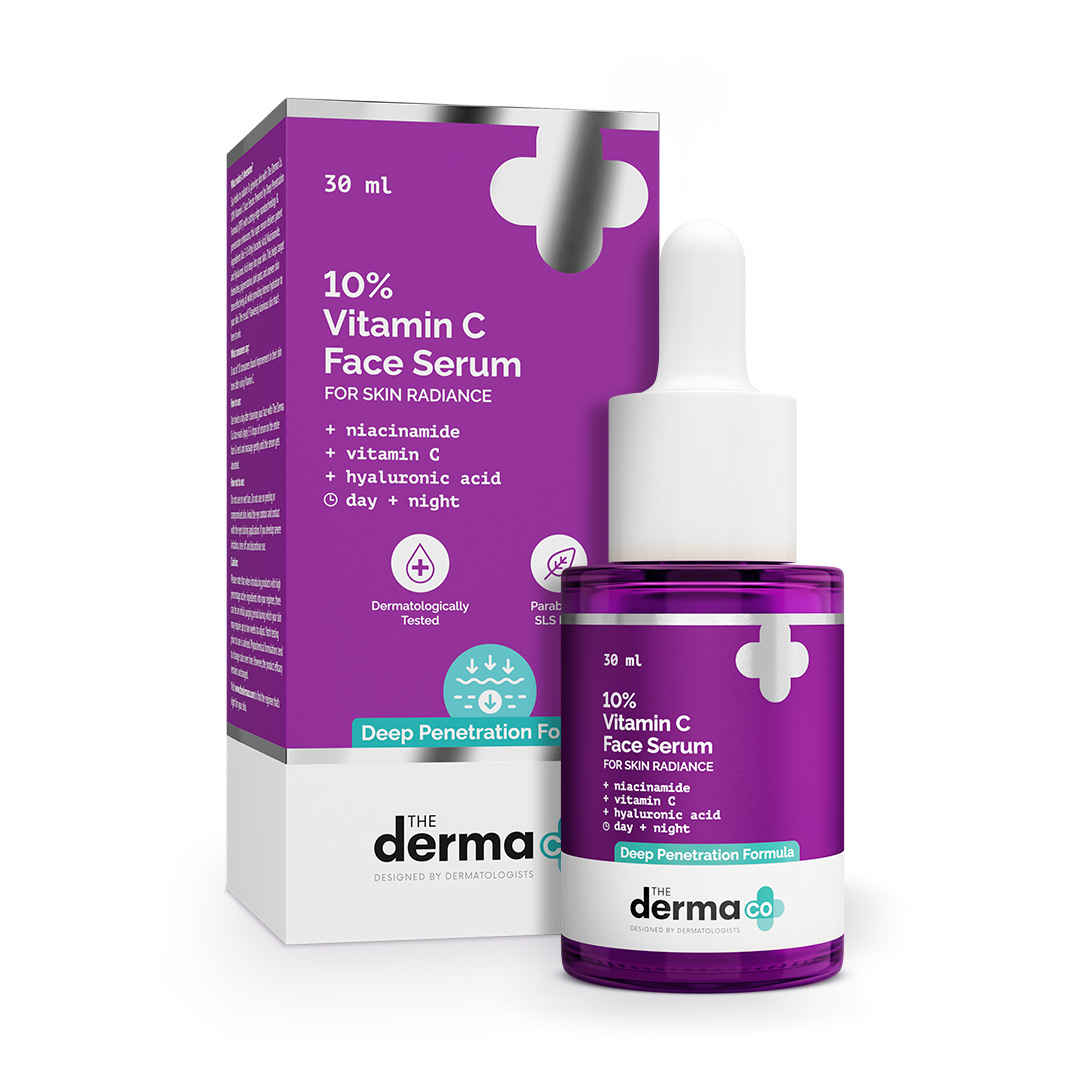
The Derma Co. 10% Vitamin C Face Serum with 5% Niacinamide & Hyaluronic Acid For Skin Radiance - 30 ml

The Derma Co. 10% Vitamin C Face Serum with 5% Niacinamide & Hyaluronic Acid For Skin Radiance - 30 ml
The Derma co.
the-derma-co-10-vitamin-c-face-serum-with-5-niacinamide-hyaluronic-acid-for-skin-radiance-30-ml
Serum
10084762419493
Morning or Evening?
How often will you use this product?
Notes


Highlights
WHAT IS IT?
Face Serum with 3 main active ingredients
FEATURES
Glowing skin, helps with blemishes, pigmentation, dark spots, uneven skin tone
BEST FOR
all skin types (not explicitly mentioned but inferred from ingredients and benefits)
CHECKS
does not contain parabens, silicones, sulfates, microplastics (typical for sensitive and non-comedogenic products but not explicitly listed so left blank)
Who Is It For?
No Explicit Age Or Gender GivenWhat Does It Help With?
Blemishes Pigmentation Dark Spots Uneven Skin Tone Skin RadianceBudget
Mid-range ($30-$75)How To Use
Which routine should it be used in?
Instructions:
Key Information


What The Derma co. Says
Product Description:
The Derma Co. 10 Vitamin C Face serum is just what your skin needs for a glow that makes heads turn. With this super combination of 3-O-Ethyl Ascorbic Acid, Niacinamide & Hyaluronic Acid bid goodbye to blemishes, pigmentation, dark spots and uneven skin tone. Its time to go filter-free in your next selfie and ace the skincare game.
About the Brand:
Ingredients Overview
Ingredients List
Purified Water, Propanediol, 3-O-Ethyl Ascorbic Acid, Niacinamide, Diethylene Glycol Monoethyl Ether, Sodium Hyaluronate, Hydroxyethylcellulose, Ferulic Acid, Sodium Gluconate, Ethylhexylglycerin, Phenoxyethanol
Key Ingredients
3-O-Ethyl Ascorbic Acid,Niacinamide,Hyaluronic Acid
Ingredients Details
3-o-ethyl Ascorbic Acid
Common Name(s): 3-o-ethyl ascorbic acid
DESCRIPTION
What It Does: Loosens corneocyte adhesion in the stratum corneum, accelerating cell turnover, refining skin texture, and improving radiance.
Why It's Used: Organic acids at cosmetic ph values provide controlled keratolytic exfoliation that improves skin texture, pore appearance, and radiance without mechanical irritation.
How It Works: At appropriate ph, the acid's undissociated form penetrates the stratum corneum and dissolves the ionic bonds between corneocyte desmosomes (calcium chelation mechanism), facilitating controlled desquamation and cell renewal.
Typically Found In: Toners,exfoliants,serums,peels,cleansers
TECHNICAL DETAILS
Primary Category: Exfoliants
Secondary Functions: Brightening,keratolytic
Application Areas:

Facial Skincare

Body Care
Hair Care
Beard Care
Color Cosmetics (Makeup)
Dietary/Oral Supplements
Typical Concentration Range: 0.5–20%
SOURCING & ETHICS
Vegan Status: Yes
Halal Status: Yes
Source Notes: Synthetic or plant-derived acid; no animal components.
SKIN COMPATIBILITY
Irritancy Rating: 2
Comedogenicity Rating: 0
Sensitivity Concerns: May cause irritation or stinging in sensitive or barrier-compromised skin at high concentrations; patch test recommended.
Safe for Sensitive Skin: Conditional
SAFETY & COMPATIBILITY
Safety Profile: Safe within recommended ph and concentration ranges. sensitization risk increases above 10% aha. patch test recommended for sensitive skin. mildly irritating to some individuals at typical cosmetic use concentrations.
Works Well With: Niacinamide,hyaluronic acid,ceramides,vitamin c
Avoid Combining With: High concentrations on sensitive/broken skin; avoid with physical exfoliants
SCIENTIFIC NOTE
Cosmetic acids function at the pka boundary: only the undissociated acid (rcooh) penetrates the stratum corneum lipid barrier, while the ionized carboxylate (rcoo⁻) does not. the henderson-hasselbalch equation governs the fraction of active species at formulation ph; typically 0.5–3.0% undissociated acid provides efficacy while minimizing irritation.
Last Verified: 2025-01-15
Primary Sources: Cosing eu database; pcpc cosmetic ingredient safety reviews; ingredient-specific safety and efficacy literature
Ethylhexylglycerin
Common Name(s): Octylglycerin,2-ethylhexyl glycerol ether,sensiva sc 10
CAS Number: 70445-33-9
DESCRIPTION
What It Does: Provides antimicrobial skin conditioning with deodorant activity and preservation system enhancement.
Why It's Used: Multifunctional clean beauty preservation active — ethylhexylglycerin provides antimicrobial, deodorant, and skin conditioning in a single ingredient accepted in most natural cosmetic certification schemes.
How It Works: Glycerol ether provides antimicrobial via bacterial membrane phospholipid disruption. deodorant activity via reduction of underarm lipase enzyme activity (similar mechanism to triethyl citrate). skin conditioning from glycerol humectant component. synergistic with phenoxyethanol and diols.
Typically Found In: Natural preservation systems,deodorants,skin conditioning products
TECHNICAL DETAILS
Primary Category: Functional ingredient – antimicrobial glycerol ether
Secondary Functions: Skin conditioning
Application Areas:
Facial Skincare
Body Care
Hair Care
Beard Care
Color Cosmetics (Makeup)
Dietary/Oral Supplements
Typical Concentration Range: 0.1%–0.5%
SOURCING & ETHICS
Vegan Status: Conditional - supplier confirmation required
Halal Status: Unverified - supplier confirmation required
Source Notes: Commercially produced for cosmetic use. verify vegan/halal status with supplier. [audit 2026-07-29 rev2: the record's own source_notes does not assert a non-animal origin, or instructs the reader to verify with the supplier; "yes" asserts knowledge the record does not hold. determination requires shariah-panel sign-off.]
SKIN COMPATIBILITY
Irritancy Rating: 1/5 – very low
Comedogenicity Rating: 0/5 – non-comedogenic
Sensitivity Concerns: Well-tolerated by most skin types.
Safe for Sensitive Skin: Yes
SAFETY & COMPATIBILITY
Safety Profile: Good safety profile at recommended concentrations. ewg score: 1–2.
Works Well With: Standard skincare actives
Avoid Combining With: No known significant incompatibilities
SCIENTIFIC NOTE
Ethylhexylglycerin's deodorant mechanism is pharmacologically identical to triethyl citrate: both inhibit skin surface microbial lipase enzymes that convert odourless triglycerides to odorous free fatty acids. the glycerol ether structure of ethylhexylglycerin, combined with the 2-ethylhexyl chain, provides lipase inhibition similar to ester-based lipase inhibitors from a different chemical class.
Last Verified: 2026-03-12
Primary Sources: Cosing database,schülke sensiva sc 10 technical data,cir safety assessment
Ferulic Acid
Common Name(s): 4-hydroxy-3-methoxycinnamic acid,coniferic acid
CAS Number: 1135-24-6
DESCRIPTION
What It Does: Doubles vitamin c and e efficacy through synergistic stabilization, providing superior photoprotection.
Why It's Used: Essential in vitamin c serums as the c+e+ferulic acid synergistic antioxidant trio that provides exceptional photoprotection – a clinically proven combination.
How It Works: Phenolic structure provides direct free radical scavenging. also stabilizes l-ascorbic acid and tocopherol by donating hydrogen atoms to regenerate oxidized antioxidants. absorbs uv (290–330nm) providing additional photoprotection.
Typically Found In: Vitamin c serums,antioxidant complexes,sunscreens,anti-aging products
TECHNICAL DETAILS
Primary Category: Active ingredient – hydroxycinnamic acid antioxidant
Secondary Functions: Vitamin c synergist,uv absorber,antioxidant stabilizer
Application Areas:
Facial Skincare
Body Care
Hair Care
Beard Care
Color Cosmetics (Makeup)
Dietary/Oral Supplements
Typical Concentration Range: 0.5%–1%
SOURCING & ETHICS
Vegan Status: Yes – plant-derived (wheat, rice bran, oats)
Halal Status: Yes
Source Notes: Extracted from ferulic acid-rich plant sources (wheat bran, rice bran, sweet corn) or synthetically produced.
SKIN COMPATIBILITY
Irritancy Rating: 1/5 – very low
Comedogenicity Rating: 0/5 – non-comedogenic
Sensitivity Concerns: Non-irritating; well-tolerated.
Safe for Sensitive Skin: Yes
SAFETY & COMPATIBILITY
Safety Profile: Excellent safety profile. ewg score: 1.
Works Well With: Vitamin c,vitamin e,ferulic acid,spf,other antioxidants
Avoid Combining With: No significant incompatibilities
SCIENTIFIC NOTE
Pinnell et al. demonstrated that the combination of 15% vitamin c + 1% vitamin e + 0.5% ferulic acid provides 8× superior photoprotection to vitamin c alone. ferulic acid stabilizes ascorbic acid by donating electrons, preventing oxidative degradation.
Last Verified: 2026-03-12
Primary Sources: Cosing database,pinnell et al. (2005) ce ferulic study,murray et al. antioxidant synergy
Hydroxyethylcellulose
Common Name(s): Hec,natrosol,ethylhydroxyethylcellulose
CAS Number: 9004-62-0
DESCRIPTION
What It Does: Provides non-ionic thickening compatible with anionic surfactants and electrolyte-containing formulations.
Why It's Used: Non-ionic cellulose thickener for surfactant systems where anionic/cationic thickener incompatibility is a concern.
How It Works: Hydroxyethyl substitution disrupts cellulose crystallinity enabling water solubility. non-ionic nature provides compatibility with anionic, cationic, and amphoteric surfactants. pseudoplastic rheology provides shear-thinning for dispensing. film formation from cellulose backbone.
Typically Found In: Shampoos,body washes,clear gels,surfactant systems
TECHNICAL DETAILS
Primary Category: Functional ingredient – cellulose thickener
Secondary Functions: Tewl reduction,skin plumping
Application Areas:
Facial Skincare
Body Care
Hair Care
Beard Care
Color Cosmetics (Makeup)
Dietary/Oral Supplements
Typical Concentration Range: 0.1%–3%
SOURCING & ETHICS
Vegan Status: Conditional - supplier confirmation required
Halal Status: Unverified - supplier confirmation required
Source Notes: Synthetic or naturally derived. excellent aqueous solubility. [audit 2026-07-29 rev2: status downgraded on audit. determination requires shariah-panel sign-off.]
SKIN COMPATIBILITY
Irritancy Rating: 1/5 – very low
Comedogenicity Rating: 0/5 – non-comedogenic
Sensitivity Concerns: Non-irritating; suitable for all skin types.
Safe for Sensitive Skin: Yes
SAFETY & COMPATIBILITY
Safety Profile: Excellent safety profile. ewg score: 1.
Works Well With: Ceramides,emollients,occlusives,glycerin,hyaluronic acid
Avoid Combining With: No significant incompatibilities
SCIENTIFIC NOTE
Hydroxyethylcellulose's non-ionic character is its primary differentiator from anionic carboxymethylcellulose – the absence of ionizable groups means hec maintains stable viscosity across ph 2-12 and at high electrolyte concentrations where carboxymethylcellulose destabilizes. this ionic independence makes hec the preferred cellulose thickener for acidic and salt-containing formulations.
Last Verified: 2026-03-12
Primary Sources: Cosing database,ashland hec technical data,cir safety assessment