
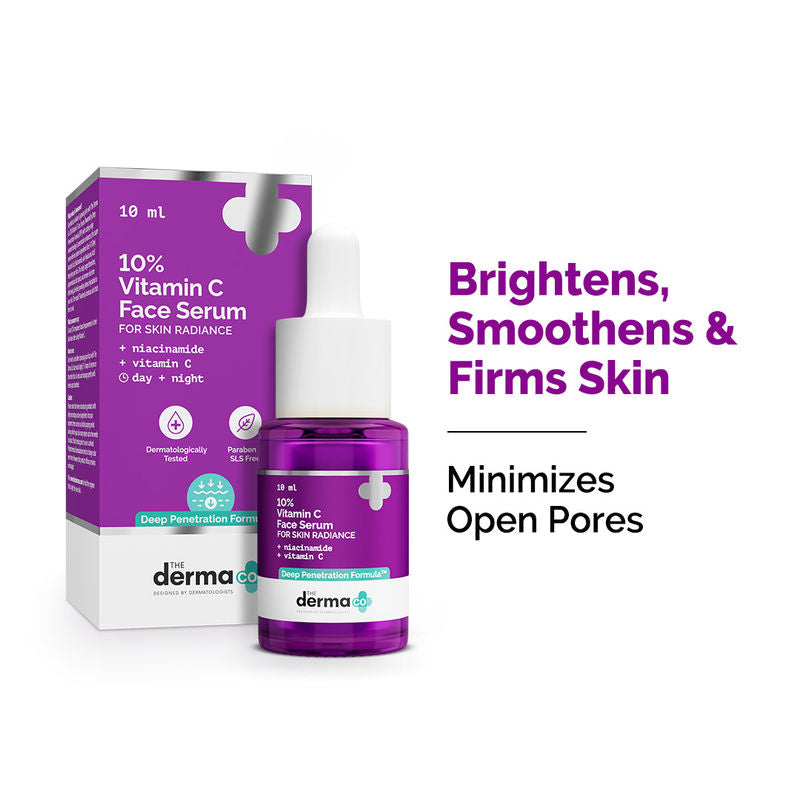

The Derma Co
The Derma Co 10% Vitamin C Face Serum Reduces Pigmentation & Glowing Skin For All Skin Types

The Derma Co 10% Vitamin C Face Serum Reduces Pigmentation & Glowing Skin For All Skin Types
The Derma Co
the-derma-co-10-vitamin-c-face-serum-reduces-pigmentation-glowing-skin-for-all-skin-types
Serum
10084930027813
Morning or Evening?
How often will you use this product?
Notes


Highlights
WHAT IS IT?
Face serum with multiple active ingredients
FEATURES
Fades dark spots, reduces pigmentation, boosts collagen, brightens skin, enhances glow
BEST FOR
all
CHECKS
Does not contain sulfates, parabens, silicones mentioned explicitly.
Who Is It For?
All Genders Adult SkinWhat Does It Help With?
Pigmentation Blemishes Dark Spots Uneven Skin Tone Hydration Fine Lines WrinklesBudget
Affordable (under $30)How To Use
Which routine should it be used in?
Instructions:
Key Information


What The Derma Co Says
Product Description:
Say hello to radiant, glowing skin with the same trusted Derma Co. 10% Vitamin C Face Serum, now supercharged with a brand-new formula! Powered by the advanced Deep Penetration Formula (DPF), featuring cutting-edge nanotechnology and penetration enhancers, this upgraded serum delivers powerful ingredients like 3-O-ethyl ascorbic acid, niacinamide, and hyaluronic acid even deeper into your skin. It targets blemishes, pigmentation, dark spots, and uneven skin tone while keeping your skin intensely hydrated. The result? Bright, spotless, and luminous skin that’s ready to shine! Features: Fades dark spots and reduces pigmentation by blocking melanin production, resulting in a more even, radiant complexion. Boosts collagen for youthful skin with vitamin C, niacinamide, and ferulic acid to stimulate collagen production for firmer and plumper skin. Brightens skin and enhances glow, safe and effective for regular use.
About the Brand:
Ingredients Overview
Ingredients List
Aqua,3-O-Ethyl-Ascorbic-Acid,1,3-Propanediol,Ethoxydiglycol,Niacinamide,Pentylene-Glycol,Methylpropanediol,Glycerin,Dimethyl-Isosorbide,L-Ascorbic-Acid,Sodium-Hyaluronate,Ferulic-Acid,Gluconolactone,Sodium-benzoate,Sodium-phytate,Sclerotium-Gum,Tris(Tetramethylhydroxypiperidinol)-Citrate,Calcium-Gluconate,Sodium-Starch-Octenylsuccinate,Citric-Acid,Hydrated-Silica,Sodium-Metabisulphite
Key Ingredients
3-O-Ethyl Ascorbic Acid, Niacinamide, Hyaluronic Acid, Ferulic Acid
Ingredients Details
Ethoxydiglycol
Common Name(s): Ethoxydiglycol,glycol co-solvent,humectant formulation aid
CAS Number: N/a
DESCRIPTION
What It Does: Provides co-solvent and penetration enhancer in cosmetic formulations, improving active ingredient dissolution and product texture while delivering mild skin conditioning.
Why It's Used: Glycol solvents are essential for dissolving actives with limited water or oil solubility — the intermediate polarity of glycol ethers provides access to the wider solubility parameter space between pure water and oil phases.
How It Works: Hydroxyl and ether groups provide h-bonding for water miscibility; the organic chain provides compatibility with lipophilic actives. medium-chain glycols (c3–c6) provide the optimal balance of water compatibility, lipophilic active dissolution, and skin-compatible humectancy.
Typically Found In: Skin care formulations,co-solvent systems
TECHNICAL DETAILS
Primary Category: Functional ingredient – humectant
Secondary Functions: Tewl reduction,skin plumping
Application Areas:

Facial Skincare
Body Care
Hair Care

Beard Care
Color Cosmetics (Makeup)
Dietary/Oral Supplements
Typical Concentration Range: 1%–30%
SOURCING & ETHICS
Vegan Status: Conditional - supplier confirmation required
Halal Status: Unverified - supplier confirmation required
Source Notes: Synthetic or naturally derived. excellent aqueous solubility. [audit 2026-07-29 rev2: status downgraded on audit. determination requires shariah-panel sign-off.]
SKIN COMPATIBILITY
Irritancy Rating: 1/5 – very low
Comedogenicity Rating: 0/5 – non-comedogenic
Sensitivity Concerns: Non-irritating; suitable for all skin types.
Safe for Sensitive Skin: Yes
SAFETY & COMPATIBILITY
Safety Profile: Excellent safety profile. ewg score: 1.
Works Well With: Ceramides,emollients,occlusives,glycerin,hyaluronic acid
Avoid Combining With: No significant incompatibilities
SCIENTIFIC NOTE
Glycol ether co-solvents enhance sc penetration of co-applied actives by increasing their thermodynamic activity in the sc lipid phase — high thermodynamic activity (near saturation) drives diffusion by concentration gradient even when absolute concentration is low.
Last Verified: 2026-03-12
Primary Sources: Cosing database,ethoxydiglycol glycol solvent review
Gluconolactone
Common Name(s): D-gluconolactone,delta-gluconolactone
CAS Number: 90-80-2
DESCRIPTION
What It Does: Provides the gentlest chemical exfoliation with simultaneous antioxidant, moisture retention, and barrier support.
Why It's Used: Preferred exfoliant for rosacea, eczema, sensitive skin, and post-procedure recovery where standard ahas cause unacceptable irritation.
How It Works: Hydrolyzes slowly on skin surface to gluconic acid providing gentle exfoliation. multiple hydroxyl groups enable water binding (humectant) and metal chelation (antioxidant).
Typically Found In: Sensitive skin exfoliants,rosacea treatments,eczema care,post-procedure recovery
TECHNICAL DETAILS
Primary Category: Active ingredient – polyhydroxy acid (pha)
Secondary Functions: Gentle exfoliation,antioxidant,humectant
Application Areas:
Facial Skincare
Body Care
Hair Care
Beard Care
Color Cosmetics (Makeup)
Dietary/Oral Supplements
Typical Concentration Range: 5%–15%
SOURCING & ETHICS
Vegan Status: Conditional - supplier confirmation required
Halal Status: Unverified - supplier confirmation required
Source Notes: Fermentation-derived from glucose or synthetic. among the safest chemical exfoliants available. [audit 2026-07-29 rev2: status downgraded on audit. determination requires shariah-panel sign-off.]
SKIN COMPATIBILITY
Irritancy Rating: 1/5 – very low
Comedogenicity Rating: 0/5 – non-comedogenic
Sensitivity Concerns: No photosensitization; no stinging; suitable for very sensitive skin.
Safe for Sensitive Skin: Yes – ideal for sensitive, reactive, rosacea, and eczema-prone skin; no photosensitization
SAFETY & COMPATIBILITY
Safety Profile: Exceptional safety profile. no photosensitization. ewg score: 1.
Works Well With: Ceramides,niacinamide,hyaluronic acid,soothing actives
Avoid Combining With: No significant incompatibilities
SCIENTIFIC NOTE
Phas have molecular weights 2–3× larger than ahas, limiting penetration to superficial layers. combined humectant and antioxidant properties make them uniquely well-tolerated while providing meaningful exfoliation.
Last Verified: 2026-03-12
Primary Sources: Cosing database,green & yu (2003) pha review,cir safety assessment
Glycerin
Common Name(s): Glycerol,glycerine,1,2,3-propanetriol
CAS Number: 56-81-5
DESCRIPTION
What It Does: Glycerin pulls water from the environment and deeper skin layers into the outer skin layer (epidermis), boosting moisture levels and keeping skin soft, smooth, and plump.
Why It's Used: It is used in virtually every moisturizer, serum, and cleanser because it is highly effective at hydrating skin, is well-tolerated by all skin types, and enhances the texture and spreadability of formulations.
How It Works: As a humectant, glycerin forms hydrogen bonds with water molecules, trapping them in the skin. it also reinforces the skin barrier by integrating into lipid structures between skin cells.
Typically Found In: Moisturizers,serums,cleansers,toners,sheet masks,sunscreens,body lotions,shampoos,conditioners
TECHNICAL DETAILS
Primary Category: Humectant
Secondary Functions: Skin barrier support,emollient,solvent
Application Areas:
Facial Skincare
Body Care
Hair Care
Beard Care
Color Cosmetics (Makeup)
Dietary/Oral Supplements
Typical Concentration Range: 1%–30% (typical: 3–10%)
SOURCING & ETHICS
Vegan Status: Conditional - feedstock declaration required
Halal Status: Unverified - feedstock declaration required (plant, animal and petrochemical routes all exist)
Source Notes: Derived from plant oils via hydrolysis or saponification; synthetic versions also available. palm-derived glycerin carries sustainability concerns. [audit 2026-07-29 rev2: origin-dependent: the same inci exists in plant, animal and petrochemical versions and the name does not discriminate. determination requires shariah-panel sign-off.]
SKIN COMPATIBILITY
Irritancy Rating: 1/5 – very low; non-irritating at all standard concentrations
Comedogenicity Rating: 0/5 – non-comedogenic
Sensitivity Concerns: Extremely rare allergic reactions; generally safe for all skin types including sensitive and baby skin
Safe for Sensitive Skin: Yes
SAFETY & COMPATIBILITY
Safety Profile: Widely recognized as safe. ewg hazard score: 1. no significant concerns for irritation, sensitization, or toxicity at typical concentrations (up to 50%).
Works Well With: Hyaluronic acid,ceramides,niacinamide,panthenol,urea,peptides,retinol,ahas/bhas
Avoid Combining With: No known incompatibilities at standard concentrations
SCIENTIFIC NOTE
Glycerin is an endogenous skin component found naturally in the stratum corneum. aquaporin-3 channels in keratinocytes facilitate glycerin transport, making it integral to natural skin hydration pathways.
Last Verified: 2026-03-12
Primary Sources: Cosing database,cir safety assessment,ewg skin deep,inci decoder
Methylpropanediol
Common Name(s): 1,3-butylene glycol alternative,2-methyl-1,3-propanediol,proline-2-propanediol
CAS Number: 2163-42-0
DESCRIPTION
What It Does: Provides humectant and solvent functionality with improved skin feel vs butylene glycol.
Why It's Used: Premium humectant solvent with superior skin feel to conventional diols for elegant premium formulation textures.
How It Works: Branched c4 structure provides good humectant activity. branching reduces viscosity and stickiness vs linear propylene glycol. excellent solvent for challenging actives. antimicrobial boosting from diol structure.
Typically Found In: Premium serums,active delivery systems
TECHNICAL DETAILS
Primary Category: Functional ingredient – humectant
Secondary Functions: Tewl reduction,skin plumping
Application Areas:
Facial Skincare
Body Care
Hair Care
Beard Care
Color Cosmetics (Makeup)
Dietary/Oral Supplements
Typical Concentration Range: 1%–10%
SOURCING & ETHICS
Vegan Status: Yes – synthetic
Halal Status: Yes
Source Notes: Synthetic or naturally derived. excellent aqueous solubility.
SKIN COMPATIBILITY
Irritancy Rating: 1/5 – very low
Comedogenicity Rating: 0/5 – non-comedogenic
Sensitivity Concerns: Non-irritating; suitable for all skin types.
Safe for Sensitive Skin: Yes
SAFETY & COMPATIBILITY
Safety Profile: Excellent safety profile. ewg score: 1.
Works Well With: Ceramides,emollients,occlusives,glycerin,hyaluronic acid
Avoid Combining With: No significant incompatibilities
SCIENTIFIC NOTE
Methylpropanediol's methyl branch provides a 25% reduction in dynamic viscosity vs linear butylene glycol at equivalent concentration — a physically measurable skin feel improvement from the branching's reduction of intermolecular attractive forces. this viscosity reduction translates directly to the 'less sticky, lighter' skin feel that premium formulations require.
Last Verified: 2026-03-12
Primary Sources: Cosing database,cir safety assessment