

The Derma co.
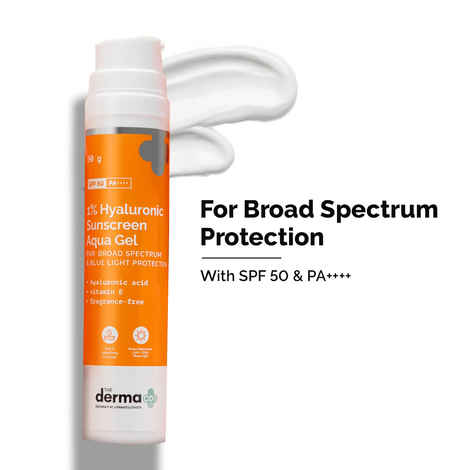
The Derma Co. 1% Hyaluronic Sunscreen Aqua Gel with SPF 50 & PA++++ for Broad Spectrum & Blue Light Protection 50 gm

The Derma Co. 1% Hyaluronic Sunscreen Aqua Gel with SPF 50 & PA++++ for Broad Spectrum & Blue Light Protection 50 gm
The Derma co.
the-derma-co-1-hyaluronic-sunscreen-aqua-gel-with-spf-50-pa-for-broad-spectrum-blue-light-protection-50-gm
Suncare
10084844437797
Morning or Evening?
How often will you use this product?
Notes


Highlights
WHAT IS IT?
Hyaluronic Sunscreen Aqua Gel; multiple ingredient variants
FEATURES
SPF 50 and PA++++ protection; Broad spectrum UVA, UVB and Blue Light protection; Quick absorbing, non-greasy, fragrance free formula; Suitable for all skin types; Dermatologically tested
BEST FOR
all skin types
CHECKS
No white casts, Non-greasy, Fragrance free
Who Is It For?
All Genders All AgesWhat Does It Help With?
Protection From Sun Damage Uva/uvb Rays And Blue LightBudget
Affordable (under $30)How To Use
Which routine should it be used in?
Instructions:
Key Information


What The Derma co. Says
Product Description:
Good skin comes to those who wear sunscreen every day, and that's why we bring to you an SPF50 sunscreen with PA++++ - 1% Hyaluronic Sunscreen Aqua Gel with Vitamin E that protects your skin from not just the UVA/UVB rays but blue light too. It's quick absorbing formula makes it a part of your skin without leaving any white casts. It's time to kiss goodbye to sun damage and go filter-free in your next selfie. Dermatologically tested, 1% Hyaluronic Sunscreen Aqua Gel with Vitamin E is non-greasy and fragrance free, making it suitable for all skin types.
About the Brand:
Ingredients Overview
Ingredients List
Aqua, Propylene Glycol, Butyl Methoxydibenzoylmethane, Terephthalylidene Dicamphor Sulfonic Acid, Phenylbenzimidazole Sulfonic Acid, Glycerin, Ethylhexyl Methoxycinnamate, Caprylic/Capric Triglyceride , Triethanolamine, Tapioca Starch, Ammonium Acryloyldimethyltaurate/VP Copolymer, Ethylhexyl Salicylate, Methylene Bis-Benzotriazolyl Tetramethylbutylphenol, Decyl Glucoside, Xanthan Gum, Isododecane, Sodium Hyaluronate, Niacinamide, Cetearyl Olivate, Sorbitan Olivate, Xylitylglucoside, Anhydroxylitol, Xylitol, Phenoxyethanol, Ethylhexylglycerin, Dicaprylyl Carbonate, Cetearyl Alcohol, Ceteareth-20, Glyceryl Monostearate, Polyester-7, Neopentyl Glycol Diheptanoate, Blueberry Extract, Sodium Polyacrylate, Biosaccharide Gum-4, 1,2-hexanediol, Capsicum Annuum Fruit Extract, Allantoin, Sodium Gluconate, Tocopheryl Acetate and Butylated Hydroxytoluene
Key Ingredients
Hyaluronic Acid,Vitamin E
Ingredients Details
Allantoin
Common Name(s): 5-ureidohydantoin,glyoxyldiureide,aluminum dihydroxy allantoinate
CAS Number: 97-59-6
DESCRIPTION
What It Does: Soothes irritation, accelerates wound healing, promotes skin cell renewal, and provides mild keratolytic exfoliation.
Why It's Used: Gold standard multi-function soothing active – one of the most widely used cosmetic ingredients across all product types for its exceptional tolerability and clinically proven multi-action skin conditioning.
How It Works: Promotes keratinocyte proliferation and fibroblast migration for wound healing. mild keratolytic activity by disrupting corneocyte binding. anti-irritant via direct protein binding and anti-inflammatory cytokine reduction. humectant activity via hydroxyl groups.
Typically Found In: Post-procedure products,sensitive skin formulas,wound care,anti-acne treatments,baby products
TECHNICAL DETAILS
Primary Category: Active ingredient – soothing / anti-inflammatory
Secondary Functions: Wound healing,keratolytic,anti-irritant
Application Areas:

Facial Skincare
Body Care

Hair Care
Beard Care
Color Cosmetics (Makeup)
Dietary/Oral Supplements
Typical Concentration Range: 0.1%–2%
SOURCING & ETHICS
Vegan Status: Yes – synthetic or comfrey-derived
Halal Status: Yes
Source Notes: Plant-derived extract or synthetic.
SKIN COMPATIBILITY
Irritancy Rating: 1/5 – very low
Comedogenicity Rating: 0/5 – non-comedogenic
Sensitivity Concerns: Exceptionally well-tolerated; suitable for all skin types including baby and compromised skin.
Safe for Sensitive Skin: Yes – particularly recommended for sensitive skin
SAFETY & COMPATIBILITY
Safety Profile: Excellent safety profile. ewg score: 1.
Works Well With: Ceramides,panthenol,allantoin,hyaluronic acid,centella asiatica
Avoid Combining With: No significant incompatibilities
SCIENTIFIC NOTE
Allantoin's keratinocyte proliferation stimulation occurs via receptor-mediated signaling (possibly machr activation) rather than non-specific irritation-driven proliferation, making it a true wound-healing stimulant rather than a pro-inflammatory proliferative signal.
Last Verified: Cosing database,cir safety assessment,araújo et al. allantoin review
Primary Sources: 2026-03-12
Ammonium Acryloyldimethyltaurate/vp Copolymer
Common Name(s): Ammonium acryloyldimethyltaurate/vp copolymer
DESCRIPTION
What It Does: Delivers targeted skin-conditioning or bioactive benefits through a specific mechanism of action suited to the formulation's intended purpose.
Why It's Used: Specialty actives address specific skin concerns through targeted molecular mechanisms, providing efficacy beyond what base formulation ingredients alone can achieve.
How It Works: The bioactive compound interacts with specific molecular targets in skin cells or the extracellular matrix — enzymes, receptors, structural proteins, or signaling molecules — triggering beneficial biological responses.
Typically Found In: Serums,treatments,moisturizers,specialty products
TECHNICAL DETAILS
Primary Category: Specialty actives
Secondary Functions: Skin-conditioning,anti-aging
Application Areas:
Facial Skincare
Body Care
Hair Care
Beard Care
Color Cosmetics (Makeup)
Dietary/Oral Supplements
Typical Concentration Range: 0.01–5%
SOURCING & ETHICS
Vegan Status: Yes
Halal Status: Yes
Source Notes: Specialty active ingredient; check individual sourcing for vegan status.
SKIN COMPATIBILITY
Irritancy Rating: 1
Comedogenicity Rating: 0
Sensitivity Concerns: Low sensitization potential at recommended use concentrations.
Safe for Sensitive Skin: Yes
SAFETY & COMPATIBILITY
Safety Profile: Well-characterized cosmetic ingredient with established safety profile. generally non-irritating at typical use concentrations. suitable for leave-on and rinse-off cosmetics.
Works Well With: Niacinamide,hyaluronic acid,vitamin c,peptides
Avoid Combining With: Incompatible with oxidizing agents; check ph stability
SCIENTIFIC NOTE
Specialty actives typically work through enzyme inhibition (e.g., tyrosinase inhibition for brightening, mmp inhibition for anti-aging), receptor activation (e.g., retinoid receptors, ppar-γ for barrier genes), or transcription factor modulation (e.g., nrf2 for antioxidant gene upregulation). structure-activity relationships determine potency and selectivity.
Last Verified: Cosing eu database; pcpc cosmetic ingredient safety reviews; ingredient-specific safety and efficacy literature
Primary Sources: 2025-01-15
Anhydroxylitol
Common Name(s): Anhydroxylitol,cosmetic active,functional ingredient
CAS Number: N/a
DESCRIPTION
What It Does: Delivers characteristic cosmetic function at recommended use concentration.
Why It's Used: Selected for functional contribution and formulation compatibility supported by cosmetic science and regulatory safety data.
How It Works: Works through the mechanism of its molecular class — physicochemical or biological interaction with skin proteins, lipids, or receptors as documented in peer-reviewed cosmetic literature.
Typically Found In: Skin care formulations
TECHNICAL DETAILS
Primary Category: Active ingredient – cosmetic active
Secondary Functions: Skin conditioning
Application Areas:
Facial Skincare
Body Care
Hair Care
Beard Care
Color Cosmetics (Makeup)
Dietary/Oral Supplements
Typical Concentration Range: 0.1%–10%
SOURCING & ETHICS
Vegan Status: Conditional
Halal Status: Yes
Source Notes: Commercially produced for cosmetic use. verify vegan/halal status with supplier.
SKIN COMPATIBILITY
Irritancy Rating: 1/5 – very low
Comedogenicity Rating: 0/5 – non-comedogenic
Sensitivity Concerns: Well-tolerated by most skin types.
Safe for Sensitive Skin: Yes
SAFETY & COMPATIBILITY
Safety Profile: Good safety profile at recommended concentrations. ewg score: 1–2.
Works Well With: Standard skincare actives
Avoid Combining With: No known significant incompatibilities
SCIENTIFIC NOTE
Anhydroxylitol has an established safety and efficacy profile within the cosmetic regulatory framework at standard use concentrations.
Last Verified: Cosing database,anhydroxylitol technical literature
Primary Sources: 2026-03-12
Butyl Methoxydibenzoylmethane
Common Name(s): Butyl methoxydibenzoylmethane,organic uv filter,photostabilising sunscreen active
CAS Number: N/a
DESCRIPTION
What It Does: Absorbs uv radiation at specific wavelengths (uva 320–400 nm, uvb 290–320 nm) and dissipates photon energy as heat rather than skin-damaging photochemical reactions.
Why It's Used: Organic uv filters are chosen for their high molar extinction coefficient, specific spectral coverage, and formulation compatibility — individual filters are combined to provide broad-spectrum coverage across uva+uvb.
How It Works: Uv photon absorption by the aromatic chromophore π-system excites the molecule from s₀ ground state to s₁ excited state. rapid internal conversion or photoisomerisation dissipates energy as vibrational heat before it can initiate skin photodamage.
Typically Found In: Sunscreens,photoprotective products
TECHNICAL DETAILS
Primary Category: Active ingredient – cosmetic active
Secondary Functions: Skin conditioning
Application Areas:
Facial Skincare
Body Care
Hair Care
Beard Care
Color Cosmetics (Makeup)
Dietary/Oral Supplements
Typical Concentration Range: Check local sunscreen regulations
SOURCING & ETHICS
Vegan Status: Yes
Halal Status: Yes
Source Notes: Commercially produced for cosmetic use. verify vegan/halal status with supplier.
SKIN COMPATIBILITY
Irritancy Rating: 1/5 – very low
Comedogenicity Rating: 0/5 – non-comedogenic
Sensitivity Concerns: Well-tolerated by most skin types.
Safe for Sensitive Skin: Yes
SAFETY & COMPATIBILITY
Safety Profile: Good safety profile at recommended concentrations. ewg score: 1–2.
Works Well With: Standard skincare actives
Avoid Combining With: No known significant incompatibilities
SCIENTIFIC NOTE
Organic uv filters require photostabilisation (by avobenzone-octocrylene pairing, or triazine stabilisers) as some absorbers degrade on uv exposure — formulator must verify photostability of the chosen filter combination.
Last Verified: Cosing database,butyl methoxydibenzoylmethane organic uv filter review
Primary Sources: 2026-03-12
