
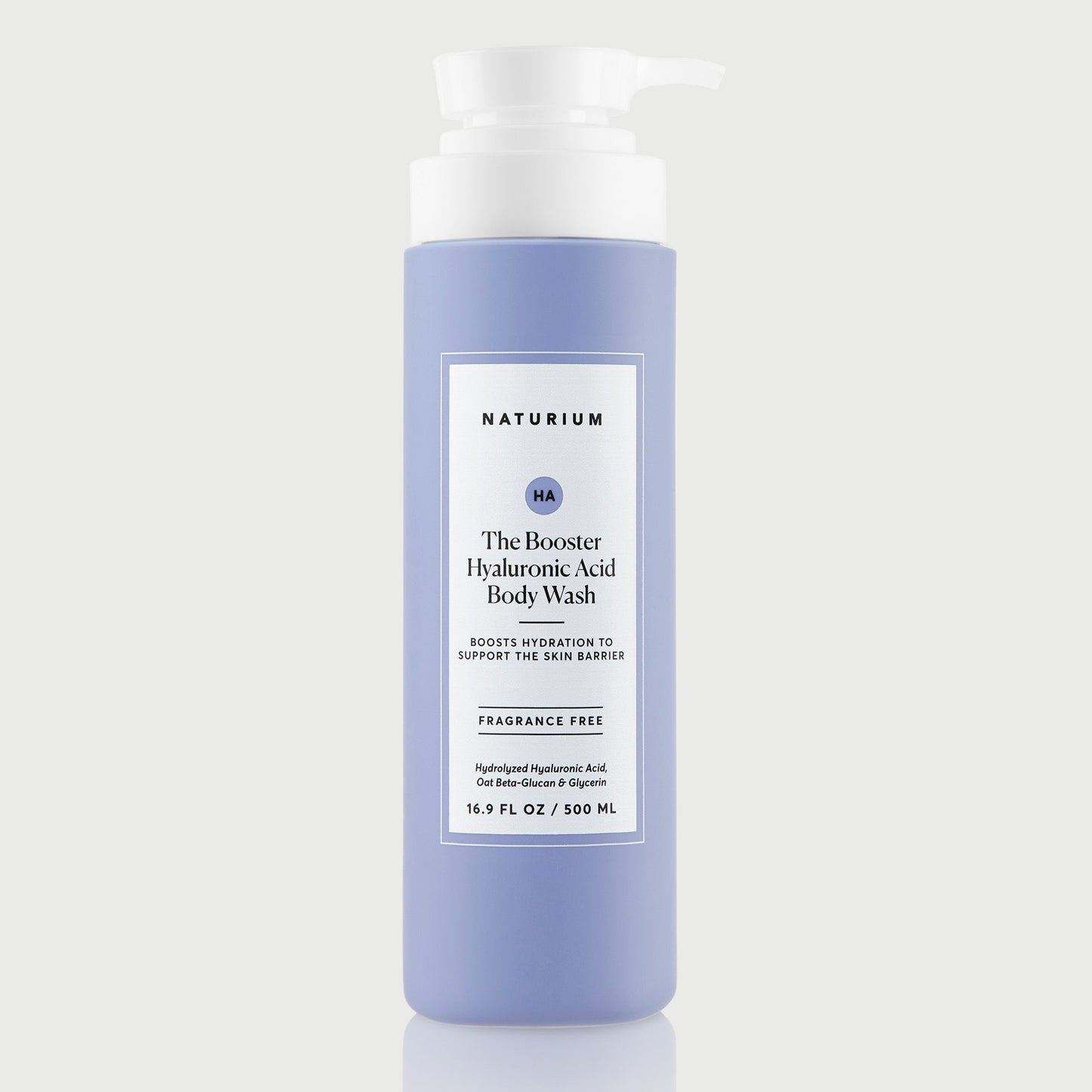

Naturium
The Booster Hyaluronic Acid Body Wash

The Booster Hyaluronic Acid Body Wash
Naturium
the-booster-hyaluronic-acid-body-wash
Body care
9818324893989
Morning or Evening?
How often will you use this product?
Notes


Highlights
WHAT IS IT?
Hydrating body wash with hyaluronic acid
FEATURES
Ultra-hydrating, reduces dryness and irritation, contains seven molecular weights of sodium hyaluronate, 30% glycerin, oat beta-glucan, vitamins B5 and B12
BEST FOR
all skin types
CHECKS
Free of paraben, fragrance
Who Is It For?
All Ages And GendersWhat Does It Help With?
Dryness Irritation Moisturization Youthful AppearanceBudget
Affordable (under $30)How To Use
Which routine should it be used in?
Instructions:
Key Information


What Naturium Says
Product Description:
Our ultra-hydrating body wash boosts moisture to help reduce dryness and irritation for healthier-looking skin. Formulated with hydrolyzed hyaluronic acid, plus seven molecular weights of sodium hyaluronate, this rich gel cleanser provides essential moisturization. Plus 30% glycerin, oat beta-glucan, and vitamins B5 and B12 soothe, replenish and nourish for a more youthful appearance.
About the Brand:
Ingredients Overview
Ingredients List
Aqua/Water/Eau, Glycerin, Cocamidopropyl Hydroxysultaine, Guar Hydroxypropyltrimonium Chloride, Coco-Glucoside, Sodium Lauroyl Glutamate, Sodium Methyl Cocoyl Taurate, Panthenol, Hydrolyzed Hyaluronic Acid, Sodium Hyaluronate, Cyanocobalamin, Nelumbo Nucifera Root Water, Beta-Glucan, Cocamidopropylamine Oxide, Hydroxyacetophenone, Trisodium Ethylenediamine Disuccinate, Caprylyl Glycol, 1,2-Hexanediol, Citric Acid, Sodium Benzoate, Sodium Hydroxide, Phenoxyethanol
Key Ingredients
hydrolyzed hyaluronic acid, sodium hyaluronate, glycerin, oat beta-glucan, vitamin B5, vitamin B12
Ingredients Details
Glycerin
Common Name(s): Glycerol,glycerine,1,2,3-propanetriol
CAS Number: 56-81-5
DESCRIPTION
What It Does: Glycerin pulls water from the environment and deeper skin layers into the outer skin layer (epidermis), boosting moisture levels and keeping skin soft, smooth, and plump.
Why It's Used: It is used in virtually every moisturizer, serum, and cleanser because it is highly effective at hydrating skin, is well-tolerated by all skin types, and enhances the texture and spreadability of formulations.
How It Works: As a humectant, glycerin forms hydrogen bonds with water molecules, trapping them in the skin. it also reinforces the skin barrier by integrating into lipid structures between skin cells.
Typically Found In: Moisturizers,serums,cleansers,toners,sheet masks,sunscreens,body lotions,shampoos,conditioners
TECHNICAL DETAILS
Primary Category: Humectant
Secondary Functions: Skin barrier support,emollient,solvent
Application Areas:

Facial Skincare
Body Care
Hair Care
Beard Care

Color Cosmetics (Makeup)
Dietary/Oral Supplements
Typical Concentration Range: 1%–30% (typical: 3–10%)
SOURCING & ETHICS
Vegan Status: Yes – plant-derived (coconut, soy, palm) or synthetic
Halal Status: Yes – when plant-derived or synthetic; verify source with supplier
Source Notes: Derived from plant oils via hydrolysis or saponification; synthetic versions also available. palm-derived glycerin carries sustainability concerns.
SKIN COMPATIBILITY
Irritancy Rating: 1/5 – very low; non-irritating at all standard concentrations
Comedogenicity Rating: 0/5 – non-comedogenic
Sensitivity Concerns: Extremely rare allergic reactions; generally safe for all skin types including sensitive and baby skin
Safe for Sensitive Skin: Yes
SAFETY & COMPATIBILITY
Safety Profile: Widely recognized as safe. ewg hazard score: 1. no significant concerns for irritation, sensitization, or toxicity at typical concentrations (up to 50%).
Works Well With: Hyaluronic acid,ceramides,niacinamide,panthenol,urea,peptides,retinol,ahas/bhas
Avoid Combining With: No known incompatibilities at standard concentrations
SCIENTIFIC NOTE
Glycerin is an endogenous skin component found naturally in the stratum corneum. aquaporin-3 channels in keratinocytes facilitate glycerin transport, making it integral to natural skin hydration pathways.
Last Verified: Cosing database,cir safety assessment,ewg skin deep,inci decoder
Primary Sources: 2026-03-12
Hydrolyzed Hyaluronic Acid
Common Name(s): Hyaluronic acid,gold standard humectant,multi-weight skin plumper
CAS Number: N/a
DESCRIPTION
What It Does: Hydrates skin at multiple depths depending on mw, provides visible plumping from dermal water retention, reduces tewl, and supports barrier integrity and fibroblast proliferation.
Why It's Used: The reference humectant in cosmetics — ha's 1,000× water binding capacity, skin-endogenous origin, and compatibility with all skin types make it the standard against which all humectants are benchmarked.
How It Works: High-mw ha (>1000 kda) films the surface reducing tewl; medium-mw (100–1000 kda) hydrates outer epidermis; low-mw (<50 kda) reaches dermis for plumping. each weight class binds water through carboxylate and amide group h-bonding across the (glcua-glcnac)ₙ disaccharide backbone.
Typically Found In: Hydrating serums,moisturisers,anti-aging
TECHNICAL DETAILS
Primary Category: Functional ingredient – humectant
Secondary Functions: Tewl reduction,skin plumping
Application Areas:
Facial Skincare
Body Care
Hair Care
Beard Care
Color Cosmetics (Makeup)
Dietary/Oral Supplements
Typical Concentration Range: 0.01%–2%
SOURCING & ETHICS
Vegan Status: Yes
Halal Status: Yes
Source Notes: Synthetic or naturally derived. excellent aqueous solubility.
SKIN COMPATIBILITY
Irritancy Rating: 1/5 – very low
Comedogenicity Rating: 0/5 – non-comedogenic
Sensitivity Concerns: Non-irritating; suitable for all skin types.
Safe for Sensitive Skin: Yes
SAFETY & COMPATIBILITY
Safety Profile: Excellent safety profile. ewg score: 1.
Works Well With: Ceramides,emollients,occlusives,glycerin,hyaluronic acid
Avoid Combining With: No significant incompatibilities
SCIENTIFIC NOTE
Ha production by streptococcus zooepidemicus fermentation provides high-purity, animal-free hyaluronic acid at molecular weights 50 kda–3 mda — batch selection determines the intended skin depth target.
Last Verified: Cosing database,hyaluronic acid multi-weight humectant review
Primary Sources: 2026-03-12
Oat Beta-glucan
Common Name(s): Oat beta-glucan,1,3/1,4-beta-glucan,glucan extract
CAS Number: 9041-22-9
DESCRIPTION
What It Does: Stimulates skin immune defense while providing deep hydration and wound healing through glucan receptor signaling.
Why It's Used: Multi-function polysaccharide combining deep hydration with unique immunomodulatory wound healing activity unavailable from standard humectants.
How It Works: Binds dectin-1 and tlr2 receptors on macrophages and dendritic cells stimulating immune activation and wound healing cytokine release. viscous polysaccharide forms hydrating film retaining 100× its weight in water. direct antioxidant via hydroxyl groups.
Typically Found In: Wound healing products,immunomodulatory serums,deep hydration products,anti-aging
TECHNICAL DETAILS
Primary Category: Active ingredient – soothing / anti-inflammatory
Secondary Functions: Dectin-1 receptor activation,wound healing,deep hydration
Application Areas:
Facial Skincare
Body Care
Hair Care
Beard Care
Color Cosmetics (Makeup)
Dietary/Oral Supplements
Typical Concentration Range: 0.1%–5%
SOURCING & ETHICS
Vegan Status: Yes – from oat bran or yeast (saccharomyces cerevisiae)
Halal Status: Yes
Source Notes: Plant-derived extract or synthetic.
SKIN COMPATIBILITY
Irritancy Rating: 1/5 – very low
Comedogenicity Rating: 0/5 – non-comedogenic
Sensitivity Concerns: Non-irritating; ideal for reactive and sensitive skin.
Safe for Sensitive Skin: Yes – particularly recommended for sensitive skin
SAFETY & COMPATIBILITY
Safety Profile: Excellent safety profile. ewg score: 1.
Works Well With: Ceramides,panthenol,allantoin,hyaluronic acid,centella asiatica
Avoid Combining With: No significant incompatibilities
SCIENTIFIC NOTE
Beta-glucan's receptor-mediated wound healing through dectin-1 activation is fundamentally different from simple polysaccharide humectant effects – it actively recruits and activates immune cells to the wound site, accelerating the immune phase of wound healing that determines subsequent repair quality and scar outcome.
Last Verified: Cosing database,schepetkin & quinn beta-glucan immunostimulation review
Primary Sources: 2026-03-12
Sodium Hyaluronate
Common Name(s): Sodium salt of hyaluronic acid,naha
CAS Number: 9067-32-7
DESCRIPTION
What It Does: Provides hyaluronic acid hydration in the most formulation-stable and compatible form.
Why It's Used: The standard form of ha used in cosmetics – more stable than free ha, better solubility, and equivalent skin hydration benefits.
How It Works: Sodium salt reduces the polyelectrolyte repulsion of ha chains, allowing better packing in formulations. on skin, sodium ions dissociate and the ha chain unfolds to its full water-binding conformation. provides full ha humectant and barrier benefits equivalent to free ha.
Typically Found In: Hydrating serums,toners,moisturizers,sheet masks,anti-aging products
TECHNICAL DETAILS
Primary Category: Active ingredient – ha sodium salt
Secondary Functions: Equivalent ha hydration,superior stability
Application Areas:
Facial Skincare
Body Care
Hair Care
Beard Care
Color Cosmetics (Makeup)
Dietary/Oral Supplements
Typical Concentration Range: 0.1%–2%
SOURCING & ETHICS
Vegan Status: Yes – bacterial fermentation
Halal Status: Yes
Source Notes: Synthetic or naturally derived. excellent aqueous solubility.
SKIN COMPATIBILITY
Irritancy Rating: 1/5 – very low
Comedogenicity Rating: 0/5 – non-comedogenic
Sensitivity Concerns: Non-irritating; suitable for all skin types.
Safe for Sensitive Skin: Yes
SAFETY & COMPATIBILITY
Safety Profile: Excellent safety profile. ewg score: 1.
Works Well With: Ceramides,emollients,occlusives,glycerin,hyaluronic acid
Avoid Combining With: No significant incompatibilities
SCIENTIFIC NOTE
The sodium salt form of ha has approximately 10% better water solubility than free hyaluronic acid at equivalent molecular weight due to reduced chain-chain electrostatic repulsion from partial sodium counterion screening. this improved solubility enables higher concentration formulations without viscosity issues.
Last Verified: Cosing database,cir safety assessment
Primary Sources: 2026-03-12
