
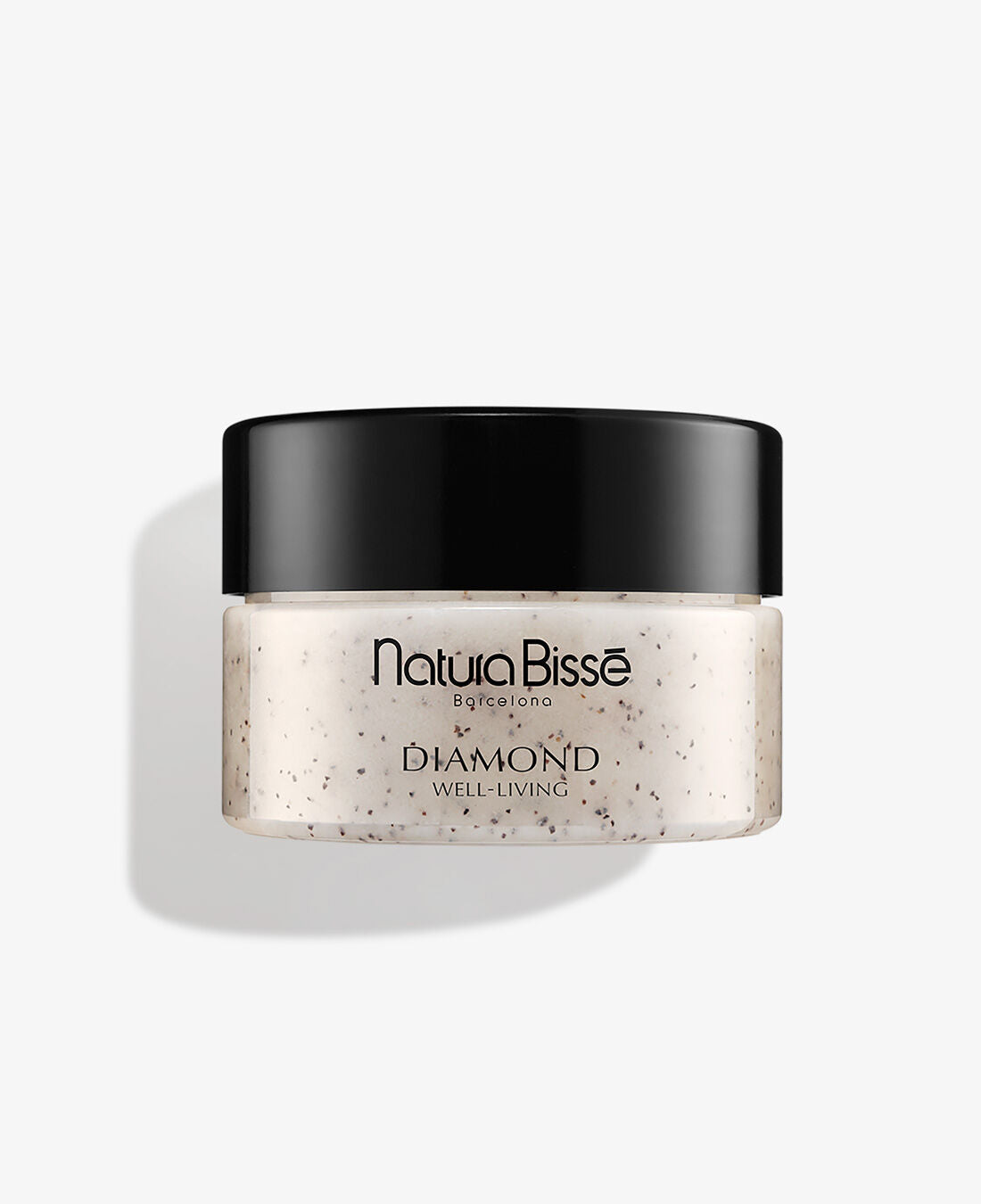

Natura Bissé
THE BODY SCRUB

THE BODY SCRUB
Natura Bissé
the-body-scrub
Body care
9643567317285
Morning or Evening?
How often will you use this product?
Notes


Highlights
WHAT IS IT?
Body scrub with sea salt, rice powder, and grape seeds
FEATURES
Exfoliates, smooths skin texture, evens tone, nourishes, preserves skin moisture, revitalizes
BEST FOR
All skin types
CHECKS
Alcohol-free, Gluten-free
Who Is It For?
Not Specified Likely For AdultsWhat Does It Help With?
Renews Skin Improves Suppleness Awakens The SensesBudget
PremiumHow To Use
Which routine should it be used in?
Instructions:
Key Information


What Natura Bissé Says
Product Description:
Sea salt, rice powder, and grape seeds for softer, renewed skin
About the Brand:
Ingredients Overview
Ingredients List
Sodium Chloride, Helianthus Annuus (Sunflower) Seed Oil, Hydrogenated Vegetable Oil, Ethylhexyl Stearate, Stearic Acid, Palmitic Acid, Polyglyceryl-3 Caprate, Glyceryl Stearate, PEG-100 Stearate, Vitis Vinifera (Grape) Seed Oil, Butyrospermum Parkii (Shea) Butter, Vitis Vinifera (Grape) Seed Powder, Oryza Sativa (Rice) Germ Powder, Trihydroxystearin, Benzotriazolyl Dodecyl p-Cresol, Microcrystalline Wax, Tocopheryl Acetate, Dilauryl Thiodipropionate, Stearyl Stearate, Fragrance (Parfum), Geraniol, Limonene, Citral, Citronellol, Linalool, Hydroxycitronellal.
Key Ingredients
Dead Sea salt crystals, Rice powder, Grape seed oil, Sunflower oil, Shea butter, Vitamin E
Ingredients Details
Ethylhexyl Stearate
Common Name(s): Ethylhexyl stearate,cosmetic active,functional ingredient
CAS Number: N/a
DESCRIPTION
What It Does: Delivers characteristic cosmetic function at recommended use concentration.
Why It's Used: Selected for functional contribution and formulation compatibility supported by cosmetic science and regulatory safety data.
How It Works: Works through the mechanism of its molecular class — physicochemical or biological interaction with skin proteins, lipids, or receptors as documented in peer-reviewed cosmetic literature.
Typically Found In: Skin care formulations
TECHNICAL DETAILS
Primary Category: Active ingredient – cosmetic active
Secondary Functions: Skin conditioning
Application Areas:

Facial Skincare

Body Care
Hair Care
Beard Care
Color Cosmetics (Makeup)
Dietary/Oral Supplements
Typical Concentration Range: 0.1%–10%
SOURCING & ETHICS
Vegan Status: Conditional - feedstock declaration required
Halal Status: Unverified - feedstock declaration required (plant, animal and petrochemical routes all exist)
Source Notes: Commercially produced for cosmetic use. verify vegan/halal status with supplier. [audit 2026-07-29 rev2: origin-dependent: the same inci exists in plant, animal and petrochemical versions and the name does not discriminate. determination requires shariah-panel sign-off.]
SKIN COMPATIBILITY
Irritancy Rating: 1/5 – very low
Comedogenicity Rating: 0/5 – non-comedogenic
Sensitivity Concerns: Well-tolerated by most skin types.
Safe for Sensitive Skin: Yes
SAFETY & COMPATIBILITY
Safety Profile: Good safety profile at recommended concentrations. ewg score: 1–2.
Works Well With: Standard skincare actives
Avoid Combining With: No known significant incompatibilities
SCIENTIFIC NOTE
Ethylhexyl stearate has an established safety and efficacy profile within the cosmetic regulatory framework at standard use concentrations.
Last Verified: 2026-03-12
Primary Sources: Cosing database,ethylhexyl stearate technical literature
Glyceryl Stearate
Common Name(s): Glycerol monostearate,gms,glycerin monostearate
CAS Number: 31566-31-1
DESCRIPTION
What It Does: Provides o/w emulsification with emolliency and skin feel improvement from a natural glycerol ester.
Why It's Used: Standard cosmetic monoglyceride emulsifier – widely used for o/w cream formation with clean, natural-origin credentials and good sensory profile.
How It Works: Monoglyceride structure (one fatty acid + glycerol) provides amphiphilic hlb ~3-4 for o/w emulsification when combined with higher hlb co-emulsifiers. forms alpha-gel lamellar structure with water for emulsion stabilization. direct skin conditioning via fatty acid film.
Typically Found In: Creams,lotions,moisturizers – standard in o/w emulsions
TECHNICAL DETAILS
Primary Category: Functional ingredient – monoglyceride emulsifier
Secondary Functions: Barrier sealing,softening
Application Areas:
Facial Skincare
Body Care
Hair Care
Beard Care
Color Cosmetics (Makeup)
Dietary/Oral Supplements
Typical Concentration Range: 1%–10%
SOURCING & ETHICS
Vegan Status: Conditional - feedstock declaration required
Halal Status: Unverified - feedstock declaration required (plant, animal and petrochemical routes all exist)
Source Notes: Plant-derived, synthetic or animal-derived. verify source. [audit 2026-07-29 rev2: origin-dependent: the same inci exists in plant, animal and petrochemical versions and the name does not discriminate. determination requires shariah-panel sign-off.]
SKIN COMPATIBILITY
Irritancy Rating: 1/5 – very low
Comedogenicity Rating: 1/5 – low; formulation-dependent
Sensitivity Concerns: Non-irritating.
Safe for Sensitive Skin: Yes
SAFETY & COMPATIBILITY
Safety Profile: Excellent safety profile. ewg score: 1.
Works Well With: Humectants,ceramides,actives as carrier
Avoid Combining With: No significant incompatibilities
SCIENTIFIC NOTE
Glyceryl stearate's alpha-gel lamellar phase formation (distinguishable by x-ray crystallography from beta crystalline phase) provides superior emulsion stability compared to its beta crystalline form. the alpha-gel phase creates a viscoelastic network that resists droplet coalescence – the fundamental mechanism behind gms's long use as a reliable primary emulsifier.
Last Verified: 2026-03-12
Primary Sources: Cosing database,cir safety assessment
Helianthus Annuus (sunflower) Seed Oil
Common Name(s): Helianthus annuus (sunflower) seed oil,botanical oil,phytochemical active
CAS Number: N/a
DESCRIPTION
What It Does: Provides antioxidant protection from reactive oxygen species, reduces inflammatory cytokine production in skin, and conditions skin through the plant's phytochemical complex.
Why It's Used: Natural origin narrative, traditional use heritage, and multi-functional phytochemical profile supporting concurrent skin care claims from one ingredient.
How It Works: Polyphenols, terpenoids, and alkaloids scavenge ros via h• donation, inhibit nf-kb or cox-2 inflammatory pathways, and interact with skin surface proteins for conditioning.
Typically Found In: Botanical skin care,natural products
TECHNICAL DETAILS
Primary Category: Active ingredient – antioxidant
Secondary Functions: Free radical scavenging,anti-aging
Application Areas:
Facial Skincare
Body Care
Hair Care
Beard Care
Color Cosmetics (Makeup)
Dietary/Oral Supplements
Typical Concentration Range: 0.1%–10%
SOURCING & ETHICS
Vegan Status: Conditional - supplier confirmation required
Halal Status: Yes
Source Notes: Plant-derived extract or synthetic. [audit 2026-07-29 rev2: status downgraded on audit. determination requires shariah-panel sign-off.]
SKIN COMPATIBILITY
Irritancy Rating: 1/5 – very low
Comedogenicity Rating: 0/5 – non-comedogenic
Sensitivity Concerns: Non-irritating; well-tolerated.
Safe for Sensitive Skin: Yes
SAFETY & COMPATIBILITY
Safety Profile: Excellent safety profile. ewg score: 1.
Works Well With: Vitamin c,vitamin e,ferulic acid,spf,other antioxidants
Avoid Combining With: No significant incompatibilities
SCIENTIFIC NOTE
Plant secondary metabolites evolved as photoprotectants and antimicrobials — mechanisms directly applicable to cosmetic antioxidant and anti-inflammatory activity in human skin.
Last Verified: 2026-03-12
Primary Sources: Cosing database,helianthus annuus (sunflower) seed botanical review
Hydrogenated Vegetable Oil
Common Name(s): Hydrogenated vegetable oil,botanical oil/butter,phytochemical active
CAS Number: N/a
DESCRIPTION
What It Does: Provides emollient conditioning, essential fatty acid supplementation, and barrier lipid support.
Why It's Used: Natural carrier oils integrate into sc lipid bilayers for genuine barrier emolliency.
How It Works: Fatty acid triglycerides deliver oleic, linoleic, and linolenic acids for sc integration and essential fatty acid barrier repair.
Typically Found In: Botanical skin care,natural products
TECHNICAL DETAILS
Primary Category: Active ingredient – antioxidant
Secondary Functions: Free radical scavenging,anti-aging
Application Areas:
Facial Skincare
Body Care
Hair Care
Beard Care
Color Cosmetics (Makeup)
Dietary/Oral Supplements
Typical Concentration Range: 0.1%–30%
SOURCING & ETHICS
Vegan Status: Conditional - supplier confirmation required
Halal Status: Conditional - basis not stated in source record; supplier origin confirmation required to determine what evidence applies
Source Notes: Plant-derived extract or synthetic. [audit 2026-07-29 rev2: status downgraded on audit. determination requires shariah-panel sign-off.]
SKIN COMPATIBILITY
Irritancy Rating: 1/5 – very low
Comedogenicity Rating: 0/5 – non-comedogenic
Sensitivity Concerns: Non-irritating; well-tolerated.
Safe for Sensitive Skin: Yes
SAFETY & COMPATIBILITY
Safety Profile: Excellent safety profile. ewg score: 1.
Works Well With: Vitamin c,vitamin e,ferulic acid,spf,other antioxidants
Avoid Combining With: No significant incompatibilities
SCIENTIFIC NOTE
Plant secondary metabolites evolved for uv photoprotection and pathogen defence — mechanisms directly translatable to cosmetic antioxidant and anti-inflammatory activity in human skin.
Last Verified: 2026-03-12
Primary Sources: Cosing database,hydrogenated vegetable oil botanical review