
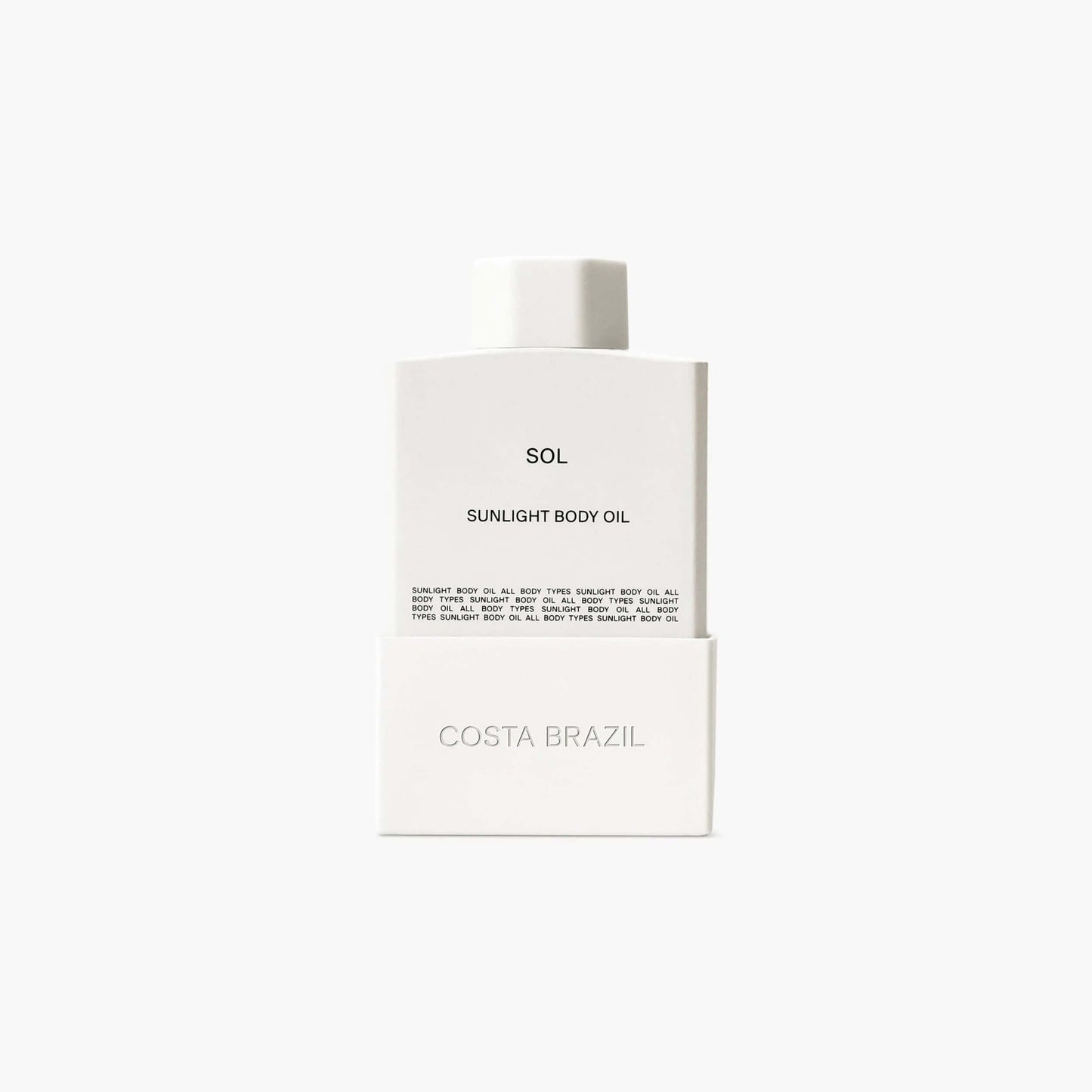

Costa Brazil
SUNLIGHT BODY OIL

SUNLIGHT BODY OIL
Costa Brazil
sunlight-body-oil
Body care
9706858348837
Morning or Evening?
How often will you use this product?
Notes


Highlights
WHAT IS IT?
Body oil with natural ingredients
FEATURES
Calms, Nourishes, Firms And Tones, Provides A Sensuous Natural Glow
BEST FOR
All skin types
CHECKS
Free of parabans, phthalates, PEGs, silicons, sulfates, mineral oil and artificial colornats
Who Is It For?
Adults Women And MenWhat Does It Help With?
Softens Fine Lines Enhances Firmness Restores MoistureBudget
PremiumHow To Use
Which routine should it be used in?
Instructions:
Key Information


What Costa Brazil Says
Product Description:
Enhance your natural radiance with Sunlight Body Oil (100 ml). Containing a nutrient-rich complex of Kaya, Cacay and Acai, along with other vitamin-dense ingredients and multi-active super fruits, this Brazilian rainforest elixir helps to soften fine lines, enhance the appearance of firmness, and restore moisture. Apply liberally for golden, sun-kissed skin that's glowing, never greasy. Good for all skin types.
About the Brand:
Ingredients Overview
Ingredients List
Persea Gratissima (Avocado) Oil, Oenocarpus Bataua (Pataua) Fruit Oil, Bertholletia Excelsa (Brazil Nut) Seed Oil, Cucurbita Pepo (Pumpkin) Seed Oil, Oryza Sativa (Rice) Bran Oil, Caryodendron Orinocense (Cacay) Seed Oil, Vegetable Oil (Lecytis Pisonis), Polyglyceryl-3 Diisostearate, Passiflora Incarnata (Passion Fruit) Seed Oil, Silica, Fragrance/Parfum, Orbignya Oleifera (Babassu) Seed Oil, Platonia Insignis (Bacuri) Seed Butter, Mica, Euterpe Oleracea (Acai) Fruit Oil, Titanium Dioxide/CI 77891, Iron Oxide Red/CI 77491, Tocopherol, Tin Oxide, Limonene, Linalool, Citronellol, Geraniol
Key Ingredients
Kaya Oil, Cacay Oil, Brazil Nut Oil, Pataua Seed Oil, Babassu Seed Oil, Bacuri Butter
Ingredients Details
Cucurbita Pepo Pumpkin Seed Oil
Common Name(s): Cucurbita pepo pumpkin seed oil oil
DESCRIPTION
What It Does: Nourishes and softens skin through its balanced fatty acid profile, while antioxidant compounds protect against oxidative skin damage.
Why It's Used: Plant oils provide physiologically compatible lipid structures that integrate into the skin barrier and deliver fat-soluble antioxidants directly to skin cells.
How It Works: Fatty acids integrate into stratum corneum lipid lamellae, reinforcing the lipid barrier. antioxidants (tocopherols, carotenoids, polyphenols) neutralize ros through electron donation or singlet oxygen quenching.
Typically Found In: Face oils,serums,moisturizers,hair treatments,body oils
TECHNICAL DETAILS
Primary Category: Plant oils
Secondary Functions: Emollient,antioxidant
Application Areas:

Facial Skincare
Body Care
Hair Care

Beard Care
Color Cosmetics (Makeup)
Dietary/Oral Supplements
Typical Concentration Range: 0.5–30%
SOURCING & ETHICS
Vegan Status: Yes
Halal Status: Yes
Source Notes: Cold-pressed or solvent-extracted plant oil; no animal components.
SKIN COMPATIBILITY
Irritancy Rating: 1899-12-31 00:00:00 -0800
Comedogenicity Rating: 2000-01-01 00:00:00 -0800
Sensitivity Concerns: Low sensitization potential at recommended use concentrations.
Safe for Sensitive Skin: Yes
SAFETY & COMPATIBILITY
Safety Profile: Well-characterized cosmetic ingredient with established safety profile. generally non-irritating at typical use concentrations. suitable for leave-on and rinse-off cosmetics.
Works Well With: Vitamin e,ceramides,other plant oils,squalane
Avoid Combining With: Strong oxidizers (accelerate rancidity)
SCIENTIFIC NOTE
Vegetable oils are triglyceride matrices where the fatty acid composition determines skin compatibility, barrier function, and comedogenicity. oleic acid-rich oils (>60%) soften barrier lipids and enhance penetration; linoleic acid-rich oils reinforce ceramide-poor stratum corneum; saturated fatty acid-rich oils provide occlusion without skin penetration.
Last Verified: 2025-01-15
Primary Sources: Cosing eu database; pcpc cosmetic ingredient safety reviews; aocs plant oil composition databases; fatty acid pharmacology reviews
Oryza Sativa (rice) Bran Oil
Common Name(s): Oryza sativa (rice) bran oil oil
DESCRIPTION
What It Does: Nourishes and softens skin through its balanced fatty acid profile, while antioxidant compounds protect against oxidative skin damage.
Why It's Used: Plant oils provide physiologically compatible lipid structures that integrate into the skin barrier and deliver fat-soluble antioxidants directly to skin cells.
How It Works: Fatty acids integrate into stratum corneum lipid lamellae, reinforcing the lipid barrier. antioxidants (tocopherols, carotenoids, polyphenols) neutralize ros through electron donation or singlet oxygen quenching.
Typically Found In: Face oils,serums,moisturizers,hair treatments,body oils
TECHNICAL DETAILS
Primary Category: Plant oils
Secondary Functions: Emollient,antioxidant
Application Areas:
Facial Skincare
Body Care
Hair Care
Beard Care
Color Cosmetics (Makeup)
Dietary/Oral Supplements
Typical Concentration Range: 0.5–30%
SOURCING & ETHICS
Vegan Status: Yes
Halal Status: Yes
Source Notes: Cold-pressed or solvent-extracted plant oil; no animal components.
SKIN COMPATIBILITY
Irritancy Rating: 1
Comedogenicity Rating: 2
Sensitivity Concerns: Low sensitization potential at recommended use concentrations.
Safe for Sensitive Skin: Yes
SAFETY & COMPATIBILITY
Safety Profile: Well-characterized cosmetic ingredient with established safety profile. generally non-irritating at typical use concentrations. suitable for leave-on and rinse-off cosmetics.
Works Well With: Vitamin e,ceramides,other plant oils,squalane
Avoid Combining With: Strong oxidizers (accelerate rancidity)
SCIENTIFIC NOTE
Vegetable oils are triglyceride matrices where the fatty acid composition determines skin compatibility, barrier function, and comedogenicity. oleic acid-rich oils (>60%) soften barrier lipids and enhance penetration; linoleic acid-rich oils reinforce ceramide-poor stratum corneum; saturated fatty acid-rich oils provide occlusion without skin penetration.
Last Verified: 2025-01-15
Primary Sources: Cosing eu database; pcpc cosmetic ingredient safety reviews; aocs plant oil composition databases; fatty acid pharmacology reviews
Persea Gratissima (avocado) Oil
Common Name(s): Persea gratissima (avocado) oil,botanical oil/butter,phytochemical active
CAS Number: N/a
DESCRIPTION
What It Does: Provides emollient conditioning and essential fatty acid supplementation.
Why It's Used: Botanical oils integrate into sc lipid bilayers for genuine barrier emolliency.
How It Works: Fatty acid triglycerides deliver oleic, linoleic, and linolenic acids for sc integration and barrier repair.
Typically Found In: Botanical skin care
TECHNICAL DETAILS
Primary Category: Active ingredient – antioxidant
Secondary Functions: Free radical scavenging,anti-aging
Application Areas:
Facial Skincare
Body Care
Hair Care
Beard Care
Color Cosmetics (Makeup)
Dietary/Oral Supplements
Typical Concentration Range: 0.1%–30%
SOURCING & ETHICS
Vegan Status: Conditional - supplier confirmation required
Halal Status: Conditional - basis not stated in source record; supplier origin confirmation required to determine what evidence applies
Source Notes: Plant-derived extract or synthetic. [audit 2026-07-29 rev2: status downgraded on audit. determination requires shariah-panel sign-off.]
SKIN COMPATIBILITY
Irritancy Rating: 1/5 – very low
Comedogenicity Rating: 0/5 – non-comedogenic
Sensitivity Concerns: Non-irritating; well-tolerated.
Safe for Sensitive Skin: Yes
SAFETY & COMPATIBILITY
Safety Profile: Excellent safety profile. ewg score: 1.
Works Well With: Vitamin c,vitamin e,ferulic acid,spf,other antioxidants
Avoid Combining With: No significant incompatibilities
SCIENTIFIC NOTE
Plant secondary metabolites evolved for uv photoprotection and pathogen defence — directly applicable to cosmetic antioxidant and anti-inflammatory activity in human skin.
Last Verified: 2026-03-12
Primary Sources: Cosing database,persea gratissima (avocado) oil botanical review
Polyglyceryl-3 Diisostearate
Common Name(s): Polyglyceryl-3 diisostearate,polyglyceryl-3 isostearic acid (diester) ester,polyglycerol-3 isostearic acid (diester)
DESCRIPTION
What It Does: Helps oil and water blend in creams and lotions while conditioning skin.
Why It's Used: Polyglyceryl-3 head provides hydrophilicity (hlb ~3–5); isostearic acid (diester) tail provides oil-phase affinity; natural-origin compatible.
How It Works: Polyglycerol-3 backbone with isostearic acid (diester) ester tail; hlb ~3–5; polyglyceryl esters are widely used natural-origin emulsifiers suitable for organic cosmetic certification.
Typically Found In: O/w emulsions,natural cosmetics,organic formulations,skin conditioning products
TECHNICAL DETAILS
Primary Category: Functional ingredient – emulsifier
Secondary Functions: Skin conditioning,surfactant,natural origin
Application Areas:
Facial Skincare
Body Care
Hair Care
Beard Care
Color Cosmetics (Makeup)
Dietary/Oral Supplements
Typical Concentration Range: 0.5%–5%
SOURCING & ETHICS
Vegan Status: Conditional - feedstock declaration required
Halal Status: Unverified - feedstock declaration required (plant, animal and petrochemical routes all exist)
Source Notes: Polyglycerin from vegetable glycerol polymerization; isostearic acid (diester) acid from plant sources; naturally derived. [audit 2026-07-29 rev2: origin-dependent: the same inci exists in plant, animal and petrochemical versions and the name does not discriminate. determination requires shariah-panel sign-off.]
SKIN COMPATIBILITY
Irritancy Rating: 1/5 – very low
Comedogenicity Rating: 1/5 – low
Sensitivity Concerns: Very mild; suitable for sensitive skin. natural-origin ingredient.
Safe for Sensitive Skin: Yes
SAFETY & COMPATIBILITY
Safety Profile: Excellent safety profile. ewg score: 1.
Works Well With: Natural oils,plant butters,other natural emulsifiers,humectants
Avoid Combining With: No significant incompatibilities
SCIENTIFIC NOTE
Pg-3 diisostearate; branched diester; very low hlb ~3-5; w/o emulsification.
Last Verified: 2026-03-27
Primary Sources: Cosing database,inci dictionary,supplier technical data