

Biotek India
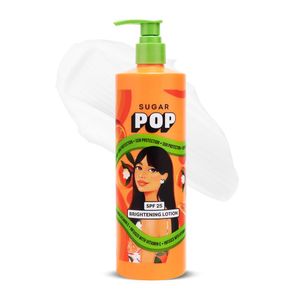
SUGAR POP SPF 25 Brightening Lotion - 400 ml

SUGAR POP SPF 25 Brightening Lotion - 400 ml
Biotek India
sugar-pop-spf-25-brightening-lotion-400-ml
Moisturize
10084850467109
Morning or Evening?
How often will you use this product?
Notes


Highlights
WHAT IS IT?
Body Lotion with vitamin C, licorice and aloe vera extracts
FEATURES
SPF 25 brightening body lotion, nourishes and soothes dry skin, protects from UV sun rays, locks in moisture, lightweight, non-sticky, non-greasy, suitable for all seasons and all skin types, 100% vegetarian, cruelty-free, paraben-free
BEST FOR
dry
CHECKS
No parabens, non-greasy, lightweight
Who Is It For?
What Does It Help With?
Brightening Dull Skin Nourishment Hydration Uv Protection Soothing SkinBudget
Affordable (under $30)How To Use
Which routine should it be used in?
Instructions:
Key Information


What Biotek India Says
Product Description:
Give your skin the deep nourishment it needs with the SUGAR POP SPF 25 Brightening Lotion. The indulgent formula not only nourishes but also brightens your skin, wrapping it in a creamy yet lightweight texture that quickly seeps in for deep hydration. Blended with vitamin C and licorice, it adds a radiant touch to dull skin. Topped off with aloe vera extracts, it provides added moisture and a soothing calmness. Sprinkled with a hefty dose of SPF 25 this body lotion offers non-greasy protection against harmful UV rays, keeping your skin both safeguarded and moisturized. So revel in the refreshing fragrance that lingers on your soft, smooth, and pampered skin.
About the Brand:
Ingredients Overview
Ingredients List
DM Water, Ethylhexyl Salicylate, Octocrylene, Phenylbenzimidazole sulfonic acid, Mineral Oil, Glycerin, Paraffin, Phenoxyethanol (and) Ethylhexylglycerin, Ascorbic Acid (Vitamin C), Aloe barbadensis leaf juice, TRI ETAHNOL AMINE, Polyquaternium-39, Glyceryl Stearate, PEG-100 Stearate, Citronellol, Geraniol, Hexyl Cinnamal, Limonene, Linalool, Disodium Edta, Carbomer
Key Ingredients
vitamin C, licorice, aloe vera extracts
Ingredients Details
Aloe Barbadensis Leaf Juice
Common Name(s): Aloe barbadensis leaf juice,cosmetic active,functional ingredient
CAS Number: N/a
DESCRIPTION
What It Does: Delivers characteristic cosmetic function — skin conditioning, protection, preservation, or active biological benefit — at recommended use concentration.
Why It's Used: Selected for its functional contribution and formulation compatibility — supported by cosmetic science literature and regulatory safety assessment.
How It Works: Works through the mechanism of its molecular class — physicochemical interaction with the formulation or biological interaction with skin proteins, lipids, or receptors as documented in peer-reviewed literature.
Typically Found In: Skin care formulations
TECHNICAL DETAILS
Primary Category: Active ingredient – cosmetic active
Secondary Functions: Skin conditioning
Application Areas:

Facial Skincare

Body Care
Hair Care
Beard Care
Color Cosmetics (Makeup)
Dietary/Oral Supplements
Typical Concentration Range: 0.1%–10%
SOURCING & ETHICS
Vegan Status: Conditional
Halal Status: Yes
Source Notes: Commercially produced for cosmetic use. verify vegan/halal status with supplier.
SKIN COMPATIBILITY
Irritancy Rating: 1/5 – very low
Comedogenicity Rating: 0/5 – non-comedogenic
Sensitivity Concerns: Well-tolerated by most skin types.
Safe for Sensitive Skin: Yes
SAFETY & COMPATIBILITY
Safety Profile: Good safety profile at recommended concentrations. ewg score: 1–2.
Works Well With: Standard skincare actives
Avoid Combining With: No known significant incompatibilities
SCIENTIFIC NOTE
Aloe barbadensis leaf juice delivers documented functional benefit with an established safety profile within the cosmetic regulatory framework (cosing eu, cir usa).
Last Verified: Cosing database,aloe barbadensis leaf juice technical literature
Primary Sources: 2026-03-12
Carbomer
Common Name(s): Carbopol,polyacrylic acid,carboxyvinyl polymer
DESCRIPTION
What It Does: Provides transparent gel textures and thickening at very low concentrations via ph-responsive swelling.
Why It's Used: The most widely used gel thickener – provides crystal-clear, stable gels at concentrations as low as 0.1-0.5% with ph-controlled viscosity.
How It Works: Highly crosslinked polyacrylic acid remains tightly coiled at acidic ph. neutralization with naoh or triethanolamine ionizes carboxylic groups causing electrostatic repulsion that unfolds and swells the polymer coils, dramatically increasing viscosity. concentration-dependent thickening.
Typically Found In: Gels,serums,emulsions,sunscreens
TECHNICAL DETAILS
Primary Category: Functional ingredient – polyacrylic acid thickener
Secondary Functions: Skin conditioning
Application Areas:
Facial Skincare
Body Care
Hair Care
Beard Care
Color Cosmetics (Makeup)
Dietary/Oral Supplements
Typical Concentration Range: 0.1%–2%
SOURCING & ETHICS
Vegan Status: Yes – synthetic
Halal Status: Yes
Source Notes: Commercially produced for cosmetic use. verify vegan/halal status with supplier.
SKIN COMPATIBILITY
Irritancy Rating: 1/5 – very low
Comedogenicity Rating: 0/5 – non-comedogenic
Sensitivity Concerns: Well-tolerated by most skin types.
Safe for Sensitive Skin: Yes
SAFETY & COMPATIBILITY
Safety Profile: Good safety profile at recommended concentrations. ewg score: 1–2.
Works Well With: Standard skincare actives
Avoid Combining With: No known significant incompatibilities
SCIENTIFIC NOTE
Carbomer's ph-responsive swelling mechanism provides an elegant formulation control tool: a neutralized gel can be liquefied by ph reduction (adding acid) and re-thickened by reneutralization. this reversible rheology control allows two-phase products that mix on application without the need for mechanical emulsification.
Last Verified: Cosing database,cir safety assessment
Primary Sources: 2026-03-12
Citronellol
Common Name(s): (r)-3,7-dimethyl-6-octen-1-ol,rhodinol
CAS Number: 106-22-9
DESCRIPTION
What It Does: Provides soft, lasting rose-floral fragrance note.
Why It's Used: Essential rose fragrance monoterpene for lasting smooth floral notes in high-quality perfumery and cosmetic fragrances.
How It Works: Allylic alcohol monoterpene provides fixative property in fragrance blends. good skin substantivity for lasting scent. softer, rounder rose note vs geraniol's fresher character. natural in rose otto at 18-34%.
Typically Found In: Rose perfumes,floral fragrances,luxury skincare
TECHNICAL DETAILS
Primary Category: Fragrance component – monoterpene alcohol
Secondary Functions: Skin conditioning
Application Areas:
Facial Skincare
Body Care
Hair Care
Beard Care
Color Cosmetics (Makeup)
Dietary/Oral Supplements
Typical Concentration Range: 0.001%–1%
SOURCING & ETHICS
Vegan Status: Yes – from rose, geranium, citronella oils
Halal Status: Yes
Source Notes: Commercially produced for cosmetic use. verify vegan/halal status with supplier.
SKIN COMPATIBILITY
Irritancy Rating: 1/5 – very low
Comedogenicity Rating: 0/5 – non-comedogenic
Sensitivity Concerns: Well-tolerated by most skin types.
Safe for Sensitive Skin: Yes
SAFETY & COMPATIBILITY
Safety Profile: Eu cosmetics regulation: declared fragrance allergen. ifra guidelines apply.
Works Well With: Standard skincare actives
Avoid Combining With: No known significant incompatibilities
SCIENTIFIC NOTE
Citronellol's r-enantiomer (natural) vs s-enantiomer (synthetic) provide meaningfully different scent character – a remarkable demonstration of chiral scent discrimination by olfactory receptors. the (r) form provides the characteristic rose note while the (s) form has a distinctly different, less pleasant character. this enantiomeric scent difference means that the biological handedness of naturally-sourced vs racemic synthetic citronellol produces perceptibly different fragrance quality.
Last Verified: Cosing database,ifra standards
Primary Sources: 2026-03-12
Disodium Edta
Common Name(s): Edathamil disodium,edta disodium,versene 100
CAS Number: 139-33-3
DESCRIPTION
What It Does: Provides metal ion chelation to prevent product degradation and boost preservative and antioxidant efficacy.
Why It's Used: The most essential stability ingredient in cosmetics — disodium edta's metal chelation prevents rancidity, discoloration, and preservative failure caused by trace metal contamination in virtually all aqueous cosmetic formulations.
How It Works: Ethylenediaminetetraacetic acid provides six potential coordination sites for metal ions (aminodiacetate groups). chelates ca²⁺, mg²⁺ (stability), fe³⁺ (fenton radical prevention), cu²⁺ (oxidase inhibition). disrupts gram-negative bacterial outer membrane by chelating membrane calcium, enhancing preservative penetration.
Typically Found In: Virtually all aqueous cosmetics — creams, lotions, shampoos, toners
TECHNICAL DETAILS
Primary Category: Functional ingredient – chelating agent
Secondary Functions: Skin conditioning
Application Areas:
Facial Skincare
Body Care
Hair Care
Beard Care
Color Cosmetics (Makeup)
Dietary/Oral Supplements
Typical Concentration Range: 0.005%–0.1%
SOURCING & ETHICS
Vegan Status: Yes – synthetic
Halal Status: Yes
Source Notes: Commercially produced for cosmetic use. verify vegan/halal status with supplier.
SKIN COMPATIBILITY
Irritancy Rating: 1/5 – very low
Comedogenicity Rating: 0/5 – non-comedogenic
Sensitivity Concerns: Well-tolerated by most skin types.
Safe for Sensitive Skin: Yes
SAFETY & COMPATIBILITY
Safety Profile: Good safety profile at recommended concentrations. ewg score: 1–2.
Works Well With: Standard skincare actives
Avoid Combining With: No known significant incompatibilities
SCIENTIFIC NOTE
Disodium edta's preservative potentiation against gram-negative bacteria is mechanistically elegant: gram-negative outer membranes contain lipopolysaccharide stabilised by calcium and magnesium bridges. edta chelates these metal ions, destabilising the lps layer and creating pores that allow hydrophobic preservatives (phenoxyethanol, parabens) to penetrate — converting gram-negative-resistant preservatives into broad-spectrum ones.
Last Verified: Cosing database,cir safety assessment
Primary Sources: 2026-03-12
