

St. D'vencé
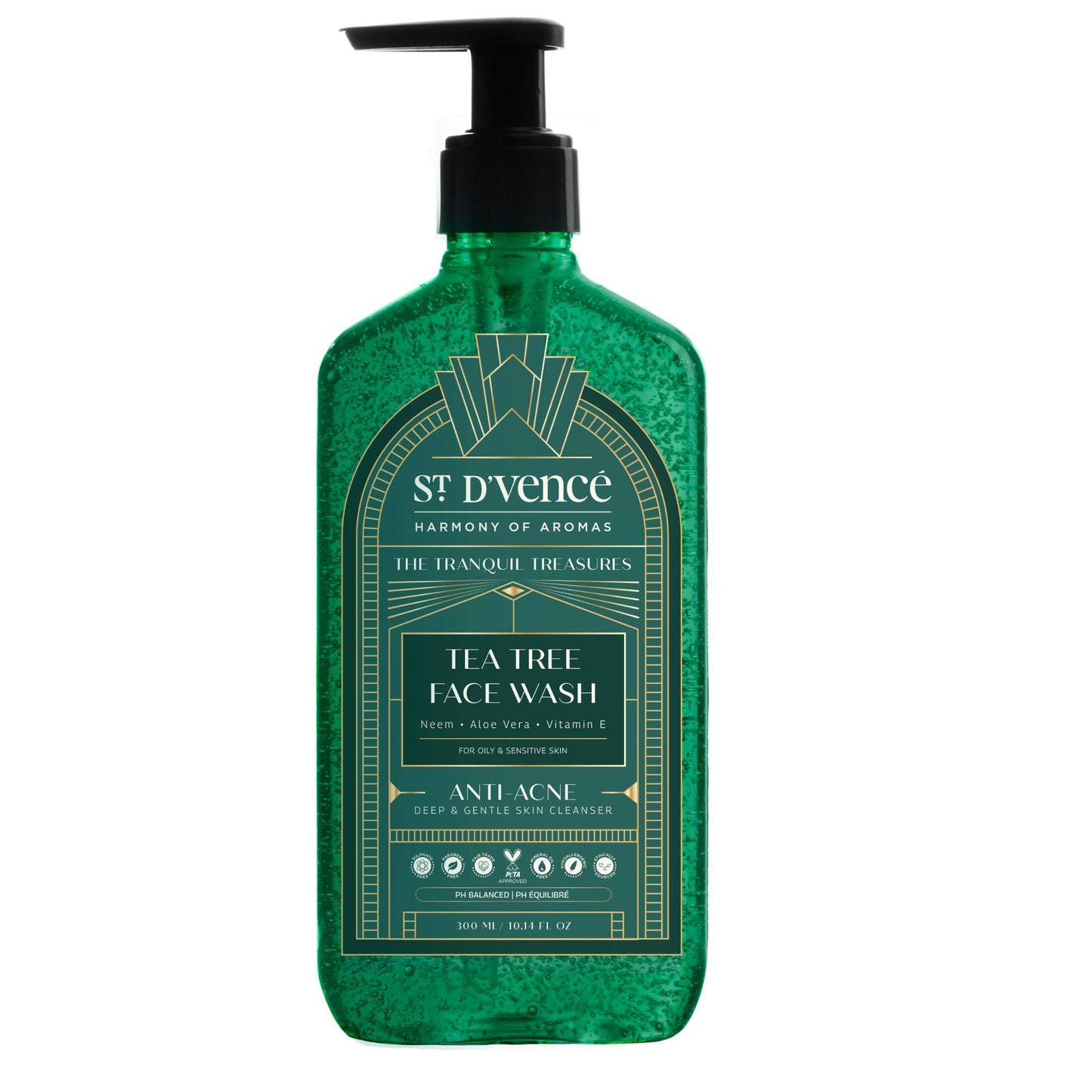
St. D'vence Tea Tree Oil And Neem Face Wash For Oily & Acne Prone Skin, Cleanses Pores & Excess Oil

St. D'vence Tea Tree Oil And Neem Face Wash For Oily & Acne Prone Skin, Cleanses Pores & Excess Oil
St. D'vencé
st-dvence-tea-tree-oil-and-neem-face-wash-for-oily-acne-prone-skin-cleanses-pores-excess-oil
Cleanse
10085463949605
Morning or Evening?
How often will you use this product?
Notes


Highlights
WHAT IS IT?
Face Wash with 2 key ingredients
FEATURES
Deep Cleansing, Acne Control, Oil Balancing, Soothing & Calming
BEST FOR
oily
CHECKS
SLS, SLES, Paraben
Who Is It For?
Unisex AdultsWhat Does It Help With?
Acne Blemishes Excess Oil Skin Infections Redness IrritationBudget
Mid-range ($30-$75)How To Use
Which routine should it be used in?
Instructions:
Key Information


What St. D'vencé Says
Product Description:
St. D’vencé Tea Tree Oil Face Wash is Deep Skin Cleansing Facial Wash. Tea Tree Oil has been extracted from oil rich and narrow leaved paperbark ti-tree from Queensland, Australia. It has supreme anti-acne, anti-microbial and anti-oxidant qualities that work to help fight multiple skin problems like blemishes and skin infections caused by acne or pimples. It is designed to remove dirt, excess oils and its helps eliminates skin impurities. Green tea extract exhibits antibacterial and anti-inflammatory properties. It helps fight off free radicals that cause damage to the cells and tissues of the face to keep it soft and smooth. St. D’vencé Tea Tree Oil Face Wash is a very gentle facial wash without SLS, SLES and paraben making it ideal for everyday use. It leaves you with a skin, that feels clean, fresh and instantly glowing. Soft and smooth skin care products.
About the Brand:
Ingredients Overview
Ingredients List
tea-tree-oil,neem-extract
Key Ingredients
Tea Tree Oil, Neem Extract
Ingredients Details
Neem Extract
Common Name(s): Neem leaf extract,indian lilac extract
CAS Number: 84696-19-5
DESCRIPTION
What It Does: Provides nimbin anti-inflammatory and nimbidin antimicrobial activity for acne and inflammatory skin conditions.
Why It's Used: Multi-function ayurvedic anti-acne and anti-inflammatory from neem with comprehensive antimicrobial and anti-inflammatory activity.
How It Works: Nimbin inhibits phospholipase a2 for arachidonic acid cascade anti-inflammatory activity. nimbidin provides antimicrobial activity vs p. acnes and s. aureus. nimbidiol inhibits histamine release for anti-allergic activity.
Typically Found In: Anti-acne products,ayurvedic formulations,antimicrobial skin care
TECHNICAL DETAILS
Primary Category: Active ingredient – soothing / anti-inflammatory
Secondary Functions: Redness reduction,anti-inflammatory,calming
Application Areas:

Facial Skincare
Body Care

Hair Care
Beard Care
Color Cosmetics (Makeup)
Dietary/Oral Supplements
Typical Concentration Range: 0.1%–5%
SOURCING & ETHICS
Vegan Status: Yes – from azadirachta indica leaves
Halal Status: Yes
Source Notes: Plant-derived extract or synthetic.
SKIN COMPATIBILITY
Irritancy Rating: 1/5 – very low
Comedogenicity Rating: 0/5 – non-comedogenic
Sensitivity Concerns: Non-irritating; ideal for reactive and sensitive skin.
Safe for Sensitive Skin: Yes – particularly recommended for sensitive skin
SAFETY & COMPATIBILITY
Safety Profile: Excellent safety profile. ewg score: 1.
Works Well With: Ceramides,panthenol,allantoin,hyaluronic acid,centella asiatica
Avoid Combining With: No significant incompatibilities
SCIENTIFIC NOTE
Neem's phospholipase a2 inhibition provides anti-inflammatory activity at the most upstream point of the arachidonic acid cascade – before arachidonic acid is even released from membrane phospholipids, preventing the entire downstream cox and lox inflammatory pathway. this upstream inhibition provides theoretically more comprehensive inflammation prevention than cox or lox inhibitors acting downstream.
Last Verified: Cosing database,subapriya & nagini neem review
Primary Sources: 2026-03-12
Tea Tree Oil
Common Name(s): Tea tree oil,tto,melaleuca oil
CAS Number: 68647-73-4
DESCRIPTION
What It Does: Provides the most potent single-plant broad-spectrum antimicrobial essential oil for skin antiseptic applications.
Why It's Used: The antimicrobial essential oil – tea tree oil's terpinen-4-ol provides clinically proven broad-spectrum antimicrobial activity in rct-level clinical studies for acne and mrsa decolonisation.
How It Works: Terpinen-4-ol (30-48%) provides membrane-disrupting antimicrobial activity vs gram+/- bacteria, fungi, and enveloped viruses. iso 4730 requires minimum 30% terpinen-4-ol and maximum 5% 1,8-cineole (sensitiser). anti-biofilm activity vs staphylococcus.
Typically Found In: Anti-acne products,antiseptic formulas,natural antimicrobials,scalp treatments
TECHNICAL DETAILS
Primary Category: Active ingredient – soothing / anti-inflammatory
Secondary Functions: Redness reduction,anti-inflammatory,calming
Application Areas:
Facial Skincare
Body Care
Hair Care
Beard Care
Color Cosmetics (Makeup)
Dietary/Oral Supplements
Typical Concentration Range: 0.001%–5%
SOURCING & ETHICS
Vegan Status: Yes – from melaleuca alternifolia leaves (australia)
Halal Status: Yes
Source Notes: Plant-derived extract or synthetic.
SKIN COMPATIBILITY
Irritancy Rating: 1/5 – very low
Comedogenicity Rating: 0/5 – non-comedogenic
Sensitivity Concerns: Non-irritating; ideal for reactive and sensitive skin.
Safe for Sensitive Skin: Yes – particularly recommended for sensitive skin
SAFETY & COMPATIBILITY
Safety Profile: Iso 4730:2017 quality standard defines authentic tea tree oil. can cause contact sensitisation at high concentrations. toxic if ingested.
Works Well With: Ceramides,panthenol,allantoin,hyaluronic acid,centella asiatica
Avoid Combining With: No significant incompatibilities
SCIENTIFIC NOTE
Randomised controlled trial comparison of 5% tea tree oil gel vs 5% benzoyl peroxide lotion for acne demonstrated equivalent efficacy for acne lesion reduction at 3 months. tea tree's slower onset (8 weeks vs 4 weeks for bpo) was offset by significantly fewer side effects (dryness, irritation, peeling) in the tto group – providing evidence-based support for clinical tto use as a well-tolerated bpo alternative.
Last Verified: Cosing database,bassett et al. tea tree oil acne rct,iso 4730
Primary Sources: 2026-03-12
