

Juice Beauty
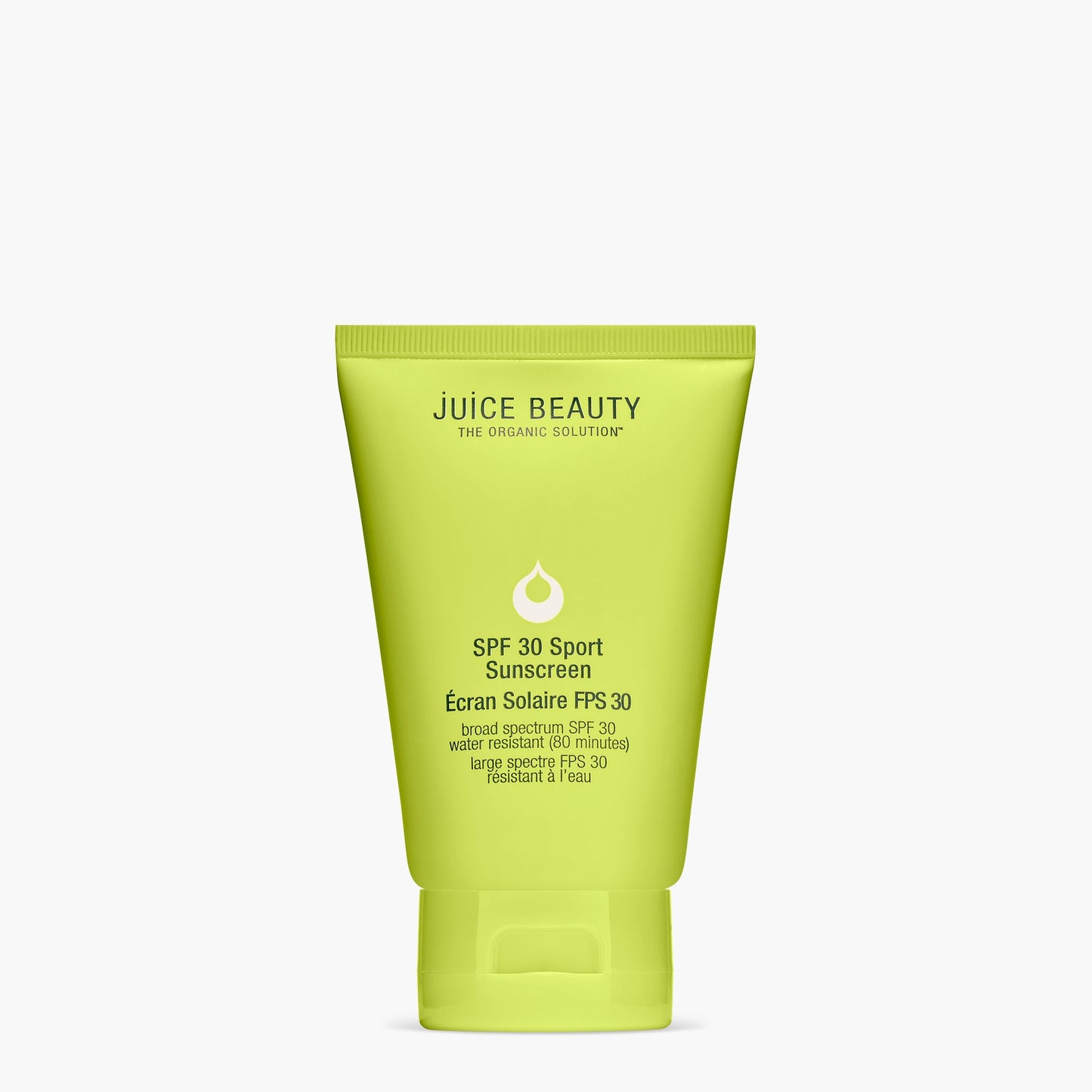
SPF 30 Sport Sunscreen

SPF 30 Sport Sunscreen
Juice Beauty
spf-30-sport-sunscreen
Suncare
9784766071077
Morning or Evening?
How often will you use this product?
Notes


Highlights
WHAT IS IT?
SPF 30 Sport Sunscreen with mineral zinc
FEATURES
Water-resistant, Contains mineral zinc, Organic ingredients, Family-friendly
BEST FOR
sensitive
CHECKS
Free of parabens, phthalates, sulfates, petroluem, pesticides, propylene, butylene glycols, PEGs, TEA, DEA, GMOs, artificial dyes, synthetic fragrances
Who Is It For?
All Ages (children Teens Adults) And GendersWhat Does It Help With?
Sun Protection Skin NourishmentBudget
Affordable (under $30)How To Use
Which routine should it be used in?
Instructions:
Key Information


What Juice Beauty Says
Product Description:
Water-resistant SPF 30 is your outdoor essential. Packed with mineral zinc and organic goodness, it shields you from harmful rays while nourishing your skin. Perfect for the whole family.
About the Brand:
Ingredients Overview
Ingredients List
Aloe Barbadensis (Organic Aloe Juice/Jus D’Aloès Bio)*, Cocos Nucifera (Organic Coconut Oil/Huile De Noix De Coco Bio)*, Pyrus Malus (Organic Apple Juice/Jus De Pomme Bio)*, Vitis Vinifera (Organic White Grape Juice/Jus De Raisin Blanc Bio)*, Caprylic/Capric Triglyceride†, Sorbitan Stearate, Ricinus Communis (Castor Seed Oil/Huile De Graines De Ricin), Hydrogenated Methyl Abietate, Polyglyceryl-10 Laurate, Magnesium Sulfate, Helianthus Annuus (Organic Sunflower Seed Oil/Huile De Graines De Tournesol Bio)*, Simmondsia Chinensis (Organic Jojoba Seed Oil/Huile De Graines De Jojoba Bio)*, Tocopherol (Vitamin E/Vitamine E), Magnesium Ascorbyl Phosphate (Vitamin C/Vitamine C), Citrus Limon (Lemon Extract/Extrait De Citron), Iron Oxides, Phenethyl Alcohol, Ethylhexylglycerin†, Citrus Reticulata (Mandarin Oil/Huile De Mandarine), Citrus Aurantium (Petitgrain Oil/Huile De Petit Grain)
Key Ingredients
zinc-oxide
Ingredients Details
Hydrogenated Methyl Abietate
Common Name(s): Hydrogenated methyl abietate
DESCRIPTION
What It Does: Delivers targeted skin-conditioning or bioactive benefits through a specific mechanism of action suited to the formulation's intended purpose.
Why It's Used: Specialty actives address specific skin concerns through targeted molecular mechanisms, providing efficacy beyond what base formulation ingredients alone can achieve.
How It Works: The bioactive compound interacts with specific molecular targets in skin cells or the extracellular matrix — enzymes, receptors, structural proteins, or signaling molecules — triggering beneficial biological responses.
Typically Found In: Serums,treatments,moisturizers,specialty products
TECHNICAL DETAILS
Primary Category: Specialty actives
Secondary Functions: Skin-conditioning,anti-aging
Application Areas:

Facial Skincare

Body Care
Hair Care
Beard Care
Color Cosmetics (Makeup)
Dietary/Oral Supplements
Typical Concentration Range: 0.01–5%
SOURCING & ETHICS
Vegan Status: Conditional - supplier confirmation required
Halal Status: Unverified - supplier confirmation required
Source Notes: Specialty active ingredient; check individual sourcing for vegan status. [audit 2026-07-29 rev2: the record's own source_notes does not assert a non-animal origin, or instructs the reader to verify with the supplier; "yes" asserts knowledge the record does not hold. determination requires shariah-panel sign-off.]
SKIN COMPATIBILITY
Irritancy Rating: 1
Comedogenicity Rating: 0
Sensitivity Concerns: Low sensitization potential at recommended use concentrations.
Safe for Sensitive Skin: Yes
SAFETY & COMPATIBILITY
Safety Profile: Well-characterized cosmetic ingredient with established safety profile. generally non-irritating at typical use concentrations. suitable for leave-on and rinse-off cosmetics.
Works Well With: Niacinamide,hyaluronic acid,vitamin c,peptides
Avoid Combining With: Incompatible with oxidizing agents; check ph stability
SCIENTIFIC NOTE
Specialty actives typically work through enzyme inhibition (e.g., tyrosinase inhibition for brightening, mmp inhibition for anti-aging), receptor activation (e.g., retinoid receptors, ppar-γ for barrier genes), or transcription factor modulation (e.g., nrf2 for antioxidant gene upregulation). structure-activity relationships determine potency and selectivity.
Last Verified: 2025-01-15
Primary Sources: Cosing eu database; pcpc cosmetic ingredient safety reviews; ingredient-specific safety and efficacy literature
Magnesium Sulfate
Common Name(s): Mineral salt,ionic strength modifier,skin mineralising agent
CAS Number: N/a
DESCRIPTION
What It Does: Provides mineral ion delivery to skin, modulates formulation ionic strength for viscosity and stability optimisation, and supports skin enzyme activity through essential mineral cofactor supplementation.
Why It's Used: Mineral salts are essential formulation ph and ionic strength adjusters — magnesium sulfate specifically provides the mg²⁺ ions that activate transglutaminase crosslinking during sc cornification, supporting barrier formation.
How It Works: Ionic dissociation in aqueous formulation provides free ions that modulate polymer viscosity (ionic strength reduces charge-based thickener swelling), provide mineral nutrition to skin enzymes (ca²⁺ for transglutaminase, mg²⁺ for mgatp phosphotransferases), and adjust osmolality for skin-surface tonicity matching.
Typically Found In: All formulations,mineral skin care
TECHNICAL DETAILS
Primary Category: Active ingredient – mineral / metal active
Secondary Functions: Antimicrobial,sebum regulation,antioxidant enzyme cofactor
Application Areas:
Facial Skincare
Body Care
Hair Care
Beard Care
Color Cosmetics (Makeup)
Dietary/Oral Supplements
Typical Concentration Range: 0.01%–5%
SOURCING & ETHICS
Vegan Status: Yes – mineral
Halal Status: Yes
Source Notes: Mineral/inorganic compound. cosmetic or pharmaceutical grade.
SKIN COMPATIBILITY
Irritancy Rating: 1/5 – very low
Comedogenicity Rating: 0/5 – non-comedogenic
Sensitivity Concerns: Non-irritating at recommended concentrations.
Safe for Sensitive Skin: Yes at recommended concentrations
SAFETY & COMPATIBILITY
Safety Profile: Excellent safety profile at cosmetic concentrations. ewg score: 1–2.
Works Well With: Niacinamide,salicylic acid,other actives
Avoid Combining With: No significant incompatibilities at standard concentrations
SCIENTIFIC NOTE
Mg²⁺ and ca²⁺ are essential cofactors for the sc cornification process — ca²⁺ specifically drives the ca²⁺ gradient across the epidermis (high in outer sc, low in basal layer) that regulates keratinocyte differentiation through ca²⁺-calmodulin signalling.
Last Verified: 2026-03-12
Primary Sources: Cosing database,magnesium sulfate mineral salt formulation review
Polyglyceryl-10 Laurate
Common Name(s): Polyglyceryl ester emulsifier,cosmos natural emulsifier,multi-glycerol hlb-tunable
CAS Number: N/a
DESCRIPTION
What It Does: Stabilises o/w or w/o emulsions depending on polyglyceryl chain length and fatty acid combination, provides gentle nonionic emulsification without the peg chemistry concerns of ethoxylated emulsifiers, and contributes skin-conditioning fatty acid emolliency.
Why It's Used: Cosmos-accepted alternative to peg emulsifiers — polyglyceryl esters provide equivalent emulsification performance from renewable glycerol + vegetable fatty acids without ethylene oxide chemistry, enabling certified natural/organic formulation.
How It Works: Polyglyceryl degree (pg-2 to pg-10) controls hlb: pg-2 (low eo equivalent) → lower hlb → w/o tendency; pg-10 → higher hlb → o/w emulsification. fatty acid chain (laurate c12, oleate c18:1, stearate c18:0) modulates lipophilicity within the hlb range. cosmos accepts from fermentation-derived glycerol + natural fatty acids.
Typically Found In: Cosmos natural emulsions,clean label formulas
TECHNICAL DETAILS
Primary Category: Active ingredient – cosmetic active
Secondary Functions: Skin conditioning
Application Areas:
Facial Skincare
Body Care
Hair Care
Beard Care
Color Cosmetics (Makeup)
Dietary/Oral Supplements
Typical Concentration Range: 1%–10%
SOURCING & ETHICS
Vegan Status: Conditional - feedstock declaration required
Halal Status: Unverified - feedstock declaration required (plant, animal and petrochemical routes all exist)
Source Notes: Commercially produced for cosmetic use. verify vegan/halal status with supplier. [audit 2026-07-29 rev2: origin-dependent: the same inci exists in plant, animal and petrochemical versions and the name does not discriminate. determination requires shariah-panel sign-off.]
SKIN COMPATIBILITY
Irritancy Rating: 1/5 – very low
Comedogenicity Rating: 0/5 – non-comedogenic
Sensitivity Concerns: Well-tolerated by most skin types.
Safe for Sensitive Skin: Yes
SAFETY & COMPATIBILITY
Safety Profile: Good safety profile at recommended concentrations. ewg score: 1–2.
Works Well With: Standard skincare actives
Avoid Combining With: No known significant incompatibilities
SCIENTIFIC NOTE
Polyglyceryl-3 diisostearate (pg-3 diisostearate) is the leading natural w/o emulsifier for natural sunscreen formulations — providing stable w/o emulsification for mineral uv filter dispersions in cosmos-certified sun care.
Last Verified: 2026-03-12
Primary Sources: Cosing database,polyglyceryl-10 laurate polyglyceryl emulsifier cosmos review
Sorbitan Stearate
Common Name(s): Span 60,sorbitan monostearate
CAS Number: 1338-41-6
DESCRIPTION
What It Does: Provides low-hlb w/o emulsification for stable water-in-oil cream systems.
Why It's Used: Low-hlb emulsifier for w/o cream formulations requiring water-in-oil texture with good skin occlusion.
How It Works: Hlb ~4.7 provides w/o emulsification tendency. stearate (c18) chain provides solid wax-like texture. when combined with polysorbate 60 or 80 (high hlb) at appropriate ratios achieves target hlb for oil type being emulsified.
Typically Found In: W/o creams,sunscreens,thick barrier creams
TECHNICAL DETAILS
Primary Category: Functional ingredient – low-hlb w/o emulsifier
Secondary Functions: Skin conditioning
Application Areas:
Facial Skincare
Body Care
Hair Care
Beard Care
Color Cosmetics (Makeup)
Dietary/Oral Supplements
Typical Concentration Range: 0.5%–5%
SOURCING & ETHICS
Vegan Status: Conditional - feedstock declaration required
Halal Status: Unverified - feedstock declaration required (plant, animal and petrochemical routes all exist)
Source Notes: Commercially produced for cosmetic use. verify vegan/halal status with supplier. [audit 2026-07-29 rev2: origin-dependent: the same inci exists in plant, animal and petrochemical versions and the name does not discriminate. determination requires shariah-panel sign-off.]
SKIN COMPATIBILITY
Irritancy Rating: 1/5 – very low
Comedogenicity Rating: 0/5 – non-comedogenic
Sensitivity Concerns: Well-tolerated by most skin types.
Safe for Sensitive Skin: Yes
SAFETY & COMPATIBILITY
Safety Profile: Good safety profile at recommended concentrations. ewg score: 1–2.
Works Well With: Standard skincare actives
Avoid Combining With: No known significant incompatibilities
SCIENTIFIC NOTE
Sorbitan stearate's transition from w/o to o/w emulsifier tendency when combined with polysorbate 60 at the classic 1:3 span:tween ratio was the original experimental basis for griffin's hlb (hydrophile-lipophile balance) theory. the span-tween system's systematic hlb tunability by ratio adjustment made it the experimental model for understanding blended emulsifier systems.
Last Verified: 2026-03-12
Primary Sources: Cosing database,griffin hlb original paper,cir safety assessment