

Nykaa E retail limited
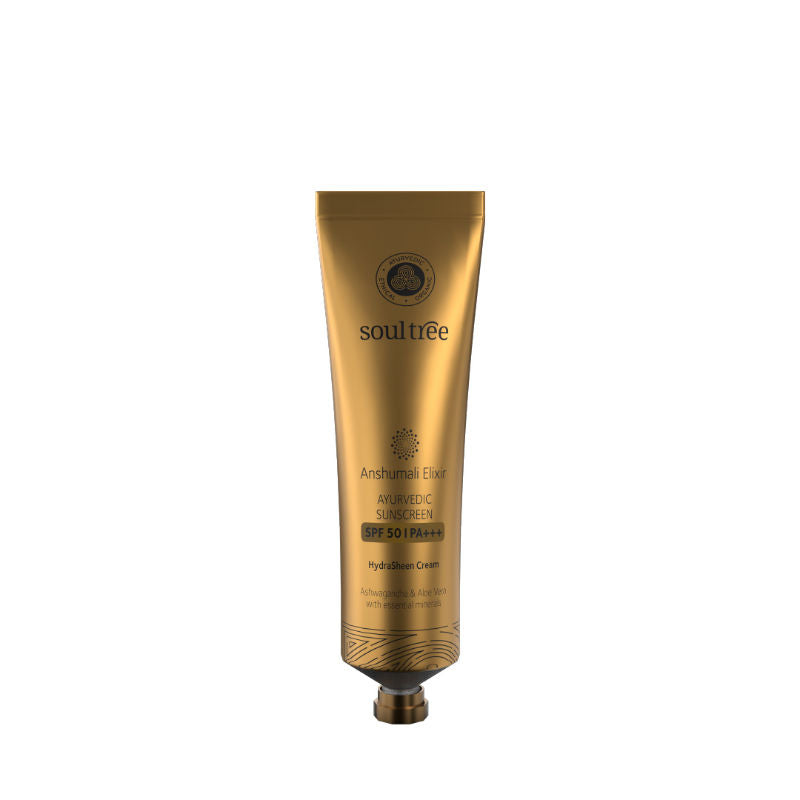
SoulTree Anshumali Elixir Ayurvedic Sunscreen SPF 50 PA+++

SoulTree Anshumali Elixir Ayurvedic Sunscreen SPF 50 PA+++
Nykaa E retail limited
soultree-anshumali-elixir-ayurvedic-sunscreen-spf-50-pa
Suncare
10084868555045
Morning or Evening?
How often will you use this product?
Notes


Highlights
WHAT IS IT?
Ayurvedic Mineral sunscreen with multiple actives (Ashwagandha, Aloe, Zinc Oxide, Sweet Orange Oil) - ingredient count approx 21 listed
FEATURES
Certified COSMOS Natural, Authentic Ayurvedic Formulation, Suitable for All Skin Types, Free from Parabens and Sulphates, 100% Sustainable Aluminium Packaging
BEST FOR
sensitive
CHECKS
Parabens,Sulphates,Plastic Packaging
Who Is It For?
What Does It Help With?
Protects Against Uva And Uvb Rays Soothes And Shields From Environmental Stress Hydrates And Cools Sunburnt/inflamed Skin Antioxidant ProtectionBudget
Professional (over $150)How To Use
Which routine should it be used in?
Instructions:
Key Information


What Nykaa E retail limited Says
Product Description:
Welcome the nurturing essence of Ayurveda with Anshumali Elixir SPF 50 PA+++, part of World’s first certified Natural Ayurvedic Mineral sunscreen range. This luxurious and unique HydraSheen formulation, infused with Ashwagandha and soothing Aloe, supports and strengthens your skin's natural barrier. Infused with Yashad Bhasma (Zinc Oxide), it offers enhanced protection from UVA and UVB rays. Let its light, non-sticky touch envelop you, imparting a radiant glow that mirrors the sun’s warmth. Primary Functions: Defends against the sun’s harmful UV rays, Preserves the skin's natural barrier throughout the day, Broad-spectrum Ayurvedic sunscreen, Non-sticky and leaves no white cast. Secondary Functions: Ashwagandha: A powerful adaptogen that soothes and shields the skin from environmental stress. Aloe Vera: Deeply hydrates and cools, offering a balm to sunburnt and inflamed skin. Yashad Bhasma (Zinc Oxide): Shields skin from UV rays with broad-spectrum protection. Sweet Orange Oil: Provides antioxidants and a refreshing, uplifting aroma. Features: Certified COSMOS Natural, Authentic Ayurvedic Formulation, Suitable for All Skin Types, Free from Parabens and Sulphates, 100% Sustainable Aluminium Packaging. About the Brand: SoulTree is the first Indian brand to offer European certified natural personal care and beauty products. All our products use authentic Ayurvedic recipes and honestly sourced natural, organic ingredients that do no harm, only good.
About the Brand:
Ingredients Overview
Ingredients List
Aqua,Zinc-Oxide,Caprylic/Capric-triglyceride,Titanium-Dioxide,Alumina,Stearic-Acid,Coco-glycerides,Glycerin,Sorbitan-Olivate,Cetearyl-glucoside,Cetearyl-Alcohol,Polyglyceryl-2-Oleate,Polyhydroxystearic-Acid,Polyglyceryl-2-Stearate,Capryloyl-Glycerin/Sebacic-Acid-Copolymer,Coco-Caprylate/Caprate,Triheptanoin,C9-12-Alkane,Polyurethane-100,Aloe-barbadensis-(Aloe-Vera)-Juice,Benzyl-alcohol,Glyceryl-laurate,Citrus-aurantium-(Neroli)-Oil,Xanthan-gum,Withania-somnifera-(Ashwagandha)-Extract,Sodium-Stearoyl-Glutamate,Citrus-sinesis-(Sweet-Orange)-Oil,Sodium-gluconate,Sclerotium-gum,Magnesium-Aluminum-Silicate,Tocopherol,Eugenol,Citral,Linalool
Key Ingredients
Ashwagandha,Aloe Vera,Zinc Oxide,Sweet Orange Oil
Ingredients Details
Alumina
Common Name(s): Alumina,cosmetic active,functional ingredient
CAS Number: N/a
DESCRIPTION
What It Does: Delivers characteristic cosmetic function at recommended use concentration.
Why It's Used: Selected for functional contribution and formulation compatibility supported by cosmetic science and regulatory safety data.
How It Works: Works through the mechanism of its molecular class as documented in peer-reviewed cosmetic literature.
Typically Found In: Skin care formulations
TECHNICAL DETAILS
Primary Category: Active ingredient – cosmetic active
Secondary Functions: Skin conditioning
Application Areas:

Facial Skincare

Body Care
Hair Care
Beard Care
Color Cosmetics (Makeup)
Dietary/Oral Supplements
Typical Concentration Range: 0.1%–10%
SOURCING & ETHICS
Vegan Status: Conditional
Halal Status: Yes
Source Notes: Commercially produced for cosmetic use. verify vegan/halal status with supplier.
SKIN COMPATIBILITY
Irritancy Rating: 1/5 – very low
Comedogenicity Rating: 0/5 – non-comedogenic
Sensitivity Concerns: Well-tolerated by most skin types.
Safe for Sensitive Skin: Yes
SAFETY & COMPATIBILITY
Safety Profile: Good safety profile at recommended concentrations. ewg score: 1–2.
Works Well With: Standard skincare actives
Avoid Combining With: No known significant incompatibilities
SCIENTIFIC NOTE
Alumina has an established safety profile within the cosmetic regulatory framework at standard use concentrations.
Last Verified: Cosing database,alumina technical literature
Primary Sources: 2026-03-12
Citral
Common Name(s): 3,7-dimethyl-2,6-octadienal,geranial+neral mix
CAS Number: 5392-40-5
DESCRIPTION
What It Does: Provides the defining intense lemon-citrus fragrance note.
Why It's Used: The lemon scent compound – citral defines the fresh lemon scent in lemon essential oil and lemongrass with potent antimicrobial activity.
How It Works: Mixture of e-isomer (geranial) and z-isomer (neral). antimicrobial via michael addition to thiol enzymes. inhibits nf-kb for anti-inflammatory activity. antioxidant via allylic aldehyde.
Typically Found In: Citrus fragrances,antibacterial products,lemon-scented cosmetics
TECHNICAL DETAILS
Primary Category: Fragrance component – lemon aldehyde
Secondary Functions: Skin conditioning
Application Areas:
Facial Skincare
Body Care
Hair Care
Beard Care
Color Cosmetics (Makeup)
Dietary/Oral Supplements
Typical Concentration Range: 0.001%–0.5%
SOURCING & ETHICS
Vegan Status: Yes – from lemon, lemongrass, melissa oils
Halal Status: Yes
Source Notes: Commercially produced for cosmetic use. verify vegan/halal status with supplier.
SKIN COMPATIBILITY
Irritancy Rating: 1/5 – very low
Comedogenicity Rating: 0/5 – non-comedogenic
Sensitivity Concerns: Well-tolerated by most skin types.
Safe for Sensitive Skin: Yes
SAFETY & COMPATIBILITY
Safety Profile: Eu cosmetics regulation: declared fragrance allergen. high sensitisation potential from alpha,beta-unsaturated aldehyde structure. ifra strict limits.
Works Well With: Standard skincare actives
Avoid Combining With: No known significant incompatibilities
SCIENTIFIC NOTE
Citral's high sensitisation potential (llna ec3 ~0.11%) is a consequence of its alpha,beta-unsaturated aldehyde structure providing a highly reactive michael acceptor for skin protein covalent binding. the e/z mixture (geranial/neral) in natural citral means both isomers contribute to the sensitisation burden – explaining why lemongrass oil (very high citral content, ~60-80%) is one of the more common essential oil allergens.
Last Verified: Cosing database,ifra standards
Primary Sources: 2026-03-12
Coco-caprylate/caprate
Common Name(s): Coco-caprylate/caprate
DESCRIPTION
What It Does: Smooths and softens skin by filling intercorneocyte spaces, reducing friction, and providing a pleasant aesthetic skin feel in formulations.
Why It's Used: Synthetic esters provide tailored aesthetic properties — spreadability, skin feel, volatility, refractive index — that natural oils alone cannot consistently deliver.
How It Works: The ester molecule fills microscopic surface irregularities between corneocytes, reducing coefficient of friction, reflecting light uniformly, and providing a lubrication layer that protects the skin surface.
Typically Found In: Moisturizers,sunscreens,color cosmetics,body lotions,lip products
TECHNICAL DETAILS
Primary Category: Synthetic emollients
Secondary Functions: Emollient
Application Areas:
Facial Skincare
Body Care
Hair Care
Beard Care
Color Cosmetics (Makeup)
Dietary/Oral Supplements
Typical Concentration Range: 1–20%
SOURCING & ETHICS
Vegan Status: Yes
Halal Status: Yes
Source Notes: Synthetically produced ester emollient; no animal components.
SKIN COMPATIBILITY
Irritancy Rating: 1
Comedogenicity Rating: 1
Sensitivity Concerns: Low sensitization potential at recommended use concentrations.
Safe for Sensitive Skin: Yes
SAFETY & COMPATIBILITY
Safety Profile: Well-characterized cosmetic ingredient with established safety profile. generally non-irritating at typical use concentrations. suitable for leave-on and rinse-off cosmetics.
Works Well With: Silicones,uv filters,other emollients
Avoid Combining With: Strongly alkaline conditions (risk of saponification of ester-type emollients)
SCIENTIFIC NOTE
The spreading coefficient of an emollient is governed by its surface tension, viscosity, and polarity. esters with branched alkyl chains (e.g., isopropyl, isostearyl) spread rapidly and leave a non-tacky film; linear long-chain esters provide more substantive moisturization. hlb value determines the preferred formulation system (w/o vs o/w emulsions).
Last Verified: Cosing eu database; pcpc cosmetic ingredient safety reviews; ingredient-specific safety and efficacy literature
Primary Sources: 2025-01-15
Eugenol
Common Name(s): 4-allyl-2-methoxyphenol,clove oil component,caryophyllene companion
CAS Number: 97-53-0
DESCRIPTION
What It Does: Provides warm clove fragrance note with local anaesthetic and antimicrobial properties.
Why It's Used: Natural local anaesthetic fragrance – eugenol provides clove's dual function as both a fragrance compound and a topical anaesthetic used in dentistry for pain relief.
How It Works: Activates trpv1 for local anaesthetic desensitisation (same mechanism as capsaicin but much weaker). inhibits cox and lox for anti-inflammatory activity. membrane disruption for antimicrobial activity. antioxidant via phenolic radical scavenging.
Typically Found In: Spice fragrances,dental products,clove-scented cosmetics
TECHNICAL DETAILS
Primary Category: Fragrance component – phenylpropanoid
Secondary Functions: Skin conditioning
Application Areas:
Facial Skincare
Body Care
Hair Care
Beard Care
Color Cosmetics (Makeup)
Dietary/Oral Supplements
Typical Concentration Range: 0.001%–0.5%
SOURCING & ETHICS
Vegan Status: Yes – from clove essential oil (syzygium aromaticum)
Halal Status: Yes
Source Notes: Commercially produced for cosmetic use. verify vegan/halal status with supplier.
SKIN COMPATIBILITY
Irritancy Rating: 1/5 – very low
Comedogenicity Rating: 0/5 – non-comedogenic
Sensitivity Concerns: Well-tolerated by most skin types.
Safe for Sensitive Skin: Yes
SAFETY & COMPATIBILITY
Safety Profile: Eu cosmetics regulation: declared fragrance allergen. ifra guidelines apply. sensitiser at high concentrations.
Works Well With: Standard skincare actives
Avoid Combining With: No known significant incompatibilities
SCIENTIFIC NOTE
Eugenol's dental anaesthetic use predates modern pharmaceutical dentistry – oil of cloves (primarily eugenol) has been used for toothache relief for centuries. modern dentistry still uses eugenol in zinc oxide-eugenol cement for temporary cavity filling, where eugenol's trpv1 desensitisation provides pain relief while zinc oxide provides structural material – a pharmaceutical application of a fragrance compound still standard in clinical dentistry.
Last Verified: Cosing database,ifra standards,eugenol dental review
Primary Sources: 2026-03-12
