

SKINTIFIC
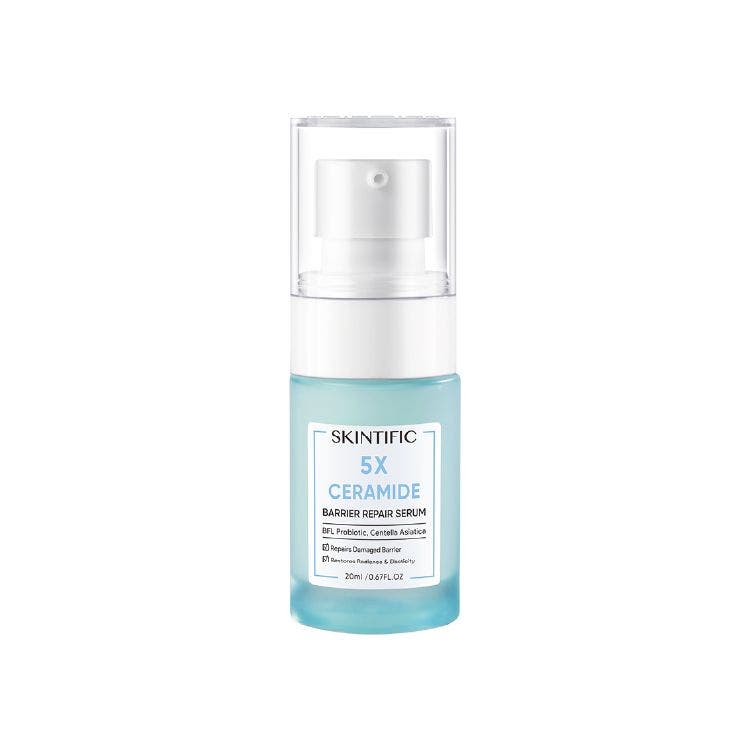
Skintific 5X Ceramide Barrier Repair Serum 20Ml

Skintific 5X Ceramide Barrier Repair Serum 20Ml
SKINTIFIC
skintific-5x-ceramide-barrier-repair-serum-20ml
Serum
10084702093605
Morning or Evening?
How often will you use this product?
Notes


Highlights
WHAT IS IT?
Serum with multiple ceramides and probiotics
FEATURES
Restores radiance and elasticity, calms and soothes skin barrier, combines Ceramides and BFL probiotics for moisturization and smoothness, supports skin elasticity
BEST FOR
sensitive
CHECKS
Does not contain allergens, safe for pregnancy, no irritation if discontinued
Who Is It For?
All Skin Types Safe During Pregnancy And BreastfeedingWhat Does It Help With?
Skin Barrier Repair Hydration Soothing Elasticity RestorationBudget
Mid-range ($30-$75)How To Use
Which routine should it be used in?
Instructions:
Key Information


What SKINTIFIC Says
Product Description:
SKINTIFIC 5X Ceramide Barrier Repair Serum restores radiance and elasticity as well as calming and soothing the skin barrier.
About the Brand:
Ingredients Overview
Ingredients List
AQUA,BUTYLENE-GLYCOL,PENTYLENE-GLYCOL,GLYCERIN,METHYL-GLUCETH-20,BIFIDA-FERMENT-LYSATE,HYDROLYZED-SODIUM-HYALURONATE,CENTELLA-ASIATICA-EXTRACT,DIPOTASSIUM-GLYCYRRHIZATE,ETHYLHEXYL-GLYCERIN,CERAMIDE-NS/CERAMIDE-NG,CERAMIDE-AP,CERAMIDE-AS,CERAMIDE-NP,CERAMIDE-EOP,LAMINARIA-DIGITATA-EXTRACT,SODIUM-ACETYLATED-HYALURONATE,SODIUM-HYALURONATE,SODIUM-HYALURONATE-CROSSPOLYMER,TREMELLA-FUCIFORMIS-SPOROCARP-EXTRACT,CALENDULA-OFFICINALIS-EXTRACT,INULIN,ALPHA-GLUCAN-OLIGOSACCHARIDE,ECTOIN,COLLAGEN,CHOLESTEROL,1,2-HEXANEDIOL,SORBITOL,CETYL-PG-HYDROXYETHYL-PALMITAMIDE,HYDROGENATED-LECITHIN,HYDROXYACETOPHENONE
Key Ingredients
Ceramide NS/NG, Ceramide AP, Ceramide AS, Ceramide NP, Ceramide EOP, Bifida Ferment Lysate, Centella Asiatica Extract
Ingredients Details
1-2-hexanediol
Common Name(s): 1-2-hexanediol,cosmetic active,functional ingredient
CAS Number: N/a
DESCRIPTION
What It Does: Delivers characteristic cosmetic function at recommended use concentration.
Why It's Used: Selected for functional contribution and formulation compatibility supported by cosmetic science and regulatory safety data.
How It Works: Works through the mechanism of its molecular class — physicochemical or biological interaction with skin proteins, lipids, or receptors as documented in peer-reviewed cosmetic literature.
Typically Found In: Skin care formulations
TECHNICAL DETAILS
Primary Category: Active ingredient – cosmetic active
Secondary Functions: Skin conditioning
Application Areas:

Facial Skincare

Body Care
Hair Care
Beard Care
Color Cosmetics (Makeup)
Dietary/Oral Supplements
Typical Concentration Range: 0.1%–10%
SOURCING & ETHICS
Vegan Status: Conditional - supplier confirmation required
Halal Status: Unverified - supplier confirmation required
Source Notes: Commercially produced for cosmetic use. verify vegan/halal status with supplier. [audit 2026-07-29 rev2: the record's own source_notes does not assert a non-animal origin, or instructs the reader to verify with the supplier; "yes" asserts knowledge the record does not hold. determination requires shariah-panel sign-off.]
SKIN COMPATIBILITY
Irritancy Rating: 1/5 – very low
Comedogenicity Rating: 0/5 – non-comedogenic
Sensitivity Concerns: Well-tolerated by most skin types.
Safe for Sensitive Skin: Yes
SAFETY & COMPATIBILITY
Safety Profile: Good safety profile at recommended concentrations. ewg score: 1–2.
Works Well With: Standard skincare actives
Avoid Combining With: No known significant incompatibilities
SCIENTIFIC NOTE
1-2-hexanediol has an established safety and efficacy profile within the cosmetic regulatory framework at standard use concentrations.
Last Verified: 2026-03-12
Primary Sources: Cosing database,1-2-hexanediol technical literature
Cholesterol
Common Name(s): 5-cholesten-3-ol,cholesterin
CAS Number: 57-88-5
DESCRIPTION
What It Does: Provides essential barrier sterol function as one of three critical stratum corneum lipid components.
Why It's Used: Essential component of complete barrier repair formulations – the stratum corneum barrier requires ceramides:cholesterol:fatty acids in approximately 1:1:1 molar ratio for complete barrier restoration.
How It Works: Integrates between ceramide headgroups in lamellar body structures, providing fluidity and flexibility to the otherwise rigid ceramide-dominated lipid matrix. controls lamellar body phase behavior for functional barrier.
Typically Found In: Barrier repair moisturizers,eczema treatments,dry skin formulations
TECHNICAL DETAILS
Primary Category: Active ingredient – barrier sterol
Secondary Functions: Lamellar body structure,barrier sterol
Application Areas:
Facial Skincare
Body Care
Hair Care
Beard Care
Color Cosmetics (Makeup)
Dietary/Oral Supplements
Typical Concentration Range: 0.01%–1%
SOURCING & ETHICS
Vegan Status: Conditional - feedstock declaration required
Halal Status: Unverified - feedstock declaration required (plant, animal and petrochemical routes all exist)
Source Notes: Traditionally from lanolin (wool grease). plant-derived cholesterol alternatives include phytosterols, though these show slightly different barrier integration. verify for vegan/halal. [audit 2026-07-29 rev2: origin-dependent: the same inci exists in plant, animal and petrochemical versions and the name does not discriminate. determination requires shariah-panel sign-off.]
SKIN COMPATIBILITY
Irritancy Rating: 1/5 – very low
Comedogenicity Rating: 0/5 – non-comedogenic
Sensitivity Concerns: Endogenous molecule; excellent tolerability.
Safe for Sensitive Skin: Yes
SAFETY & COMPATIBILITY
Safety Profile: Exceptional safety profile. natural skin component. ewg score: 1.
Works Well With: Other ceramides,cholesterol,free fatty acids,hyaluronic acid,niacinamide
Avoid Combining With: No significant incompatibilities
SCIENTIFIC NOTE
Elias demonstrated that barrier repair requires all three lipid classes (ceramides, cholesterol, fatty acids) in approximately equimolar ratios. formulations providing only ceramides without cholesterol and fatty acids show significantly inferior barrier restoration vs complete triple-lipid combinations.
Last Verified: 2026-03-12
Primary Sources: Cosing database,elias et al. barrier lipid ratio study,loden barrier repair review
Collagen
Common Name(s): Collagen
DESCRIPTION
What It Does: Delivers targeted skin-conditioning or bioactive benefits through a specific mechanism of action suited to the formulation's intended purpose.
Why It's Used: Specialty actives address specific skin concerns through targeted molecular mechanisms, providing efficacy beyond what base formulation ingredients alone can achieve.
How It Works: The bioactive compound interacts with specific molecular targets in skin cells or the extracellular matrix — enzymes, receptors, structural proteins, or signaling molecules — triggering beneficial biological responses.
Typically Found In: Serums,treatments,moisturizers,specialty products
TECHNICAL DETAILS
Primary Category: Specialty actives
Secondary Functions: Skin-conditioning,anti-aging
Application Areas:
Facial Skincare
Body Care
Hair Care
Beard Care
Color Cosmetics (Makeup)
Dietary/Oral Supplements
Typical Concentration Range: 0.01–5%
SOURCING & ETHICS
Vegan Status: No - animal-derived
Halal Status: Conditional - halal slaughter certificate required (species declaration and slaughter method)
Source Notes: Contains animal-derived components (collagen...); not suitable for vegan formulations. [audit 2026-07-29 rev2: name declares rendered fat or animal tissue; halal status depends on species and slaughter, neither of which is in the record. determination requires shariah-panel sign-off.]
SKIN COMPATIBILITY
Irritancy Rating: 1
Comedogenicity Rating: 0
Sensitivity Concerns: Low sensitization potential at recommended use concentrations.
Safe for Sensitive Skin: Conditional
SAFETY & COMPATIBILITY
Safety Profile: Well-characterized cosmetic ingredient with established safety profile. generally non-irritating at typical use concentrations. suitable for leave-on and rinse-off cosmetics.
Works Well With: Niacinamide,hyaluronic acid,vitamin c,peptides
Avoid Combining With: Incompatible with oxidizing agents; check ph stability
SCIENTIFIC NOTE
Specialty actives typically work through enzyme inhibition (e.g., tyrosinase inhibition for brightening, mmp inhibition for anti-aging), receptor activation (e.g., retinoid receptors, ppar-γ for barrier genes), or transcription factor modulation (e.g., nrf2 for antioxidant gene upregulation). structure-activity relationships determine potency and selectivity.
Last Verified: 2025-01-15
Primary Sources: Cosing eu database; pcpc cosmetic ingredient safety reviews; ingredient-specific safety and efficacy literature
Ectoin
Common Name(s): Ectoin,extremophile stress protector,anti-aging humectant
CAS Number: N/a
DESCRIPTION
What It Does: Hydrates by forming a water-shell around skin biomolecules, stabilises cellular membranes against heat/uv stress, and reduces inflammatory cytokine release in stressed skin.
Why It's Used: Provides dual humectancy plus cellular protection — unique among humectants for its documented ability to stabilise skin proteins and membranes against uv and environmental stress, not just attract water.
How It Works: Ectoin's tetrahydropyrimidine ring forms an ordered hydration shell around proteins, lipid bilayers, and dna through kosmotropic water structuring. this preferential hydration excludes denaturants and uv-stress mediators from biomolecule surfaces while simultaneously providing humectant moisture binding.
Typically Found In: Sensitive skin,uv protection actives,anti-inflammatory
TECHNICAL DETAILS
Primary Category: Functional ingredient – humectant
Secondary Functions: Tewl reduction,skin plumping
Application Areas:
Facial Skincare
Body Care
Hair Care
Beard Care
Color Cosmetics (Makeup)
Dietary/Oral Supplements
Typical Concentration Range: 0.1%–2%
SOURCING & ETHICS
Vegan Status: Conditional - supplier confirmation required
Halal Status: Unverified - supplier confirmation required
Source Notes: Synthetic or naturally derived. excellent aqueous solubility. [audit 2026-07-29 rev2: status downgraded on audit. determination requires shariah-panel sign-off.]
SKIN COMPATIBILITY
Irritancy Rating: 1/5 – very low
Comedogenicity Rating: 0/5 – non-comedogenic
Sensitivity Concerns: Non-irritating; suitable for all skin types.
Safe for Sensitive Skin: Yes
SAFETY & COMPATIBILITY
Safety Profile: Excellent safety profile. ewg score: 1.
Works Well With: Ceramides,emollients,occlusives,glycerin,hyaluronic acid
Avoid Combining With: No significant incompatibilities
SCIENTIFIC NOTE
Extremophile bacteria accumulate ectoin at up to 15% intracellular concentration to survive 100°c temperatures and extreme salinity — the same biomolecule protection mechanism applies to human skin cells at cosmetic concentrations.
Last Verified: 2026-03-12
Primary Sources: Cosing database,ectoin extremophile anti-stress clinical review