

dermalogica
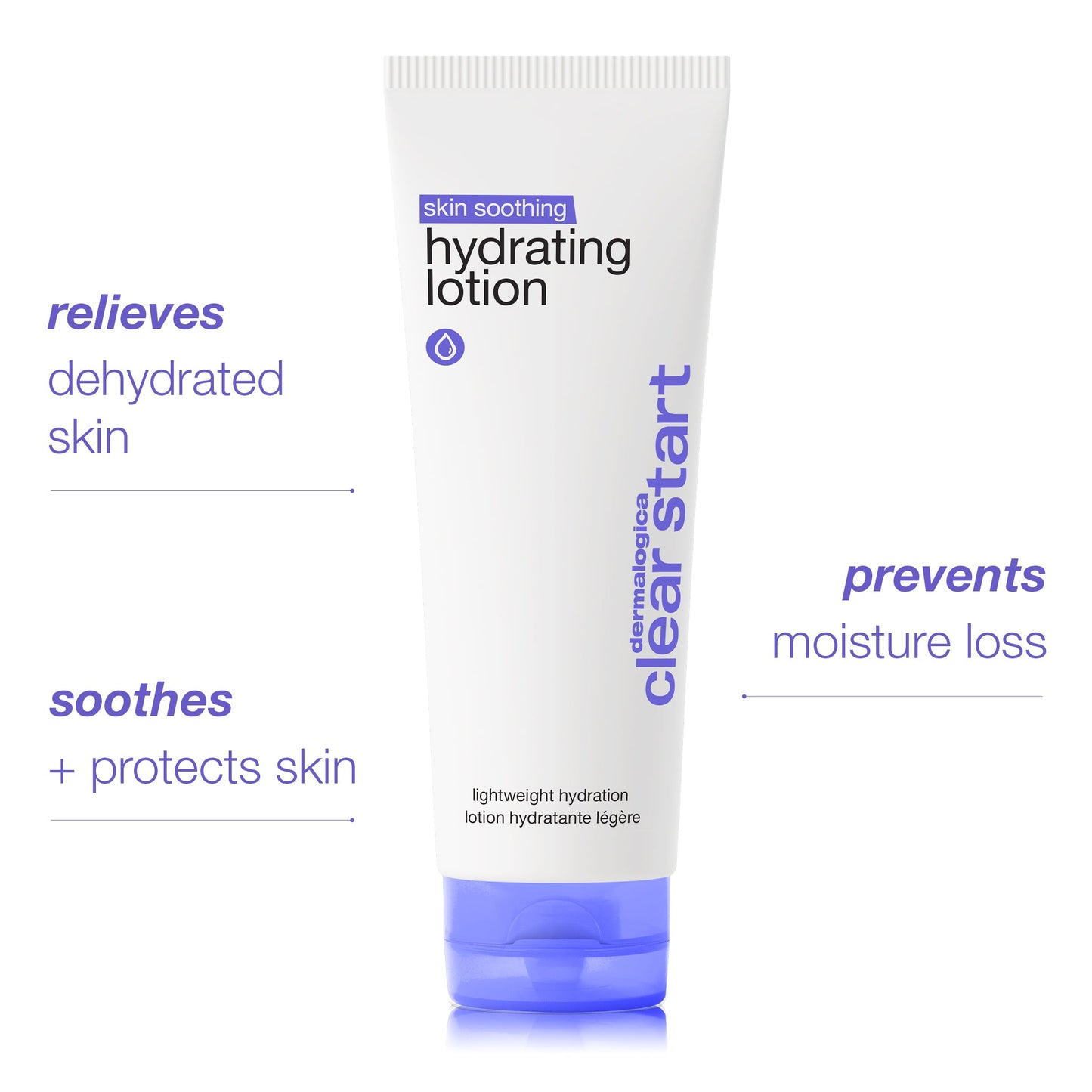
Skin Soothing Hydrating Lotion

Skin Soothing Hydrating Lotion
dermalogica
skin-soothing-hydrating-lotion
Moisturize
9784812798245
Morning or Evening?
How often will you use this product?
Notes


Highlights
WHAT IS IT?
Lightweight moisturizer
FEATURES
Lightweight, soothing, hydrating, helps with breakout-irritated skin
BEST FOR
sensitive
CHECKS
No artificial colours or fragrances
Who Is It For?
All Skin TypesWhat Does It Help With?
Acne Blemishes Dryness Dehydration Sensitivity RednessBudget
Affordable (under $30)How To Use
Which routine should it be used in?
Instructions:
Key Information


What dermalogica Says
Product Description:
Soothing, hydrating relief. Say goodbye to dehydrated, breakout-irritated skin with this lightweight moisturizer! Sheer, easy-to-apply formula helps soothe discomfort and hydrate areas that feel dry. Also helps relieve the dryness often associated with some acne treatments.
About the Brand:
Ingredients Overview
Ingredients List
Water/Aqua/Eau, Squalane, Butylene Glycol, C14-22 Alcohol, Naringenin, Salicylic Acid, Sodium Hyaluronate, Citrus Grandis (Grapefruit) Peel Oil, Zingiber Officinale (Ginger) Root Oil, Citrus Aurantium Dulcis (Orange) Peel Oil, Saccharide Isomerate, Glyceryl Caprylate, Triethyl Citrate, C12-20 Alkyl Glucoside, Acrylates/C10-30 Alkyl Acrylate Crosspolymer, Panthenyl Triacetate, Caprylhydroxamic Acid, Methylpropanediol, Aminomethyl Propanol, Polysorbate 20, Xanthan Gum, Benzoic Acid, Ethylhexylglycerin, Caprylic/Capric Triglyceride, Citric Acid, Sodium Citrate, Limonene, Citral, Phenoxyethanol
Key Ingredients
Gentle botanicals including ginger, orange, grapefruit, hyaluronic acid, plant-based squalene
Ingredients Details
Butylene Glycol
Common Name(s): 1,3-butanediol,bg,1,3-butylene glycol
CAS Number: 107-88-0
DESCRIPTION
What It Does: Provides humectant hydration and active ingredient solubilization with excellent skin feel.
Why It's Used: Preferred glycol humectant in premium and k-beauty formulations for superior skin feel vs propylene glycol with equivalent functionality.
How It Works: Two hydroxyl groups at 1,3-positions provide water binding and solvent activity. better tolerated than propylene glycol with minimal sensitization risk. 4-carbon backbone provides slightly greater hydrophobic character enabling dissolution of less polar actives vs pg.
Typically Found In: Toners,essences,serums,k-beauty formulas
TECHNICAL DETAILS
Primary Category: Functional ingredient – glycol humectant
Secondary Functions: Tewl reduction,skin plumping
Application Areas:

Facial Skincare
Body Care
Hair Care

Beard Care
Color Cosmetics (Makeup)
Dietary/Oral Supplements
Typical Concentration Range: 1%–10%
SOURCING & ETHICS
Vegan Status: Yes – synthetic
Halal Status: Yes
Source Notes: Synthetic or naturally derived. excellent aqueous solubility.
SKIN COMPATIBILITY
Irritancy Rating: 1/5 – very low
Comedogenicity Rating: 0/5 – non-comedogenic
Sensitivity Concerns: Non-irritating; suitable for all skin types.
Safe for Sensitive Skin: Yes
SAFETY & COMPATIBILITY
Safety Profile: Excellent safety profile. ewg score: 1.
Works Well With: Ceramides,emollients,occlusives,glycerin,hyaluronic acid
Avoid Combining With: No significant incompatibilities
SCIENTIFIC NOTE
K-beauty's preference for butylene glycol over propylene glycol is driven by two factors: bg's superior skin feel (less tacky than pg's higher viscosity) and its lower sensitization potential (1,3-bg has better spatial distribution of hydroxyl groups that reduces protein interaction vs pg's 1,2-position oh groups).
Last Verified: Cosing database,cir safety assessment
Primary Sources: 2026-03-12
Citrus Aurantium Dulcis Orange Peel Oil
Common Name(s): Citrus aurantium dulcis orange peel oil oil
DESCRIPTION
What It Does: Nourishes and softens skin through its balanced fatty acid profile, while antioxidant compounds protect against oxidative skin damage.
Why It's Used: Plant oils provide physiologically compatible lipid structures that integrate into the skin barrier and deliver fat-soluble antioxidants directly to skin cells.
How It Works: Fatty acids integrate into stratum corneum lipid lamellae, reinforcing the lipid barrier. antioxidants (tocopherols, carotenoids, polyphenols) neutralize ros through electron donation or singlet oxygen quenching.
Typically Found In: Face oils,serums,moisturizers,hair treatments,body oils
TECHNICAL DETAILS
Primary Category: Plant oils
Secondary Functions: Emollient,antioxidant
Application Areas:
Facial Skincare
Body Care
Hair Care
Beard Care
Color Cosmetics (Makeup)
Dietary/Oral Supplements
Typical Concentration Range: 0.5–30%
SOURCING & ETHICS
Vegan Status: Yes
Halal Status: Yes
Source Notes: Cold-pressed or solvent-extracted plant oil; no animal components.
SKIN COMPATIBILITY
Irritancy Rating: 1899-12-31 00:00:00 -0800
Comedogenicity Rating: 1900-01-01 00:00:00 -0800
Sensitivity Concerns: Low sensitization potential at recommended use concentrations.
Safe for Sensitive Skin: Yes
SAFETY & COMPATIBILITY
Safety Profile: Well-characterized cosmetic ingredient with established safety profile. generally non-irritating at typical use concentrations. suitable for leave-on and rinse-off cosmetics.
Works Well With: Vitamin e,ceramides,other plant oils,squalane
Avoid Combining With: Strong oxidizers (accelerate rancidity)
SCIENTIFIC NOTE
Vegetable oils are triglyceride matrices where the fatty acid composition determines skin compatibility, barrier function, and comedogenicity. oleic acid-rich oils (>60%) soften barrier lipids and enhance penetration; linoleic acid-rich oils reinforce ceramide-poor stratum corneum; saturated fatty acid-rich oils provide occlusion without skin penetration.
Last Verified: Cosing eu database; pcpc cosmetic ingredient safety reviews; aocs plant oil composition databases; fatty acid pharmacology reviews
Primary Sources: 2025-01-15
Naringenin
Common Name(s): Flavonoid antioxidant,plant polyphenol complex,anti-inflammatory brightening
CAS Number: N/a
DESCRIPTION
What It Does: Scavenges uv and pollution-derived free radicals via phenol h• donation, inhibits inflammatory nf-kb, cox-2, and 5-lox enzymes, and provides tyrosinase inhibition for hyperpigmentation treatment.
Why It's Used: Flavonoids provide the broadest multi-target anti-inflammatory coverage of any plant compound class — simultaneous cox, lox, and nf-kb inhibition from one ingredient addresses prostaglandin, leukotriene, and cytokine inflammatory pathways simultaneously.
How It Works: Multiple catechol and hydroxyl groups provide radical scavenging (dpph ic₅₀ 2–50 μm for most flavonoids); the catechol b-ring chelates fe²⁺ and cu²⁺ preventing fenton reaction; nf-kb inhibition occurs through ikb kinase modification; tyrosinase inhibition from catechol coordination to the active site cu²⁺.
Typically Found In: Anti-aging,anti-inflammatory,brightening botanicals
TECHNICAL DETAILS
Primary Category: Active ingredient – antioxidant
Secondary Functions: Free radical scavenging,anti-aging
Application Areas:
Facial Skincare
Body Care
Hair Care
Beard Care
Color Cosmetics (Makeup)
Dietary/Oral Supplements
Typical Concentration Range: 0.05%–2%
SOURCING & ETHICS
Vegan Status: Yes
Halal Status: Yes
Source Notes: Plant-derived extract or synthetic.
SKIN COMPATIBILITY
Irritancy Rating: 1/5 – very low
Comedogenicity Rating: 0/5 – non-comedogenic
Sensitivity Concerns: Non-irritating; well-tolerated.
Safe for Sensitive Skin: Yes
SAFETY & COMPATIBILITY
Safety Profile: Excellent safety profile. ewg score: 1.
Works Well With: Vitamin c,vitamin e,ferulic acid,spf,other antioxidants
Avoid Combining With: No significant incompatibilities
SCIENTIFIC NOTE
Quercetin's multi-target activity spectrum spans antioxidant (dpph ic₅₀ 4 μm), 12-lox inhibition (ic₅₀ 0.8 μm), nf-kb inhibition (ic₅₀ 15 μm), and tyrosinase inhibition (ic₅₀ 25 μm) — the breadth of multi-pathway coverage explaining why flavonoids are the most studied natural anti-inflammatory compound class.
Last Verified: Cosing database,flavonoid multi-target antioxidant anti-inflammatory review
Primary Sources: 2026-03-12
Saccharide Isomerate
Common Name(s): Pentavitin,carbohydrate complex
CAS Number: N/a
DESCRIPTION
What It Does: Provides wash-resistant, long-lasting skin hydration through unique covalent binding to skin surface proteins.
Why It's Used: The only humectant that covalently binds to skin proteins for wash-resistant, 72-hour moisture retention – categorically different mechanism from all other humectants.
How It Works: Carbohydrate complex with aldehyde-generating groups forms reversible schiff base covalent bonds with lysine epsilon-amino groups in skin surface proteins. this covalent binding retains the humectant on skin through washing, sweat, and environmental exposure for up to 72 hours.
Typically Found In: Long-lasting moisturizers,anti-chapping products,sports skincare
TECHNICAL DETAILS
Primary Category: Active ingredient – carbohydrate complex humectant
Secondary Functions: Covalent skin binding,wash-resistant,72h hydration
Application Areas:
Facial Skincare
Body Care
Hair Care
Beard Care
Color Cosmetics (Makeup)
Dietary/Oral Supplements
Typical Concentration Range: 1%–10%
SOURCING & ETHICS
Vegan Status: Yes – from plant carbohydrates
Halal Status: Yes
Source Notes: Synthetic or naturally derived. excellent aqueous solubility.
SKIN COMPATIBILITY
Irritancy Rating: 1/5 – very low
Comedogenicity Rating: 0/5 – non-comedogenic
Sensitivity Concerns: Non-irritating; suitable for all skin types.
Safe for Sensitive Skin: Yes
SAFETY & COMPATIBILITY
Safety Profile: Excellent safety profile. ewg score: 1.
Works Well With: Ceramides,emollients,occlusives,glycerin,hyaluronic acid
Avoid Combining With: No significant incompatibilities
SCIENTIFIC NOTE
No other cosmetic humectant forms covalent bonds with skin proteins – all others (glycerin, ha, sodium pca) interact through non-covalent hydrogen bonds that are disrupted by washing or sweat. saccharide isomerate's schiff base chemistry creates bonds that survive the ph and mechanical disruption of washing, explaining clinical evidence for 72-hour hydration persistence.
Last Verified: Cosing database,codex beauty saccharide isomerate review,dsm pentavitin technical data
Primary Sources: 2026-03-12
