
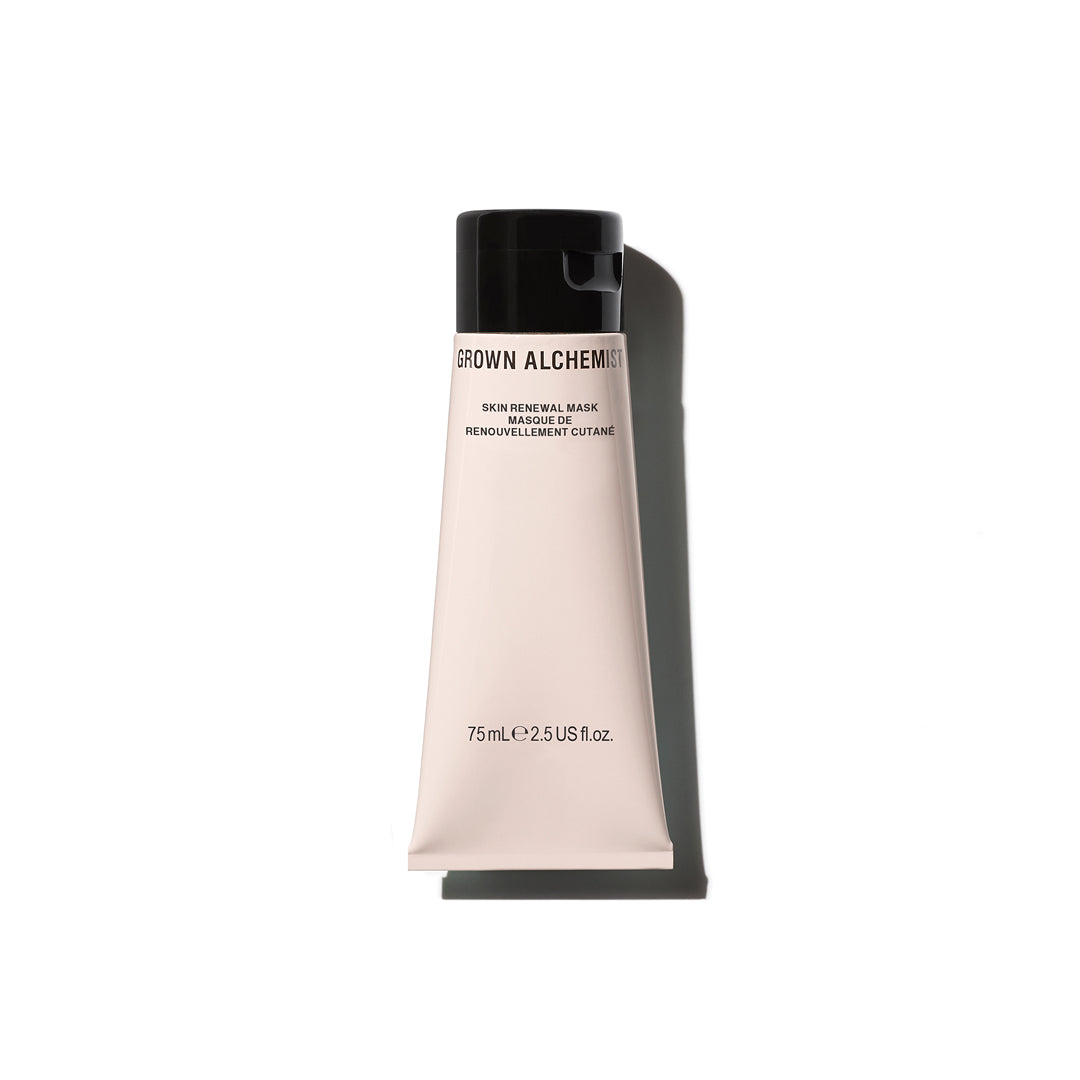

Grown Alchemist
SKIN RENEWAL MASK (75ML)

SKIN RENEWAL MASK (75ML)
Grown Alchemist
skin-renewal-mask-75ml
Face Mask
9784770232613
Morning or Evening?
How often will you use this product?
Notes


Highlights
WHAT IS IT?
Clay-to-Cream Wash Off Mask
FEATURES
Contains Snow Mushroom adaptogen, Echinacea for soothing and protection, Fruit acid blend for gentle exfoliation, Kaolin + Bentonite clays for purification
BEST FOR
normal
CHECKS
Clean beauty formulation
Who Is It For?
What Does It Help With?
Skin Renewal Purification Hydration Environmental ProtectionBudget
Mid-range ($30-$75)How To Use
Which routine should it be used in?
Instructions:
Key Information


What Grown Alchemist Says
Product Description:
Clay-to-Cream Wash Off Mask with Snow Mushroom, Echinacea + Fruit Acids
About the Brand:
Ingredients Overview
Ingredients List
Water/Aqua/Eau, Kaolin, Bentonite, Caprylic/Capric Triglyceride, Propylene Glycol, Ceteareth-20, Cetearyl Olivate, Vitis Vinifera (Grape) Seed Oil, Vaccinium Myrtillus Fruit Extract, Sorbitan Olivate, Myristyl Myristate, Xanthan Gum, Saccharum Officinarum (Sugarcane) Extract, 1,2-Hexanediol, Caprylyl Glycol, Illite, Montmorillonite, Sodium Hydroxide, Citrus Aurantium Dulcis (Orange) Fruit Extract, Citrus Limon (Lemon) Fruit Extract, Tremella Fuciformis Sporocarp Extract, Myristyl Laurate, Echinacea Purpurea Extract, Acer Saccharum (Sugar Maple) Extract, Cedrus Atlantica Bark Oil, Citrus Nobilis (Mandarin Orange) Peel Oil, Cymbopogon Martini Oil, Lavandula Angustifolia (Lavender) Oil, Pelargonium Graveolens Flower Oil, Citrus Aurantium Dulcis (Orange) Peel Extract, Salvia Sclarea (Clary) Oil, Piper Nigum (Pepper) Fruit Oil, Myroxylon Pereirea (Balsam Peru) Oil, Triethyl Citrate, Santalum Album (Sandalwood) Oil, Limonene, Geraniol, Linalool, Citronellol, Citral, Benzyl Benzoate, Farnesol, Benzyl Cinnamate
Key Ingredients
Snow Mushroom, Echinacea, Fruit Acids, Kaolin Clay, Bentonite Clay
Ingredients Details
Bentonite
Common Name(s): Montmorillonite,volcanic ash clay,swelling clay
CAS Number: 1302-78-9
DESCRIPTION
What It Does: Provides thixotropic clay gellation and deep oil absorption from swelling smectite clay.
Why It's Used: Strongest adsorbing clay for deep cleansing masks – bentonite's high cation exchange capacity and swelling capacity provide the deepest oil and toxin adsorption of common cosmetic clays.
How It Works: Montmorillonite 2:1 layered silicate swells up to 15× in water via interlayer water absorption. very high cation exchange capacity (cec: 80-150 meq/100g) provides exceptional adsorption of cations, oils, and toxins. thixotropic gel provides 'mask that hardens' sensory experience.
Typically Found In: Clay masks,deep cleansing products,detoxifying formulas
TECHNICAL DETAILS
Primary Category: Functional ingredient – swelling clay mineral
Secondary Functions: Skin conditioning
Application Areas:

Facial Skincare

Body Care
Hair Care
Beard Care
Color Cosmetics (Makeup)
Dietary/Oral Supplements
Typical Concentration Range: 1%–25%
SOURCING & ETHICS
Vegan Status: Yes – natural mineral
Halal Status: Yes
Source Notes: Commercially produced for cosmetic use. verify vegan/halal status with supplier.
SKIN COMPATIBILITY
Irritancy Rating: 1/5 – very low
Comedogenicity Rating: 0/5 – non-comedogenic
Sensitivity Concerns: Well-tolerated by most skin types.
Safe for Sensitive Skin: Yes
SAFETY & COMPATIBILITY
Safety Profile: Good safety profile at recommended concentrations. ewg score: 1–2.
Works Well With: Standard skincare actives
Avoid Combining With: No known significant incompatibilities
SCIENTIFIC NOTE
Bentonite's extraordinary swelling (up to 15× dry volume) arises from its 2:1 layer structure: sodium bentonite's inter-layer sodium cations attract very thick water shells, forcing the silicate layers apart by electrostatic repulsion. calcium bentonite swells only 2-3× by comparison, explaining why sodium-exchanged bentonite is the industrial standard for swelling applications.
Last Verified: Cosing database,cir safety assessment
Primary Sources: 2026-03-12
Caprylic/capric Triglyceride
Common Name(s): Mct oil,fractionated coconut oil,c8/c10 triglyceride
CAS Number: 73398-61-5
DESCRIPTION
What It Does: Lightweight, stable emollient that solubilizes oil-soluble actives for excellent delivery without greasy feel.
Why It's Used: Universal lightweight emollient base and solubilizer for oil-soluble actives in serums and low-viscosity formulations where mineral oil or petrolatum would be too heavy.
How It Works: Medium-chain length provides ideal balance of spreading coefficient, penetration rate, and barrier-sealing properties. excellent solubilizer for vitamin e, retinoids, and other lipophilic actives.
Typically Found In: Serums,facial oils,sunscreens,anti-aging products,hair products
TECHNICAL DETAILS
Primary Category: Active ingredient – medium-chain triglyceride emollient
Secondary Functions: Active solubilizer,spreading agent
Application Areas:
Facial Skincare
Body Care
Hair Care
Beard Care
Color Cosmetics (Makeup)
Dietary/Oral Supplements
Typical Concentration Range: 1%–50%
SOURCING & ETHICS
Vegan Status: Yes – from coconut/palm kernel oil
Halal Status: Yes
Source Notes: Fractionated by hydrolysis and re-esterification of coconut oil. only c8 and c10 fatty acids retained.
SKIN COMPATIBILITY
Irritancy Rating: 1/5 – very low
Comedogenicity Rating: 1/5 – very low; medium-chain length generally non-comedogenic
Sensitivity Concerns: Non-irritating.
Safe for Sensitive Skin: Yes
SAFETY & COMPATIBILITY
Safety Profile: Excellent safety profile. ewg score: 1.
Works Well With: Humectants,ceramides,actives as carrier
Avoid Combining With: No significant incompatibilities
SCIENTIFIC NOTE
Mct oil's medium-chain length (c8/c10) provides superior oxidative stability vs longer polyunsaturated chains and better skin aesthetics (lighter, less greasy) vs longer chain emollients (c16/c18). excellent solubilizer for retinoic acid, tocopheryl esters, and other lipophilic actives.
Last Verified: Cosing database,cir safety assessment,ewg skin deep
Primary Sources: 2026-03-12
Ceteareth-20
Common Name(s): Polyethylene glycol cetearyl ether,peg-20 cetearyl ether
CAS Number: 68439-49-6
DESCRIPTION
What It Does: Provides high-hlb o/w emulsification for stable cream formation from ethoxylated cetearyl alcohol.
Why It's Used: Classic self-emulsifying wax component for standard pharmaceutical and cosmetic cream formulation.
How It Works: 20 eo units on cetearyl alcohol chain provide hlb ~15-17 for strong o/w emulsification. often pre-blended with cetearyl alcohol as 'emulsifying wax' for simplified cream making. combined low-hlb cetearyl alcohol + high-hlb ceteareth-20 forms a balanced self-emulsifying system.
Typically Found In: Classic pharmaceutical and cosmetic creams
TECHNICAL DETAILS
Primary Category: Functional ingredient – ethoxylated fatty alcohol emulsifier
Secondary Functions: Skin conditioning
Application Areas:
Facial Skincare
Body Care
Hair Care
Beard Care
Color Cosmetics (Makeup)
Dietary/Oral Supplements
Typical Concentration Range: 1%–8%
SOURCING & ETHICS
Vegan Status: Conditional – peg petroleum; cetearyl vegetable
Halal Status: Yes
Source Notes: Commercially produced for cosmetic use. verify vegan/halal status with supplier.
SKIN COMPATIBILITY
Irritancy Rating: 1/5 – very low
Comedogenicity Rating: 0/5 – non-comedogenic
Sensitivity Concerns: Well-tolerated by most skin types.
Safe for Sensitive Skin: Yes
SAFETY & COMPATIBILITY
Safety Profile: Good safety profile at recommended concentrations. ewg score: 1–2.
Works Well With: Standard skincare actives
Avoid Combining With: No known significant incompatibilities
SCIENTIFIC NOTE
Ceteareth-20's combination with cetearyl alcohol in the classic 'emulsifying wax nf' creates what is called a 'mixed emulsifier system' where the fatty alcohol forms lamellar crystal phases that physically trap and stabilize oil droplets. this physical (lamellar crystal) + chemical (hlb balance) dual stabilization provides superior stability compared to either component alone.
Last Verified: Cosing database,cir safety assessment
Primary Sources: 2026-03-12
Cetearyl Olivate
Common Name(s): Nonionic emulsifier,o/w surfactant,emulsion stabiliser
CAS Number: N/a
DESCRIPTION
What It Does: Stabilises o/w emulsions by forming a molecular monolayer at the oil-water interface, provides co-emulsification synergy with other emulsifiers, and contributes to emulsion texture through interfacial film properties.
Why It's Used: Nonionic emulsifiers are preferred for sensitive skin and ph-extreme formulations — no ionic charge means no electrostatic interaction with skin proteins, no ph-dependent function loss, and compatibility with both anionic and cationic co-ingredients.
How It Works: Hlb determines emulsion type: hlb 8–12 for o/w emulsification; hlb 3–6 for w/o. the peg or glycoside head group provides hydrophilicity while the c16–c18 fatty chain provides lipophilicity. at the o/w interface, nonionic emulsifiers form a mixed monolayer reducing interfacial tension from ~35 mn/m (clean oil-water) to 5–10 mn/m, providing thermodynamic stabilisation.
Typically Found In: Creams,lotions,o/w emulsions
TECHNICAL DETAILS
Primary Category: Active ingredient – cosmetic active
Secondary Functions: Skin conditioning
Application Areas:
Facial Skincare
Body Care
Hair Care
Beard Care
Color Cosmetics (Makeup)
Dietary/Oral Supplements
Typical Concentration Range: 1%–10%
SOURCING & ETHICS
Vegan Status: Conditional
Halal Status: Yes
Source Notes: Commercially produced for cosmetic use. verify vegan/halal status with supplier.
SKIN COMPATIBILITY
Irritancy Rating: 1/5 – very low
Comedogenicity Rating: 0/5 – non-comedogenic
Sensitivity Concerns: Well-tolerated by most skin types.
Safe for Sensitive Skin: Yes
SAFETY & COMPATIBILITY
Safety Profile: Good safety profile at recommended concentrations. ewg score: 1–2.
Works Well With: Standard skincare actives
Avoid Combining With: No known significant incompatibilities
SCIENTIFIC NOTE
Mixed emulsifier systems (e.g., glyceryl stearate + peg-100 stearate, or cetearyl glucoside + cetearyl alcohol) provide better emulsion stability than single emulsifiers — synergistic packing of different molecular geometries creates a more cohesive, mechanically robust interfacial film.
Last Verified: Cosing database,nonionic emulsifier hlb system review
Primary Sources: 2026-03-12
