

SIMPLE
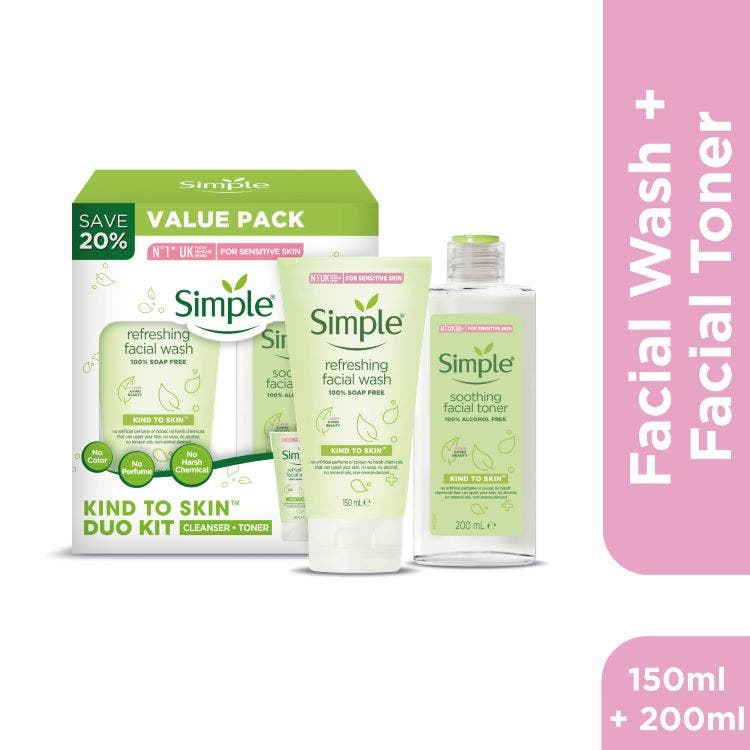
Simple Kind To Skin Duo Kit# (Simple Kind To Skin Refreshing Facial Wash Gel 150Ml+Simple Kind To Skin Soothing Toner 200Ml)

Simple Kind To Skin Duo Kit# (Simple Kind To Skin Refreshing Facial Wash Gel 150Ml+Simple Kind To Skin Soothing Toner 200Ml)
SIMPLE
simple-kind-to-skin-duo-kit-simple-kind-to-skin-refreshing-facial-wash-gel-150ml-simple-kind-to-skin-soothing-toner-200ml
Cleanse
10084807115045
Morning or Evening?
How often will you use this product?
Notes


Highlights
WHAT IS IT?
Duo kit containing 2 skincare products: a facial wash gel and a soothing facial toner
FEATURES
Soap free cleanser, Gel-based, Alcohol free toner, Restores natural pH level, Contains Pro-Vitamin B5
BEST FOR
sensitive
CHECKS
No soap, No alcohol, No fragrance
Who Is It For?
What Does It Help With?
Restores Softens Smooths Skin; Removes Makeup Dirt Impurities; Balances Skin's PhBudget
Affordable (under $30)How To Use
Which routine should it be used in?
Instructions:
Key Information

What SIMPLE Says
Product Description:
Simple Kind to Skin Refreshing Facial Wash Gel is a 100% soap free cleanser that washes away make-up, dirt and other impurities without drying (gel-based). Simple Kind to Skin Soothing Facial Toner is a 100% alcohol free toner that removes any alkaline residue left after cleansing, helping restore the balance to your skin's natural pH level.
About the Brand:
Ingredients Overview
Ingredients List
aqua,cocamidopropyl-betaine,propylene-glycol,hydroxypropyl-methylcellulose,panthenol,disodium-edta,hydroxypropyl-cyclodextrin,iodopropynyl-butylcarbamate,pantolactone,phenoxyethanol,sodium-benzoate,sodium-chloride,sodium-hydroxide,tocopheryl-acetate,hydrogenated-starch-hydrolysate,sodium-pca,allantoin,cetylpyridinium-chloride,niacinamide,hamamelis-virginiana-leaf-water,decyl-glucoside
Key Ingredients
Pro-Vitamin-B5,Niacinamide,Allantoin
Ingredients Details
Allantoin
Common Name(s): 5-ureidohydantoin,glyoxyldiureide,aluminum dihydroxy allantoinate
CAS Number: 97-59-6
DESCRIPTION
What It Does: Soothes irritation, accelerates wound healing, promotes skin cell renewal, and provides mild keratolytic exfoliation.
Why It's Used: Gold standard multi-function soothing active – one of the most widely used cosmetic ingredients across all product types for its exceptional tolerability and clinically proven multi-action skin conditioning.
How It Works: Promotes keratinocyte proliferation and fibroblast migration for wound healing. mild keratolytic activity by disrupting corneocyte binding. anti-irritant via direct protein binding and anti-inflammatory cytokine reduction. humectant activity via hydroxyl groups.
Typically Found In: Post-procedure products,sensitive skin formulas,wound care,anti-acne treatments,baby products
TECHNICAL DETAILS
Primary Category: Active ingredient – soothing / anti-inflammatory
Secondary Functions: Wound healing,keratolytic,anti-irritant
Application Areas:

Facial Skincare
Body Care

Hair Care
Beard Care
Color Cosmetics (Makeup)
Dietary/Oral Supplements
Typical Concentration Range: 0.1%–2%
SOURCING & ETHICS
Vegan Status: Yes – synthetic or comfrey-derived
Halal Status: Yes
Source Notes: Plant-derived extract or synthetic.
SKIN COMPATIBILITY
Irritancy Rating: 1/5 – very low
Comedogenicity Rating: 0/5 – non-comedogenic
Sensitivity Concerns: Exceptionally well-tolerated; suitable for all skin types including baby and compromised skin.
Safe for Sensitive Skin: Yes – particularly recommended for sensitive skin
SAFETY & COMPATIBILITY
Safety Profile: Excellent safety profile. ewg score: 1.
Works Well With: Ceramides,panthenol,allantoin,hyaluronic acid,centella asiatica
Avoid Combining With: No significant incompatibilities
SCIENTIFIC NOTE
Allantoin's keratinocyte proliferation stimulation occurs via receptor-mediated signaling (possibly machr activation) rather than non-specific irritation-driven proliferation, making it a true wound-healing stimulant rather than a pro-inflammatory proliferative signal.
Last Verified: Cosing database,cir safety assessment,araújo et al. allantoin review
Primary Sources: 2026-03-12
Niacinamide
Common Name(s): Vitamin b3,nicotinamide,pyridine-3-carboxamide
CAS Number: 98-92-0
DESCRIPTION
What It Does: Niacinamide strengthens the skin barrier, reduces visible pore size, regulates sebum production, fades dark spots, and improves skin texture and tone.
Why It's Used: It is used because it addresses multiple skin concerns at once without irritation, making it suitable for all skin types. it is stable in formulations and pairs well with most other actives.
How It Works: Niacinamide inhibits the transfer of melanosomes (pigment packets) to skin cells, reducing hyperpigmentation. it also stimulates ceramide synthesis to strengthen the skin barrier and reduces inflammation by modulating cytokine activity.
Typically Found In: Serums,moisturizers,toners,cleansers,eye creams,sunscreens,primers
TECHNICAL DETAILS
Primary Category: Active ingredient – vitamin
Secondary Functions: Barrier repair,brightening,anti-inflammatory
Application Areas:
Facial Skincare
Body Care
Hair Care
Beard Care
Color Cosmetics (Makeup)
Dietary/Oral Supplements
Typical Concentration Range: 2%–10% (typical: 5%; higher concentrations may cause flushing in some individuals)
SOURCING & ETHICS
Vegan Status: Yes – synthetically produced
Halal Status: Yes – synthetic origin
Source Notes: Commercially produced via synthesis from nicotinic acid or 3-cyanopyridine. no animal-derived sources used in cosmetic-grade niacinamide.
SKIN COMPATIBILITY
Irritancy Rating: 1/5 – very low; concentrations above 10% may cause temporary flushing in sensitive individuals
Comedogenicity Rating: 0/5 – non-comedogenic
Sensitivity Concerns: At concentrations >10%, some users experience niacin flush (transient redness/tingling). generally very well-tolerated.
Safe for Sensitive Skin: Yes – one of the best-tolerated actives for sensitive skin
SAFETY & COMPATIBILITY
Safety Profile: Extensively studied and considered very safe. ewg hazard score: 1. no significant systemic toxicity concerns at topical concentrations.
Works Well With: Retinol,peptides,ahas/bhas,hyaluronic acid,ceramides,zinc,vitamin c,spf
Avoid Combining With: High concentrations of vitamin c (ascorbic acid) may theoretically convert to niacin – use at different times if using pure l-ascorbic acid above 15%
SCIENTIFIC NOTE
Niacinamide is a precursor to nad+ and nadp+, coenzymes vital to cellular energy metabolism. its benefits for dna repair and mitochondrial function make it a key ingredient in anti-aging strategies.
Last Verified: Cosing database,cir safety assessment,ewg skin deep,pubmed clinical studies
Primary Sources: 2026-03-12
Panthenol
Common Name(s): Provitamin b5,d-panthenol,dl-panthenol,d-pantothenyl alcohol,(r)-2,4-dihydroxy-n-(3-hydroxypropyl)-3,3-dimethylbutanamide
DESCRIPTION
What It Does: Panthenol deeply moisturizes skin and hair, soothes irritation, accelerates wound healing, strengthens the skin barrier, and improves hair elasticity and shine.
Why It's Used: It is used because it is exceptionally versatile, working in both skin and hair formulations. it is gentle enough for sensitive and post-procedure skin, and converts to the active vitamin b5 within the skin.
How It Works: Panthenol penetrates skin and hair, where it is oxidized to pantothenic acid (vitamin b5), a coenzyme a precursor essential to metabolism. in skin, it acts as a humectant and stimulates fibroblast proliferation. in hair, it coats the shaft, improving manageability.
Typically Found In: Moisturizers,serums,toners,after-sun products,wound healing products,shampoos,conditioners,hair masks,beard care
TECHNICAL DETAILS
Primary Category: Active ingredient – provitamin b5
Secondary Functions: Anti-inflammatory,wound healing,hair conditioning
Application Areas:
Facial Skincare
Body Care
Hair Care
Beard Care
Color Cosmetics (Makeup)
Dietary/Oral Supplements
Typical Concentration Range: 0.5%–5% (typical: 1–3%)
SOURCING & ETHICS
Vegan Status: Yes – synthetically produced
Halal Status: Yes
Source Notes: Commercially synthesized. both d- and dl-forms used in cosmetics; d-panthenol is the biologically active isomer but dl-panthenol is less expensive and widely used.
SKIN COMPATIBILITY
Irritancy Rating: 1/5 – very low; one of the most soothing ingredients in cosmetics
Comedogenicity Rating: 0/5 – non-comedogenic
Sensitivity Concerns: Extremely rare contact allergy; considered one of the safest cosmetic ingredients. suitable for all skin types.
Safe for Sensitive Skin: Yes – ideal for sensitive, reactive, and post-procedure skin
SAFETY & COMPATIBILITY
Safety Profile: Exceptionally safe. ewg hazard score: 1. no significant concerns for irritation, sensitization, or systemic toxicity. safe during pregnancy.
Works Well With: Hyaluronic acid,ceramides,allantoin,niacinamide,centella asiatica,retinol (reduces irritation),glycerin
Avoid Combining With: No known significant incompatibilities
SCIENTIFIC NOTE
Panthenol has demonstrated wound-healing properties in clinical studies, stimulating fibroblast proliferation and migration. its dual humectant and anti-inflammatory action makes it particularly effective in barrier-repair formulations.
Last Verified: Cosing database,cir safety assessment,ebner et al. (2002) skin pharmacology and applied skin physiology
Primary Sources: 2026-03-12
Pantolactone
Common Name(s): Dl-pantolactone,2(3h)-furanone pantoyl lactone
CAS Number: 0599-04-02
DESCRIPTION
What It Does: Provides pantothenic acid-related skin and hair conditioning with humectant activity.
Why It's Used: Pantothenic acid pathway ingredient providing skin and hair conditioning from the pantoic acid lactone structure in formulations requiring b5-associated benefits.
How It Works: Cyclic lactone hydrolysis to pantoic acid provides vitamin b5 pathway supplementation. humectant from hydroxyl groups. skin conditioning from vitamin b5-related chemistry. hair conditioning from interaction with keratin proteins.
Typically Found In: Hair conditioners,moisturisers,b5-adjacent formulations
TECHNICAL DETAILS
Primary Category: Active ingredient – pantothenic acid lactone
Secondary Functions: Antioxidant cofactor,metabolic support
Application Areas:
Facial Skincare
Body Care
Hair Care
Beard Care
Color Cosmetics (Makeup)
Dietary/Oral Supplements
Typical Concentration Range: 0.5%–5%
SOURCING & ETHICS
Vegan Status: Yes – synthetic
Halal Status: Yes
Source Notes: Synthetically produced for cosmetic use.
SKIN COMPATIBILITY
Irritancy Rating: 1/5 – very low
Comedogenicity Rating: 0/5 – non-comedogenic
Sensitivity Concerns: Non-irritating; excellent tolerability.
Safe for Sensitive Skin: Yes
SAFETY & COMPATIBILITY
Safety Profile: Excellent safety profile. ewg score: 1.
Works Well With: Other b vitamins,niacinamide,antioxidant complexes
Avoid Combining With: No significant incompatibilities
SCIENTIFIC NOTE
Pantolactone's ring-opening hydrolysis to pantoic acid (the non-beta-alanine half of pantothenic acid) provides a different metabolic entry point into the vitamin b5 pathway than panthenol. while panthenol (provitamin b5) provides pantothenic acid directly after oxidation, pantolactone provides pantoic acid which requires coupling with beta-alanine for complete pantothenic acid synthesis — a different metabolic contribution to the same vitamin.
Last Verified: Cosing database,cir safety assessment
Primary Sources: 2026-03-12
