

AfricanBotanicsStaging
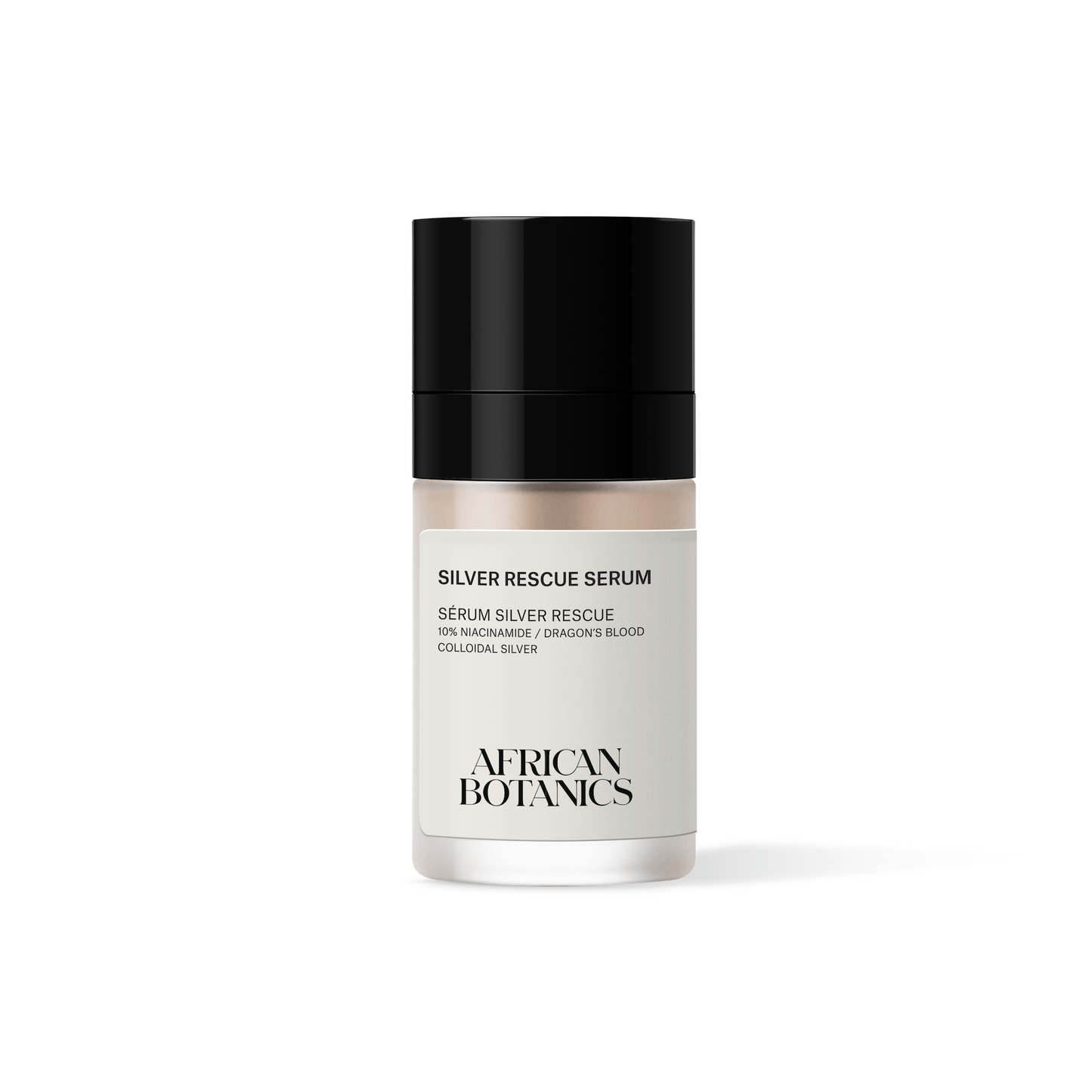
Silver Rescue Serum

Silver Rescue Serum
AfricanBotanicsStaging
silver-rescue-serum
Serum
9784846975269
Morning or Evening?
How often will you use this product?
Notes


Highlights
WHAT IS IT?
Restorative serum with biome-protective properties
FEATURES
Fast-acting, barrier-supporting, acne-fighting formula
BEST FOR
sensitive
CHECKS
Parabens-free, silicones-free, phthalates-free, mineral oil-free, artificial fragrance-free, colorants-free, SLS-free
Who Is It For?
All Skin Types Especially Those With Reactive Or Compromised SkinWhat Does It Help With?
Skin Flora Balance Barrier Function Skin StrengtheningBudget
Professional (over $150)How To Use
Which routine should it be used in?
Instructions:
Key Information


What AfricanBotanicsStaging Says
Product Description:
A highly restorative serum that promotes balance of skin flora while optimizing the skin's natural barrier function. This fast-acting formula contains biome-protective, barrier-supporting and acne-fighting ingredients to strengthen all skin types. Especially effective on reactive, compromised and sensitive skin.
About the Brand:
Ingredients Overview
Ingredients List
Aqua, Niacinamide, Globularia Cordifolia Callus Culture (Stem Cells), Cannabis Sativa Leaf (Full Spectrum CBD) Extract, Colloidal Silver, Glycerin, Hydrolyzed Soy Protein, Harpagophytum Procumbens (Devil's Claw) Root Extract, Propanediol, Panthenol (Pro Vitamin B5), Olive Squalane, Allantoin, Butylene Glycol, _x0003_Myrothamnus Flabellifolius (Resurrection) Extract, Kigelia Africana Fruit Extract, Tetrasodium Glutamate, Hyaluronic Acid, Calendula Officinalis Flower Extract, Arnica Montana Flower Extract, Aspalathus Linearis (Rooibos) Leaf Extract, Cyclopia Intermedia (Honeybush) Leaf Extract, Bulbine Frutescens Leaf Extract, Hypoxis Hemerocallidea (African Potatoe) Extract, Sclerocarya Birrea (Marula) Seed Oil, Cucumis Sativus (Cucumber) Extract, Althaea Officinalis (Marshmallow) Extract, Rosa Moschata (Rose Hip) Seed Oil, Olea Europaea (Olive) Oil, Dracaena Cambodiana Leaf (Dragon’s Blood) Resin Extract, Phenoxyethanol, Ethylhexylglycerin.
Key Ingredients
10% NIACINAMIDE, COLLOIDAL SILVER, FULL SPECTRUM CBD, GLOBULARIA STEM CELL CULTURE, DRAGON’S BLOOD, PANTHENOL, OLIVE SQUALANE, RESURRECTION PLANT, HYALURONIC ACID, ROOIBOS LEAF + HONEYBUSH, Calendula + Arnica
Ingredients Details
Allantoin
Common Name(s): 5-ureidohydantoin,glyoxyldiureide,aluminum dihydroxy allantoinate
CAS Number: 97-59-6
DESCRIPTION
What It Does: Soothes irritation, accelerates wound healing, promotes skin cell renewal, and provides mild keratolytic exfoliation.
Why It's Used: Gold standard multi-function soothing active – one of the most widely used cosmetic ingredients across all product types for its exceptional tolerability and clinically proven multi-action skin conditioning.
How It Works: Promotes keratinocyte proliferation and fibroblast migration for wound healing. mild keratolytic activity by disrupting corneocyte binding. anti-irritant via direct protein binding and anti-inflammatory cytokine reduction. humectant activity via hydroxyl groups.
Typically Found In: Post-procedure products,sensitive skin formulas,wound care,anti-acne treatments,baby products
TECHNICAL DETAILS
Primary Category: Active ingredient – soothing / anti-inflammatory
Secondary Functions: Wound healing,keratolytic,anti-irritant
Application Areas:

Facial Skincare
Body Care

Hair Care
Beard Care
Color Cosmetics (Makeup)
Dietary/Oral Supplements
Typical Concentration Range: 0.1%–2%
SOURCING & ETHICS
Vegan Status: Conditional - feedstock declaration required
Halal Status: Unverified - feedstock declaration required (plant, animal and petrochemical routes all exist)
Source Notes: Plant-derived extract or synthetic. [audit 2026-07-29 rev2: origin-dependent: the same inci exists in plant, animal and petrochemical versions and the name does not discriminate. determination requires shariah-panel sign-off.]
SKIN COMPATIBILITY
Irritancy Rating: 1/5 – very low
Comedogenicity Rating: 0/5 – non-comedogenic
Sensitivity Concerns: Exceptionally well-tolerated; suitable for all skin types including baby and compromised skin.
Safe for Sensitive Skin: Yes – particularly recommended for sensitive skin
SAFETY & COMPATIBILITY
Safety Profile: Excellent safety profile. ewg score: 1.
Works Well With: Ceramides,panthenol,allantoin,hyaluronic acid,centella asiatica
Avoid Combining With: No significant incompatibilities
SCIENTIFIC NOTE
Allantoin's keratinocyte proliferation stimulation occurs via receptor-mediated signaling (possibly machr activation) rather than non-specific irritation-driven proliferation, making it a true wound-healing stimulant rather than a pro-inflammatory proliferative signal.
Last Verified: 2026-03-12
Primary Sources: Cosing database,cir safety assessment,araújo et al. allantoin review
Colloidal Silver
Common Name(s): Colloidal/ionic silver,antimicrobial nanoparticle,broad-spectrum bactericidal
CAS Number: N/a
DESCRIPTION
What It Does: Provides broad-spectrum antimicrobial protection against bacteria, fungi, and viruses through silver ion release, with documented wound healing promotion through anti-biofilm activity and inflammatory modulation.
Why It's Used: Silver's multi-target antimicrobial mechanism prevents resistance development — bacteria cannot simultaneously mutate all silver-targeted enzymes (thiol enzymes, respiratory chain proteins, dna) to escape silver's activity, unlike single-target antibiotics.
How It Works: Ag⁺ ions bind bacterial thiol (-sh) groups in respiratory chain enzymes (nadh dehydrogenase, succinate dehydrogenase) inactivating atp synthesis. simultaneously, ag⁺ binds bacterial dna causing structural disruption, and binds cell wall lipopolysaccharide increasing membrane permeability. the three concurrent mechanisms provide resistance-proof bactericidal activity.
Typically Found In: Wound care,antimicrobial skin care
TECHNICAL DETAILS
Primary Category: Active ingredient – cosmetic active
Secondary Functions: Skin conditioning
Application Areas:
Facial Skincare
Body Care
Hair Care
Beard Care
Color Cosmetics (Makeup)
Dietary/Oral Supplements
Typical Concentration Range: Check concentration limits
SOURCING & ETHICS
Vegan Status: Conditional - supplier confirmation required
Halal Status: Unverified - supplier confirmation required
Source Notes: Commercially produced for cosmetic use. verify vegan/halal status with supplier. [audit 2026-07-29 rev2: the record's own source_notes does not assert a non-animal origin, or instructs the reader to verify with the supplier; "yes" asserts knowledge the record does not hold. determination requires shariah-panel sign-off.]
SKIN COMPATIBILITY
Irritancy Rating: 1/5 – very low
Comedogenicity Rating: 0/5 – non-comedogenic
Sensitivity Concerns: Well-tolerated by most skin types.
Safe for Sensitive Skin: Yes
SAFETY & COMPATIBILITY
Safety Profile: Good safety profile at recommended concentrations. ewg score: 1–2.
Works Well With: Standard skincare actives
Avoid Combining With: No known significant incompatibilities
SCIENTIFIC NOTE
Nano-silver regulatory status varies by market — eu considers nano-silver ingredients under nano-material notification requirements. ionic silver (ag⁺ salts) and colloidal forms have different regulatory pathways. formulators must verify nano-definition compliance for particle size specifications.
Last Verified:
Glycerin
Common Name(s): Glycerol,glycerine,1,2,3-propanetriol
CAS Number: 56-81-5
DESCRIPTION
What It Does: Glycerin pulls water from the environment and deeper skin layers into the outer skin layer (epidermis), boosting moisture levels and keeping skin soft, smooth, and plump.
Why It's Used: It is used in virtually every moisturizer, serum, and cleanser because it is highly effective at hydrating skin, is well-tolerated by all skin types, and enhances the texture and spreadability of formulations.
How It Works: As a humectant, glycerin forms hydrogen bonds with water molecules, trapping them in the skin. it also reinforces the skin barrier by integrating into lipid structures between skin cells.
Typically Found In: Moisturizers,serums,cleansers,toners,sheet masks,sunscreens,body lotions,shampoos,conditioners
TECHNICAL DETAILS
Primary Category: Humectant
Secondary Functions: Skin barrier support,emollient,solvent
Application Areas:
Facial Skincare
Body Care
Hair Care
Beard Care
Color Cosmetics (Makeup)
Dietary/Oral Supplements
Typical Concentration Range: 1%–30% (typical: 3–10%)
SOURCING & ETHICS
Vegan Status: Conditional - feedstock declaration required
Halal Status: Unverified - feedstock declaration required (plant, animal and petrochemical routes all exist)
Source Notes: Derived from plant oils via hydrolysis or saponification; synthetic versions also available. palm-derived glycerin carries sustainability concerns. [audit 2026-07-29 rev2: origin-dependent: the same inci exists in plant, animal and petrochemical versions and the name does not discriminate. determination requires shariah-panel sign-off.]
SKIN COMPATIBILITY
Irritancy Rating: 1/5 – very low; non-irritating at all standard concentrations
Comedogenicity Rating: 0/5 – non-comedogenic
Sensitivity Concerns: Extremely rare allergic reactions; generally safe for all skin types including sensitive and baby skin
Safe for Sensitive Skin: Yes
SAFETY & COMPATIBILITY
Safety Profile: Widely recognized as safe. ewg hazard score: 1. no significant concerns for irritation, sensitization, or toxicity at typical concentrations (up to 50%).
Works Well With: Hyaluronic acid,ceramides,niacinamide,panthenol,urea,peptides,retinol,ahas/bhas
Avoid Combining With: No known incompatibilities at standard concentrations
SCIENTIFIC NOTE
Glycerin is an endogenous skin component found naturally in the stratum corneum. aquaporin-3 channels in keratinocytes facilitate glycerin transport, making it integral to natural skin hydration pathways.
Last Verified: 2026-03-12
Primary Sources: Cosing database,cir safety assessment,ewg skin deep,inci decoder
Hydrolyzed Soy Protein
Common Name(s): Hydrolysed protein,conditioning amino acid complex,film-forming active
CAS Number: N/a
DESCRIPTION
What It Does: Deposits a conditioning, moisture-retaining film on skin and hair from substantive protein-surface adsorption, delivers amino acids for sc keratin compatibility, and provides temporary firming from the protein film's tensile properties.
Why It's Used: Provides the conditioning benefits of structural proteins in a topically deliverable form — molecular weight distribution determines whether surface film formation (high mw) or sc penetration with deeper conditioning (low mw <500 da) predominates.
How It Works: Low-mw protein hydrolysate fractions (<500 da) penetrate the sc via aqueous channels; high-mw fractions adsorb substantively to negative hair and skin surfaces through h-bonding and electrostatic interactions. film formation reduces tewl and provides mechanical smoothing.
Typically Found In: Hair conditioners,skin serums,conditioning
TECHNICAL DETAILS
Primary Category: Functional ingredient – humectant
Secondary Functions: Tewl reduction,skin plumping
Application Areas:
Facial Skincare
Body Care
Hair Care
Beard Care
Color Cosmetics (Makeup)
Dietary/Oral Supplements
Typical Concentration Range: 0.1%–5%
SOURCING & ETHICS
Vegan Status: Conditional - supplier confirmation required
Halal Status: Unverified - supplier confirmation required
Source Notes: Synthetic or naturally derived. excellent aqueous solubility. [audit 2026-07-29 rev2: status downgraded on audit. determination requires shariah-panel sign-off.]
SKIN COMPATIBILITY
Irritancy Rating: 1/5 – very low
Comedogenicity Rating: 0/5 – non-comedogenic
Sensitivity Concerns: Non-irritating; suitable for all skin types.
Safe for Sensitive Skin: Yes
SAFETY & COMPATIBILITY
Safety Profile: Excellent safety profile. ewg score: 1.
Works Well With: Ceramides,emollients,occlusives,glycerin,hyaluronic acid
Avoid Combining With: No significant incompatibilities
SCIENTIFIC NOTE
Optimal hydrolysis degree for hair conditioning: mw 1,000–5,000 da — large enough for adsorption to hair cuticle, small enough to penetrate the cuticle surface and access cortex damage sites.
Last Verified: 2026-03-12
Primary Sources: Cosing database,hydrolyzed soy protein hydrolysed protein review