
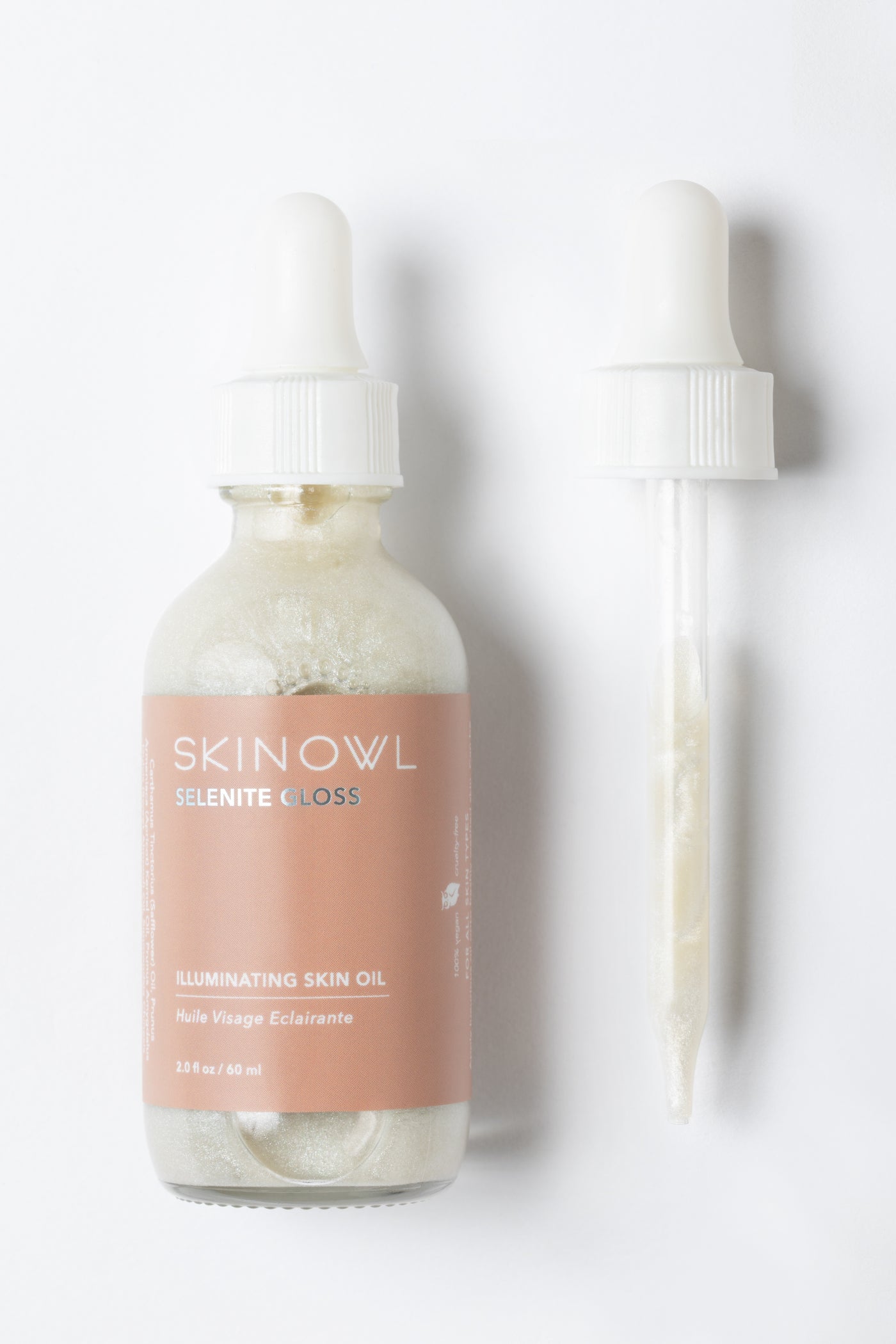

SkinOwl
Selenite Gloss

Selenite Gloss
SkinOwl
selenite-gloss
Face Oil
9706809360677
Morning or Evening?
How often will you use this product?
Notes


Highlights
WHAT IS IT?
A face oil with 11 ingredients
FEATURES
Softens imperfections, calms redness, mitigates uneven texture and tone, provides sheen and moisture
BEST FOR
All skin types (can be inferred from description)
CHECKS
Free of parabens, sulfates, phthalates, synthetic fragrances
Who Is It For?
Adults (default Above 18) Women And MenWhat Does It Help With?
Redness Uneven Texture And Tone Dry SkinBudget
Mid-rangeHow To Use
Which routine should it be used in?
Instructions:
Key Information


What SkinOwl Says
Product Description:
Cue a subtle sheen and snow-kiss glow! Our skincare-meets-highlighter softens imperfections with a blend of pure plant oils. Bright white calms redness and mitigates the appearance of uneven texture and tone. This soothing oil can be worn under makeup or by itself. Use as an eyelid gloss, cuticle oil or lip gloss for optimal sheen and moisture.
About the Brand:
Ingredients Overview
Ingredients List
Carthamus Tinctorius (Safflower) Oil, Prunus Armeniaca (Apricot) Kernel Oil, Prunus Amygdalus Dulcis (Sweet Almond) Oil, Simmondsia Chinensis (Organic Jojoba) Seed Oil, Aloe Barbadensis (Organic Aloe) Leaf Oil, Tocopherol (Vitamin E), Calendula Officinalis (Calendula) Flowers in Olea Europaea (Organic Olive) Oil, Rosmarinus Officinalis (Rosemary) Leaf Extract, Azadirachta Indica (Neem) Seed Oil, Mica
Key Ingredients
Safflower Oil, Apricot Kernel Oil, Sweet Almond Oil, Jojoba Seed Oil, Aloe Leaf Oil, Vitamin E, Calendula Flowers in Olive Oil, Rosemary Leaf Extract, Neem Seed Oil
Ingredients Details
Mica
Common Name(s): Muscovite mica,sericite,potassium aluminum silicate
CAS Number: 12001-26-2
DESCRIPTION
What It Does: Provides shimmer and pearlescence from flat-platelet mica crystal light reflection.
Why It's Used: Universal cosmetic shimmer ingredient – mica's flat-platelet morphology provides the directional light reflection responsible for the dimensional shimmer effect in all pearlescent cosmetics.
How It Works: Flat platelets (1-200μm) reflect and refract light specularly producing shimmer. when coated with tio2 or iron oxides, provides colour-shifting pearlescence via thin-film optical interference. natural slip from platelet layering reduces application friction.
Typically Found In: Foundation,eyeshadow,highlighter,blush – virtually all colour cosmetics
TECHNICAL DETAILS
Primary Category: Colorant – mineral shimmer pigment
Secondary Functions: Skin conditioning
Application Areas:

Facial Skincare

Body Care
Hair Care
Beard Care
Color Cosmetics (Makeup)
Dietary/Oral Supplements
Typical Concentration Range: 0.01%–50%
SOURCING & ETHICS
Vegan Status: Conditional - supplier confirmation required
Halal Status: Unverified - supplier confirmation required
Source Notes: Commercially produced for cosmetic use. verify vegan/halal status with supplier. [audit 2026-07-29 rev2: the record's own source_notes does not assert a non-animal origin, or instructs the reader to verify with the supplier; "yes" asserts knowledge the record does not hold. determination requires shariah-panel sign-off.]
SKIN COMPATIBILITY
Irritancy Rating: 1/5 – very low
Comedogenicity Rating: 0/5 – non-comedogenic
Sensitivity Concerns: Well-tolerated by most skin types.
Safe for Sensitive Skin: Yes
SAFETY & COMPATIBILITY
Safety Profile: Good safety profile at recommended concentrations. ewg score: 1–2.
Works Well With: Standard skincare actives
Avoid Combining With: No known significant incompatibilities
SCIENTIFIC NOTE
Mica-based pearlescent pigments (mica coated with tio2 or iron oxides) produce colour-shifting optical effects via thin-film light interference – the same phenomenon as oil on water or butterfly wings. as tio2 coating thickness increases, the interference wavelength shifts from silver → gold → red → violet → blue → green, creating the entire pearlescent colour palette from a single mineral substrate by controlling coating thickness.
Last Verified: 2026-03-12
Primary Sources: Cosing database,eu cosmetics regulation annex iv,cir safety assessment
Prunus Amygdalus Dulcis (sweet Almond) Oil
Common Name(s): Prunus amygdalus dulcis (sweet almond) oil,botanical oil,phytochemical active
CAS Number: N/a
DESCRIPTION
What It Does: Provides antioxidant protection from reactive oxygen species, reduces inflammatory cytokine production in skin, and conditions skin through the plant's phytochemical complex.
Why It's Used: Natural origin narrative, traditional use heritage, and multi-functional phytochemical profile supporting concurrent skin care claims from one ingredient.
How It Works: Polyphenols, terpenoids, and alkaloids scavenge ros via h• donation, inhibit nf-kb or cox-2 inflammatory pathways, and interact with skin surface proteins for conditioning.
Typically Found In: Botanical skin care,natural products
TECHNICAL DETAILS
Primary Category: Active ingredient – antioxidant
Secondary Functions: Free radical scavenging,anti-aging
Application Areas:
Facial Skincare
Body Care
Hair Care
Beard Care
Color Cosmetics (Makeup)
Dietary/Oral Supplements
Typical Concentration Range: 0.1%–10%
SOURCING & ETHICS
Vegan Status: Conditional - supplier confirmation required
Halal Status: Yes
Source Notes: Plant-derived extract or synthetic. [audit 2026-07-29 rev2: status downgraded on audit. determination requires shariah-panel sign-off.]
SKIN COMPATIBILITY
Irritancy Rating: 1/5 – very low
Comedogenicity Rating: 0/5 – non-comedogenic
Sensitivity Concerns: Non-irritating; well-tolerated.
Safe for Sensitive Skin: Yes
SAFETY & COMPATIBILITY
Safety Profile: Excellent safety profile. ewg score: 1.
Works Well With: Vitamin c,vitamin e,ferulic acid,spf,other antioxidants
Avoid Combining With: No significant incompatibilities
SCIENTIFIC NOTE
Plant secondary metabolites evolved as photoprotectants and antimicrobials — mechanisms directly applicable to cosmetic antioxidant and anti-inflammatory activity in human skin.
Last Verified: 2026-03-12
Primary Sources: Cosing database,prunus amygdalus dulcis (sweet almo botanical review
Prunus Armeniaca (apricot) Kernel Oil
Common Name(s): Prunus armeniaca (apricot) kernel oil,botanical oil,phytochemical active
CAS Number: N/a
DESCRIPTION
What It Does: Provides antioxidant protection from reactive oxygen species, reduces inflammatory cytokine production in skin, and conditions skin through the plant's phytochemical complex.
Why It's Used: Natural origin narrative, traditional use heritage, and multi-functional phytochemical profile supporting concurrent skin care claims from one ingredient.
How It Works: Polyphenols, terpenoids, and alkaloids scavenge ros via h• donation, inhibit nf-kb or cox-2 inflammatory pathways, and interact with skin surface proteins for conditioning.
Typically Found In: Botanical skin care,natural products
TECHNICAL DETAILS
Primary Category: Active ingredient – antioxidant
Secondary Functions: Free radical scavenging,anti-aging
Application Areas:
Facial Skincare
Body Care
Hair Care
Beard Care
Color Cosmetics (Makeup)
Dietary/Oral Supplements
Typical Concentration Range: 0.1%–10%
SOURCING & ETHICS
Vegan Status: Conditional - supplier confirmation required
Halal Status: Yes
Source Notes: Plant-derived extract or synthetic. [audit 2026-07-29 rev2: status downgraded on audit. determination requires shariah-panel sign-off.]
SKIN COMPATIBILITY
Irritancy Rating: 1/5 – very low
Comedogenicity Rating: 0/5 – non-comedogenic
Sensitivity Concerns: Non-irritating; well-tolerated.
Safe for Sensitive Skin: Yes
SAFETY & COMPATIBILITY
Safety Profile: Excellent safety profile. ewg score: 1.
Works Well With: Vitamin c,vitamin e,ferulic acid,spf,other antioxidants
Avoid Combining With: No significant incompatibilities
SCIENTIFIC NOTE
Plant secondary metabolites evolved as photoprotectants and antimicrobials — mechanisms directly applicable to cosmetic antioxidant and anti-inflammatory activity in human skin.
Last Verified: 2026-03-12
Primary Sources: Cosing database,prunus armeniaca (apricot) kernel o botanical review
Rosmarinus Officinalis (rosemary) Leaf Extract
Common Name(s): Rosmarinus officinalis (rosemary) leaf extract,botanical extract,phytochemical active
CAS Number: N/a
DESCRIPTION
What It Does: Provides antioxidant protection, anti-inflammatory activity, and skin conditioning from polyphenols, terpenoids, and phytochemicals.
Why It's Used: Multi-functional phytochemical profiles support concurrent skin care claims with authentic botanical heritage from one ingredient.
How It Works: Polyphenols scavenge ros, inhibit nf-kb/cox pathways, and interact with skin surface proteins for conditioning.
Typically Found In: Botanical skin care,natural products
TECHNICAL DETAILS
Primary Category: Active ingredient – antioxidant
Secondary Functions: Free radical scavenging,anti-aging
Application Areas:
Facial Skincare
Body Care
Hair Care
Beard Care
Color Cosmetics (Makeup)
Dietary/Oral Supplements
Typical Concentration Range: 0.1%–30%
SOURCING & ETHICS
Vegan Status: Conditional - supplier confirmation required
Halal Status: Conditional - basis not stated in source record; supplier origin confirmation required to determine what evidence applies
Source Notes: Plant-derived extract or synthetic. [audit 2026-07-29 rev2: status downgraded on audit. determination requires shariah-panel sign-off.]
SKIN COMPATIBILITY
Irritancy Rating: 1/5 – very low
Comedogenicity Rating: 0/5 – non-comedogenic
Sensitivity Concerns: Non-irritating; well-tolerated.
Safe for Sensitive Skin: Yes
SAFETY & COMPATIBILITY
Safety Profile: Excellent safety profile. ewg score: 1.
Works Well With: Vitamin c,vitamin e,ferulic acid,spf,other antioxidants
Avoid Combining With: No significant incompatibilities
SCIENTIFIC NOTE
Plant secondary metabolites evolved for uv photoprotection and pathogen defence — mechanisms directly translatable to cosmetic antioxidant and anti-inflammatory activity in human skin.
Last Verified: 2026-03-12
Primary Sources: Cosing database,rosmarinus officinalis (rosemary) l botanical review