

BIODERMA
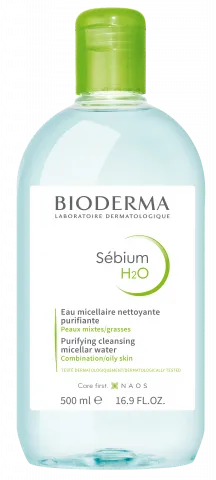
Sébium H2O Micellar Water

Sébium H2O Micellar Water
BIODERMA
sebium-h2o-micellar-water
Cleanse
9706827219237
Morning or Evening?
How often will you use this product?
Notes


Highlights
WHAT IS IT?
Micellar water cleanser
FEATURES
Purifying, dermatological, no-rinse formula
BEST FOR
Combination to oily skin, Skin prone to irregularities
CHECKS
Free of harsh chemicals, fragrances , alcohol
Who Is It For?
Adults TeensWhat Does It Help With?
Cleanses Removes Makeup Purifies The SkinBudget
AffordableHow To Use
Which routine should it be used in?
Instructions:
Key Information


What BIODERMA Says
Product Description:
Purifying, dermatological micellar water that cleanses the skin by effectively removing dirt, debris, and makeup.
About the Brand:
Ingredients Overview
Ingredients List
AQUA/WATER/EAU, PEG-6 CAPRYLIC/CAPRIC GLYCERIDES, SODIUM CITRATE, ZINC GLUCONATE, COPPER SULFATE, GINKGO BILOBA LEAF EXTRACT, MANNITOL, XYLITOL, RHAMNOSE, FRUCTOOLIGOSACCHARIDES, PROPYLENE GLYCOL, CITRIC ACID, DISODIUM EDTA, CETRIMONIUM BROMIDE, FRAGRANCE (PARFUM). [BI 442]
Key Ingredients
Zinc gluconate, Copper sulfate, Ginkgo biloba leaf extract
Ingredients Details
Copper Sulfate
Common Name(s): Copper sulfate,cosmetic active,functional ingredient
CAS Number: N/a
DESCRIPTION
What It Does: Delivers characteristic cosmetic function at recommended use concentration.
Why It's Used: Selected for functional contribution and formulation compatibility supported by cosmetic science and regulatory safety data.
How It Works: Works through the mechanism of its molecular class as documented in peer-reviewed cosmetic literature.
Typically Found In: Skin care formulations
TECHNICAL DETAILS
Primary Category: Active ingredient – cosmetic active
Secondary Functions: Skin conditioning
Application Areas:

Facial Skincare

Body Care
Hair Care
Beard Care
Color Cosmetics (Makeup)
Dietary/Oral Supplements
Typical Concentration Range: 0.1%–10%
SOURCING & ETHICS
Vegan Status: Conditional - supplier confirmation required
Halal Status: Unverified - supplier confirmation required
Source Notes: Commercially produced for cosmetic use. verify vegan/halal status with supplier. [audit 2026-07-29 rev2: the record's own source_notes does not assert a non-animal origin, or instructs the reader to verify with the supplier; "yes" asserts knowledge the record does not hold. determination requires shariah-panel sign-off.]
SKIN COMPATIBILITY
Irritancy Rating: 1/5 – very low
Comedogenicity Rating: 0/5 – non-comedogenic
Sensitivity Concerns: Well-tolerated by most skin types.
Safe for Sensitive Skin: Yes
SAFETY & COMPATIBILITY
Safety Profile: Good safety profile at recommended concentrations. ewg score: 1–2.
Works Well With: Standard skincare actives
Avoid Combining With: No known significant incompatibilities
SCIENTIFIC NOTE
Copper sulfate has an established safety profile within the cosmetic regulatory framework at standard use concentrations.
Last Verified: 2026-03-12
Primary Sources: Cosing database,copper sulfate technical literature
Fructooligosaccharides
Common Name(s): Fos,oligofructose,short-chain inulin
CAS Number: 308066-66-2
DESCRIPTION
What It Does: Provides rapid-acting prebiotic microbiome support with humectant conditioning from short-chain fructan oligomers.
Why It's Used: Fast-acting prebiotic for rapid microbiome support — fos's shorter chain length provides faster fermentation by beneficial bacteria vs long-chain inulin, enabling quicker microbiome compositional shifts.
How It Works: Dp 2-10 fructooligomers (vs inulin's dp 10-60) provide more rapid access to bacterial fermentation enzymes. higher water solubility and humectant activity than long-chain inulin. more bioavailable to skin surface bacteria vs longer-chain inulin that penetrates deeper before fermentation.
Typically Found In: Prebiotic skin care,rapid microbiome support products
TECHNICAL DETAILS
Primary Category: Active ingredient – short-chain prebiotic
Secondary Functions: Tewl reduction,skin plumping
Application Areas:
Facial Skincare
Body Care
Hair Care
Beard Care
Color Cosmetics (Makeup)
Dietary/Oral Supplements
Typical Concentration Range: 0.5%–5%
SOURCING & ETHICS
Vegan Status: Conditional - supplier confirmation required
Halal Status: Unverified - supplier confirmation required
Source Notes: Synthetic or naturally derived. excellent aqueous solubility. [audit 2026-07-29 rev2: status downgraded on audit. determination requires shariah-panel sign-off.]
SKIN COMPATIBILITY
Irritancy Rating: 1/5 – very low
Comedogenicity Rating: 0/5 – non-comedogenic
Sensitivity Concerns: Non-irritating; suitable for all skin types.
Safe for Sensitive Skin: Yes
SAFETY & COMPATIBILITY
Safety Profile: Excellent safety profile. ewg score: 1.
Works Well With: Ceramides,emollients,occlusives,glycerin,hyaluronic acid
Avoid Combining With: No significant incompatibilities
SCIENTIFIC NOTE
Fos's shorter chain length provides different prebiotic kinetics vs long-chain inulin: short-chain fos (dp 2-5) is fermented within 12-24 hours by surface bacteria, while long-chain inulin (dp 10-60) ferments over 48-72 hours. this temporal difference enables formulation of 'fast-acting' (fos) vs 'sustained-release' (inulin) prebiotic products with different microbiome support kinetics.
Last Verified: 2026-03-12
Primary Sources: Cosing database,roberfroid fos prebiotic review
Ginkgo Biloba Leaf Extract
Common Name(s): Ginkgo biloba leaf extract,botanical extract,phytochemical active
CAS Number: N/a
DESCRIPTION
What It Does: Provides antioxidant protection from reactive oxygen species, reduces inflammatory cytokine production in skin, and conditions skin through the plant's phytochemical complex.
Why It's Used: Natural origin narrative, traditional use heritage, and multi-functional phytochemical profile supporting concurrent skin care claims from one ingredient.
How It Works: Polyphenols, terpenoids, and alkaloids scavenge ros via h• donation, inhibit nf-kb or cox-2 inflammatory pathways, and interact with skin surface proteins for conditioning.
Typically Found In: Botanical skin care,natural products
TECHNICAL DETAILS
Primary Category: Active ingredient – antioxidant
Secondary Functions: Free radical scavenging,anti-aging
Application Areas:
Facial Skincare
Body Care
Hair Care
Beard Care
Color Cosmetics (Makeup)
Dietary/Oral Supplements
Typical Concentration Range: 0.1%–10%
SOURCING & ETHICS
Vegan Status: Conditional - supplier confirmation required
Halal Status: Yes
Source Notes: Plant-derived extract or synthetic. [audit 2026-07-29 rev2: status downgraded on audit. determination requires shariah-panel sign-off.]
SKIN COMPATIBILITY
Irritancy Rating: 1/5 – very low
Comedogenicity Rating: 0/5 – non-comedogenic
Sensitivity Concerns: Non-irritating; well-tolerated.
Safe for Sensitive Skin: Yes
SAFETY & COMPATIBILITY
Safety Profile: Excellent safety profile. ewg score: 1.
Works Well With: Vitamin c,vitamin e,ferulic acid,spf,other antioxidants
Avoid Combining With: No significant incompatibilities
SCIENTIFIC NOTE
Plant secondary metabolites evolved as photoprotectants and antimicrobials — mechanisms directly applicable to cosmetic antioxidant and anti-inflammatory activity in human skin.
Last Verified: 2026-03-12
Primary Sources: Cosing database,ginkgo biloba leaf extract botanical review
Mannitol
Common Name(s): D-mannitol,manna sugar,mannite
CAS Number: 69-65-8
DESCRIPTION
What It Does: Provides exceptional hydroxyl radical scavenging antioxidant protection alongside humectant moisture retention.
Why It's Used: Used for potent hydroxyl radical scavenging where standard antioxidants (tocopherol, ascorbic acid) are less effective, combined with humectant activity.
How It Works: 6 hydroxyl groups provide both water binding (humectant) and direct hydroxyl radical (.oh) scavenging. hydroxyl radicals are the most reactive and damaging free radicals – mannitol is one of few compounds that scavenges them directly.
Typically Found In: Antioxidant formulations,premium moisturizers,protective skincare
TECHNICAL DETAILS
Primary Category: Functional ingredient – sugar alcohol / free radical scavenger
Secondary Functions: Free radical scavenger,superior antioxidant
Application Areas:
Facial Skincare
Body Care
Hair Care
Beard Care
Color Cosmetics (Makeup)
Dietary/Oral Supplements
Typical Concentration Range: 1%–10%
SOURCING & ETHICS
Vegan Status: Yes – plant-derived or synthetic
Halal Status: Yes
Source Notes: Plant-derived from ash tree manna, seaweed, mushrooms, or produced by reduction of mannose. gras food-approved.
SKIN COMPATIBILITY
Irritancy Rating: 1/5 – very low
Comedogenicity Rating: 0/5 – non-comedogenic
Sensitivity Concerns: Non-irritating; suitable for all skin types.
Safe for Sensitive Skin: Yes
SAFETY & COMPATIBILITY
Safety Profile: Excellent safety profile. ewg score: 1.
Works Well With: Ceramides,emollients,occlusives,glycerin,hyaluronic acid
Avoid Combining With: No significant incompatibilities
SCIENTIFIC NOTE
Mannitol's rate constant for hydroxyl radical scavenging (k = 1.4 × 10^7 m^-1s^-1) makes it one of the most effective biological hydroxyl radical scavengers. this is important because hydroxyl radicals cannot be scavenged by standard antioxidants like tocopherol or ascorbic acid.
Last Verified: 2026-03-12
Primary Sources: Cosing database,halliwell et al. free radical scavenging,cir safety assessment