

SANCTUS
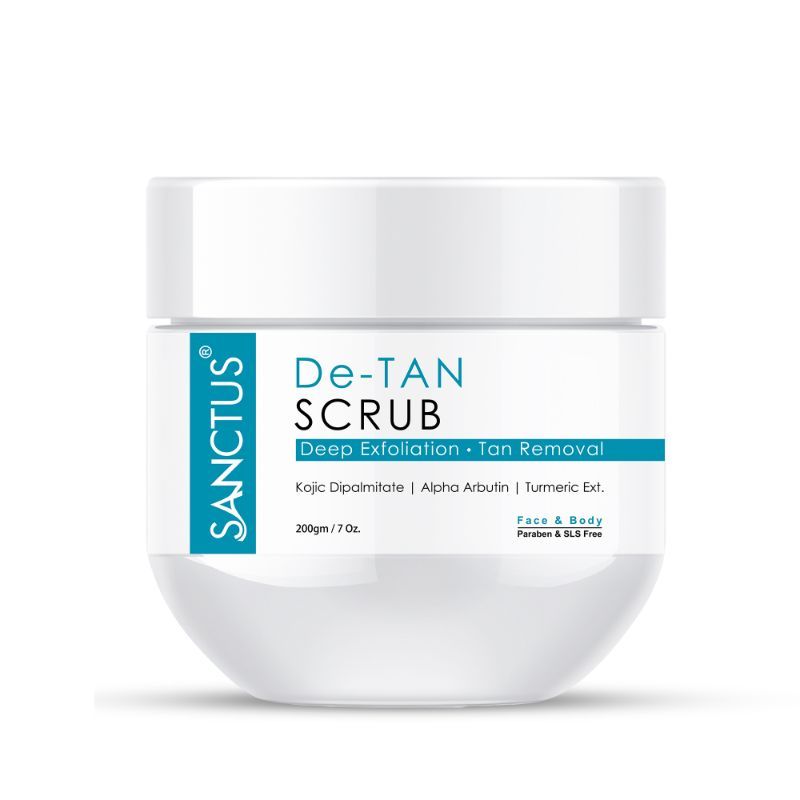
SANCTUS De-Tan Scrub Deep Exfoliation For Tan Removal

SANCTUS De-Tan Scrub Deep Exfoliation For Tan Removal
SANCTUS
sanctus-de-tan-scrub-deep-exfoliation-for-tan-removal
Exfoliation
10084864164133
Morning or Evening?
How often will you use this product?
Notes


Highlights
WHAT IS IT?
De-Tan Scrub exfoliation product with alpha arbutin, kojic dipalmitate, turmeric extract, almond oil
FEATURES
Instant tan removal, blackhead removal, deep exfoliation, UV-ray protection, improves complexion, reduces discoloration, sun damage protection, free from parabens, silicones, sulfates, mineral oil, suitable for men and women
BEST FOR
normal
CHECKS
No parabens, No harmful silicones, No sulfates, No mineral oil
Who Is It For?
Men And Women No Specific Age Range MentionedWhat Does It Help With?
Tan Removal Blackhead Removal Sun Damage Protection Reducing Dark Spots And DiscolorationBudget
Affordable (under $30)How To Use
Which routine should it be used in?
Instructions:
Key Information


What SANCTUS Says
Product Description:
Try the Sanctus De-Tan Scrub for instant tan removal, blackhead removal, and deep exfoliation for both the face and body. Effectively eliminate the tan caused by harmful UV rays, revealing younger-looking skin. Protect your skin from sun damage and dark spots with this powerful scrub, ideal for both men and women. De-Tan Scrub not only removes dead skin cells from the skin but also removes tan deposits. The skin is also replenished with good nutrients to fight the sun tan. The skin needs to be empowered to keep the bad effects away.
About the Brand:
Ingredients Overview
Ingredients List
Curcuma Longa,Prunus Amygdalus,Citrus Limon,Sesamum Indicum Linn.,Walnut Scrubber,Alpha Arbutin,Kojic Dipalmitate,Beeswax,DMDM Hydantoin,Perfume
Key Ingredients
Alpha Arbutin,Kojic Dipalmitate,Turmeric Extract,Almond Oil
Ingredients Details
Alpha Arbutin
Common Name(s): Alpha arbutin
DESCRIPTION
What It Does: Delivers targeted skin-conditioning or bioactive benefits through a specific mechanism of action suited to the formulation's intended purpose.
Why It's Used: Specialty actives address specific skin concerns through targeted molecular mechanisms, providing efficacy beyond what base formulation ingredients alone can achieve.
How It Works: The bioactive compound interacts with specific molecular targets in skin cells or the extracellular matrix — enzymes, receptors, structural proteins, or signaling molecules — triggering beneficial biological responses.
Typically Found In: Serums,treatments,moisturizers,specialty products
TECHNICAL DETAILS
Primary Category: Specialty actives
Secondary Functions: Skin-conditioning,anti-aging
Application Areas:

Facial Skincare

Body Care
Hair Care
Beard Care
Color Cosmetics (Makeup)
Dietary/Oral Supplements
Typical Concentration Range: 0.01–5%
SOURCING & ETHICS
Vegan Status: Yes
Halal Status: Yes
Source Notes: Specialty active ingredient; check individual sourcing for vegan status.
SKIN COMPATIBILITY
Irritancy Rating: 1899-12-31 00:00:00 -0800
Sensitivity Concerns: Low sensitization potential at recommended use concentrations.
Safe for Sensitive Skin: Yes
SAFETY & COMPATIBILITY
Safety Profile: Well-characterized cosmetic ingredient with established safety profile. generally non-irritating at typical use concentrations. suitable for leave-on and rinse-off cosmetics.
Works Well With: Niacinamide,hyaluronic acid,vitamin c,peptides
Avoid Combining With: Incompatible with oxidizing agents; check ph stability
SCIENTIFIC NOTE
Specialty actives typically work through enzyme inhibition (e.g., tyrosinase inhibition for brightening, mmp inhibition for anti-aging), receptor activation (e.g., retinoid receptors, ppar-γ for barrier genes), or transcription factor modulation (e.g., nrf2 for antioxidant gene upregulation). structure-activity relationships determine potency and selectivity.
Last Verified: Cosing eu database; pcpc cosmetic ingredient safety reviews; ingredient-specific safety and efficacy literature
Primary Sources: 2025-01-15
Beeswax
Common Name(s): Cera alba (white),cera flava (yellow),apis mellifera wax
CAS Number: 8012-89-3
DESCRIPTION
What It Does: Provides natural wax structure and emolliency for cosmetic texture and lip balm applications.
Why It's Used: The original cosmetic wax – provides natural, hard-texture structure for lip balms, sticks, and creams with emollient skin conditioning.
How It Works: Complex mixture of esters (wax esters), hydrocarbons (hentriacontane), and fatty acids provides semi-crystalline structure. melting point 62-65°c enables stable solid products. emulsifying capacity from free cerotic acid content.
Typically Found In: Lip balms,cosmetic sticks,creams,natural cosmetics
TECHNICAL DETAILS
Primary Category: Functional ingredient – natural wax
Secondary Functions: Natural wax structure,occlusive conditioning
Application Areas:
Facial Skincare
Body Care
Hair Care
Beard Care
Color Cosmetics (Makeup)
Dietary/Oral Supplements
Typical Concentration Range: 2%–30%
SOURCING & ETHICS
Vegan Status: No – honeybee-derived
Halal Status: Conditional – animal-derived; verify halal certification
Source Notes: Plant-derived, synthetic or animal-derived. verify source.
SKIN COMPATIBILITY
Irritancy Rating: 1/5 – very low
Comedogenicity Rating: 1/5 – low; formulation-dependent
Sensitivity Concerns: Non-irritating.
Safe for Sensitive Skin: Yes
SAFETY & COMPATIBILITY
Safety Profile: Excellent safety profile. ewg score: 1.
Works Well With: Humectants,ceramides,actives as carrier
Avoid Combining With: No significant incompatibilities
SCIENTIFIC NOTE
Beeswax's multi-component wax ester composition (myricyl palmitate as primary component) provides a unique crystalline structure that gives lip balms and cosmetic sticks their characteristic 'dragée' glide – different from synthetic wax esters that lack this crystalline lattice diversity.
Last Verified: Cosing database,cir safety assessment
Primary Sources: 2026-03-12
Dmdm Hydantoin
Common Name(s): Formaldehyde-releasing preservative,antimicrobial preservation,formaldehyde donor
CAS Number: N/a
DESCRIPTION
What It Does: Provides broad-spectrum preservation against bacteria and fungi through controlled formaldehyde release, maintaining product safety throughout shelf life at eu-permitted concentrations.
Why It's Used: Formaldehyde-releasing preservatives provide reliable broad-spectrum preservation but face increasing consumer and regulatory scrutiny — eu requires label declaration, and many brands adopt 'formaldehyde-free' positioning due to sensitisation concerns.
How It Works: Hydrolysis in aqueous formulation releases formaldehyde (hcho) at controlled rates depending on ph and temperature. free formaldehyde cross-links bacterial proteins and nucleic acids through schiff base formation with amine groups, providing bactericidal activity. sensitisation risk from free formaldehyde's reactivity with skin proteins forming haptens.
Typically Found In: All aqueous formulations
TECHNICAL DETAILS
Primary Category: Active ingredient – cosmetic active
Secondary Functions: Skin conditioning
Application Areas:
Facial Skincare
Body Care
Hair Care
Beard Care
Color Cosmetics (Makeup)
Dietary/Oral Supplements
Typical Concentration Range: Check eu annex v limits
SOURCING & ETHICS
Vegan Status: Yes
Halal Status: Yes
Source Notes: Commercially produced for cosmetic use. verify vegan/halal status with supplier.
SKIN COMPATIBILITY
Irritancy Rating: 1/5 – very low
Comedogenicity Rating: 0/5 – non-comedogenic
Sensitivity Concerns: Well-tolerated by most skin types.
Safe for Sensitive Skin: Yes
SAFETY & COMPATIBILITY
Safety Profile: Good safety profile at recommended concentrations. ewg score: 1–2.
Works Well With: Standard skincare actives
Avoid Combining With: No known significant incompatibilities
SCIENTIFIC NOTE
Eu regulation 1223/2009 requires 'contains formaldehyde' label declaration when free formaldehyde >0.05% in the finished product. many formulators are transitioning away from formaldehyde-releasing preservatives to avoid this label requirement regardless of safety profile.
Last Verified: Cosing database,eu annex v formaldehyde-releasing preservative declaration
Primary Sources: 2026-03-12
Kojic Dipalmitate
Common Name(s): Kojic acid dipalmitate,kdp,kojic acid ester
CAS Number: 79725-98-7
DESCRIPTION
What It Does: Provides stable lipophilic kojic acid for deeper-penetrating brightening with improved formulation stability.
Why It's Used: Stable brightening kojic acid — kojic dipalmitate provides effective brightening with 6+ months formulation stability vs pure kojic acid's rapid discoloration in aqueous formulations.
How It Works: Dipalmitate ester protects kojic acid's reactive 3-hydroxy-4-pyranone from oxidation. skin esterases cleave palmitate groups releasing free kojic acid for tyrosinase copper chelation. higher logp than free kojic acid provides better skin penetration. oil-phase compatible for anhydrous formulations.
Typically Found In: Brightening creams,stable lightening products,oil-phase brighteners
TECHNICAL DETAILS
Primary Category: Active ingredient – brightening / tyrosinase inhibitor
Secondary Functions: Melanin inhibition,hyperpigmentation reduction
Application Areas:
Facial Skincare
Body Care
Hair Care
Beard Care
Color Cosmetics (Makeup)
Dietary/Oral Supplements
Typical Concentration Range: 0.5%–3%
SOURCING & ETHICS
Vegan Status: Yes – from kojic acid (fermentation) + palmitic acid (plant)
Halal Status: Yes
Source Notes: Synthetic or plant-derived.
SKIN COMPATIBILITY
Irritancy Rating: 1/5 – very low
Comedogenicity Rating: 0/5 – non-comedogenic
Sensitivity Concerns: Non-irritating; well-tolerated.
Safe for Sensitive Skin: Yes
SAFETY & COMPATIBILITY
Safety Profile: Excellent safety profile. use with spf for maximum efficacy. ewg score: 1.
Works Well With: Niacinamide,vitamin c,alpha-arbutin,tranexamic acid,spf
Avoid Combining With: No significant incompatibilities
SCIENTIFIC NOTE
Kojic dipalmitate's stability advantage (white powder, 6+ month stability vs kojic acid's rapid yellow discoloration) arises from the ester groups masking the alpha-pyranone's iron-chelating catechol-type functionality. kojic acid's discoloration results from iron complexation and oxidation of the 3-hydroxyl group — precisely the same group that provides tyrosinase copper chelation and is protected by palmitate esterification.
Last Verified: Cosing database,cir safety assessment
Primary Sources: 2026-03-12
