

SAFI
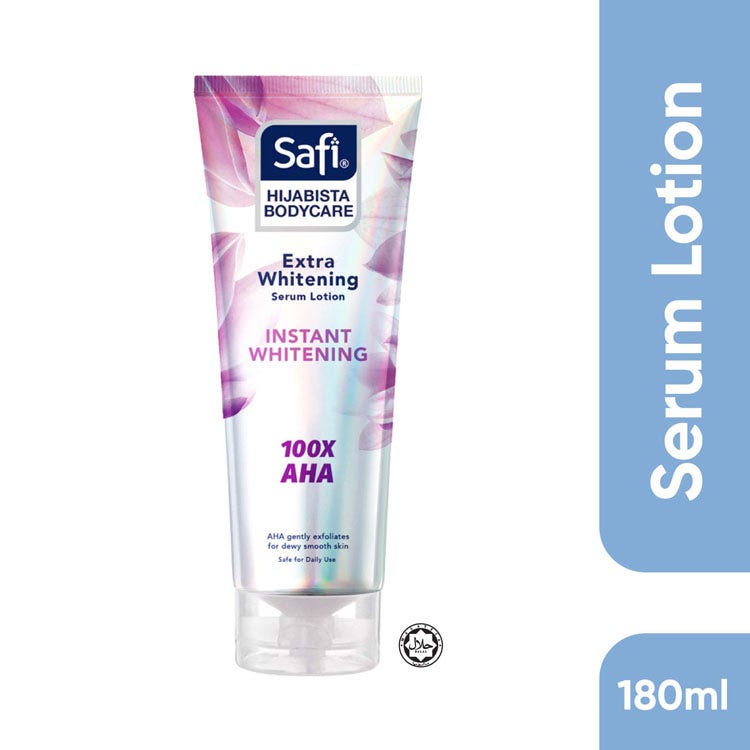
Safi Hijabista Bodycare Serum Lotion Instant Whitening 100X Aha 180Ml

Safi Hijabista Bodycare Serum Lotion Instant Whitening 100X Aha 180Ml
SAFI
safi-hijabista-bodycare-serum-lotion-instant-whitening-100x-aha-180ml
Moisturize
10084871897381
Morning or Evening?
How often will you use this product?
Notes


Highlights
WHAT IS IT?
Bodycare Serum Lotion with 100X Alpha Hydroxy Acids (AHA)
FEATURES
100X AHA for gentle exfoliation, Vitamin A, C & E for nourishment, Lightweight, Non Sticky, Quick Absorption, 24-hour long-lasting fragrance, Dermatologically & Clinically Tested
BEST FOR
normal
CHECKS
Free from Paraben, Mineral Oil, Animal Testing
Who Is It For?
What Does It Help With?
Brightening Gentle Exfoliation NourishingBudget
Affordable (under $30)How To Use
Which routine should it be used in?
Instructions:
Key Information


What SAFI Says
Product Description:
Reveal brighter, dewy smooth skin with this extra whitening serum lotion. With advanced skincare benefits of 100X* Alpha Hydroxy Acids (AHA), it works to gently exfoliate and visibly brighten the skin for an Instant Whitening look. Specially formulated for the comfort of Hijabista that is Lightweight, Non Sticky and provides Quick Absorption. - 100X* AHA that gently exfoliates for dewy smooth skin - Vitamin A, C & E that nourishes the skin - Lightweight texture: Weightless feel on skin for everyday comfort - Non Sticky: Leaves skin feeling fresh, smooth and velvety - Quick Absorption: Penetrates fast, ensures comfort for hijabistas, even under layers - 24-hour** long-lasting fragrance - Dermatologically & Clinically Tested - Free from: - Paraben - Mineral Oil - Animal Testing
About the Brand:
Ingredients Overview
Ingredients List
Water,Glyceryl-Stearate,Glycerin,Isopropyl-Myristate,Dimethicone,Cyclopentasiloxane,Titanium-Dioxide,Stearic-Acid,Cyclohexasiloxane,Ceteareth-20,Palmitic-Acid,Cetanol,Carbomer,Octadecanol,Olea-Europaea-(Olive)-Oil-Unsaponifiables,Polysorbate-20,Xanthan-Gum,Disodium-EDTA,Sodium-Hydroxide,Hydroxyethyl-Acrylate/Sodium-Acryloyldimethyl-Taurate-Copolymer,Lactic-Acid,Squalane,Solanum-Lycopersicum-(Tomato)-Fruit/Leaf/Stem-Extract,Polysorbate-60,Propylene-Glycol,Citric-Acid,Citrus-Grandis-(Grapefruit)-Fruit-Extract,Citrus-Medica-Limonum-(Lemon)-Fruit-Extract,Malic-Acid,Vaccinium-Myrtillus-(Bilberry)-Fruit/Leaf-Extract,Retinyl-Palmitate,Arachis-Hypogaea-(Peanut)-Oil,Niacinamide,Calcium-Pantothenate,Maltodextrin,Amylodextrin,Sodium-Ascorbyl-Phosphate,Pyridoxine-HCl,Tocopheryl-Acetate,Sodium-Hyaluronate,Tocopherol,Silica,Fragrance,Phenoxyethanol,Chlorphenesin
Key Ingredients
Alpha Hydroxy Acids (AHA),Vitamin A,Vitamin C,Vitamin E
Ingredients Details
Amylodextrin
Common Name(s): Amylodextrin,natural biopolymer,film-former texture absorbent
CAS Number: N/a
DESCRIPTION
What It Does: Amylodextrin absorbs surface sebum and cosmetic oils through its porous granule structure, provides a silky soft-focus powdery finish on skin from the biopolymer particle's low friction coefficient, forms a breathable protective film on skin and hair, and acts as an excipient carrier or encapsulation matrix for actives in powder formulations.
Why It's Used: Formulators choose amylodextrin as a biodegradable, renewable alternative to synthetic polymers (ptfe, nylon, polyethylene) in powder cosmetics — providing equivalent or superior absorbency and skin feel without microplastic regulatory concerns under eu regulation 2023/2055. natural starch granules have an intrinsically soft, semi-crystalline structure (mohs hardness ~1) that spreads smoothly on skin without abrasion, making them preferred over silica or talc when maximum gentleness is required. modified versions (cross-linked, esterified) extend the range of performance from pure powder through gel-forming to film-forming applications.
How It Works: Amylodextrin works through the physical properties of its semicrystalline polysaccharide granule architecture: (1) oil absorption — starch granules are semicrystalline spheres (amylose crystalline domains surrounded by amorphous amylopectin matrix) with a porous surface and internal channels. surface sebum and oil penetrate the granule via capillary action into these channels and are immobilised by van der waals forces with the polysaccharide chains — providing oil-mattifying at the skin surface; (2) soft-focus texture — granule diameter (5–50 μm, depending on source) and smooth spherical morphology provide low-friction glide between skin surface and the applying finger/brush, with the semicrystalline granule structure being soft enough to deform without sharp edges; (3) film formation — when wetted, starch granules gelatinise (crystalline structure melts to amorphous hydrogel) above 60°c during processing, cooling to form a continuous film. modified starches with crosslinks maintain film integrity without complete gelatinisation; (4) biodegradation — amylase enzymes in soil rapidly hydrolyse the α-1,4 and α-1,6 glycosidic bonds, providing complete mineralisation to co₂ and water — zero environmental persistence compared to synthetic polymer particles.
Typically Found In: Powders,dry shampoos,biodegradable cosmetics
TECHNICAL DETAILS
Primary Category: Active ingredient – cosmetic active
Secondary Functions: Skin conditioning
Application Areas:

Facial Skincare

Body Care
Hair Care
Beard Care
Color Cosmetics (Makeup)
Dietary/Oral Supplements
Typical Concentration Range: 0.5%–30%
SOURCING & ETHICS
Vegan Status: Yes
Halal Status: Yes
Source Notes: Commercially produced for cosmetic use. verify vegan/halal status with supplier.
SKIN COMPATIBILITY
Irritancy Rating: 1/5 – very low
Comedogenicity Rating: 0/5 – non-comedogenic
Sensitivity Concerns: Well-tolerated by most skin types.
Safe for Sensitive Skin: Yes
SAFETY & COMPATIBILITY
Safety Profile: Good safety profile at recommended concentrations. ewg score: 1–2.
Works Well With: Standard skincare actives
Avoid Combining With: No known significant incompatibilities
SCIENTIFIC NOTE
Starch granule oil absorption capacity: oil absorption capacity (oac) of biopolymer powders correlates with granule porosity and internal surface area. rice starch (3–8 μm granules, high surface area) oac ~1.0 g oil/g; tapioca starch (15–35 μm, lower surface area) oac ~0.8 g/g; corn starch (10–25 μm) oac ~0.9 g/g. cross-linked modified starches maintain granule integrity under mechanical stress providing higher effective oac in use conditions. silica (oac ~2.5 g/g) outperforms starches on pure absorbency but the skin feel advantage of the softer biopolymer — particularly the non-abrasive, cushioned texture — justifies the lower oac for sensitive skin powders.
Last Verified: Cosing database,starch biopolymer cosmetic application review
Primary Sources: 2026-03-12
Carbomer
Common Name(s): Carbopol,polyacrylic acid,carboxyvinyl polymer
DESCRIPTION
What It Does: Provides transparent gel textures and thickening at very low concentrations via ph-responsive swelling.
Why It's Used: The most widely used gel thickener – provides crystal-clear, stable gels at concentrations as low as 0.1-0.5% with ph-controlled viscosity.
How It Works: Highly crosslinked polyacrylic acid remains tightly coiled at acidic ph. neutralization with naoh or triethanolamine ionizes carboxylic groups causing electrostatic repulsion that unfolds and swells the polymer coils, dramatically increasing viscosity. concentration-dependent thickening.
Typically Found In: Gels,serums,emulsions,sunscreens
TECHNICAL DETAILS
Primary Category: Functional ingredient – polyacrylic acid thickener
Secondary Functions: Skin conditioning
Application Areas:
Facial Skincare
Body Care
Hair Care
Beard Care
Color Cosmetics (Makeup)
Dietary/Oral Supplements
Typical Concentration Range: 0.1%–2%
SOURCING & ETHICS
Vegan Status: Yes – synthetic
Halal Status: Yes
Source Notes: Commercially produced for cosmetic use. verify vegan/halal status with supplier.
SKIN COMPATIBILITY
Irritancy Rating: 1/5 – very low
Comedogenicity Rating: 0/5 – non-comedogenic
Sensitivity Concerns: Well-tolerated by most skin types.
Safe for Sensitive Skin: Yes
SAFETY & COMPATIBILITY
Safety Profile: Good safety profile at recommended concentrations. ewg score: 1–2.
Works Well With: Standard skincare actives
Avoid Combining With: No known significant incompatibilities
SCIENTIFIC NOTE
Carbomer's ph-responsive swelling mechanism provides an elegant formulation control tool: a neutralized gel can be liquefied by ph reduction (adding acid) and re-thickened by reneutralization. this reversible rheology control allows two-phase products that mix on application without the need for mechanical emulsification.
Last Verified: Cosing database,cir safety assessment
Primary Sources: 2026-03-12
Ceteareth-20
Common Name(s): Polyethylene glycol cetearyl ether,peg-20 cetearyl ether
CAS Number: 68439-49-6
DESCRIPTION
What It Does: Provides high-hlb o/w emulsification for stable cream formation from ethoxylated cetearyl alcohol.
Why It's Used: Classic self-emulsifying wax component for standard pharmaceutical and cosmetic cream formulation.
How It Works: 20 eo units on cetearyl alcohol chain provide hlb ~15-17 for strong o/w emulsification. often pre-blended with cetearyl alcohol as 'emulsifying wax' for simplified cream making. combined low-hlb cetearyl alcohol + high-hlb ceteareth-20 forms a balanced self-emulsifying system.
Typically Found In: Classic pharmaceutical and cosmetic creams
TECHNICAL DETAILS
Primary Category: Functional ingredient – ethoxylated fatty alcohol emulsifier
Secondary Functions: Skin conditioning
Application Areas:
Facial Skincare
Body Care
Hair Care
Beard Care
Color Cosmetics (Makeup)
Dietary/Oral Supplements
Typical Concentration Range: 1%–8%
SOURCING & ETHICS
Vegan Status: Conditional – peg petroleum; cetearyl vegetable
Halal Status: Yes
Source Notes: Commercially produced for cosmetic use. verify vegan/halal status with supplier.
SKIN COMPATIBILITY
Irritancy Rating: 1/5 – very low
Comedogenicity Rating: 0/5 – non-comedogenic
Sensitivity Concerns: Well-tolerated by most skin types.
Safe for Sensitive Skin: Yes
SAFETY & COMPATIBILITY
Safety Profile: Good safety profile at recommended concentrations. ewg score: 1–2.
Works Well With: Standard skincare actives
Avoid Combining With: No known significant incompatibilities
SCIENTIFIC NOTE
Ceteareth-20's combination with cetearyl alcohol in the classic 'emulsifying wax nf' creates what is called a 'mixed emulsifier system' where the fatty alcohol forms lamellar crystal phases that physically trap and stabilize oil droplets. this physical (lamellar crystal) + chemical (hlb balance) dual stabilization provides superior stability compared to either component alone.
Last Verified: Cosing database,cir safety assessment
Primary Sources: 2026-03-12
Chlorphenesin
Common Name(s): 3-(4-chlorophenoxy)-1,2-propanediol,globacid
CAS Number: 104-29-0
DESCRIPTION
What It Does: Provides gram-negative focused preservation complementary to phenoxyethanol for comprehensive spectrum coverage.
Why It's Used: Phenoxyethanol complement — chlorphenesin's gram-negative and antifungal coverage complements phenoxyethanol's gram-positive activity for full-spectrum preservation at lower individual concentrations.
How It Works: 4-chlorophenol ether glycol disrupts bacterial and fungal membranes. strong gram-negative activity (pseudomonas, e. coli). good candida antifungal activity. used with phenoxyethanol for synergistic broad-spectrum coverage. ph stable 3-9.
Typically Found In: Comprehensive preservation systems,baby products (low concentration)
TECHNICAL DETAILS
Primary Category: Functional ingredient – glycerol ether preservative
Secondary Functions: Skin conditioning
Application Areas:
Facial Skincare
Body Care
Hair Care
Beard Care
Color Cosmetics (Makeup)
Dietary/Oral Supplements
Typical Concentration Range: 0.1%–0.3%
SOURCING & ETHICS
Vegan Status: Yes – synthetic
Halal Status: Yes
Source Notes: Commercially produced for cosmetic use. verify vegan/halal status with supplier.
SKIN COMPATIBILITY
Irritancy Rating: 1/5 – very low
Comedogenicity Rating: 0/5 – non-comedogenic
Sensitivity Concerns: Well-tolerated by most skin types.
Safe for Sensitive Skin: Yes
SAFETY & COMPATIBILITY
Safety Profile: Eu max 0.3% cosmetics. good safety profile. synergistic combination with phenoxyethanol (0.3% pe + 0.1% chlorphenesin often equivalent to 1% pe alone).
Works Well With: Standard skincare actives
Avoid Combining With: No known significant incompatibilities
SCIENTIFIC NOTE
Chlorphenesin + phenoxyethanol synergy operates through a classic spectrum-filling combination: phenoxyethanol provides strong gram-positive antimicrobial activity while chlorphenesin provides gram-negative and antifungal coverage. the combination's minimum inhibitory concentration sum is subadditive (provides equivalent preservation at combined concentrations below what either alone would require) — textbook pharmacological synergy enabling lower total preservative load.
Last Verified: Cosing database,eu preservative annex v,cir safety assessment
Primary Sources: 2026-03-12
