
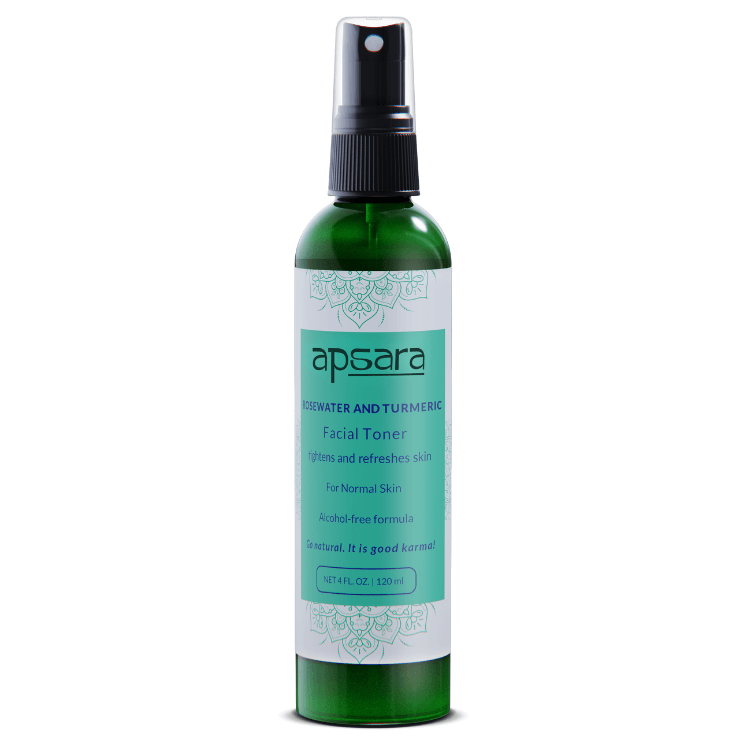

Apsara Skin Care
Rosewater And Turmeric Natural Facial Toner

Rosewater And Turmeric Natural Facial Toner
Apsara Skin Care
rosewater-and-turmeric-natural-facial-toner
Tone
9706844782885
Morning or Evening?
How often will you use this product?
Notes


Highlights
WHAT IS IT?
A natural facial toner with Ayurvedic ingredients
FEATURES
Alcohol-free, promotes hydration and healthy glow, diminishes appearance of open pores
BEST FOR
Normal Skin
CHECKS
Free of harsh chemicals, parabens, sulfates
Who Is It For?
Adults Women And MenWhat Does It Help With?
Hydration Open Pores Skin TighteningBudget
Mid-rangeHow To Use
Which routine should it be used in?
Instructions:
Key Information


What Apsara Skin Care Says
Product Description:
This refreshing facial toner is formulated with an effective blend of Ayurvedic ingredients that tightens and refreshes the skin while also giving it antioxidant repair. This toner from alcohol which can irritate the skin and increase dryness. Regular use promotes hydration, healthy glow and diminishes the appearance of open pores.
About the Brand:
Ingredients Overview
Ingredients List
Rosa centifolia (Rose) Water, Citric Acid, Potassium Sorbate, Aqua (Water), Polysorbate-20, Azadirachta indica (Neem) EO, Curcuma longa (Turmeric) EO, Pelargonium graveolens (Geranium) EO.
Key Ingredients
Rosewater, Turmeric
Ingredients Details
Citric Acid
Common Name(s): Lemon acid,2-hydroxypropane-1,2,3-tricarboxylic acid
CAS Number: 77-92-9
DESCRIPTION
What It Does: Adjusts ph to optimal ranges, chelates destabilizing metal ions, provides mild exfoliation at higher concentrations.
Why It's Used: Universal cosmetic ph adjuster and chelating agent. aha exfoliant activity is secondary.
How It Works: As ph adjuster, donates protons. as chelating agent, three carboxylic groups bind divalent metals (ca²⁺, mg²⁺, fe²⁺) preventing oxidative degradation.
Typically Found In: Nearly all cosmetic formulations,brightening products,exfoliants
TECHNICAL DETAILS
Primary Category: Active ingredient – alpha hydroxy acid (aha)
Secondary Functions: Chelating agent,ph adjustment,preservation enhancement
Application Areas:

Facial Skincare
Body Care
Hair Care

Beard Care
Color Cosmetics (Makeup)
Dietary/Oral Supplements
Typical Concentration Range: 0.1%–10%
SOURCING & ETHICS
Vegan Status: Yes – synthetic or fermentation-derived
Halal Status: Yes
Source Notes: Produced by fermentation of sugars by aspergillus niger. gras (e330). most abundant organic acid in citrus.
SKIN COMPATIBILITY
Irritancy Rating: 1/5 – very low at low concentrations; 2/5 at exfoliant concentrations
Comedogenicity Rating: 0/5 – non-comedogenic
Sensitivity Concerns: Photosensitizing – mandatory spf use. start at low frequency.
Safe for Sensitive Skin: Use with caution – spf required
SAFETY & COMPATIBILITY
Safety Profile: Safe at otc concentrations. eu: ≤10% leave-on at ph ≥3.5. mandatory spf advisory.
Works Well With: Niacinamide,ceramides,hyaluronic acid,spf
Avoid Combining With: Retinol in same step; multiple exfoliants simultaneously
SCIENTIFIC NOTE
Three carboxylic acid groups provide multiple proton donation sites and stronger chelation than monocarboxylic ahas. this makes citric acid the preferred cosmetic chelating agent alongside edta.
Last Verified: Cosing database,cir safety assessment,ewg skin deep
Primary Sources: 2026-03-12
Polysorbate 20
Common Name(s): Tween 20,poe(20) sorbitan monolaurate
CAS Number: 9005-64-5
DESCRIPTION
What It Does: Solubilizes fragrance oils and other lipophilic ingredients into water-based formulations.
Why It's Used: Standard fragrance solubilizer for water-based formulations – the industry standard for incorporating oil-soluble fragrances and actives into aqueous systems without separate oil phase.
How It Works: Hlb ~16.7 provides strong solubilization capacity for oils in water. laurate (c12) chain provides milder skin interaction than higher-hlb polysorbates. polyoxyethylene chains (20 eo units) provide high water solubility. effective solubilizer at 3-4:1 polysorbate:fragrance ratio.
Typically Found In: Toners,micellar waters,fragrance-containing aqueous products
TECHNICAL DETAILS
Primary Category: Functional ingredient – sorbitan ester emulsifier/solubilizer
Secondary Functions: Skin conditioning
Application Areas:
Facial Skincare
Body Care
Hair Care
Beard Care
Color Cosmetics (Makeup)
Dietary/Oral Supplements
Typical Concentration Range: 0.5%–5%
SOURCING & ETHICS
Vegan Status: Conditional – sorbitol from plant, peg from petroleum
Halal Status: Yes
Source Notes: Commercially produced for cosmetic use. verify vegan/halal status with supplier.
SKIN COMPATIBILITY
Irritancy Rating: 1/5 – very low
Comedogenicity Rating: 0/5 – non-comedogenic
Sensitivity Concerns: Well-tolerated by most skin types.
Safe for Sensitive Skin: Yes
SAFETY & COMPATIBILITY
Safety Profile: Same peg 1,4-dioxane concern as all peg compounds. quality-grade ps-20 should be tested for impurities.
Works Well With: Standard skincare actives
Avoid Combining With: No known significant incompatibilities
SCIENTIFIC NOTE
Polysorbate 20's optimal solubilization ratio (3-4 parts ps-20 per part fragrance oil) is lower than expected from pure hlb theory. this efficiency arises from polysorbate's formation of very small, stable oil-in-water microemulsions (droplets <50nm) rather than conventional emulsions, providing optically clear, thermodynamically stable fragrance incorporation that conventional emulsifiers cannot achieve.
Last Verified: Cosing database,cir safety assessment
Primary Sources: 2026-03-12
Potassium Sorbate
Common Name(s): Potassium e,2-hexenoate,sorbate of potash
CAS Number: 24634-61-5
DESCRIPTION
What It Does: Provides mould and yeast focused broad-spectrum preservation in a widely accepted food-grade preservative.
Why It's Used: Standard mould and yeast preservative — potassium sorbate is effective at slightly higher ph than sodium benzoate, making it the preferred sorbate preservative for formulations at ph 4.5-6.
How It Works: Inactive salt form — sorbic acid (free acid, pka 4.76) is active. more effective than benzoate at higher ph (pka 4.76 vs benzoate 4.2). active at ph up to ~6.0 (meaningful sorbic acid present). inhibits malassezia and candida at lower concentrations than bacteria. synergistic with sodium benzoate.
Typically Found In: Cosmetics ph 4-6,natural preservation systems,combined with sodium benzoate
TECHNICAL DETAILS
Primary Category: Functional ingredient – sorbate preservative
Secondary Functions: Skin conditioning
Application Areas:
Facial Skincare
Body Care
Hair Care
Beard Care
Color Cosmetics (Makeup)
Dietary/Oral Supplements
Typical Concentration Range: 0.1%–0.6%
SOURCING & ETHICS
Vegan Status: Yes – synthetic
Halal Status: Yes
Source Notes: Commercially produced for cosmetic use. verify vegan/halal status with supplier.
SKIN COMPATIBILITY
Irritancy Rating: 1/5 – very low
Comedogenicity Rating: 0/5 – non-comedogenic
Sensitivity Concerns: Well-tolerated by most skin types.
Safe for Sensitive Skin: Yes
SAFETY & COMPATIBILITY
Safety Profile: Eu max 0.6% cosmetics. fda gras. synergistic with sodium benzoate. oxidises to sorbaldehyde (yellow colouration) on uv exposure — protect from light.
Works Well With: Standard skincare actives
Avoid Combining With: No known significant incompatibilities
SCIENTIFIC NOTE
Potassium sorbate's antifungal mechanism (disruption of mitochondrial electron transport in fungi) is different from its antibacterial mechanism (cell membrane and enzyme disruption). this mechanistic bifunctionality provides broad spectrum from a single preservative, though the lower antifungal mic values mean mould and yeast protection is achieved at lower concentrations than bacterial protection.
Last Verified: Cosing database,eu preservative annex v,fda gras,cir safety assessment
Primary Sources: 2026-03-12
