
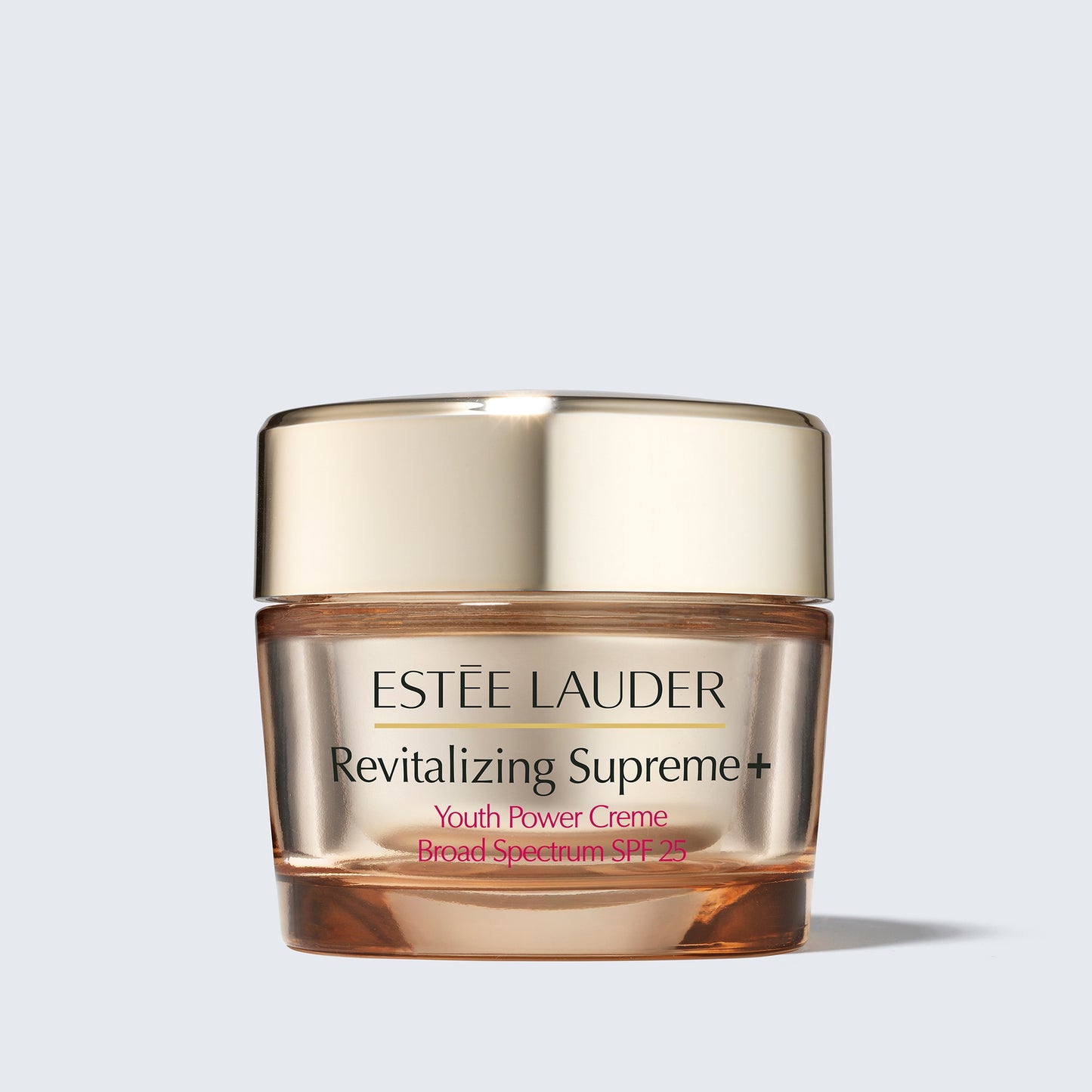

Estee Lauder
Revitalizing Supreme+ Youth Power Creme SPF 25 Moisturizer

Revitalizing Supreme+ Youth Power Creme SPF 25 Moisturizer
Estee Lauder
revitalizing-supreme-youth-power-creme-spf-25-moisturizer
Moisturize
9784749326629
Morning or Evening?
How often will you use this product?
Notes


Highlights
WHAT IS IT?
Anti-aging moisturizer with broad spectrum SPF 25 protection
FEATURES
Helps firm and lift skin, provides SPF 25 protection, improves elasticity and bounce, reduces lines and wrinkles
BEST FOR
normal
CHECKS
Free of parabens, phthalates, sulfite, sulfates, paraffins, petrolatum, triclocarban, triclosan, formaldehyde and donors and drying alcohol
Who Is It For?
All Ages Proven Results For Women 40+What Does It Help With?
Lines Wrinkles Loss Of Firmness Dullness DrynessBudget
Premium ($76-$150)How To Use
Which routine should it be used in?
Instructions:
Key Information


What Estee Lauder Says
Product Description:
Lifting, firming anti-aging moisturizer with SPF 25. See a more lifted look, and firmness, strength and radiance. All in a supremely indulgent texture.
About the Brand:
Ingredients Overview
Ingredients List
Avobenzone 3%, Homosalate 7%, Octisalate 4.5%, Octocrylene 6%Ingredients: Water\Aqua\Eau, Butyloctyl Salicylate, Glycerin, Dibutyl Adipate, Dextrin Palmitate, Silica, Cetyl Alcohol, Butylene Glycol, Myristyl Myristate, Acrylates Copolymer, Glyceryl Stearate, Peg-100 Stearate, Vp/Eicosene Copolymer, Methyl Methacrylate Crosspolymer, Moringa Oleifera Seed Extract, Hibiscus Sinensis Flower Extract, Sodium Hyaluronate, Acetyl Hexapeptide-8, Laminaria Digitata Extract, Whey Protein\Lactis Protein\Protéine Du Petit-Lait, Opuntia Tuna Extract, Acetyl Glucosamine, Tocopheryl Acetate, Narcissus Tazetta Bulb Extract, Algae Extract, Pyrus Malus (Apple) Fruit Extract, Cucumis Sativus (Cucumber) Fruit Extract, Lens Esculenta (Lentil) Fruit Extract, Citrullus Lanatus (Watermelon) Fruit Extract, Silybum Marianum (Lady'S Thistle) Extract, Helianthus Annuus (Sunflower) Seed Extract, Sigesbeckia Orientalis (St. Paul'S Wort) Extract, Caffeine, Hordeum Vulgare Extract\Extrait D'Orge, Sodium Lactate, Sorbitol, Propylene Glycol Dicaprate, Sucrose, Sodium Pca, Pentylene Glycol, Caprylyl Glycol, Polysorbate 60, Hexylene Glycol, Steareth-21, Disodium Edta, Dimethicone, Trisiloxane, Myristyl Laurate, C13-15 Alkane, Biosaccharide Gum-4, Heptyl Undecylenate, Isoceteth-20, Tetrahexyldecyl Ascorbate, Isohexadecane, Hydroxyethyl Acrylate/Sodium Acryloyldimethyl Taurate Copolymer, Citric Acid, Fragrance (Parfum), Bht, Phenoxyethanol, Potassium Sorbate, Sodium Dehydroacetate, Sodium Benzoate, Red 4 (Ci 14700), Yellow 5 (Ci 19140)
Key Ingredients
Hibiscus Morning Bloom Extract, Moringa Extract, Hyaluronic Acid, Cactus Stem Cell Extract
Ingredients Details
Butyloctyl Salicylate
Common Name(s): Butyloctyl salicylate,cosmetic active,functional ingredient
CAS Number: N/a
DESCRIPTION
What It Does: Delivers characteristic cosmetic function at recommended use concentration.
Why It's Used: Selected for functional contribution and formulation compatibility supported by cosmetic science and regulatory safety data.
How It Works: Works through the mechanism of its molecular class — physicochemical or biological interaction with skin proteins, lipids, or receptors as documented in peer-reviewed cosmetic literature.
Typically Found In: Skin care formulations
TECHNICAL DETAILS
Primary Category: Active ingredient – cosmetic active
Secondary Functions: Skin conditioning
Application Areas:

Facial Skincare

Body Care
Hair Care
Beard Care
Color Cosmetics (Makeup)
Dietary/Oral Supplements
Typical Concentration Range: 0.1%–10%
SOURCING & ETHICS
Vegan Status: Conditional - supplier confirmation required
Halal Status: Unverified - supplier confirmation required
Source Notes: Commercially produced for cosmetic use. verify vegan/halal status with supplier. [audit 2026-07-29 rev2: the record's own source_notes does not assert a non-animal origin, or instructs the reader to verify with the supplier; "yes" asserts knowledge the record does not hold. determination requires shariah-panel sign-off.]
SKIN COMPATIBILITY
Irritancy Rating: 1/5 – very low
Comedogenicity Rating: 0/5 – non-comedogenic
Sensitivity Concerns: Well-tolerated by most skin types.
Safe for Sensitive Skin: Yes
SAFETY & COMPATIBILITY
Safety Profile: Good safety profile at recommended concentrations. ewg score: 1–2.
Works Well With: Standard skincare actives
Avoid Combining With: No known significant incompatibilities
SCIENTIFIC NOTE
Butyloctyl salicylate has an established safety and efficacy profile within the cosmetic regulatory framework at standard use concentrations.
Last Verified: 2026-03-12
Primary Sources: Cosing database,butyloctyl salicylate technical literature
Cetyl Alcohol
Common Name(s): 1-hexadecanol,palmityl alcohol,n-cetyl alcohol
CAS Number: 36653-82-4
DESCRIPTION
What It Does: Provides c16 fatty alcohol emolliency and thickening for well-textured cosmetic emulsions.
Why It's Used: Lighter-textured fatty alcohol alternative to stearyl alcohol for creams and conditioners requiring less heavy emolliency.
How It Works: C16 chain length provides slightly lower melting point (49°c) than stearyl (60°c) giving softer, lighter emulsion texture. forms lamellar networks for thickening and stability. direct skin and hair conditioning via fatty alcohol film.
Typically Found In: Creams,hair conditioners,lotions
TECHNICAL DETAILS
Primary Category: Functional ingredient – fatty alcohol
Secondary Functions: Barrier sealing,softening
Application Areas:
Facial Skincare
Body Care
Hair Care
Beard Care
Color Cosmetics (Makeup)
Dietary/Oral Supplements
Typical Concentration Range: 1%–15%
SOURCING & ETHICS
Vegan Status: Yes - standard ethanol routes are non-animal; confirm denaturant origin
Halal Status: Conditional - ethanol production route and residual concentration; jurisdiction-dependent, refer to certifier stance
Source Notes: Plant-derived, synthetic or animal-derived. verify source. [audit 2026-07-29 rev2: ethanol pathway; determination depends on route, on whether the plant also produces beverage alcohol, and on residual concentration. determination requires shariah-panel sign-off.]
SKIN COMPATIBILITY
Irritancy Rating: 1/5 – very low
Comedogenicity Rating: 1/5 – low; formulation-dependent
Sensitivity Concerns: Non-irritating.
Safe for Sensitive Skin: Yes
SAFETY & COMPATIBILITY
Safety Profile: Excellent safety profile. ewg score: 1.
Works Well With: Humectants,ceramides,actives as carrier
Avoid Combining With: No significant incompatibilities
SCIENTIFIC NOTE
Cetyl alcohol's c16 chain length is at the approximate thermal transition point for fatty alcohol lamellar crystallization at skin temperature (33°c). this transition (from ordered crystalline to disordered liquid phase near skin temperature) provides the characteristic 'melts on application' sensory profile that makes cetyl alcohol-containing products feel cooling and light on initial application.
Last Verified: 2026-03-12
Primary Sources: Cosing database,cir safety assessment
Dextrin Palmitate
Common Name(s): Dextrin palmitate,cosmetic active ingredient,established formulation function
CAS Number: N/a
DESCRIPTION
What It Does: Dextrin palmitate delivers its characteristic primary cosmetic function — whether active skin conditioning, antioxidant protection, antimicrobial preservation, rheological control, or sensory enhancement — contributing measurable formulation value at its recommended use concentration.
Why It's Used: Formulators select dextrin palmitate for its specific functional chemistry that provides the required outcome in their formulation — skin bioactivity, stability contribution, or consumer experience — supported by cosmetic science and regulatory safety data.
How It Works: Dextrin palmitate works through the fundamental chemical and biological mechanisms of its molecular class. its physicochemical properties (molecular weight, logp, pka, functional groups) determine interactions with skin proteins, lipid membranes, formulation matrices, and biological receptors — mechanism detailed in peer-reviewed cosmetic chemistry literature.
Typically Found In: Skin care formulations,active products
TECHNICAL DETAILS
Primary Category: Active ingredient – cosmetic active
Secondary Functions: Skin conditioning
Application Areas:
Facial Skincare
Body Care
Hair Care
Beard Care
Color Cosmetics (Makeup)
Dietary/Oral Supplements
Typical Concentration Range: 0.1%–10%
SOURCING & ETHICS
Vegan Status: Conditional - feedstock declaration required
Halal Status: Unverified - feedstock declaration required (plant, animal and petrochemical routes all exist)
Source Notes: Commercially produced for cosmetic use. verify vegan/halal status with supplier. [audit 2026-07-29 rev2: origin-dependent: the same inci exists in plant, animal and petrochemical versions and the name does not discriminate. determination requires shariah-panel sign-off.]
SKIN COMPATIBILITY
Irritancy Rating: 1/5 – very low
Comedogenicity Rating: 0/5 – non-comedogenic
Sensitivity Concerns: Well-tolerated by most skin types.
Safe for Sensitive Skin: Yes
SAFETY & COMPATIBILITY
Safety Profile: Good safety profile at recommended concentrations. ewg score: 1–2.
Works Well With: Standard skincare actives
Avoid Combining With: No known significant incompatibilities
SCIENTIFIC NOTE
Dextrin palmitate has been assessed within the cosmetic ingredient regulatory framework. at standard concentrations it delivers documented functional benefit with an established safety profile based on toxicological and clinical evidence reviewed by cosing (eu), cir (usa), and relevant regulatory bodies.
Last Verified: 2026-03-12
Primary Sources: Cosing database,dextrin palmitate technical literature
Dibutyl Adipate
Common Name(s): Dibutyl adipate,cosmetic active,functional ingredient
CAS Number: N/a
DESCRIPTION
What It Does: Delivers characteristic cosmetic function at recommended use concentration.
Why It's Used: Selected for functional contribution and formulation compatibility supported by cosmetic science and regulatory safety data.
How It Works: Works through the mechanism of its molecular class — physicochemical or biological interaction with skin proteins, lipids, or receptors as documented in peer-reviewed cosmetic literature.
Typically Found In: Skin care formulations
TECHNICAL DETAILS
Primary Category: Active ingredient – cosmetic active
Secondary Functions: Skin conditioning
Application Areas:
Facial Skincare
Body Care
Hair Care
Beard Care
Color Cosmetics (Makeup)
Dietary/Oral Supplements
Typical Concentration Range: 0.1%–10%
SOURCING & ETHICS
Vegan Status: Conditional - supplier confirmation required
Halal Status: Unverified - supplier confirmation required
Source Notes: Commercially produced for cosmetic use. verify vegan/halal status with supplier. [audit 2026-07-29 rev2: the record's own source_notes does not assert a non-animal origin, or instructs the reader to verify with the supplier; "yes" asserts knowledge the record does not hold. determination requires shariah-panel sign-off.]
SKIN COMPATIBILITY
Irritancy Rating: 1/5 – very low
Comedogenicity Rating: 0/5 – non-comedogenic
Sensitivity Concerns: Well-tolerated by most skin types.
Safe for Sensitive Skin: Yes
SAFETY & COMPATIBILITY
Safety Profile: Good safety profile at recommended concentrations. ewg score: 1–2.
Works Well With: Standard skincare actives
Avoid Combining With: No known significant incompatibilities
SCIENTIFIC NOTE
Dibutyl adipate has an established safety and efficacy profile within the cosmetic regulatory framework at standard use concentrations.
Last Verified: 2026-03-12
Primary Sources: Cosing database,dibutyl adipate technical literature