

Paula's Choice
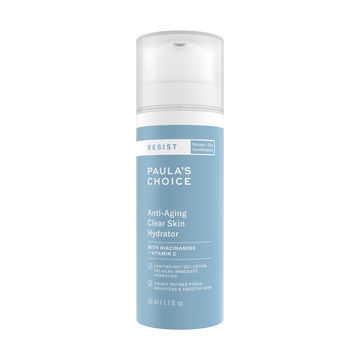
RESIST Anti-Aging Clear Skin Hydrator

RESIST Anti-Aging Clear Skin Hydrator
Paula's Choice
resist-anti-aging-clear-skin-hydrator
9818302054693
Morning or Evening?
How often will you use this product?
Notes


Highlights
WHAT IS IT?
Niacinamide, vitamin C, and adenosine face moisturizer
FEATURES
Provides immediate hydration, nourishing skin, creating a more even-looking skin tone, defending skin against environmental stresses.
BEST FOR
Oily, combination, normal, dry
CHECKS
Free of Fragrance, Oil, Paraben, Sulphate
Who Is It For?
AdultsWhat Does It Help With?
Pores Size Brighten And Smooth SkinBudget
Mid-range ($30-$75)How To Use
Which routine should it be used in?
Instructions:
Key Information

About the Brand:
Ingredients Overview
Ingredients List
Water, Cyclopentasiloxane, Octyldodecyl Neopentanoate, Vinyl Dimethicone/Methicone, Silsesquioxane Crosspolymer, Glycerin, Sodium Ascorbyl Phosphate, Cetyl Alcohol, Niacinamide, Dimethicone, Cetearyl Alcohol, Butylene Glycol, Glyceryl Stearate, PEG-100 Stearate, Adenosine, Epigallocatechin Gallate, Glucose Oxidase, Lactoperoxidase, Boerhavia Diffusa Root Extract, Cocos Nucifera (Coconut) Fruit Extract, Lactobacillus Ferment, Polysilicone-11, Sodium Chloride, Potassium, Glucose, Xanthan Gum, Ceteareth-20, Decyl Glucoside, Citric Acid, Phenoxyethanol
Key Ingredients
Sodium Ascorbyl Phosphate, Lactoperoxidase, Adenosine, Boerhavia Diffusa Root Extract, Epigallocatechin Gallate, Niacinamide, Glucose Oxidase
Ingredients Details
Sodium Ascorbyl Phosphate
Common Name(s): Sap,l-ascorbic acid 2-phosphate sodium
DESCRIPTION
What It Does: Provides stable water-soluble vitamin c with documented anti-acne activity beyond typical brightening benefits.
Why It's Used: The anti-acne vitamin c derivative — sap's documented anti-p. acnes activity makes it uniquely suited for acne-brightening formulations targeting both acne and post-acne hyperpigmentation simultaneously.
How It Works: Phosphate ester resists oxidation in aqueous formulation. converted to ascorbic acid by alkaline phosphatase in viable epidermis. anti-acne via reduction of p. acnes oxidative stress and direct antimicrobial activity. tyrosinase inhibition for brightening.
Typically Found In: Anti-acne brightening serums,oily skin products
TECHNICAL DETAILS
Primary Category: Active ingredient – phosphate vitamin c
Secondary Functions: Tyrosinase inhibitor,collagen cofactor
Application Areas:

Facial Skincare

Body Care
Hair Care
Beard Care
Color Cosmetics (Makeup)
Dietary/Oral Supplements
Typical Concentration Range: 1%–5%
SOURCING & ETHICS
Vegan Status: Yes – synthetic
Halal Status: Yes
Source Notes: Synthetically produced vitamin c derivative.
SKIN COMPATIBILITY
Irritancy Rating: 1/5 – very low
Comedogenicity Rating: 0/5 – non-comedogenic
Sensitivity Concerns: Non-irritating; suitable for all skin types.
Safe for Sensitive Skin: Yes
SAFETY & COMPATIBILITY
Safety Profile: Excellent safety profile. ewg score: 1.
Works Well With: Tocopherol,ferulic acid,niacinamide,spf
Avoid Combining With: No significant incompatibilities
SCIENTIFIC NOTE
Sodium ascorbyl phosphate's anti-p. acnes activity was demonstrated by klock et al. (2005) showing sap at 1% reduced p. acnes populations and reduced inflammatory acne lesions in a clinical study. the mechanism involves ascorbic acid's pro-oxidant activity in p. acnes — generating reactive oxygen species toxic to the bacterium, which is the opposite of ascorbic acid's antioxidant role in human cells.
Last Verified: ##########
Primary Sources: Cosing database,klock et al. sap anti-acne study
Water
Common Name(s): Water,purified water,deionised water,inci water
CAS Number: 7732-18-5
DESCRIPTION
What It Does: Provides the universal solvent and vehicle for water-soluble actives and the continuous phase of all o/w emulsions.
Why It's Used: The most essential cosmetic ingredient — aqua (water) is listed first on virtually all water-containing cosmetic inci labels as the highest-concentration ingredient, serving as the foundation of the global cosmetics industry.
How It Works: Acts as solvent for all water-soluble ingredients (glycols, amino acids, water-soluble actives). forms the continuous external phase of o/w emulsions (lotions, creams, serums). provides aqueous environment for enzymatic and chemical reactions between actives. ph adjustment medium.
Typically Found In: Virtually all cosmetic products — the most universal cosmetic ingredient globally
TECHNICAL DETAILS
Primary Category: Functional ingredient – water
Secondary Functions: Skin conditioning
Application Areas:
Facial Skincare
Body Care
Hair Care
Beard Care
Color Cosmetics (Makeup)
Dietary/Oral Supplements
Typical Concentration Range: Varies widely — up to 95% in some toners and serums
SOURCING & ETHICS
Vegan Status: Yes – water (deionised/purified)
Halal Status: Yes
Source Notes: Cosmetic-grade water is purified (deionised, distilled, or ro filtered) to prevent mineral content interference with formulation stability. european pharmacopoeial water (aqua purificata ph. eur.) is the quality standard for pharmaceutical and high-end cosmetic formulations.
SKIN COMPATIBILITY
Irritancy Rating: 1/5 – non-irritant
Comedogenicity Rating: 0/5 – non-comedogenic
Sensitivity Concerns: Well-tolerated by most skin types.
Safe for Sensitive Skin: Yes
SAFETY & COMPATIBILITY
Safety Profile: Good safety profile at recommended concentrations. ewg score: 1–2.
Works Well With: Standard skincare actives
Avoid Combining With: No known significant incompatibilities
SCIENTIFIC NOTE
Water's position as the first inci ingredient on most cosmetic labels reflects the regulatory requirement to list ingredients in descending concentration order — meaning water is the most abundant ingredient in the majority of cosmetic products. the fundamental role of water as the universal cosmetic solvent and vehicle makes it simultaneously the most important cosmetic ingredient and the one that requires the most sophisticated formulation chemistry to control — every emulsifier, thickener, preservative, and ph adjuster exists primarily to manage water's interaction with other ingredients in formulation.
Last Verified: 2026-03-12
Primary Sources: Cosing database,eu cosmetics regulation 1223/2009 inci requirements,ph. eur. aqua purificata monograph