

Estee Lauder
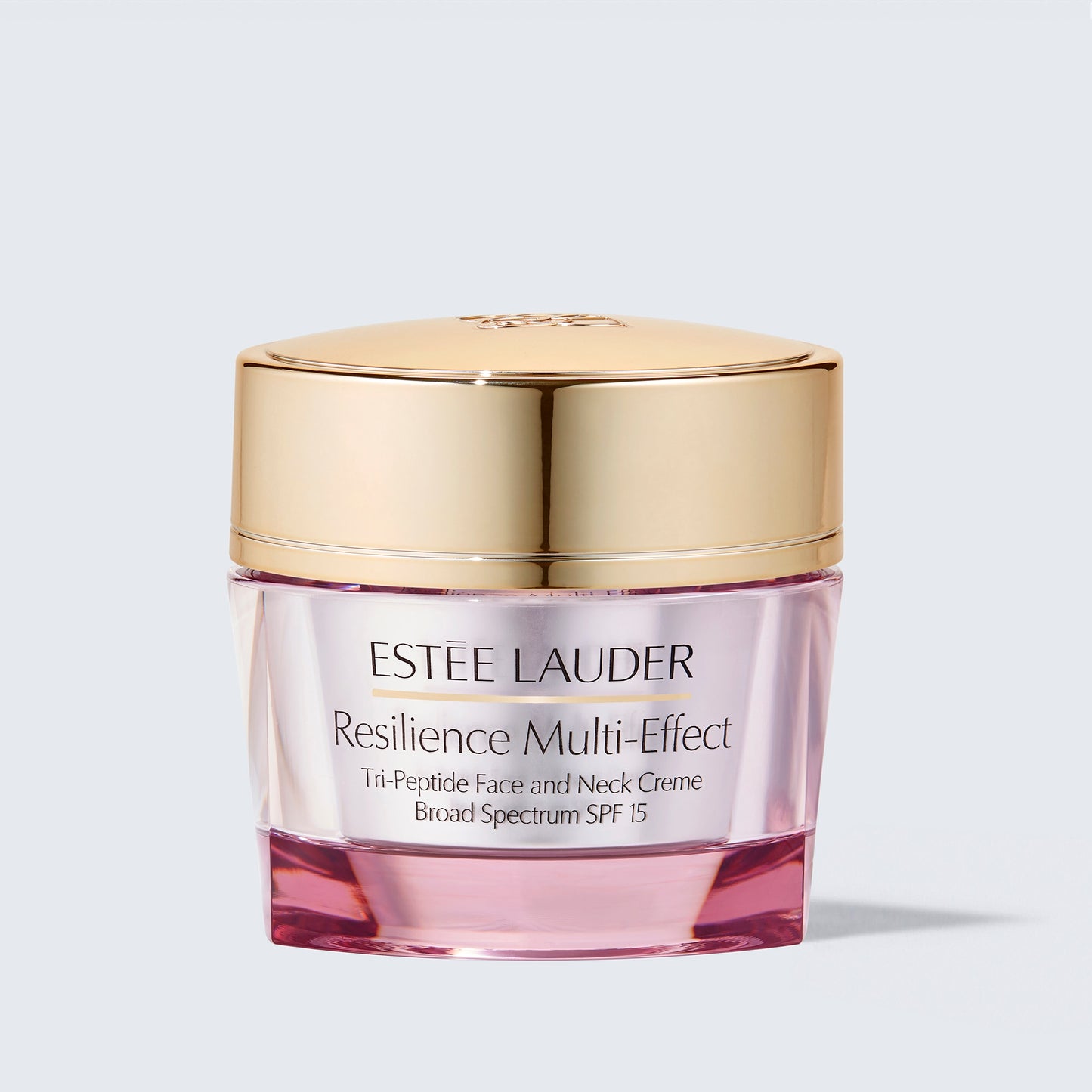
Resilience Multi-Effect Moisturizer Tri-Peptide Face and Neck Creme SPF 15

Resilience Multi-Effect Moisturizer Tri-Peptide Face and Neck Creme SPF 15
Estee Lauder
resilience-multi-effect-moisturizer-tri-peptide-face-and-neck-creme-spf-15
Moisturize
9784749261093
Morning or Evening?
How often will you use this product?
Notes


Highlights
WHAT IS IT?
Face and neck moisturizer with Tri-Peptide Complex
FEATURES
Intensely nourishing, helps prevent collagen degradation, supports skin firmness, provides SPF 15 protection, contains IR-Defense Technology
BEST FOR
normal
CHECKS
Non-acnegenic
Who Is It For?
Adults Seeking Anti-aging BenefitsWhat Does It Help With?
Multiple Signs Of Aging Targeting Natural Collagen Smooth Supple Skin Dullness Lines And WrinklesBudget
Premium ($76-$150)How To Use
Which routine should it be used in?
Instructions:
Key Information


What Estee Lauder Says
Product Description:
Look as young as you feel. This intensely nourishing, youth-infusing creme brings out skin that is radiant, plumped, supple-more resilient. Includes advanced Tri-Peptide Complex.
About the Brand:
Ingredients Overview
Ingredients List
Water\Aqua\Eau, Neopentyl Glycol Diheptanoate, Ethylhexyl Salicylate, Butyl Methoxydibenzoylmethane, Octocrylene, Cetyl Alcohol, Glycerin, Butyloctyl Salicylate, Pentaerythrityl Tetraethylhexanoate, Polyethylene, Di-C12-15 Alkyl Fumarate, Petrolatum, Hydrogenated Lecithin, Butylene Glycol, Propanediol, Hydrogenated Polyisobutene, Octyldodecyl Myristate, Hexyldecyl Stearate, Behenyl Alcohol, Cucumis Melo (Melon) Fruit Extract, Polygonum Aviculare Extract, Myrtus Communis Leaf Extract, Laminaria Digitata Extract, Acetyl Hexapeptide-8, Tetradecyl Aminobutyroylvalylaminobutyric Urea Trifluoroacetate, Lactoperoxidase, Glucose Oxidase, Cholesterol, Propylene Glycol Dicaprylate, Aminopropyl Ascorbyl Phosphate, Sodium Hyaluronate, Glucose, Algae Extract, Artemia Extract, Acetyl Glucosamine, Sigesbeckia Orientalis (St. Paul'S Wort) Extract, Glyceryl Stearate, Persea Gratissima (Avocado) Oil, Dimethicone, C12-16 Alcohols, Trehalose, Ethylhexylglycerin, Peg-100 Stearate, Caffeine, Palmitic Acid, Glycine Soja (Soybean) Sterols, Caprylyl Glycol, Isohexadecane, Polymethyl Methacrylate, Trifluoroacetyl Tripeptide-2, Tocopheryl Acetate, Zinc Pca, Polysilicone-11, Polysorbate 80, Yeast Extract\Faex\Extrait De Levure, Potato Starch Modified, Decarboxy Carnosine Hcl, Xanthan Gum, Fragrance (Parfum), Sodium Hydroxide, Potassium Sulfate, Acrylamide/Sodium Acryloyldimethyltaurate Copolymer, Dextran, Hexylene Glycol, Disodium Edta, Bht, Potassium Sorbate, Phenoxyethanol, Red 4 (Ci 14700), Mica, Titanium Dioxide (Ci 77891)
Key Ingredients
Tri-Peptide Complex
Ingredients Details
Butyl Methoxydibenzoylmethane
Common Name(s): Butyl methoxydibenzoylmethane,organic uv filter,photostabilising sunscreen active
CAS Number: N/a
DESCRIPTION
What It Does: Absorbs uv radiation at specific wavelengths (uva 320–400 nm, uvb 290–320 nm) and dissipates photon energy as heat rather than skin-damaging photochemical reactions.
Why It's Used: Organic uv filters are chosen for their high molar extinction coefficient, specific spectral coverage, and formulation compatibility — individual filters are combined to provide broad-spectrum coverage across uva+uvb.
How It Works: Uv photon absorption by the aromatic chromophore π-system excites the molecule from s₀ ground state to s₁ excited state. rapid internal conversion or photoisomerisation dissipates energy as vibrational heat before it can initiate skin photodamage.
Typically Found In: Sunscreens,photoprotective products
TECHNICAL DETAILS
Primary Category: Active ingredient – cosmetic active
Secondary Functions: Skin conditioning
Application Areas:

Facial Skincare

Body Care
Hair Care
Beard Care
Color Cosmetics (Makeup)
Dietary/Oral Supplements
Typical Concentration Range: Check local sunscreen regulations
SOURCING & ETHICS
Vegan Status: Conditional - supplier confirmation required
Halal Status: Unverified - supplier confirmation required
Source Notes: Commercially produced for cosmetic use. verify vegan/halal status with supplier. [audit 2026-07-29 rev2: the record's own source_notes does not assert a non-animal origin, or instructs the reader to verify with the supplier; "yes" asserts knowledge the record does not hold. determination requires shariah-panel sign-off.]
SKIN COMPATIBILITY
Irritancy Rating: 1/5 – very low
Comedogenicity Rating: 0/5 – non-comedogenic
Sensitivity Concerns: Well-tolerated by most skin types.
Safe for Sensitive Skin: Yes
SAFETY & COMPATIBILITY
Safety Profile: Good safety profile at recommended concentrations. ewg score: 1–2.
Works Well With: Standard skincare actives
Avoid Combining With: No known significant incompatibilities
SCIENTIFIC NOTE
Organic uv filters require photostabilisation (by avobenzone-octocrylene pairing, or triazine stabilisers) as some absorbers degrade on uv exposure — formulator must verify photostability of the chosen filter combination.
Last Verified: 2026-03-12
Primary Sources: Cosing database,butyl methoxydibenzoylmethane organic uv filter review
Butyloctyl Salicylate
Common Name(s): Butyloctyl salicylate,cosmetic active,functional ingredient
CAS Number: N/a
DESCRIPTION
What It Does: Delivers characteristic cosmetic function at recommended use concentration.
Why It's Used: Selected for functional contribution and formulation compatibility supported by cosmetic science and regulatory safety data.
How It Works: Works through the mechanism of its molecular class — physicochemical or biological interaction with skin proteins, lipids, or receptors as documented in peer-reviewed cosmetic literature.
Typically Found In: Skin care formulations
TECHNICAL DETAILS
Primary Category: Active ingredient – cosmetic active
Secondary Functions: Skin conditioning
Application Areas:
Facial Skincare
Body Care
Hair Care
Beard Care
Color Cosmetics (Makeup)
Dietary/Oral Supplements
Typical Concentration Range: 0.1%–10%
SOURCING & ETHICS
Vegan Status: Conditional - supplier confirmation required
Halal Status: Unverified - supplier confirmation required
Source Notes: Commercially produced for cosmetic use. verify vegan/halal status with supplier. [audit 2026-07-29 rev2: the record's own source_notes does not assert a non-animal origin, or instructs the reader to verify with the supplier; "yes" asserts knowledge the record does not hold. determination requires shariah-panel sign-off.]
SKIN COMPATIBILITY
Irritancy Rating: 1/5 – very low
Comedogenicity Rating: 0/5 – non-comedogenic
Sensitivity Concerns: Well-tolerated by most skin types.
Safe for Sensitive Skin: Yes
SAFETY & COMPATIBILITY
Safety Profile: Good safety profile at recommended concentrations. ewg score: 1–2.
Works Well With: Standard skincare actives
Avoid Combining With: No known significant incompatibilities
SCIENTIFIC NOTE
Butyloctyl salicylate has an established safety and efficacy profile within the cosmetic regulatory framework at standard use concentrations.
Last Verified: 2026-03-12
Primary Sources: Cosing database,butyloctyl salicylate technical literature
Cetyl Alcohol
Common Name(s): 1-hexadecanol,palmityl alcohol,n-cetyl alcohol
CAS Number: 36653-82-4
DESCRIPTION
What It Does: Provides c16 fatty alcohol emolliency and thickening for well-textured cosmetic emulsions.
Why It's Used: Lighter-textured fatty alcohol alternative to stearyl alcohol for creams and conditioners requiring less heavy emolliency.
How It Works: C16 chain length provides slightly lower melting point (49°c) than stearyl (60°c) giving softer, lighter emulsion texture. forms lamellar networks for thickening and stability. direct skin and hair conditioning via fatty alcohol film.
Typically Found In: Creams,hair conditioners,lotions
TECHNICAL DETAILS
Primary Category: Functional ingredient – fatty alcohol
Secondary Functions: Barrier sealing,softening
Application Areas:
Facial Skincare
Body Care
Hair Care
Beard Care
Color Cosmetics (Makeup)
Dietary/Oral Supplements
Typical Concentration Range: 1%–15%
SOURCING & ETHICS
Vegan Status: Yes - standard ethanol routes are non-animal; confirm denaturant origin
Halal Status: Conditional - ethanol production route and residual concentration; jurisdiction-dependent, refer to certifier stance
Source Notes: Plant-derived, synthetic or animal-derived. verify source. [audit 2026-07-29 rev2: ethanol pathway; determination depends on route, on whether the plant also produces beverage alcohol, and on residual concentration. determination requires shariah-panel sign-off.]
SKIN COMPATIBILITY
Irritancy Rating: 1/5 – very low
Comedogenicity Rating: 1/5 – low; formulation-dependent
Sensitivity Concerns: Non-irritating.
Safe for Sensitive Skin: Yes
SAFETY & COMPATIBILITY
Safety Profile: Excellent safety profile. ewg score: 1.
Works Well With: Humectants,ceramides,actives as carrier
Avoid Combining With: No significant incompatibilities
SCIENTIFIC NOTE
Cetyl alcohol's c16 chain length is at the approximate thermal transition point for fatty alcohol lamellar crystallization at skin temperature (33°c). this transition (from ordered crystalline to disordered liquid phase near skin temperature) provides the characteristic 'melts on application' sensory profile that makes cetyl alcohol-containing products feel cooling and light on initial application.
Last Verified: 2026-03-12
Primary Sources: Cosing database,cir safety assessment
Ethylhexyl Salicylate
Common Name(s): Ethylhexyl salicylate,organic uv filter,photostabilising sunscreen active
CAS Number: N/a
DESCRIPTION
What It Does: Absorbs uv radiation at specific wavelengths (uva 320–400 nm, uvb 290–320 nm) and dissipates photon energy as heat rather than skin-damaging photochemical reactions.
Why It's Used: Organic uv filters are chosen for their high molar extinction coefficient, specific spectral coverage, and formulation compatibility — individual filters are combined to provide broad-spectrum coverage across uva+uvb.
How It Works: Uv photon absorption by the aromatic chromophore π-system excites the molecule from s₀ ground state to s₁ excited state. rapid internal conversion or photoisomerisation dissipates energy as vibrational heat before it can initiate skin photodamage.
Typically Found In: Sunscreens,photoprotective products
TECHNICAL DETAILS
Primary Category: Active ingredient – cosmetic active
Secondary Functions: Skin conditioning
Application Areas:
Facial Skincare
Body Care
Hair Care
Beard Care
Color Cosmetics (Makeup)
Dietary/Oral Supplements
Typical Concentration Range: Check local sunscreen regulations
SOURCING & ETHICS
Vegan Status: Conditional - supplier confirmation required
Halal Status: Unverified - supplier confirmation required
Source Notes: Commercially produced for cosmetic use. verify vegan/halal status with supplier. [audit 2026-07-29 rev2: the record's own source_notes does not assert a non-animal origin, or instructs the reader to verify with the supplier; "yes" asserts knowledge the record does not hold. determination requires shariah-panel sign-off.]
SKIN COMPATIBILITY
Irritancy Rating: 1/5 – very low
Comedogenicity Rating: 0/5 – non-comedogenic
Sensitivity Concerns: Well-tolerated by most skin types.
Safe for Sensitive Skin: Yes
SAFETY & COMPATIBILITY
Safety Profile: Good safety profile at recommended concentrations. ewg score: 1–2.
Works Well With: Standard skincare actives
Avoid Combining With: No known significant incompatibilities
SCIENTIFIC NOTE
Organic uv filters require photostabilisation (by avobenzone-octocrylene pairing, or triazine stabilisers) as some absorbers degrade on uv exposure — formulator must verify photostability of the chosen filter combination.
Last Verified: 2026-03-12
Primary Sources: Cosing database,ethylhexyl salicylate organic uv filter review