

Olay
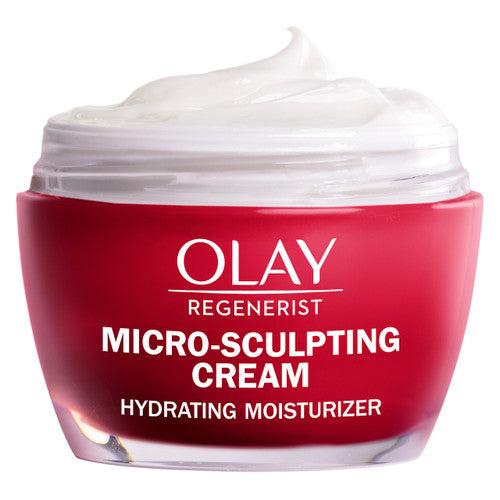
Regenerist Micro-Sculpting Cream Moisturizer

Regenerist Micro-Sculpting Cream Moisturizer
Olay
regenerist-micro-sculpting-cream-moisturizer
Moisturize
9784832360741
Morning or Evening?
How often will you use this product?
Notes


Highlights
WHAT IS IT?
Anti-aging moisturizer with amino peptides
FEATURES
Hydrates, firms, smooths wrinkles, lifts, regenerates, strengthens, brightens, nourishes, plumps, evens tone
BEST FOR
normal
CHECKS
Free of Parabens, phthalates, and synthetic dyes
Who Is It For?
Adult Women Concerned With Aging SkinWhat Does It Help With?
Fine Lines Wrinkles Sagging Skin Dryness Uneven TextureBudget
Affordable (under $30)How To Use
Which routine should it be used in?
Instructions:
Key Information

What Olay Says
Product Description:
Hydrates for Tighter, Firmer Skin. Helps restore and improve elasticity, visibly improves texture and sagging, and instantly diminishes the look of fine lines and wrinkles.
About the Brand:
Ingredients Overview
Ingredients List
water,glycerin,isohexadecane,niacinamide,distarch-phosphate,isopropyl-isostearate,dimethicone,panthenol,palmitoyl-pentapeptide-4,sodium-hyaluronate,caprylic-capric-triglyceride,ethylhexylglycerin,hydroxyacetophenone,dimethiconol,cetearyl-glucoside,cetearyl-alcohol,stearic-acid,palmitic-acid,stearyl-alcohol,cetyl-alcohol,behenyl-alcohol,disodium-edta,sodium-acrylates-copolymer,peg-100-stearate,titanium-dioxide,mica,phenoxyethanol,fragrance
Key Ingredients
Amino Peptides, Niacinamide, Hyaluronic Acid
Ingredients Details
Dimethicone
Common Name(s): Pdms,polydimethylsiloxane,silicone fluid
CAS Number: 9006-65-9
DESCRIPTION
What It Does: Provides silicone-characteristic silky feel and skin protection with adjustable viscosity.
Why It's Used: The benchmark cosmetic silicone – sets the gold standard for silky application feel, spreadability, and skin protection in virtually all skin care categories.
How It Works: Polydimethylsiloxane chain flexibility provides extremely low surface tension and high spreadability. inert si-o backbone provides chemical stability and excellent skin tolerance. occlusive film formation reduces tewl. higher viscosity grades provide more intense conditioning.
Typically Found In: Moisturizers,foundations,primers,sunscreens – nearly universal
TECHNICAL DETAILS
Primary Category: Functional ingredient – polydimethylsiloxane
Secondary Functions: Barrier sealing,softening
Application Areas:

Facial Skincare
Body Care
Hair Care

Beard Care
Color Cosmetics (Makeup)
Dietary/Oral Supplements
Typical Concentration Range: 0.1%–30%
SOURCING & ETHICS
Vegan Status: Yes – synthetic
Halal Status: Yes
Source Notes: Plant-derived, synthetic or animal-derived. verify source.
SKIN COMPATIBILITY
Irritancy Rating: 1/5 – very low
Comedogenicity Rating: 1/5 – low; formulation-dependent
Sensitivity Concerns: Non-irritating.
Safe for Sensitive Skin: Yes
SAFETY & COMPATIBILITY
Safety Profile: Excellent safety profile. ewg score: 1.
Works Well With: Humectants,ceramides,actives as carrier
Avoid Combining With: No significant incompatibilities
SCIENTIFIC NOTE
Dimethicone's exceptional silky feel arises from its very low intermolecular attractive forces (weak van der waals forces due to non-polar methyl groups) that allow silicone chains to slide freely over skin. the coefficient of kinetic friction for pdms against skin (~0.04) is among the lowest of any cosmetic material – explaining why even small amounts transform product feel.
Last Verified: Cosing database,cir safety assessment
Primary Sources: 2026-03-12
Distarch Phosphate
Common Name(s): Distarch phosphate,natural biopolymer,film-former texture absorbent
CAS Number: N/a
DESCRIPTION
What It Does: Distarch phosphate absorbs surface sebum and cosmetic oils through its porous granule structure, provides a silky soft-focus powdery finish on skin from the biopolymer particle's low friction coefficient, forms a breathable protective film on skin and hair, and acts as an excipient carrier or encapsulation matrix for actives in powder formulations.
Why It's Used: Formulators choose distarch phosphate as a biodegradable, renewable alternative to synthetic polymers (ptfe, nylon, polyethylene) in powder cosmetics — providing equivalent or superior absorbency and skin feel without microplastic regulatory concerns under eu regulation 2023/2055. natural starch granules have an intrinsically soft, semi-crystalline structure (mohs hardness ~1) that spreads smoothly on skin without abrasion, making them preferred over silica or talc when maximum gentleness is required. modified versions (cross-linked, esterified) extend the range of performance from pure powder through gel-forming to film-forming applications.
How It Works: Distarch phosphate works through the physical properties of its semicrystalline polysaccharide granule architecture: (1) oil absorption — starch granules are semicrystalline spheres (amylose crystalline domains surrounded by amorphous amylopectin matrix) with a porous surface and internal channels. surface sebum and oil penetrate the granule via capillary action into these channels and are immobilised by van der waals forces with the polysaccharide chains — providing oil-mattifying at the skin surface; (2) soft-focus texture — granule diameter (5–50 μm, depending on source) and smooth spherical morphology provide low-friction glide between skin surface and the applying finger/brush, with the semicrystalline granule structure being soft enough to deform without sharp edges; (3) film formation — when wetted, starch granules gelatinise (crystalline structure melts to amorphous hydrogel) above 60°c during processing, cooling to form a continuous film. modified starches with crosslinks maintain film integrity without complete gelatinisation; (4) biodegradation — amylase enzymes in soil rapidly hydrolyse the α-1,4 and α-1,6 glycosidic bonds, providing complete mineralisation to co₂ and water — zero environmental persistence compared to synthetic polymer particles.
Typically Found In: Powders,dry shampoos,biodegradable cosmetics
TECHNICAL DETAILS
Primary Category: Active ingredient – cosmetic active
Secondary Functions: Skin conditioning
Application Areas:
Facial Skincare
Body Care
Hair Care
Beard Care
Color Cosmetics (Makeup)
Dietary/Oral Supplements
Typical Concentration Range: 0.5%–30%
SOURCING & ETHICS
Vegan Status: Yes
Halal Status: Yes
Source Notes: Commercially produced for cosmetic use. verify vegan/halal status with supplier.
SKIN COMPATIBILITY
Irritancy Rating: 1/5 – very low
Comedogenicity Rating: 0/5 – non-comedogenic
Sensitivity Concerns: Well-tolerated by most skin types.
Safe for Sensitive Skin: Yes
SAFETY & COMPATIBILITY
Safety Profile: Good safety profile at recommended concentrations. ewg score: 1–2.
Works Well With: Standard skincare actives
Avoid Combining With: No known significant incompatibilities
SCIENTIFIC NOTE
Starch granule oil absorption capacity: oil absorption capacity (oac) of biopolymer powders correlates with granule porosity and internal surface area. rice starch (3–8 μm granules, high surface area) oac ~1.0 g oil/g; tapioca starch (15–35 μm, lower surface area) oac ~0.8 g/g; corn starch (10–25 μm) oac ~0.9 g/g. cross-linked modified starches maintain granule integrity under mechanical stress providing higher effective oac in use conditions. silica (oac ~2.5 g/g) outperforms starches on pure absorbency but the skin feel advantage of the softer biopolymer — particularly the non-abrasive, cushioned texture — justifies the lower oac for sensitive skin powders.
Last Verified: Cosing database,starch biopolymer cosmetic application review
Primary Sources: 2026-03-12
Ethylhexylglycerin
Common Name(s): Octylglycerin,2-ethylhexyl glycerol ether,sensiva sc 10
CAS Number: 70445-33-9
DESCRIPTION
What It Does: Provides antimicrobial skin conditioning with deodorant activity and preservation system enhancement.
Why It's Used: Multifunctional clean beauty preservation active — ethylhexylglycerin provides antimicrobial, deodorant, and skin conditioning in a single ingredient accepted in most natural cosmetic certification schemes.
How It Works: Glycerol ether provides antimicrobial via bacterial membrane phospholipid disruption. deodorant activity via reduction of underarm lipase enzyme activity (similar mechanism to triethyl citrate). skin conditioning from glycerol humectant component. synergistic with phenoxyethanol and diols.
Typically Found In: Natural preservation systems,deodorants,skin conditioning products
TECHNICAL DETAILS
Primary Category: Functional ingredient – antimicrobial glycerol ether
Secondary Functions: Skin conditioning
Application Areas:
Facial Skincare
Body Care
Hair Care
Beard Care
Color Cosmetics (Makeup)
Dietary/Oral Supplements
Typical Concentration Range: 0.1%–0.5%
SOURCING & ETHICS
Vegan Status: Yes – synthetic
Halal Status: Yes
Source Notes: Commercially produced for cosmetic use. verify vegan/halal status with supplier.
SKIN COMPATIBILITY
Irritancy Rating: 1/5 – very low
Comedogenicity Rating: 0/5 – non-comedogenic
Sensitivity Concerns: Well-tolerated by most skin types.
Safe for Sensitive Skin: Yes
SAFETY & COMPATIBILITY
Safety Profile: Good safety profile at recommended concentrations. ewg score: 1–2.
Works Well With: Standard skincare actives
Avoid Combining With: No known significant incompatibilities
SCIENTIFIC NOTE
Ethylhexylglycerin's deodorant mechanism is pharmacologically identical to triethyl citrate: both inhibit skin surface microbial lipase enzymes that convert odourless triglycerides to odorous free fatty acids. the glycerol ether structure of ethylhexylglycerin, combined with the 2-ethylhexyl chain, provides lipase inhibition similar to ester-based lipase inhibitors from a different chemical class.
Last Verified: Cosing database,schülke sensiva sc 10 technical data,cir safety assessment
Primary Sources: 2026-03-12
Glycerin
Common Name(s): Glycerol,glycerine,1,2,3-propanetriol
CAS Number: 56-81-5
DESCRIPTION
What It Does: Glycerin pulls water from the environment and deeper skin layers into the outer skin layer (epidermis), boosting moisture levels and keeping skin soft, smooth, and plump.
Why It's Used: It is used in virtually every moisturizer, serum, and cleanser because it is highly effective at hydrating skin, is well-tolerated by all skin types, and enhances the texture and spreadability of formulations.
How It Works: As a humectant, glycerin forms hydrogen bonds with water molecules, trapping them in the skin. it also reinforces the skin barrier by integrating into lipid structures between skin cells.
Typically Found In: Moisturizers,serums,cleansers,toners,sheet masks,sunscreens,body lotions,shampoos,conditioners
TECHNICAL DETAILS
Primary Category: Humectant
Secondary Functions: Skin barrier support,emollient,solvent
Application Areas:
Facial Skincare
Body Care
Hair Care
Beard Care
Color Cosmetics (Makeup)
Dietary/Oral Supplements
Typical Concentration Range: 1%–30% (typical: 3–10%)
SOURCING & ETHICS
Vegan Status: Yes – plant-derived (coconut, soy, palm) or synthetic
Halal Status: Yes – when plant-derived or synthetic; verify source with supplier
Source Notes: Derived from plant oils via hydrolysis or saponification; synthetic versions also available. palm-derived glycerin carries sustainability concerns.
SKIN COMPATIBILITY
Irritancy Rating: 1/5 – very low; non-irritating at all standard concentrations
Comedogenicity Rating: 0/5 – non-comedogenic
Sensitivity Concerns: Extremely rare allergic reactions; generally safe for all skin types including sensitive and baby skin
Safe for Sensitive Skin: Yes
SAFETY & COMPATIBILITY
Safety Profile: Widely recognized as safe. ewg hazard score: 1. no significant concerns for irritation, sensitization, or toxicity at typical concentrations (up to 50%).
Works Well With: Hyaluronic acid,ceramides,niacinamide,panthenol,urea,peptides,retinol,ahas/bhas
Avoid Combining With: No known incompatibilities at standard concentrations
SCIENTIFIC NOTE
Glycerin is an endogenous skin component found naturally in the stratum corneum. aquaporin-3 channels in keratinocytes facilitate glycerin transport, making it integral to natural skin hydration pathways.
Last Verified: Cosing database,cir safety assessment,ewg skin deep,inci decoder
Primary Sources: 2026-03-12
