
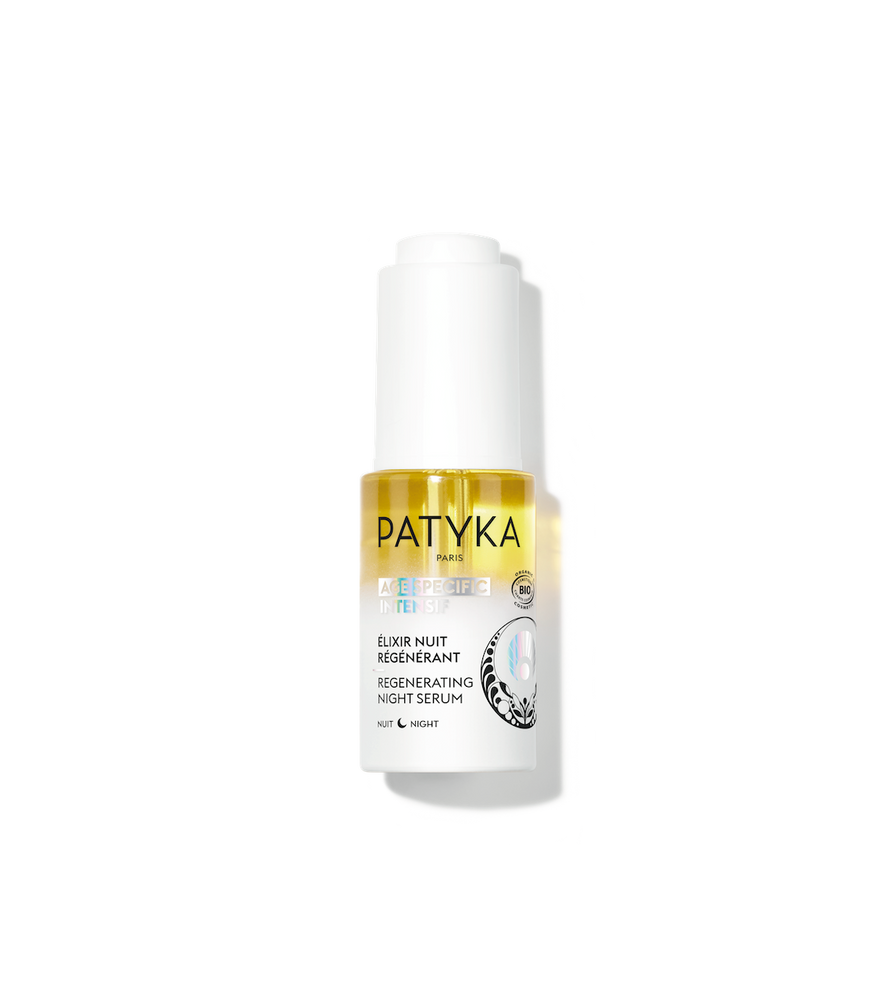

Patyka
REGENERATING NIGHT SERUM

REGENERATING NIGHT SERUM
Patyka
regenerating-night-serum
Serum
9706865262885
Morning or Evening?
How often will you use this product?
Notes


Highlights
WHAT IS IT?
Night serum with 15 anti-aging and relaxing essential and plant oils
FEATURES
100% natural, 99.5% organic, stimulates cell renewal, regenerates and smooths skin
BEST FOR
All skin types
CHECKS
Free of silicones, parabens, polymers, phthalates, PEGs, fatty alcohols, solvents, mineral oils, waxes, synthetic fragrances
Who Is It For?
Adults Women And MenWhat Does It Help With?
Anti-aging Smoothing Wrinkles Skin Regeneration RadianceBudget
PremiumHow To Use
Which routine should it be used in?
Instructions:
Key Information


What Patyka Says
Product Description:
This powerful youth cure, 100% natural and 99.5% organic, stimulates cell renewal during the night to regenerate, smooth, and revive the skin its radiance. Combining 15 anti-aging and relaxing essential and plant oils, it increases tenfold the benefits of sleep on the skin for a deeply restorative night. In the morning, the skin is radiant, smoothed, and rested and the complexion is more radiant.
About the Brand:
Ingredients Overview
Ingredients List
ROSA CANINA FRUIT OIL, SESAMUM INDICUM SESAME SEED OIL, LIMONENE, CITRUS NOBILIS MANDARIN ORANGE PEEL OIL, TRITICUM VULGARE WHEAT GERM OIL, CITRUS AURANTIUM BERGAMIA PEEL OIL CITRUS AURANTIUM AMARA BITTER ORANGE PEEL OIL , PELARGONIUM GRAVEOLENS FLOWER OIL, CITRUS LIMON LEMON PEEL OIL, LINALOOL, CITRUS AURANTIFOLIA LIME OIL, SALVIA SCLAREA CLARY OIL, CITRONELLOL, MENTHA ARVENSIS PIPERASCENS HERB OIL, LAVANDULA ANGUSTIFOLIA LAVENDER OIL, MENTHA VIRIDIS SPEARMINT LEAF OIL, GERANIOL, CITRAL, CISTUS LADANIFERUS OIL, SANTALUM AUSTROCALEDONICUM WOOD OIL, CITRUS AURANTIUM AMARA BITTER ORANGE FLOWER OIL
Key Ingredients
Rosa Canina Fruit Oil, Sesamum Indicum Sesame Seed Oil, Citrus Nobilis Mandarin Orange Peel Oil, Triticum Vulgare Wheat Germ Oil
Ingredients Details
Citrus Aurantium Bergamia Peel Oil
Common Name(s): Botanical extract,polyphenol antioxidant,anti-inflammatory plant active
CAS Number: N/a
DESCRIPTION
What It Does: Provides botanical polyphenol antioxidant and anti-inflammatory activity.
Why It's Used: Botanical plant active — plant secondary metabolites accumulated through evolutionary stress adaptation provide high-density antioxidant and anti-inflammatory activity for cosmetic skin protection and conditioning.
How It Works: Plant extraction. secondary metabolites: polyphenols, terpenoids, alkaloids. antioxidant: radical scavenging. anti-inflammatory: nf-kb or cox pathway. traditional use. skin conditioning. cosmos conditional from sustainable sourcing.
Typically Found In: Botanical antioxidant skin care
TECHNICAL DETAILS
Primary Category: Active ingredient – antioxidant
Secondary Functions: Free radical scavenging,anti-aging
Application Areas:

Facial Skincare
Body Care

Hair Care
Beard Care
Color Cosmetics (Makeup)
Dietary/Oral Supplements
Typical Concentration Range: 0.1%–10%
SOURCING & ETHICS
Vegan Status: Yes
Halal Status: Yes
Source Notes: Plant-derived extract or synthetic.
SKIN COMPATIBILITY
Irritancy Rating: 1/5 – very low
Comedogenicity Rating: 0/5 – non-comedogenic
Sensitivity Concerns: Non-irritating; well-tolerated.
Safe for Sensitive Skin: Yes
SAFETY & COMPATIBILITY
Safety Profile: Excellent safety profile. ewg score: 1.
Works Well With: Vitamin c,vitamin e,ferulic acid,spf,other antioxidants
Avoid Combining With: No significant incompatibilities
SCIENTIFIC NOTE
Plant secondary metabolite cosmetic value: plants evolved high-concentration antioxidants (flavonoids, terpenes, phenolic acids) as uv photoprotection and pathogen defence. these same antioxidant mechanisms that protect plant cells in uv-stressed environments provide equivalent radical-scavenging photoprotective activity on human skin — evolutionary stress adaptation directly translating to cosmetic antioxidant functionality.
Last Verified: 2026-03-12
Primary Sources: Cosing database,botanical extract antioxidant review
Citrus Limon Lemon Peel Oil
Common Name(s): Citrus limon lemon peel oil oil
DESCRIPTION
What It Does: Nourishes and softens skin through its balanced fatty acid profile, while antioxidant compounds protect against oxidative skin damage.
Why It's Used: Plant oils provide physiologically compatible lipid structures that integrate into the skin barrier and deliver fat-soluble antioxidants directly to skin cells.
How It Works: Fatty acids integrate into stratum corneum lipid lamellae, reinforcing the lipid barrier. antioxidants (tocopherols, carotenoids, polyphenols) neutralize ros through electron donation or singlet oxygen quenching.
Typically Found In: Face oils,serums,moisturizers,hair treatments,body oils
TECHNICAL DETAILS
Primary Category: Plant oils
Secondary Functions: Emollient,antioxidant
Application Areas:
Facial Skincare
Body Care
Hair Care
Beard Care
Color Cosmetics (Makeup)
Dietary/Oral Supplements
Typical Concentration Range: 0.5–30%
SOURCING & ETHICS
Vegan Status: Yes
Halal Status: Yes
Source Notes: Cold-pressed or solvent-extracted plant oil; no animal components.
SKIN COMPATIBILITY
Irritancy Rating: 1899-12-31 00:00:00 -0800
Comedogenicity Rating: 2000-01-01 00:00:00 -0800
Sensitivity Concerns: Low sensitization potential at recommended use concentrations.
Safe for Sensitive Skin: Yes
SAFETY & COMPATIBILITY
Safety Profile: Well-characterized cosmetic ingredient with established safety profile. generally non-irritating at typical use concentrations. suitable for leave-on and rinse-off cosmetics.
Works Well With: Vitamin e,ceramides,other plant oils,squalane
Avoid Combining With: Strong oxidizers (accelerate rancidity)
SCIENTIFIC NOTE
Vegetable oils are triglyceride matrices where the fatty acid composition determines skin compatibility, barrier function, and comedogenicity. oleic acid-rich oils (>60%) soften barrier lipids and enhance penetration; linoleic acid-rich oils reinforce ceramide-poor stratum corneum; saturated fatty acid-rich oils provide occlusion without skin penetration.
Last Verified: 2025-01-15
Primary Sources: Cosing eu database; pcpc cosmetic ingredient safety reviews; aocs plant oil composition databases; fatty acid pharmacology reviews
Limonene
Common Name(s): D-limonene,(r)-limonene,dipentene
CAS Number: 5989-27-5
DESCRIPTION
What It Does: Provides the defining fresh citrus fragrance note alongside solvent and antimicrobial properties.
Why It's Used: The citrus industry's primary fragrance compound and the most abundant terpene in essential oils – limonene provides the clean, universally appealing fresh citrus scent character.
How It Works: D-limonene activates trpv1 mildly at high concentrations. antimicrobial via membrane disruption. solvent for oils and lipophilic compounds. cleaning via emulsification of lipid soils.
Typically Found In: Citrus-scented products,cleaning products,fragrance compounds
TECHNICAL DETAILS
Primary Category: Fragrance component – cyclic monoterpene
Secondary Functions: Skin conditioning
Application Areas:
Facial Skincare
Body Care
Hair Care
Beard Care
Color Cosmetics (Makeup)
Dietary/Oral Supplements
Typical Concentration Range: 0.001%–3%
SOURCING & ETHICS
Vegan Status: Conditional - supplier confirmation required
Halal Status: Unverified - supplier confirmation required
Source Notes: Commercially produced for cosmetic use. verify vegan/halal status with supplier. [audit 2026-07-29 rev2: the record's own source_notes does not assert a non-animal origin, or instructs the reader to verify with the supplier; "yes" asserts knowledge the record does not hold. determination requires shariah-panel sign-off.]
SKIN COMPATIBILITY
Irritancy Rating: 1/5 – very low
Comedogenicity Rating: 0/5 – non-comedogenic
Sensitivity Concerns: Well-tolerated by most skin types.
Safe for Sensitive Skin: Yes
SAFETY & COMPATIBILITY
Safety Profile: Eu cosmetics regulation: declared fragrance allergen. oxidises to sensitising compounds (limonene hydroperoxides) on air exposure – use with antioxidant stabilisers. ifra guidelines apply.
Works Well With: Standard skincare actives
Avoid Combining With: No known significant incompatibilities
SCIENTIFIC NOTE
Limonene's sensitisation risk arises not from limonene itself but from its autooxidation products (limonene-1,2-epoxide and limonene hydroperoxides) formed on air exposure. fresh limonene has low sensitisation potential, but air-oxidised limonene's hydroperoxide products are potent skin sensitisers. this explains why oxidation-stabilised formulations (with bht or other antioxidants) are required to manage limonene safety.
Last Verified: 2026-03-12
Primary Sources: Cosing database,ifra standards,bråred christensson et al. limonene oxidation study
Linalool
Common Name(s): 3,7-dimethyl-1,6-octadien-3-ol,linalyl alcohol
CAS Number: 78-70-6
DESCRIPTION
What It Does: Provides the most common natural floral-citrus fragrance note with additional anti-inflammatory properties.
Why It's Used: The most abundant fragrance terpene in nature – linalool forms the primary scent character of lavender, responsible for lavender's documented aromatherapy calming effects.
How It Works: Monoterpene alcohol activates gaba-a receptors for anti-anxiety activity (same receptor as benzodiazepines). inhibits glutamate-induced excitotoxicity. antimicrobial via membrane disruption. anti-inflammatory via nf-kb inhibition.
Typically Found In: Virtually all fragranced cosmetics
TECHNICAL DETAILS
Primary Category: Fragrance component – tertiary terpene alcohol
Secondary Functions: Skin conditioning
Application Areas:
Facial Skincare
Body Care
Hair Care
Beard Care
Color Cosmetics (Makeup)
Dietary/Oral Supplements
Typical Concentration Range: 0.001%–3%
SOURCING & ETHICS
Vegan Status: Conditional - supplier confirmation required
Halal Status: Unverified - supplier confirmation required
Source Notes: Commercially produced for cosmetic use. verify vegan/halal status with supplier. [audit 2026-07-29 rev2: the record's own source_notes does not assert a non-animal origin, or instructs the reader to verify with the supplier; "yes" asserts knowledge the record does not hold. determination requires shariah-panel sign-off.]
SKIN COMPATIBILITY
Irritancy Rating: 1/5 – very low
Comedogenicity Rating: 0/5 – non-comedogenic
Sensitivity Concerns: Well-tolerated by most skin types.
Safe for Sensitive Skin: Yes
SAFETY & COMPATIBILITY
Safety Profile: Eu cosmetics regulation: declared fragrance allergen on label when >0.001% (leave-on) or >0.01% (rinse-off). ifra guidelines apply.
Works Well With: Standard skincare actives
Avoid Combining With: No known significant incompatibilities
SCIENTIFIC NOTE
Linalool's gaba-a receptor activation provides a pharmacological basis for lavender aromatherapy's documented anxiolytic effects. the same receptor modulation used by benzodiazepine drugs (such as diazepam) is activated by inhaled linalool vapor, providing receptor-mediated calming without the tolerance and dependence associated with pharmaceutical gaba-a modulators.
Last Verified: 2026-03-12
Primary Sources: Cosing database,ifra standards,elisabetsky et al. linalool gaba study