

Nykaa E retail limited
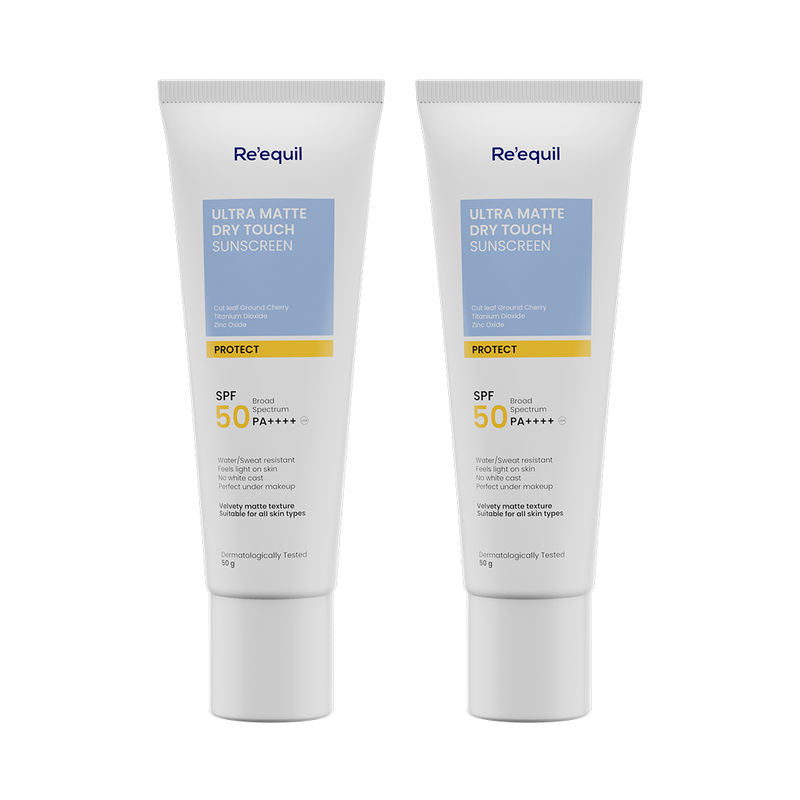
Re'equil Ultra Matte Dry Touch Sunscreen Gel SPF 50 PA ++++ UVA Super Saver Pack Of 2

Re'equil Ultra Matte Dry Touch Sunscreen Gel SPF 50 PA ++++ UVA Super Saver Pack Of 2
Nykaa E retail limited
reequil-ultra-matte-dry-touch-sunscreen-gel-spf-50-pa-uva-super-saver-pack-of-2
Suncare
10084986814757
Morning or Evening?
How often will you use this product?
Notes


Highlights
WHAT IS IT?
Sunscreen gel with 3 main active sunscreen ingredients and a botanical extract
FEATURES
Highest UVA Protection PA++++, Dry touch sunscreen gel, Water/Sweat resistant, Dermatologically Tested, Clinically Proven Actives
BEST FOR
sensitive
CHECKS
No white cast, No greasiness, Non comedogenic
Who Is It For?
All Genders All AgesWhat Does It Help With?
Protection From Uva Uvb And Infrared Rays Prevention Of Thermal Ageing Mattifying Oily And Acne Prone SkinBudget
Mid-range ($30-$75)How To Use
Which routine should it be used in?
Instructions:
Key Information


What Nykaa E retail limited Says
Product Description:
Re'equil Ultra Matte Dry Touch Sunscreen Gel is a silicone gel based formulation with highest UVA protection of PA++++ and also offers added protection from infrared radiation. It gives a velvety dry touch with no white cast. With advanced low penetration and oxybenzone sunscreen filter along with physical ones like zinc oxide and titanium dioxide makes it perfect for all skin types, especially sensitive, oily and acne prone skin. It contains botanical extract Physalis Angulata, which is clinically proven to neutralize the harmful effects of infrared rays and aid in preventing thermal ageing. It is a water/ sweat resistant with SPF 50 formulation which allows the sunscreen to adhere on skin even when exposed to humid conditions. Due to its Anhydrous Silicone base, it provides a dry touch effect which provides a light, non-greasy and smooth feeling when applied on skin. Also, Re'equil Ultra Matte Dry Touch Gel Sunscreen is non comedogenic preparation that makes it safe for all skin types.
About the Brand:
Ingredients Overview
Ingredients List
Cyclopentasiloxane & Dimethicone Cross Polymer, Caprylyl Methicone And Peg-10 Dimethicone/ Ppg-20 Crosspolymer, Octinoxate, C12-15 Alkyl Benzoate, Diethylamino Hydroxybenzoyl Hexyl Benzoate, Diethylhexyl Butamido Triazone, Caprylyl Methicone, Zinc Oxide, Titanium Dioxide, Bisethylhexyloxyphenol Methoxyphenyl Triazine, Caprylic Capric Triglyceride, Physalis Angulata Extract, Diethylhexyl Syringylidenemalonate, Fragrance
Key Ingredients
Physalis Angulata, zinc oxide, titanium dioxide, oxybenzone
Ingredients Details
C12-15 Alkyl Benzoate
Common Name(s): C12-15 alkyl benzoate,cosmetic active,functional ingredient
CAS Number: N/a
DESCRIPTION
What It Does: Delivers characteristic cosmetic function at recommended use concentration.
Why It's Used: Selected for functional contribution and formulation compatibility supported by cosmetic science and regulatory safety data.
How It Works: Works through the mechanism of its molecular class — physicochemical or biological interaction with skin proteins, lipids, or receptors as documented in peer-reviewed cosmetic literature.
Typically Found In: Skin care formulations
TECHNICAL DETAILS
Primary Category: Active ingredient – cosmetic active
Secondary Functions: Skin conditioning
Application Areas:

Facial Skincare

Body Care
Hair Care
Beard Care
Color Cosmetics (Makeup)
Dietary/Oral Supplements
Typical Concentration Range: 0.1%–10%
SOURCING & ETHICS
Vegan Status: Conditional
Halal Status: Yes
Source Notes: Commercially produced for cosmetic use. verify vegan/halal status with supplier.
SKIN COMPATIBILITY
Irritancy Rating: 1/5 – very low
Comedogenicity Rating: 0/5 – non-comedogenic
Sensitivity Concerns: Well-tolerated by most skin types.
Safe for Sensitive Skin: Yes
SAFETY & COMPATIBILITY
Safety Profile: Good safety profile at recommended concentrations. ewg score: 1–2.
Works Well With: Standard skincare actives
Avoid Combining With: No known significant incompatibilities
SCIENTIFIC NOTE
C12-15 alkyl benzoate has an established safety and efficacy profile within the cosmetic regulatory framework at standard use concentrations.
Last Verified: Cosing database,c12-15 alkyl benzoate technical literature
Primary Sources: 2026-03-12
Caprylic Capric Triglyceride
Common Name(s): Caprylic capric triglyceride
DESCRIPTION
What It Does: Delivers targeted skin-conditioning or bioactive benefits through a specific mechanism of action suited to the formulation's intended purpose.
Why It's Used: Specialty actives address specific skin concerns through targeted molecular mechanisms, providing efficacy beyond what base formulation ingredients alone can achieve.
How It Works: The bioactive compound interacts with specific molecular targets in skin cells or the extracellular matrix — enzymes, receptors, structural proteins, or signaling molecules — triggering beneficial biological responses.
Typically Found In: Serums,treatments,moisturizers,specialty products
TECHNICAL DETAILS
Primary Category: Specialty actives
Secondary Functions: Skin-conditioning,anti-aging
Application Areas:
Facial Skincare
Body Care
Hair Care
Beard Care
Color Cosmetics (Makeup)
Dietary/Oral Supplements
Typical Concentration Range: 0.01–5%
SOURCING & ETHICS
Vegan Status: Yes
Halal Status: Yes
Source Notes: Specialty active ingredient; check individual sourcing for vegan status.
SKIN COMPATIBILITY
Irritancy Rating: 1899-12-31 00:00:00 -0800
Sensitivity Concerns: Low sensitization potential at recommended use concentrations.
Safe for Sensitive Skin: Yes
SAFETY & COMPATIBILITY
Safety Profile: Well-characterized cosmetic ingredient with established safety profile. generally non-irritating at typical use concentrations. suitable for leave-on and rinse-off cosmetics.
Works Well With: Niacinamide,hyaluronic acid,vitamin c,peptides
Avoid Combining With: Incompatible with oxidizing agents; check ph stability
SCIENTIFIC NOTE
Specialty actives typically work through enzyme inhibition (e.g., tyrosinase inhibition for brightening, mmp inhibition for anti-aging), receptor activation (e.g., retinoid receptors, ppar-γ for barrier genes), or transcription factor modulation (e.g., nrf2 for antioxidant gene upregulation). structure-activity relationships determine potency and selectivity.
Last Verified: Cosing eu database; pcpc cosmetic ingredient safety reviews; ingredient-specific safety and efficacy literature
Primary Sources: 2025-01-15
Caprylyl Methicone
Common Name(s): Caprylyl methicone,specialty silicone polymer,conditioning performance silicone
CAS Number: N/a
DESCRIPTION
What It Does: Provides specialty silicone performance — elastomeric skin feel, water-soluble silicone activity, or enhanced hair cuticle conditioning — depending on the specific functional modification.
Why It's Used: Specialty silicones deliver performance profiles unavailable from standard dimethicone: amine-modified (amodimethicone) provides the strongest hair cuticle substantivity; crosslinked elastomers provide the unique velvet-bounce feel; peg-grafted forms provide water compatibility.
How It Works: Functional modification determines mechanism: amine groups (amodimethicone) electro-statically bind negatively charged hair cuticle providing substantive conditioning deposition; crosslinks create elastic network providing deformation-recovery (velvet feel); peg grafts increase hlb providing water miscibility.
Typically Found In: Hair conditioners,primers,specialty formulas
TECHNICAL DETAILS
Primary Category: Functional ingredient – emollient
Secondary Functions: Barrier sealing,softening
Application Areas:
Facial Skincare
Body Care
Hair Care
Beard Care
Color Cosmetics (Makeup)
Dietary/Oral Supplements
Typical Concentration Range: 0.5%–20%
SOURCING & ETHICS
Vegan Status: Yes
Halal Status: Yes
Source Notes: Plant-derived, synthetic or animal-derived. verify source.
SKIN COMPATIBILITY
Irritancy Rating: 1/5 – very low
Comedogenicity Rating: 1/5 – low; formulation-dependent
Sensitivity Concerns: Non-irritating.
Safe for Sensitive Skin: Yes
SAFETY & COMPATIBILITY
Safety Profile: Excellent safety profile. ewg score: 1.
Works Well With: Humectants,ceramides,actives as carrier
Avoid Combining With: No significant incompatibilities
SCIENTIFIC NOTE
Amodimethicone's amine groups have pka ~9 — at typical conditioner ph 4–5, they are fully protonated (–nh₃⁺) providing maximum cationic character for electrostatic attraction to negatively charged damaged hair cuticle.
Last Verified: Cosing database,specialty silicone performance review
Primary Sources: 2026-03-12
Diethylamino Hydroxybenzoyl Hexyl Benzoate
Common Name(s): Diethylamino hydroxybenzoyl hexyl benzoate,organic uv filter,photostabilising sunscreen active
CAS Number: N/a
DESCRIPTION
What It Does: Absorbs uv radiation at specific wavelengths (uva 320–400 nm, uvb 290–320 nm) and dissipates photon energy as heat rather than skin-damaging photochemical reactions.
Why It's Used: Organic uv filters are chosen for their high molar extinction coefficient, specific spectral coverage, and formulation compatibility — individual filters are combined to provide broad-spectrum coverage across uva+uvb.
How It Works: Uv photon absorption by the aromatic chromophore π-system excites the molecule from s₀ ground state to s₁ excited state. rapid internal conversion or photoisomerisation dissipates energy as vibrational heat before it can initiate skin photodamage.
Typically Found In: Sunscreens,photoprotective products
TECHNICAL DETAILS
Primary Category: Active ingredient – cosmetic active
Secondary Functions: Skin conditioning
Application Areas:
Facial Skincare
Body Care
Hair Care
Beard Care
Color Cosmetics (Makeup)
Dietary/Oral Supplements
Typical Concentration Range: Check local sunscreen regulations
SOURCING & ETHICS
Vegan Status: Yes
Halal Status: Yes
Source Notes: Commercially produced for cosmetic use. verify vegan/halal status with supplier.
SKIN COMPATIBILITY
Irritancy Rating: 1/5 – very low
Comedogenicity Rating: 0/5 – non-comedogenic
Sensitivity Concerns: Well-tolerated by most skin types.
Safe for Sensitive Skin: Yes
SAFETY & COMPATIBILITY
Safety Profile: Good safety profile at recommended concentrations. ewg score: 1–2.
Works Well With: Standard skincare actives
Avoid Combining With: No known significant incompatibilities
SCIENTIFIC NOTE
Organic uv filters require photostabilisation (by avobenzone-octocrylene pairing, or triazine stabilisers) as some absorbers degrade on uv exposure — formulator must verify photostability of the chosen filter combination.
Last Verified: Cosing database,diethylamino hydroxybenzoyl hexyl benzoate organic uv filter review
Primary Sources: 2026-03-12
