
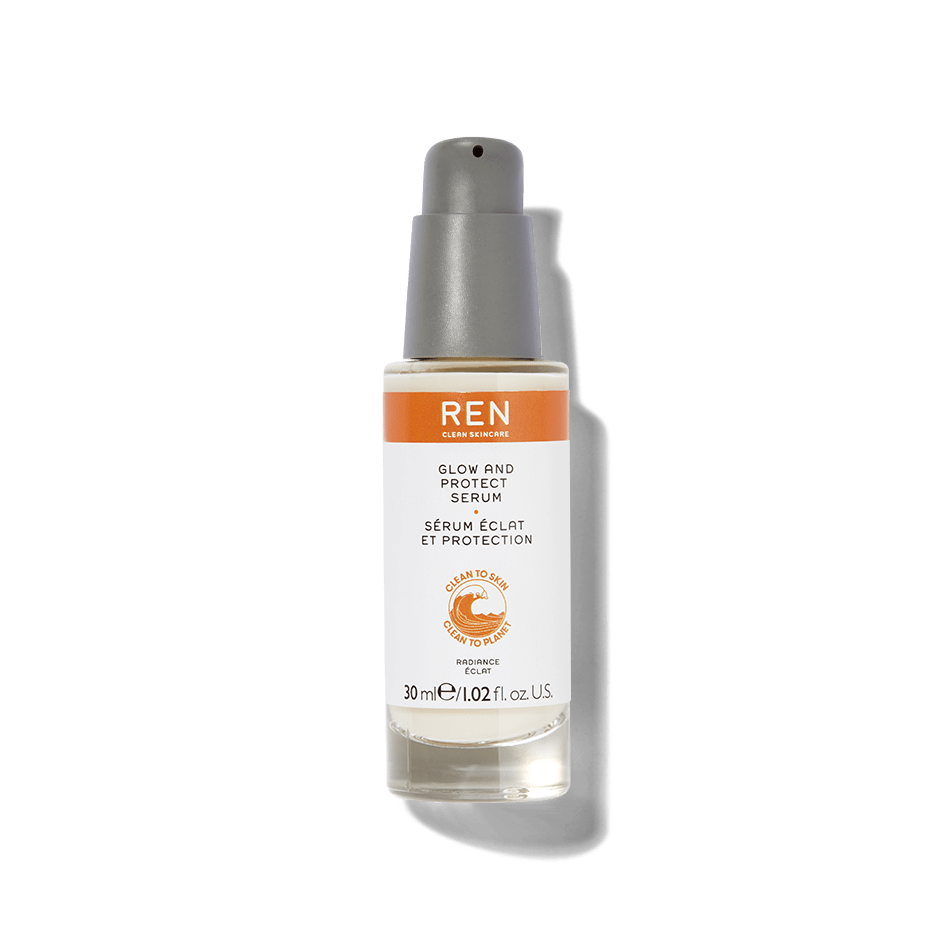

REN Clean Skincare
Radiance Glow And Protect Vitamin C Serum

Radiance Glow And Protect Vitamin C Serum
REN Clean Skincare
radiance-glow-and-protect-vitamin-c-serum
Serum
9706856579365
Morning or Evening?
How often will you use this product?
Notes


Highlights
WHAT IS IT?
Vitamin C serum
FEATURES
Brightens and evens skin tone, Protects against free radical damage, Reduces signs of photoaging, Hydrates skin
BEST FOR
All skin types including sensitive skin
CHECKS
Clean beauty, free of synthetic fragrances or colors, silicones, sulfates, PEGs, parabens, urea, TEA/DEA
Who Is It For?
Adults Women And MenWhat Does It Help With?
Dullness Uneven Skin Tone Fine Lines And Wrinkles PigmentationBudget
Mid-rangeHow To Use
Which routine should it be used in?
Instructions:
Key Information


What REN Clean Skincare Says
Product Description:
A lightweight superfruit serum clinically proven to significantly brighten and even skin in just 14 days, with protective antioxidants to help protect skin from damage caused by free radicals. Proven to visibly reduce the signs of photoaging, such as fine lines and wrinkles, dullness and pigmentation, whilst still being formulated to limit irritation, the energizing formula combines three types of Vitamin C with moisture-boosting Glycogen and Hyaluronic Acid, for the ultimate radiant glow. Enriched with a bioactive blend of nature's most powerful ingredients; Kakadu Plum, with 100x more Vitamin C than oranges, helps brighten and even skin tone, Dragon Fruit, packed with prebiotics and essential minerals, helps protect and strengthen the skin's moisture barrier, Pomegranate, rich in Omega 5, helps soothe, and Polyphenols and Vitamin E's antioxidant action helps protect skin from damaged caused by environmental aggressors.
About the Brand:
Ingredients Overview
Ingredients List
Aqua, Glycerin, Cococaprylate/Caprate, Propanediol, Diisooctyl Succinate, Squalane, Sucrose Polystearate, Punica Granatum Seed Oil, Cetearyl Alcohol, Ascorbyl Tetraisopalmitate, Rosa Canina Fruit Oil, Benzyl Alcohol, Helianthus Annuus Seed Oil, Hylocereus Undatus Fruit Extract, Xanthan Gum, Glycogen, Sodium Dehydroacetate, Hydrolyzed Lupine Protein, Sodium Hyaluronate, Sodium Stearoyl Glutamate, Hippophae Rhamnoides Oil, Citric Acid, Olea Europaea Oil Unsaponifiables, Magnesium Ascorbyl Phosphate, Dehydroacetic Acid, Terminalia Ferdinandiana Fruit Extract, Rosmarinus Officinalis Leaf Extract, Parfum, Citrus Aurantium Amara Flower Extract, Linalool, Limonene, Geraniol, Benzoic Acid, Sodium Hydroxide
Key Ingredients
Vitamin C (Ascorbyl Tetraisopalmitate and Magnesium Ascorbyl Phosphate), Glycogen, Hyaluronic Acid, Kakadu Plum (Terminalia Ferdinandiana Fruit Extract), Dragon Fruit (Hylocereus Undatus Fruit Extract), Pomegranate Seed Oil
Ingredients Details
Ascorbyl Tetraisopalmitate
Common Name(s): Atip,vc-ip,vitamin c tetraisopalmitate
CAS Number: 183476-82-6
DESCRIPTION
What It Does: Delivers potent, stable vitamin c deep into skin for antioxidant protection, brightening, and collagen stimulation.
Why It's Used: Premium anti-aging where deep vitamin c penetration and exceptional stability are both required.
How It Works: Four isopalmitate chains facilitate passive diffusion through stratum corneum lipid bilayers. esterases progressively cleave chains releasing ascorbic acid in deeper skin layers.
Typically Found In: Premium serums,oil-based vitamin c,anti-aging oils
TECHNICAL DETAILS
Primary Category: Active ingredient – vitamin c derivative
Secondary Functions: Superior penetration,stable vitamin c
Application Areas:

Facial Skincare

Body Care
Hair Care
Beard Care
Color Cosmetics (Makeup)
Dietary/Oral Supplements
Typical Concentration Range: 0.5%–3%
SOURCING & ETHICS
Vegan Status: Yes – synthetic
Halal Status: Yes
Source Notes: Fully synthetic. produced by esterification of ascorbic acid with isopalmitic acid derivatives.
SKIN COMPATIBILITY
Irritancy Rating: 1/5 – very low
Comedogenicity Rating: 0/5 – non-comedogenic
Sensitivity Concerns: Non-irritating; suitable for all skin types.
Safe for Sensitive Skin: Yes
SAFETY & COMPATIBILITY
Safety Profile: Excellent safety profile. ewg score: 1.
Works Well With: Tocopherol,ferulic acid,niacinamide,spf
Avoid Combining With: No significant incompatibilities
SCIENTIFIC NOTE
Ex vivo penetration studies confirm significantly higher skin penetration depth vs l-ascorbic acid. the four isopalmitate chains facilitate partitioning into the lipid-continuous stratum corneum phase.
Last Verified: ##########
Primary Sources: Cosing database,pinnell vitamin c derivatives review
Cetearyl Alcohol
Common Name(s): Cetostearyl alcohol,c16-18 fatty alcohol
CAS Number: 8005-44-5
DESCRIPTION
What It Does: Provides fatty alcohol emulsification and thickening for stable, well-textured emulsions.
Why It's Used: The most widely used fatty alcohol in cosmetics – provides emulsification, thickening, and emolliency simultaneously from a single ingredient with excellent safety profile.
How It Works: Forms bilayer lamellar structures in water with emulsifiers creating a viscous structured network that thickens and stabilizes emulsions. fatty alcohol emolliency provides direct skin conditioning. bilayer formation reduces inter-droplet coalescence in emulsions.
Typically Found In: Creams,lotions,conditioners – virtually all emulsion products
TECHNICAL DETAILS
Primary Category: Functional ingredient – fatty alcohol emulsifier/thickener
Secondary Functions: Barrier sealing,softening
Application Areas:
Facial Skincare
Body Care
Hair Care
Beard Care
Color Cosmetics (Makeup)
Dietary/Oral Supplements
Typical Concentration Range: 1%–25%
SOURCING & ETHICS
Vegan Status: Yes - standard ethanol routes are non-animal; confirm denaturant origin
Halal Status: Conditional - ethanol production route and residual concentration; jurisdiction-dependent, refer to certifier stance
Source Notes: Plant-derived, synthetic or animal-derived. verify source. [audit 2026-07-29 rev2: ethanol pathway; determination depends on route, on whether the plant also produces beverage alcohol, and on residual concentration. determination requires shariah-panel sign-off.]
SKIN COMPATIBILITY
Irritancy Rating: 1/5 – very low
Comedogenicity Rating: 1/5 – low; formulation-dependent
Sensitivity Concerns: Non-irritating.
Safe for Sensitive Skin: Yes
SAFETY & COMPATIBILITY
Safety Profile: Excellent safety profile. ewg score: 1.
Works Well With: Humectants,ceramides,actives as carrier
Avoid Combining With: No significant incompatibilities
SCIENTIFIC NOTE
Cetearyl alcohol's ability to form lamellar liquid crystal structures ('krafft phases') with water and co-emulsifiers provides not only emulsion stability but also enhanced skin penetration via the lamellar skin barrier pathway. these crystalline structures can act as a reservoir for active ingredients, slowly releasing them as the lamellar structure melts on skin contact.
Last Verified: 2026-03-12
Primary Sources: Cosing database,cir safety assessment
Cococaprylate Caprate
Common Name(s): Cococaprylate caprate
DESCRIPTION
What It Does: Smooths and softens skin by filling intercorneocyte spaces, reducing friction, and providing a pleasant aesthetic skin feel in formulations.
Why It's Used: Synthetic esters provide tailored aesthetic properties — spreadability, skin feel, volatility, refractive index — that natural oils alone cannot consistently deliver.
How It Works: The ester molecule fills microscopic surface irregularities between corneocytes, reducing coefficient of friction, reflecting light uniformly, and providing a lubrication layer that protects the skin surface.
Typically Found In: Moisturizers,sunscreens,color cosmetics,body lotions,lip products
TECHNICAL DETAILS
Primary Category: Synthetic emollients
Secondary Functions: Emollient
Application Areas:
Facial Skincare
Body Care
Hair Care
Beard Care
Color Cosmetics (Makeup)
Dietary/Oral Supplements
Typical Concentration Range: 1–20%
SOURCING & ETHICS
Vegan Status: Conditional - feedstock declaration required
Halal Status: Unverified - feedstock declaration required (plant, animal and petrochemical routes all exist)
Source Notes: Synthetically produced ester emollient; no animal components. [audit 2026-07-29 rev2: origin-dependent: the same inci exists in plant, animal and petrochemical versions and the name does not discriminate. determination requires shariah-panel sign-off.]
SKIN COMPATIBILITY
Irritancy Rating: 1899-12-31 00:00:00 -0800
Comedogenicity Rating: 1899-12-31 00:00:00 -0800
Sensitivity Concerns: Low sensitization potential at recommended use concentrations.
Safe for Sensitive Skin: Yes
SAFETY & COMPATIBILITY
Safety Profile: Well-characterized cosmetic ingredient with established safety profile. generally non-irritating at typical use concentrations. suitable for leave-on and rinse-off cosmetics.
Works Well With: Silicones,uv filters,other emollients
Avoid Combining With: Strongly alkaline conditions (risk of saponification of ester-type emollients)
SCIENTIFIC NOTE
The spreading coefficient of an emollient is governed by its surface tension, viscosity, and polarity. esters with branched alkyl chains (e.g., isopropyl, isostearyl) spread rapidly and leave a non-tacky film; linear long-chain esters provide more substantive moisturization. hlb value determines the preferred formulation system (w/o vs o/w emulsions).
Last Verified: 2025-01-15
Primary Sources: Cosing eu database; pcpc cosmetic ingredient safety reviews; ingredient-specific safety and efficacy literature
Diisooctyl Succinate
Common Name(s): Diisooctyl succinate,cosmetic active,functional ingredient
CAS Number: N/a
DESCRIPTION
What It Does: Delivers characteristic cosmetic function at recommended use concentration.
Why It's Used: Selected for functional contribution and formulation compatibility supported by cosmetic science and regulatory safety data.
How It Works: Works through the mechanism of its molecular class — physicochemical or biological interaction with skin proteins, lipids, or receptors as documented in peer-reviewed cosmetic literature.
Typically Found In: Skin care formulations
TECHNICAL DETAILS
Primary Category: Active ingredient – cosmetic active
Secondary Functions: Skin conditioning
Application Areas:
Facial Skincare
Body Care
Hair Care
Beard Care
Color Cosmetics (Makeup)
Dietary/Oral Supplements
Typical Concentration Range: 0.1%–10%
SOURCING & ETHICS
Vegan Status: Conditional - supplier confirmation required
Halal Status: Unverified - supplier confirmation required
Source Notes: Commercially produced for cosmetic use. verify vegan/halal status with supplier. [audit 2026-07-29 rev2: the record's own source_notes does not assert a non-animal origin, or instructs the reader to verify with the supplier; "yes" asserts knowledge the record does not hold. determination requires shariah-panel sign-off.]
SKIN COMPATIBILITY
Irritancy Rating: 1/5 – very low
Comedogenicity Rating: 0/5 – non-comedogenic
Sensitivity Concerns: Well-tolerated by most skin types.
Safe for Sensitive Skin: Yes
SAFETY & COMPATIBILITY
Safety Profile: Good safety profile at recommended concentrations. ewg score: 1–2.
Works Well With: Standard skincare actives
Avoid Combining With: No known significant incompatibilities
SCIENTIFIC NOTE
Diisooctyl succinate has an established safety and efficacy profile within the cosmetic regulatory framework at standard use concentrations.
Last Verified: 2026-03-12
Primary Sources: Cosing database,diisooctyl succinate technical literature