

Dermalogica
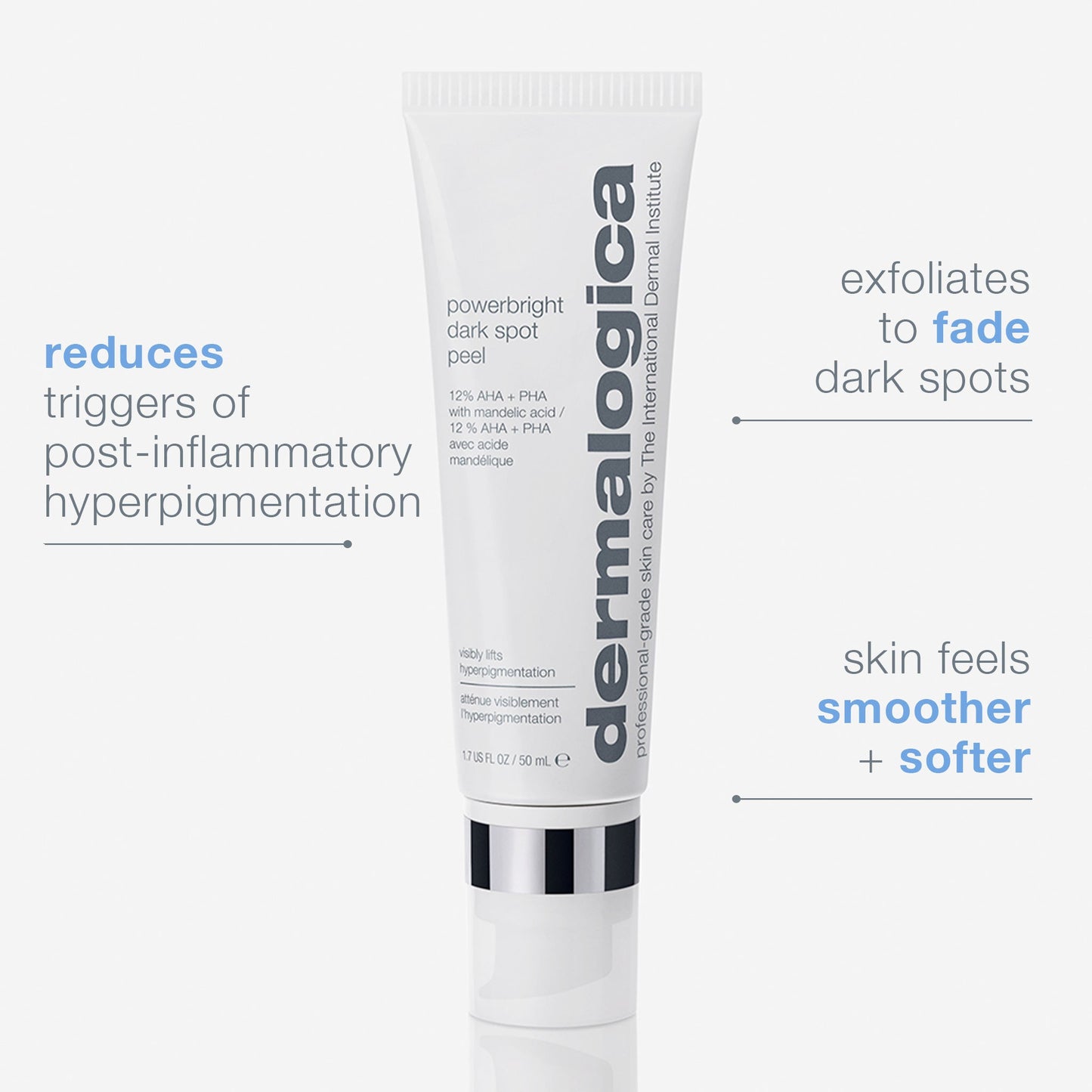
PowerBright Dark Spot Peel

PowerBright Dark Spot Peel
Dermalogica
powerbright-dark-spot-peel
Exfoliation
9784815452453
Morning or Evening?
How often will you use this product?
Notes


Highlights
WHAT IS IT?
Dark spot peel exfoliant
FEATURES
Visibly lift hyperpigmentation
BEST FOR
combination
CHECKS
Paraben-free, artificial colors-free, fragrances-free, gluten-free
Who Is It For?
What Does It Help With?
Uneven Skin ToneBudget
Mid-range ($30-$75)How To Use
Which routine should it be used in?
Instructions:
Key Information


About the Brand:
Ingredients Overview
Ingredients List
Water/Aqua/Eau, Glycerin, Butylene Glycol, Lactobacillus/Pumpkin Fruit Ferment Filtrate, Glycolic Acid, Polysorbate 20, Niacinamide, C12-18 Alkanoyl Glycerin/Sebacic Acid Copolymer, Gluconolactone, Phytic Acid, Mandelic Acid, Butyrospermum Parkii (Shea) Butter, Elaeis Guineensis (Palm) Butter, Sodium Hydroxide, Tetrahydroxypropyl Ethylenediamine, Hectorite, Behenyl Alcohol, Arachidyl Alcohol, Tranexamic Acid, Dipotassium Glycyrrhizate, Simmondsia Chinensis (Jojoba) Seed Oil, Citrus Aurantium Dulcis (Orange) Peel Oil, Citrus Aurantium Bergamia (Bergamot) Fruit Oil, Citrus Limon (Lemon) Peel Oil, Citrus Paradisi (Grapefruit) Peel Oil, Ricinus Communis (Castor) Seed Oil, Zingiber Officinale (Ginger) Root Oil, Lavandula Angustifolia (Lavender) Oil, Jasminum Sambac (Jasmine) Flower Extract, Vanilla Planifolia Fruit, Viola Odorata Leaf Extract, Cocos Nucifera (Coconut) Oil, Leuconostoc/Radish Root Ferment Filtrate, Peat Extract, Juniperus Virginiana Oil, Curcuma Longa (Turmeric) Root Extract, Prunus Amygdalus Dulcis (Sweet Almond) Oil, Isochrysis Galbana Extract, Nannochloropsis Gaditana Extract, Ilex Paraguariensis Leaf Extract, Cucumis Sativus (Cucumber) Seed Oil, Mimosa Tenuiflora Bark Extract, Tocopherol, Squalene, Phosphatidylcholine, Caprylyl Glycol, Lecithin, Glyceryl Stearate, Lauryl Alcohol, Ethoxydiglycol, Arachidyl Glucoside, Palmitic Acid, Myristyl Alcohol, Bisabolol, Polyquaternium-80, Didecyldimonium Chloride, Beta-Sitosterol, Dipteryx Odorata Seed Extract, Xanthan Gum, Methylpropanediol, Cetyl Alcohol, Titanium Dioxide, Tetrasodium Glutamate Diacetate, Citric Acid, Stearic Acid, Hydroxyethyl- cellulose, Cistus Ladaniferus Resin, Styrax Benzoin Resin Extract, Sodium Benzoate, Potassium Sorbate, Limonene
Key Ingredients
12% AHA + PHA Blend with Mandelic Acid, algae derived omega-3 blend, Brightening Niacinamide, Tranexamic Acid, Turmeric Butter Blend
Ingredients Details
Butylene Glycol
Common Name(s): 1,3-butanediol,bg,1,3-butylene glycol
CAS Number: 107-88-0
DESCRIPTION
What It Does: Provides humectant hydration and active ingredient solubilization with excellent skin feel.
Why It's Used: Preferred glycol humectant in premium and k-beauty formulations for superior skin feel vs propylene glycol with equivalent functionality.
How It Works: Two hydroxyl groups at 1,3-positions provide water binding and solvent activity. better tolerated than propylene glycol with minimal sensitization risk. 4-carbon backbone provides slightly greater hydrophobic character enabling dissolution of less polar actives vs pg.
Typically Found In: Toners,essences,serums,k-beauty formulas
TECHNICAL DETAILS
Primary Category: Functional ingredient – glycol humectant
Secondary Functions: Tewl reduction,skin plumping
Application Areas:

Facial Skincare
Body Care
Hair Care

Beard Care
Color Cosmetics (Makeup)
Dietary/Oral Supplements
Typical Concentration Range: 1%–10%
SOURCING & ETHICS
Vegan Status: Yes – synthetic
Halal Status: Yes
Source Notes: Synthetic or naturally derived. excellent aqueous solubility.
SKIN COMPATIBILITY
Irritancy Rating: 1/5 – very low
Comedogenicity Rating: 0/5 – non-comedogenic
Sensitivity Concerns: Non-irritating; suitable for all skin types.
Safe for Sensitive Skin: Yes
SAFETY & COMPATIBILITY
Safety Profile: Excellent safety profile. ewg score: 1.
Works Well With: Ceramides,emollients,occlusives,glycerin,hyaluronic acid
Avoid Combining With: No significant incompatibilities
SCIENTIFIC NOTE
K-beauty's preference for butylene glycol over propylene glycol is driven by two factors: bg's superior skin feel (less tacky than pg's higher viscosity) and its lower sensitization potential (1,3-bg has better spatial distribution of hydroxyl groups that reduces protein interaction vs pg's 1,2-position oh groups).
Last Verified: Cosing database,cir safety assessment
Primary Sources: 2026-03-12
Gluconolactone
Common Name(s): D-gluconolactone,delta-gluconolactone
CAS Number: 90-80-2
DESCRIPTION
What It Does: Provides the gentlest chemical exfoliation with simultaneous antioxidant, moisture retention, and barrier support.
Why It's Used: Preferred exfoliant for rosacea, eczema, sensitive skin, and post-procedure recovery where standard ahas cause unacceptable irritation.
How It Works: Hydrolyzes slowly on skin surface to gluconic acid providing gentle exfoliation. multiple hydroxyl groups enable water binding (humectant) and metal chelation (antioxidant).
Typically Found In: Sensitive skin exfoliants,rosacea treatments,eczema care,post-procedure recovery
TECHNICAL DETAILS
Primary Category: Active ingredient – polyhydroxy acid (pha)
Secondary Functions: Gentle exfoliation,antioxidant,humectant
Application Areas:
Facial Skincare
Body Care
Hair Care
Beard Care
Color Cosmetics (Makeup)
Dietary/Oral Supplements
Typical Concentration Range: 5%–15%
SOURCING & ETHICS
Vegan Status: Yes – fermentation or synthetic
Halal Status: Yes
Source Notes: Fermentation-derived from glucose or synthetic. among the safest chemical exfoliants available.
SKIN COMPATIBILITY
Irritancy Rating: 1/5 – very low
Comedogenicity Rating: 0/5 – non-comedogenic
Sensitivity Concerns: No photosensitization; no stinging; suitable for very sensitive skin.
Safe for Sensitive Skin: Yes – ideal for sensitive, reactive, rosacea, and eczema-prone skin; no photosensitization
SAFETY & COMPATIBILITY
Safety Profile: Exceptional safety profile. no photosensitization. ewg score: 1.
Works Well With: Ceramides,niacinamide,hyaluronic acid,soothing actives
Avoid Combining With: No significant incompatibilities
SCIENTIFIC NOTE
Phas have molecular weights 2–3× larger than ahas, limiting penetration to superficial layers. combined humectant and antioxidant properties make them uniquely well-tolerated while providing meaningful exfoliation.
Last Verified: Cosing database,green & yu (2003) pha review,cir safety assessment
Primary Sources: 2026-03-12
Glycerin
Common Name(s): Glycerol,glycerine,1,2,3-propanetriol
CAS Number: 56-81-5
DESCRIPTION
What It Does: Glycerin pulls water from the environment and deeper skin layers into the outer skin layer (epidermis), boosting moisture levels and keeping skin soft, smooth, and plump.
Why It's Used: It is used in virtually every moisturizer, serum, and cleanser because it is highly effective at hydrating skin, is well-tolerated by all skin types, and enhances the texture and spreadability of formulations.
How It Works: As a humectant, glycerin forms hydrogen bonds with water molecules, trapping them in the skin. it also reinforces the skin barrier by integrating into lipid structures between skin cells.
Typically Found In: Moisturizers,serums,cleansers,toners,sheet masks,sunscreens,body lotions,shampoos,conditioners
TECHNICAL DETAILS
Primary Category: Humectant
Secondary Functions: Skin barrier support,emollient,solvent
Application Areas:
Facial Skincare
Body Care
Hair Care
Beard Care
Color Cosmetics (Makeup)
Dietary/Oral Supplements
Typical Concentration Range: 1%–30% (typical: 3–10%)
SOURCING & ETHICS
Vegan Status: Yes – plant-derived (coconut, soy, palm) or synthetic
Halal Status: Yes – when plant-derived or synthetic; verify source with supplier
Source Notes: Derived from plant oils via hydrolysis or saponification; synthetic versions also available. palm-derived glycerin carries sustainability concerns.
SKIN COMPATIBILITY
Irritancy Rating: 1/5 – very low; non-irritating at all standard concentrations
Comedogenicity Rating: 0/5 – non-comedogenic
Sensitivity Concerns: Extremely rare allergic reactions; generally safe for all skin types including sensitive and baby skin
Safe for Sensitive Skin: Yes
SAFETY & COMPATIBILITY
Safety Profile: Widely recognized as safe. ewg hazard score: 1. no significant concerns for irritation, sensitization, or toxicity at typical concentrations (up to 50%).
Works Well With: Hyaluronic acid,ceramides,niacinamide,panthenol,urea,peptides,retinol,ahas/bhas
Avoid Combining With: No known incompatibilities at standard concentrations
SCIENTIFIC NOTE
Glycerin is an endogenous skin component found naturally in the stratum corneum. aquaporin-3 channels in keratinocytes facilitate glycerin transport, making it integral to natural skin hydration pathways.
Last Verified: Cosing database,cir safety assessment,ewg skin deep,inci decoder
Primary Sources: 2026-03-12
Glycolic Acid
Common Name(s): Hydroxyacetic acid,2-hydroxyacetic acid
CAS Number: 79-14-1
DESCRIPTION
What It Does: Provides maximum aha efficacy from the smallest most penetrating alpha-hydroxy acid.
Why It's Used: The most potent aha — glycolic acid's smallest molecular size provides the deepest penetration and highest efficacy of any alpha-hydroxy acid for exfoliation and anti-aging.
How It Works: Smallest aha (mw 76) provides deepest stratum corneum penetration. disrupts corneodesmosomes reducing cohesion. stimulates fibroblast collagen i and iii synthesis. efficacy is ph-dependent — free acid fraction determines activity.
Typically Found In: Chemical peels,body lotions,anti-aging serums,exfoliating toners
TECHNICAL DETAILS
Primary Category: Active ingredient – primary aha
Secondary Functions: Brightening,collagen stimulation
Application Areas:
Facial Skincare
Body Care
Hair Care
Beard Care
Color Cosmetics (Makeup)
Dietary/Oral Supplements
Typical Concentration Range: 1%–10% cosmetic; higher professional
SOURCING & ETHICS
Vegan Status: Yes – synthetic or fermentation-derived
Halal Status: Yes
Source Notes: Fermentation-derived or synthetic. ph must be ≤4.0 for aha activity.
SKIN COMPATIBILITY
Irritancy Rating: 2/5 – low to moderate
Comedogenicity Rating: 0/5 – non-comedogenic
Sensitivity Concerns: Photosensitizing – mandatory spf use. start at low frequency.
Safe for Sensitive Skin: Use with caution – spf required
SAFETY & COMPATIBILITY
Safety Profile: Eu cosmetics: max 10% leave-on, ph ≥3.5, mandatory sun protection advisory. professional peel concentrations regulated separately.
Works Well With: Niacinamide,ceramides,hyaluronic acid,spf
Avoid Combining With: Retinol in same step; multiple exfoliants simultaneously
SCIENTIFIC NOTE
Glycolic acid's ph-dependent efficacy is critical: at ph 3.0 ~100% is in the free acid (membrane-permeable) form; at ph 3.5 ~70%; at ph 4.0 ~50%. the eu ph ≥3.5 requirement reduces free acid proportion, lowering efficacy but also reducing irritation — why professional peel concentrations at lower ph are far more active than equivalent cosmetic concentrations.
Last Verified: Cosing database,eu aha guidelines,cir safety assessment
Primary Sources: 2026-03-12
