

Dr. Jart+
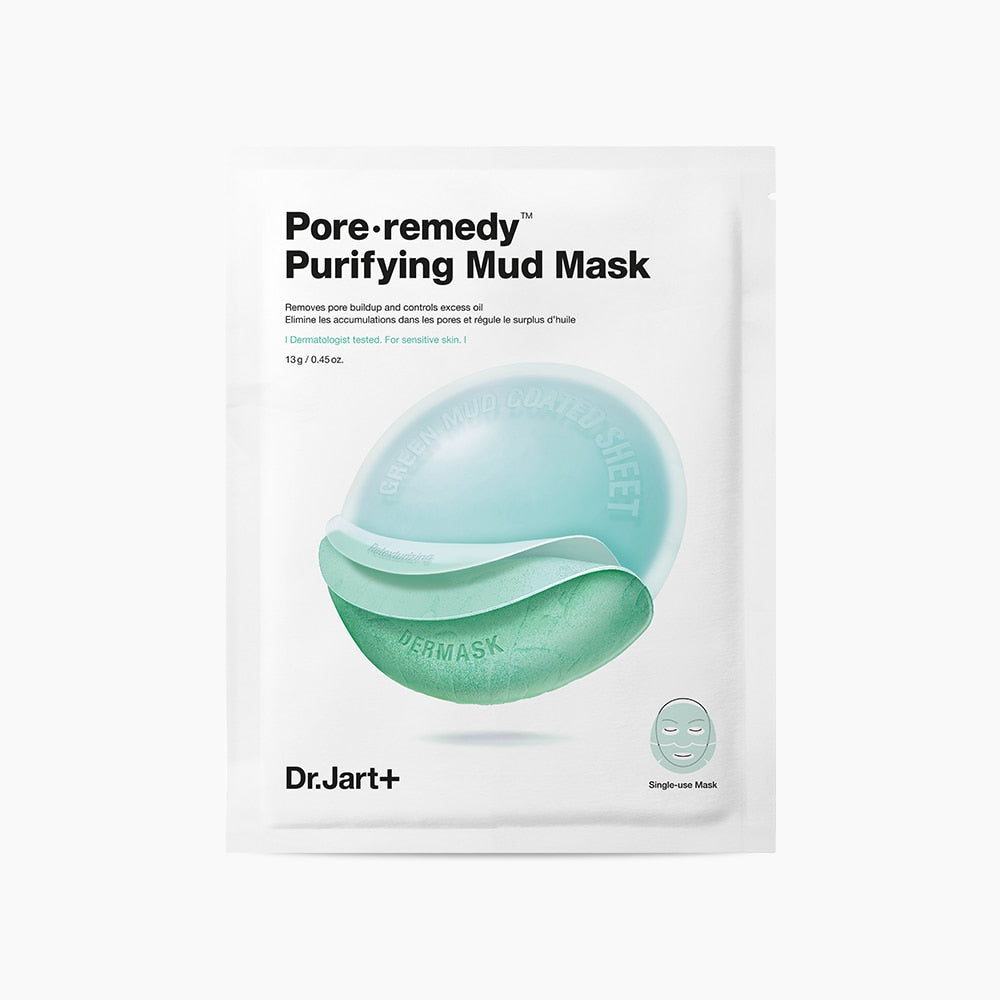
Pore remedy Purifying Mud Face Mask

Pore remedy Purifying Mud Face Mask
Dr. Jart+
pore-remedy-purifying-mud-face-mask
Face Mask
9706786062629
Morning or Evening?
How often will you use this product?
Notes


Highlights
WHAT IS IT?
A green mud-coated sheet mask
FEATURES
Pore-clearing, exfoliating, reduces oil, extracts blackheads, removes dead skin cells, shrinks pores
BEST FOR
Not specifically statedlikely good for oily and combination skin types
CHECKS
Free of synthetic fragrances, parabens, silicones, phthalates, mineral oils, alcohol
Who Is It For?
For Adults (18+) Of All GendersWhat Does It Help With?
Removing Buildup Blackheads Excess Oil; Smoothing Skin Texture; Minimizing PoresBudget
AffordableHow To Use
Which routine should it be used in?
Instructions:
Key Information


What Dr. Jart+ Says
Product Description:
A mess-less green mud-coated sheet mask proven to remove buildup, blackheads and excess oil and smooth skin in a single use, all without dehydrating skin.
About the Brand:
Ingredients Overview
Ingredients List
Water/Aqua/Eau, Kaolin, Butylene Gycol, Bentonite, Polysorbate 80, 1,2-Hexanediol, Magnesium Aluminum Silicate, Sea Salt/Maris Sal/Sel Marin, Montmorillonite, Allantoin, Artemisia Vulgaris (Mugwort) Oil, Gycerin, Ethylhexylglycerin, Arginine, Glyoproteins, Copper Tripeptide-1, Polygylyceryl-10 Laurate, Illite, Stearic Acid, Panthenol, Lecithin, Citric Acid, Myristic Acid, Gluconolactone, Disodium Edta, Sodium Citrate, Tocopherol, Blue 1 (Ci 42090), Yellow 5 (Ci 19140).
Key Ingredients
PHA, Green Mud, Sea Salt
Ingredients Details
12 Hexanediol
Common Name(s): 12 hexanediol
DESCRIPTION
What It Does: Delivers targeted skin-conditioning or bioactive benefits through a specific mechanism of action suited to the formulation's intended purpose.
Why It's Used: Specialty actives address specific skin concerns through targeted molecular mechanisms, providing efficacy beyond what base formulation ingredients alone can achieve.
How It Works: The bioactive compound interacts with specific molecular targets in skin cells or the extracellular matrix — enzymes, receptors, structural proteins, or signaling molecules — triggering beneficial biological responses.
Typically Found In: Serums,treatments,moisturizers,specialty products
TECHNICAL DETAILS
Primary Category: Specialty actives
Secondary Functions: Skin-conditioning,anti-aging
Application Areas:

Facial Skincare

Body Care
Hair Care
Beard Care
Color Cosmetics (Makeup)
Dietary/Oral Supplements
Typical Concentration Range: 0.01–5%
SOURCING & ETHICS
Vegan Status: Yes
Halal Status: Yes
Source Notes: Specialty active ingredient; check individual sourcing for vegan status.
SKIN COMPATIBILITY
Irritancy Rating: 1899-12-31 00:00:00 -0800
Sensitivity Concerns: Low sensitization potential at recommended use concentrations.
Safe for Sensitive Skin: Yes
SAFETY & COMPATIBILITY
Safety Profile: Well-characterized cosmetic ingredient with established safety profile. generally non-irritating at typical use concentrations. suitable for leave-on and rinse-off cosmetics.
Works Well With: Niacinamide,hyaluronic acid,vitamin c,peptides
Avoid Combining With: Incompatible with oxidizing agents; check ph stability
SCIENTIFIC NOTE
Specialty actives typically work through enzyme inhibition (e.g., tyrosinase inhibition for brightening, mmp inhibition for anti-aging), receptor activation (e.g., retinoid receptors, ppar-γ for barrier genes), or transcription factor modulation (e.g., nrf2 for antioxidant gene upregulation). structure-activity relationships determine potency and selectivity.
Last Verified: Cosing eu database; pcpc cosmetic ingredient safety reviews; ingredient-specific safety and efficacy literature
Primary Sources: 2025-01-15
Allantoin
Common Name(s): 5-ureidohydantoin,glyoxyldiureide,aluminum dihydroxy allantoinate
CAS Number: 97-59-6
DESCRIPTION
What It Does: Soothes irritation, accelerates wound healing, promotes skin cell renewal, and provides mild keratolytic exfoliation.
Why It's Used: Gold standard multi-function soothing active – one of the most widely used cosmetic ingredients across all product types for its exceptional tolerability and clinically proven multi-action skin conditioning.
How It Works: Promotes keratinocyte proliferation and fibroblast migration for wound healing. mild keratolytic activity by disrupting corneocyte binding. anti-irritant via direct protein binding and anti-inflammatory cytokine reduction. humectant activity via hydroxyl groups.
Typically Found In: Post-procedure products,sensitive skin formulas,wound care,anti-acne treatments,baby products
TECHNICAL DETAILS
Primary Category: Active ingredient – soothing / anti-inflammatory
Secondary Functions: Wound healing,keratolytic,anti-irritant
Application Areas:
Facial Skincare
Body Care
Hair Care
Beard Care
Color Cosmetics (Makeup)
Dietary/Oral Supplements
Typical Concentration Range: 0.1%–2%
SOURCING & ETHICS
Vegan Status: Yes – synthetic or comfrey-derived
Halal Status: Yes
Source Notes: Plant-derived extract or synthetic.
SKIN COMPATIBILITY
Irritancy Rating: 1/5 – very low
Comedogenicity Rating: 0/5 – non-comedogenic
Sensitivity Concerns: Exceptionally well-tolerated; suitable for all skin types including baby and compromised skin.
Safe for Sensitive Skin: Yes – particularly recommended for sensitive skin
SAFETY & COMPATIBILITY
Safety Profile: Excellent safety profile. ewg score: 1.
Works Well With: Ceramides,panthenol,allantoin,hyaluronic acid,centella asiatica
Avoid Combining With: No significant incompatibilities
SCIENTIFIC NOTE
Allantoin's keratinocyte proliferation stimulation occurs via receptor-mediated signaling (possibly machr activation) rather than non-specific irritation-driven proliferation, making it a true wound-healing stimulant rather than a pro-inflammatory proliferative signal.
Last Verified: Cosing database,cir safety assessment,araújo et al. allantoin review
Primary Sources: 2026-03-12
Bentonite
Common Name(s): Montmorillonite,volcanic ash clay,swelling clay
CAS Number: 1302-78-9
DESCRIPTION
What It Does: Provides thixotropic clay gellation and deep oil absorption from swelling smectite clay.
Why It's Used: Strongest adsorbing clay for deep cleansing masks – bentonite's high cation exchange capacity and swelling capacity provide the deepest oil and toxin adsorption of common cosmetic clays.
How It Works: Montmorillonite 2:1 layered silicate swells up to 15× in water via interlayer water absorption. very high cation exchange capacity (cec: 80-150 meq/100g) provides exceptional adsorption of cations, oils, and toxins. thixotropic gel provides 'mask that hardens' sensory experience.
Typically Found In: Clay masks,deep cleansing products,detoxifying formulas
TECHNICAL DETAILS
Primary Category: Functional ingredient – swelling clay mineral
Secondary Functions: Skin conditioning
Application Areas:
Facial Skincare
Body Care
Hair Care
Beard Care
Color Cosmetics (Makeup)
Dietary/Oral Supplements
Typical Concentration Range: 1%–25%
SOURCING & ETHICS
Vegan Status: Yes – natural mineral
Halal Status: Yes
Source Notes: Commercially produced for cosmetic use. verify vegan/halal status with supplier.
SKIN COMPATIBILITY
Irritancy Rating: 1/5 – very low
Comedogenicity Rating: 0/5 – non-comedogenic
Sensitivity Concerns: Well-tolerated by most skin types.
Safe for Sensitive Skin: Yes
SAFETY & COMPATIBILITY
Safety Profile: Good safety profile at recommended concentrations. ewg score: 1–2.
Works Well With: Standard skincare actives
Avoid Combining With: No known significant incompatibilities
SCIENTIFIC NOTE
Bentonite's extraordinary swelling (up to 15× dry volume) arises from its 2:1 layer structure: sodium bentonite's inter-layer sodium cations attract very thick water shells, forcing the silicate layers apart by electrostatic repulsion. calcium bentonite swells only 2-3× by comparison, explaining why sodium-exchanged bentonite is the industrial standard for swelling applications.
Last Verified: Cosing database,cir safety assessment
Primary Sources: 2026-03-12
Kaolin
Common Name(s): China clay,kaolinite,white cosmetic clay
CAS Number: 1332-58-7
DESCRIPTION
What It Does: Provides oil absorption and matting from the fine platelet clay structure.
Why It's Used: Most versatile cosmetic clay – gentle enough for sensitive skin while providing effective oil absorption, matting, and mineral conditioning.
How It Works: 1:1 layered silicate clay platelets absorb oils via capillary action in inter-platelet spaces. very mild ph (6-7). white colour from al-o-si lattice. fine particle size (0.5-4μm) provides gentle exfoliation and smooth texture. negative surface charge provides light skin conditioning.
Typically Found In: Masks,foundations,dry shampoo,mattifying products
TECHNICAL DETAILS
Primary Category: Functional ingredient – white clay mineral
Secondary Functions: Skin conditioning
Application Areas:
Facial Skincare
Body Care
Hair Care
Beard Care
Color Cosmetics (Makeup)
Dietary/Oral Supplements
Typical Concentration Range: 0.1%–50%
SOURCING & ETHICS
Vegan Status: Yes – natural mineral
Halal Status: Yes
Source Notes: Commercially produced for cosmetic use. verify vegan/halal status with supplier.
SKIN COMPATIBILITY
Irritancy Rating: 1/5 – very low
Comedogenicity Rating: 0/5 – non-comedogenic
Sensitivity Concerns: Well-tolerated by most skin types.
Safe for Sensitive Skin: Yes
SAFETY & COMPATIBILITY
Safety Profile: Good safety profile at recommended concentrations. ewg score: 1–2.
Works Well With: Standard skincare actives
Avoid Combining With: No known significant incompatibilities
SCIENTIFIC NOTE
Kaolin's oil absorption mechanism involves genuine capillary condensation of oils into the inter-platelet micropores between its layered silicate sheets. the surface area of cosmetic-grade kaolin (10-30 m²/g) provides thousands of square meters of oil-adsorbing surface per gram – explaining its exceptional mattifying efficacy despite its inert mineral composition.
Last Verified: Cosing database,cir safety assessment
Primary Sources: 2026-03-12
