
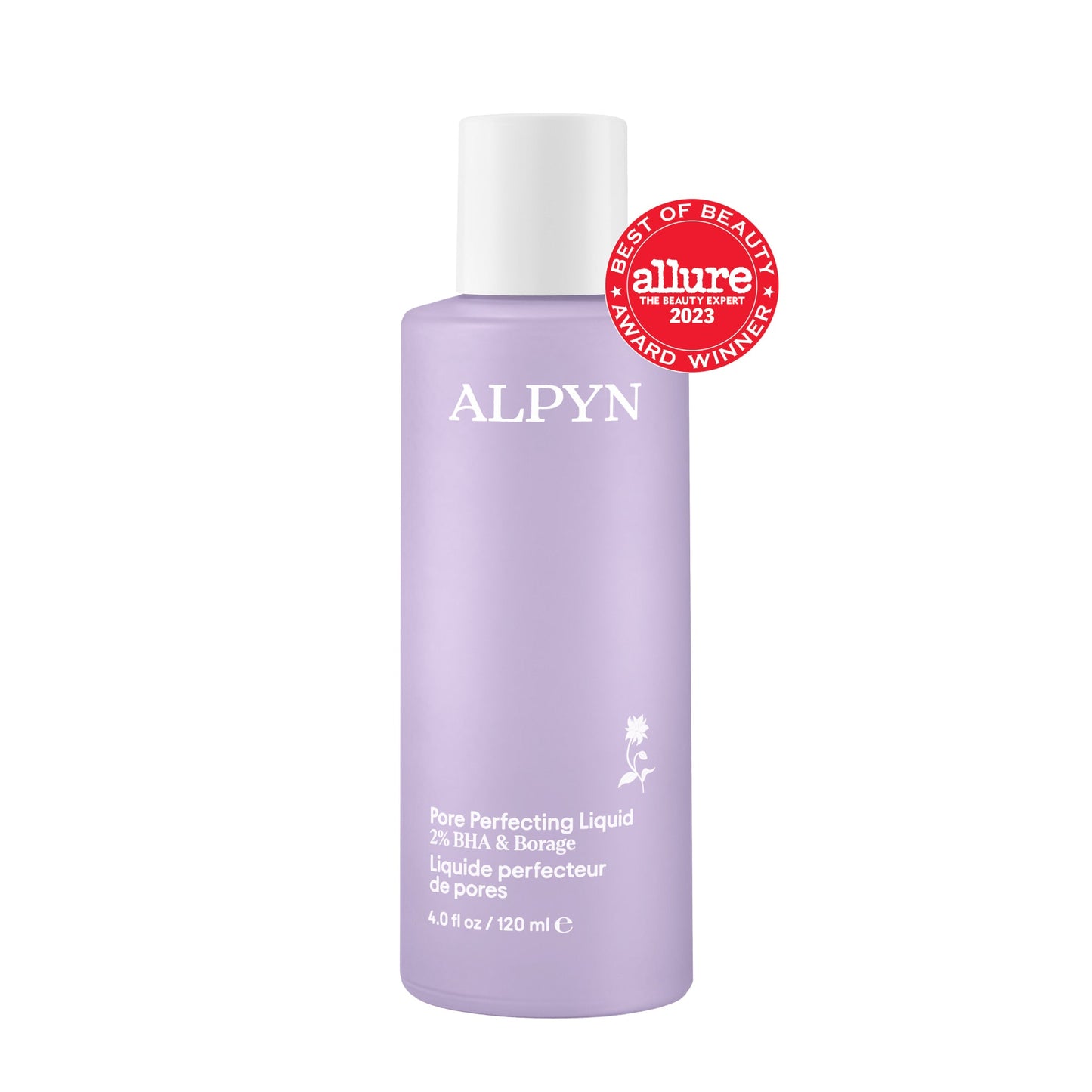

Alpyn
Pore Perfecting Liquid

Pore Perfecting Liquid
Alpyn
pore-perfecting-liquid
Tone
9818416054565
Morning or Evening?
How often will you use this product?
Notes


Highlights
WHAT IS IT?
Liquid exfoliator with 2% salicylic acid
FEATURES
Minimizes pores, reveals clearer and brighter skin, non-drying
BEST FOR
oily
CHECKS
Free of Phenoxyethanol, Parabens, Formaldehyde Donors, MEA/DEA/TEA, Palm Ingredients, Sulfates, Synthetic Dyes, Colors, Fragrance, Phthalates, Petrochemicals, PEG’s/ PPG’s, Metallic Aluminum, Triclosan, Talc, Mineral Oil, Petrolatum
Who Is It For?
Adults With Pore ConcernsWhat Does It Help With?
Pore Minimizing Skin Brightening ExfoliationBudget
Mid-range ($30-$75)How To Use
Which routine should it be used in?
Instructions:
Key Information


What Alpyn Says
Product Description:
A leave-on liquid exfoliator with 2% salicylic acid to visibly minimize pores and reveal clearer, brighter-looking skin—without a stripping or drying effect.
About the Brand:
Ingredients Overview
Ingredients List
water/aqua/eau, propanediol, salicylic acid, polyglyceryl-4 caprate, polyglyceryl-6 caprylate, borago officinalis (borage) flower extract, aloe barbadensis leaf juice, benzyl alcohol, helianthus annuus (sunflower) seed oil, tocopherol, glycerin, sodium hydroxide, ascorbic acid, ethylhexylglycerin, potassium sorbate, melaleuca alternifolia (tea tree) leaf oil, phytic acid, gardenia florida fruit extract, maltodextrin, simmondsia chinensis (jojoba) seed oil, squalane, hydrolyzed sodium hyaluronate, moringa oleifera seed oil, niacinamide, phyllostachys bambusoides extract, sclerocarya birrea (marula) kernel oil, sodium hyaluronate, tremella fuciformis sporocarp (mushroom) extract, rosa damascena flower water, pyrus malus (apple) fruit extract, prunus virginiana (chokecherry) extract, beta sitosterol, hamamelis virginiana (witch hazel) leaf extract, sodium benzoate, medicago sativa (alfalfa) extract, acetyl hexapeptide-8, centella asiatica extract, vegetable collagen, sorbic acid, leuconostoc/radish root ferment filtrate, citric acid
Key Ingredients
Salicylic Acid (2% BHA), Vitamin C, Tremella Mushroom, Borage
Ingredients Details
Salicylic Acid
Common Name(s): Bha,2-hydroxybenzoic acid,orthohydroxybenzoic acid,willow bark acid
CAS Number: 69-72-7
DESCRIPTION
What It Does: Salicylic acid exfoliates the skin surface and inside pores, dissolves the 'glue' holding dead skin cells together, reduces sebum production, and combats acne-causing bacteria.
Why It's Used: Its oil solubility makes it uniquely effective at penetrating pores and dissolving sebum plugs – a function that water-soluble ahas cannot perform. it is the preferred exfoliant for oily, acne-prone, and congested skin.
How It Works: Salicylic acid disrupts desmosomal bonds between corneocytes, promoting exfoliation. its oil solubility allows it to penetrate the sebaceous follicle, dissolving sebum and dead cells. it also has anti-inflammatory properties by inhibiting prostaglandin synthesis.
Typically Found In: Cleansers,toners,serums,spot treatments,masks,chemical peels,anti-dandruff shampoos,acne treatments
TECHNICAL DETAILS
Primary Category: Active ingredient – beta hydroxy acid (bha)
Secondary Functions: Anti-acne,anti-dandruff,keratolytic
Application Areas:

Facial Skincare

Body Care
Hair Care
Beard Care
Color Cosmetics (Makeup)
Dietary/Oral Supplements
Typical Concentration Range: 0.5%–2% (otc acne treatment in us); up to 30% in professional chemical peels
SOURCING & ETHICS
Vegan Status: Yes – synthetic or willow bark derived
Halal Status: Yes
Source Notes: Naturally occurring in willow bark (salix alba) and wintergreen oil. commercially produced synthetically via kolbe-schmitt reaction for cosmetic use.
SKIN COMPATIBILITY
Irritancy Rating: 3/5 – moderate; can cause dryness, peeling, and irritation, especially at higher concentrations
Comedogenicity Rating: 0/5 – non-comedogenic; actually anti-comedogenic
Sensitivity Concerns: Can cause irritation, dryness, and sun sensitivity. avoid contact with eyes. not recommended during pregnancy at high concentrations. can be drying – follow with moisturizer.
Safe for Sensitive Skin: Use with caution – start with lower concentrations and frequency; may not be suitable for reactive or rosacea-prone skin
SAFETY & COMPATIBILITY
Safety Profile: Safe at otc concentrations (0.5–2%). regulated as a drug in some countries (us: fda category i acne treatment). avoid in pregnancy at high concentrations.
Works Well With: Niacinamide,zinc,tea tree oil,benzoyl peroxide (at different times),hyaluronic acid (to counteract dryness)
Avoid Combining With: High concentrations of retinol (cumulative irritation),multiple exfoliating acids simultaneously,benzoyl peroxide in same step (can increase irritation)
SCIENTIFIC NOTE
Salicylic acid is a member of the salicylate family and shares structural similarity with aspirin. its anti-inflammatory mechanism mirrors aspirin's cox inhibition pathway, making it uniquely effective for inflammatory acne.
Last Verified: 2026-03-12
Primary Sources: Cosing database,cir safety assessment,us fda acne monograph,journal of the american academy of dermatology
Vitamin C
Common Name(s): Vitamin c,cosmetic active,established function
CAS Number: N/a
DESCRIPTION
What It Does: Delivers characteristic cosmetic function — skin conditioning, antioxidant protection, active biological benefit, or formulation function — at recommended use concentration.
Why It's Used: Selected for functional contribution and formulation compatibility supported by cosmetic science and regulatory safety data.
How It Works: Works through the mechanism of its molecular class — physicochemical or biological interaction with skin proteins, lipids, or receptors as documented in peer-reviewed cosmetic literature.
Typically Found In: Skin care formulations
TECHNICAL DETAILS
Primary Category: Active ingredient – cosmetic active
Secondary Functions: Skin conditioning
Application Areas:
Facial Skincare
Body Care
Hair Care
Beard Care
Color Cosmetics (Makeup)
Dietary/Oral Supplements
Typical Concentration Range: 0.1%–10%
SOURCING & ETHICS
Vegan Status: Conditional - supplier confirmation required
Halal Status: Unverified - supplier confirmation required
Source Notes: Commercially produced for cosmetic use. verify vegan/halal status with supplier. [audit 2026-07-29 rev2: the record's own source_notes does not assert a non-animal origin, or instructs the reader to verify with the supplier; "yes" asserts knowledge the record does not hold. determination requires shariah-panel sign-off.]
SKIN COMPATIBILITY
Irritancy Rating: 1/5 – very low
Comedogenicity Rating: 0/5 – non-comedogenic
Sensitivity Concerns: Well-tolerated by most skin types.
Safe for Sensitive Skin: Yes
SAFETY & COMPATIBILITY
Safety Profile: Good safety profile at recommended concentrations. ewg score: 1–2.
Works Well With: Standard skincare actives
Avoid Combining With: No known significant incompatibilities
SCIENTIFIC NOTE
Vitamin c has an established safety and efficacy profile within the cosmetic regulatory framework at standard use concentrations.
Last Verified: 2026-03-12
Primary Sources: Cosing database,vitamin c technical literature