

Plum
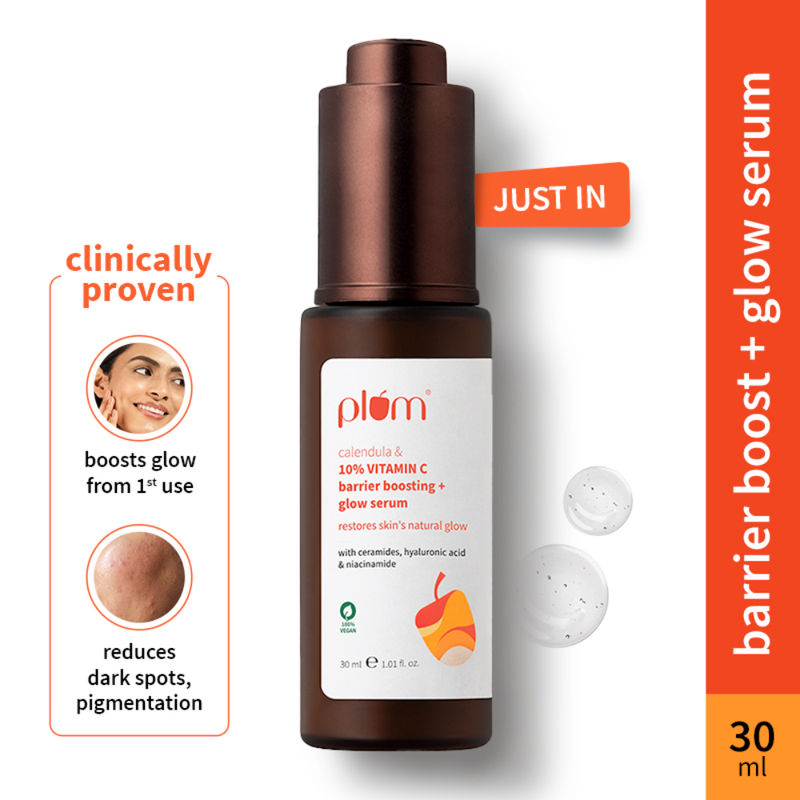
Plum 10% Vitamin C Barrier Boosting + Glow Serum with Calendula For Glowing Skin

Plum 10% Vitamin C Barrier Boosting + Glow Serum with Calendula For Glowing Skin
Plum
plum-10-vitamin-c-barrier-boosting-glow-serum-with-calendula-for-glowing-skin
Serum
10084740858149
Morning or Evening?
How often will you use this product?
Notes


Highlights
WHAT IS IT?
Serum with multiple key actives including 10% Vitamin C
FEATURES
Boosts skin barrier, brightens skin, contains Calendula and multiple forms of Hyaluronic Acid, includes Ceramides for barrier repair
BEST FOR
sensitive
CHECKS
Doesn't contain fragrance, alcohol, parabens
Who Is It For?
All Genders Suitable For Adult SkinWhat Does It Help With?
Glowing Skin Barrier Boosting Dark Spots BlemishesBudget
Affordable (under $30)How To Use
Which routine should it be used in?
Instructions:
Key Information


What Plum Says
Product Description:
Explore the entire range of Serums & Essence available on Nykaa. Shop more Plum products here. You can browse through the complete world of Plum Serums & Essence.
About the Brand:
Ingredients Overview
Ingredients List
aqua,3-o-ethyl-ascorbic-acid,niacinamide,propanediol,betaine,sodium-hyaluronate-crosspolymer,sodium-hyaluronate,sodium-acetylated-hyaluronate,hydrolyzed-sodium-hyaluronate,pentylene-glycol,laminaria-digitata-extract,citrus-reticulata-peel-extract,terminalia-ferdinandiana-fruit-extract,calendula-officinalis-flower-extract,1,2-hexanediol,hydrogenated-lecithin,cetyl-pg-hydroxyethyl-palmitamide,ceramide-eop,ceramide-ns-ng,ceramide-np,ceramide-as,ceramide-ap,cholesterol,sodium-citrate,rosa-damascena-flower-water,phenoxyethanol,ethylhexylglycerin,citric-acid,olive-oil-glycereth-8-esters,cyclodextrin,ethoxydiglycol,methyl-gluceth-20,maltitol,sodium-acrylates-copolymer,lecithin,sodium-gluconate,xanthan-gum,vitamin-c
Key Ingredients
Vitamin C, Calendula, Ceramides, Hyaluronic Acid, Niacinamide
Ingredients Details
1-2-hexanediol
Common Name(s): 1-2-hexanediol,cosmetic active,functional ingredient
CAS Number: N/a
DESCRIPTION
What It Does: Delivers characteristic cosmetic function at recommended use concentration.
Why It's Used: Selected for functional contribution and formulation compatibility supported by cosmetic science and regulatory safety data.
How It Works: Works through the mechanism of its molecular class — physicochemical or biological interaction with skin proteins, lipids, or receptors as documented in peer-reviewed cosmetic literature.
Typically Found In: Skin care formulations
TECHNICAL DETAILS
Primary Category: Active ingredient – cosmetic active
Secondary Functions: Skin conditioning
Application Areas:

Facial Skincare

Body Care
Hair Care
Beard Care
Color Cosmetics (Makeup)
Dietary/Oral Supplements
Typical Concentration Range: 0.1%–10%
SOURCING & ETHICS
Vegan Status: Conditional
Halal Status: Yes
Source Notes: Commercially produced for cosmetic use. verify vegan/halal status with supplier.
SKIN COMPATIBILITY
Irritancy Rating: 1/5 – very low
Comedogenicity Rating: 0/5 – non-comedogenic
Sensitivity Concerns: Well-tolerated by most skin types.
Safe for Sensitive Skin: Yes
SAFETY & COMPATIBILITY
Safety Profile: Good safety profile at recommended concentrations. ewg score: 1–2.
Works Well With: Standard skincare actives
Avoid Combining With: No known significant incompatibilities
SCIENTIFIC NOTE
1-2-hexanediol has an established safety and efficacy profile within the cosmetic regulatory framework at standard use concentrations.
Last Verified: Cosing database,1-2-hexanediol technical literature
Primary Sources: 2026-03-12
Betaine
Common Name(s): Trimethylglycine,tmg,natural betaine
CAS Number: 107-43-7
DESCRIPTION
What It Does: Provides osmoprotective humectant conditioning with anti-irritant and mild foam-boosting activity.
Why It's Used: Natural-origin multifunctional osmolyte from sugar beet providing hydration, anti-irritancy, and conditioning in virtually every cosmetic category.
How It Works: Quaternary ammonium betaine provides zwitterionic character for water binding via ionic hydration. osmoprotective function at 100–500mm as compatible solute protecting cells from osmotic stress. reduces surfactant irritation by competing with sls for protein binding sites. mild foam enhancement.
Typically Found In: Virtually all categories — moisturisers, shampoos, cleansers
TECHNICAL DETAILS
Primary Category: Functional ingredient – humectant
Secondary Functions: Tewl reduction,skin plumping
Application Areas:
Facial Skincare
Body Care
Hair Care
Beard Care
Color Cosmetics (Makeup)
Dietary/Oral Supplements
Typical Concentration Range: 0.5%–10%
SOURCING & ETHICS
Vegan Status: Yes – from beta vulgaris (sugar beet) molasses
Halal Status: Yes
Source Notes: Synthetic or naturally derived. excellent aqueous solubility.
SKIN COMPATIBILITY
Irritancy Rating: 1/5 – very low
Comedogenicity Rating: 0/5 – non-comedogenic
Sensitivity Concerns: Non-irritating; suitable for all skin types.
Safe for Sensitive Skin: Yes
SAFETY & COMPATIBILITY
Safety Profile: Excellent safety profile. ewg score: 1.
Works Well With: Ceramides,emollients,occlusives,glycerin,hyaluronic acid
Avoid Combining With: No significant incompatibilities
SCIENTIFIC NOTE
Betaine's anti-irritant mechanism for surfactant systems involves competitive protein protection: betaine at high concentrations preferentially interacts with skin proteins, occupying binding sites that would otherwise be occupied by surfactant molecules causing protein denaturation. this competition reduces available protein binding for irritating surfactants, explaining betaine's well-documented ability to reduce sls irritation when co-formulated.
Last Verified: Cosing database,craig betaine osmoprotective review,cir safety assessment
Primary Sources: 2026-03-12
Cholesterol
Common Name(s): 5-cholesten-3-ol,cholesterin
CAS Number: 57-88-5
DESCRIPTION
What It Does: Provides essential barrier sterol function as one of three critical stratum corneum lipid components.
Why It's Used: Essential component of complete barrier repair formulations – the stratum corneum barrier requires ceramides:cholesterol:fatty acids in approximately 1:1:1 molar ratio for complete barrier restoration.
How It Works: Integrates between ceramide headgroups in lamellar body structures, providing fluidity and flexibility to the otherwise rigid ceramide-dominated lipid matrix. controls lamellar body phase behavior for functional barrier.
Typically Found In: Barrier repair moisturizers,eczema treatments,dry skin formulations
TECHNICAL DETAILS
Primary Category: Active ingredient – barrier sterol
Secondary Functions: Lamellar body structure,barrier sterol
Application Areas:
Facial Skincare
Body Care
Hair Care
Beard Care
Color Cosmetics (Makeup)
Dietary/Oral Supplements
Typical Concentration Range: 0.01%–1%
SOURCING & ETHICS
Vegan Status: Conditional – animal-derived (lanolin) or plant-derived phytosterol analogs; verify
Halal Status: Conditional – verify source
Source Notes: Traditionally from lanolin (wool grease). plant-derived cholesterol alternatives include phytosterols, though these show slightly different barrier integration. verify for vegan/halal.
SKIN COMPATIBILITY
Irritancy Rating: 1/5 – very low
Comedogenicity Rating: 0/5 – non-comedogenic
Sensitivity Concerns: Endogenous molecule; excellent tolerability.
Safe for Sensitive Skin: Yes
SAFETY & COMPATIBILITY
Safety Profile: Exceptional safety profile. natural skin component. ewg score: 1.
Works Well With: Other ceramides,cholesterol,free fatty acids,hyaluronic acid,niacinamide
Avoid Combining With: No significant incompatibilities
SCIENTIFIC NOTE
Elias demonstrated that barrier repair requires all three lipid classes (ceramides, cholesterol, fatty acids) in approximately equimolar ratios. formulations providing only ceramides without cholesterol and fatty acids show significantly inferior barrier restoration vs complete triple-lipid combinations.
Last Verified: Cosing database,elias et al. barrier lipid ratio study,loden barrier repair review
Primary Sources: 2026-03-12
Cyclodextrin
Common Name(s): Bcd,cycloheptaamylose,betadex
CAS Number: 7585-39-9
DESCRIPTION
What It Does: Provides molecular encapsulation for improved solubility, stability, and controlled release of challenging cosmetic actives.
Why It's Used: Molecular encapsulation technology — beta-cyclodextrin's toroidal cavity provides a hydrophobic microenvironment for solubilising and stabilising oil-soluble actives in aqueous formulations.
How It Works: 7 glucose units in cyclic toroidal structure provide 6.0-6.5å inner cavity. hydrophobic interior complexes lipophilic guest molecules. complexation improves water solubility (guest molecule becomes water-dispersible), stability (protection from oxidation and hydrolysis), and controlled release (guest releases gradually by diffusion). outer hydrophilic face provides water compatibility.
Typically Found In: Active delivery systems,fragrance encapsulation,stability-challenged actives
TECHNICAL DETAILS
Primary Category: Functional ingredient – inclusion complex host
Secondary Functions: Skin conditioning
Application Areas:
Facial Skincare
Body Care
Hair Care
Beard Care
Color Cosmetics (Makeup)
Dietary/Oral Supplements
Typical Concentration Range: 0.1%–10%
SOURCING & ETHICS
Vegan Status: Yes – from starch (corn, potato)
Halal Status: Yes
Source Notes: Commercially produced for cosmetic use. verify vegan/halal status with supplier.
SKIN COMPATIBILITY
Irritancy Rating: 1/5 – very low
Comedogenicity Rating: 0/5 – non-comedogenic
Sensitivity Concerns: Well-tolerated by most skin types.
Safe for Sensitive Skin: Yes
SAFETY & COMPATIBILITY
Safety Profile: Good safety profile at recommended concentrations. ewg score: 1–2.
Works Well With: Standard skincare actives
Avoid Combining With: No known significant incompatibilities
SCIENTIFIC NOTE
Beta-cyclodextrin's pharmaceutical drug delivery applications (dozens of fda-approved cd-drug complexes) provide unparalleled safety and efficacy documentation for a cosmetic excipient. the same cd technology that delivers cholesterol-lowering drugs and antifungals in pharmaceutical formulations enables cosmetic actives to be delivered more effectively — a pharmaceutical innovation directly adapted to cosmetic performance enhancement.
Last Verified: Cosing database,loftsson & brewster cyclodextrin review
Primary Sources: 2026-03-12
